Showing posts with label meanings & representations. Show all posts

Wednesday, March 24, 2021

Finding the ‘Meaning’ in Meanings and Representations!

In this second guest blog of the week, Mr McVeigh takes a look at how he approaches Paper 1 Questions 1 & 2 with his students. 

As a Linguistics graduate, I loved the part of my studies where you started to acknowledge language around us. I could no longer sit at a train station people watching. I was consumed by the way that words encapsulate our everyday lives, connect with us on so many levels and shape our thoughts and attitudes.

To me, Meanings and Representations is the aspect of A Level English Language that helps students to see the power of words; the careful construction of texts and the ability to influence society.

Within this short blog post, I am going to outline some of the approaches to single text analysis of the construction of Meanings and Representations that I have found useful over the past few years.

When I first begin teaching Meanings and Representations, towards the start of their A Level journey, I try to encourage students to reflect on the construction of texts. Simply by making judgements on the way that a range of different texts impact and influence the students, we start to explore the connection between our attitudes towards a text and the language used to convey that.

The main aspect of the single text question is to understand what is meant by Meanings and Representations. I define this as; what is demonstrated or highlighted from a text (Representations) and what can be inferred from the text/ what that text wants you to do (Meanings). Introducing this terminology is essential as I ask students to ensure they use both words within their written responses to clearly demonstrate to an examiner that they are reflecting the assessment expectations.

Students then need to understand language frameworks and levels. This aspect of Meanings and Representations is the most complex aspect of this question: students often feel overwhelmed with the precision of terminology required to reach the top band in their answers. To begin to introduce language levels, I tend to start by setting students a SATS test. This gives them an understanding of some of the expectations needed when analysing texts and also gives me an indication of support needed. 

Graphology, as a language level, tends to be something that students fall back on as a support. Although, I stress its importance, I encourage students to apply more grammatical and pragmatic comments to their essays to try to show a greater control over their analysis. Recently, I taught a lesson on clause types. We spent the whole lesson trying to familiarise ourselves with the way that different clause types are used within journalism. I can’t say we all had fallen in love with grammar at the end of the 60 minutes but it certainly has helped to see an increase in grammatical points being expressed in writing.

Once students have grasped language level analysis (this is by no means something that happens overnight!) I begin to teach the construction of analytical paragraphs. Often, I have to do a layered approach to language levels, building confidence throughout the units we study in Year 12, connecting meanings and representations-style texts to language discourses.

Prior to annotation and beginning the writing process, I ask students to contextualise the text by identifying the purpose, audience and form of a text (PAF). I then ask students to have this as their introduction to a Meanings and Representations question. This helps to strengthen the overall structure of writing.

My approach to Question One and Two for Meanings and Representations has been refined over the past few years of teaching. I like students to identify at least three representations. I normally say that the author is always represented within a text so that is always a good starting point. I then say to focus on layers within the issue being discussed in the text. E.g. if the text talks about the representation of women in an old advert you may talk about both how women are represented and how men are represented with strong contextual connections and comments.

To clearly demonstrate an understanding of representations, I ask my students to begin each paragraph with “the representation of ‘x’” and apply language levels to that representation. Originally, I used to ask students to take a language level per paragraph but felt that, by fronting representations, students had a tighter control over their overall structure and were able to be more precise with their language level analysis. 

I also encourage students to apply a range of language levels throughout. As mentioned previously, I place emphasis on inclusions of grammatical and pragmatic references but also encourage lexis and semantics for students who may not feel as confident applying more grammatical terms.

Having applied language levels to support the representation, students need to mention audience positioning. This is where they can connect the representation to the meaning. I ask students through questioning the following questions: “How does the writer position a reader to connect with this representation?” and “What meaning do you think they are conveying?”. This then builds the deeper analytical points needed to hit the top band answers. Audience positioning is also something that is frequently written in the AQA mark scheme so I try to encourage this phrasing being written alongside representations and meanings.

The last component of the paragraphs needed is to contextualise their exploration and connect back to the PAF stated previously. When exploring the older text, students can reflect on society at the time, similarly with the more modern texts, students can reflect on more pragmatic viewpoints that help to justify the meanings established.

Now that I am in my fifth year of teaching A Level English Language, I feel confident in this structure. My students have found the methods logical and apply these to essays and show a willingness to apply more complex linguistic features. I only hope that the next time they are sat at a train station, they too can no longer people watch!

If you wish to find out anymore from this strategy, please do have a look at the Teacher Guidance Pack shared on my Twitter account which provides an example paragraph to support.


Monday, March 22, 2021

Paper One: Section A - Trying Something Else

This is the first of a few guest blogs coming up this week, so thank you to all those teachers and linguists who have contributed their ideas and time. This one is by Neil Hutchinson, a teacher at Kirkbie Kendal School in the Lake District (on Twitter as @Hutchinsonnet). Thanks Neil!

In what has been a surreal and tumultuous ‘Endgame’ lead up to exam preparation with Year 13, like most schools across the country we are having to find our own way to assess our students in the face of cancelled exams. As a result of this we decided to make Paper One an integral part of this, as it does seem the bread and butter of English Language: the analysis of language and structure in unseen written texts has been something these kids have been working towards all of their lives in our subject. 

It is so important then that we constantly revise our practice to help them practise this skill. Twitter has a knack of placing you in the middle of a number of converging narratives when it comes to resources. Think of a shared universe of linguistic superheroes teaming up in one megablockbuster. So at the same time Dan posted this thread containing an article about an assault on a woman “on a path” (we’ll come to that later), another fantastic member of the linguistic twitter Avengers, Mr Crawford, whose superhero moniker is @MrCrawford9, posted this excellent entry on his own blog about a method of analysis he calls “Try Something Else”. 

I shamelessly adapted Mr Crawford’s idea in combination with the article posted by Dan, and so, like a low rent linguistic Thor (let’s face it I’m more like Falcon hanging on the cape tails of the enhanced) I am answering Dan’s call to assemble and sharing the outcome of this combination of ideas. 

I do encourage you to read Mr Crawford’s blog for a more detailed breakdown of the method but in short, I found that if you have students who want for a way in to the analysis of lexis and grammar (particularly grammar) in a given text, this works perfectly. If you have students who struggle to move beyond the obvious in terms of audience positioning, representation i.e. pre-modification and specific adjective choices writer’s make, this works perfectly. What Mr Crawford advocates is taking what, on the surface, seems a fairly innocuous sentence and making changes to it in order to draw attention to what was there in the first place. For example:

The text was taken from The Guardian, and was about the writer’s attempts to overcome her addiction to Diet Coke. I asked them to focus their analysis on the grammatical features of the text. We focused on the text’s sub-heading (known as a 'standfirst' in the media), which read:

 “I have been obsessed with the sugar-free soda since I was four, spending £500 a year on up to seven cans a day. This is what happened when I tried to quit.”

The students said that they had been able to identify grammatical features, including the use of present perfect tense, and adverbial and non-finite clauses, but that they did not know what to say about the text’s use of these features.

So, I asked the students to try something else. We swapped one of the words in the sub-heading:

“I had been obsessed...”

Now, instead of present perfect tense, we were looking at past perfect tense.

By focusing on the altered meanings, the student’s are now well placed to consider the original in a way which they may not have seen first time round. Aside from the advantages of this approach, I found it was also an excellent way to revise subject terminology, spot linguistic and thematic patterns and crucially to write a lot about a little - all essential AO1 goodness. 

So what I did was take the original headline in the article:

Teenage girl headbutts man after being grabbed on path

Not innocuous by any means, I know. In fact it was the justifiable criticism posted in response to this headline that makes this an essential piece of journalism for practising analysing representations. 

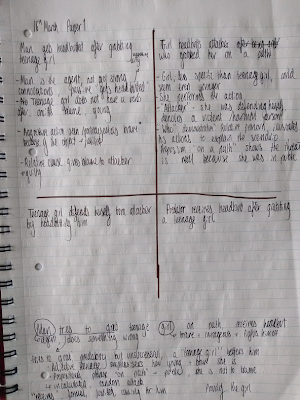
The first thing I had the students do was split their page into four quarters, putting this piece of text in the centre of the crosshairs. I then proposed the students re-write the headline in four different ways. At this juncture you can suggest they focus on using language to alter the representations or simply leave it as vague as “change the headline”. I did suggest they have a go at changing the grammar in at least one of their examples, again to move away from simply looking at lexical choices. 


Next I simply put some of their examples on the interactive whiteboard and modelled annotating and analysing. 

One example of a change was:
Man tries to grab teenage girl on path, receives headbutt

The first strikingly salient point in this student’s example (thanks Millie!) was the overall grammatical structure carrying a very “online” tone. The omission of a final coordinating conjunction in place of a comma followed by a final verb (receives) and indirect object (headbutt) is something we’re used to seeing pop up on our phones. But instead of dwelling on this we focused more on agency in this construction. The students suggested that in the first clause, the fact that the man is the agent of the verb phrase shifted the story to being about his crime and represented him as the wrong-doer. This formed a pattern with that second clause as “receives headbutt” almost removed the teenage girl as the subject and agent of the headbutt through the passive construction. The student in question said definitively she didn’t think the girl had done anything wrong and therefore wanted to suggest this in the headline. At this point we were able to go straight back to the original and looked more specifically at the agency. The students suggested that “Teenage girl headbutts man”, placing her as the agent seemed to represent her as the criminal in the story. And coupled with the violent nature of the verb “headbutt” this painted a very ugly picture of a young woman who had been attacked. Further to this, they similarly went straight to the second subordinate clause, like they did in the changed example, and suggested that “after being grabbed” similarly removed him as an agent in this assault, once again through its passive nature.

I mentioned pattern spotting was an area we wanted to revise and this method unlocked this perfectly. We went next to terms of address. Sticking with the changed example I asked why they stuck with “teenage girl” as the original did. The rest of the class suggested that in the changed headline the pre-modification of the noun with the adjective “teenage” in the changed headline represents her as brave and courageous in the face of the man’s assault. Indeed the juxtaposition between “teenage girl” and “man” demonstrates an unpleasant imbalance of power again representing him as an older criminal and she as a child victim. However, because the original seemed to offer a polar opposite set of representations, this pattern didn’t hold up in the original. Instead because the girl was being held up as the instigator of the incident by the BBC, “teenage” carrying now the socially negative connotations of “chav” or “delinquent”. This was a gift in revising pinning our analyses down to audience pragmatic awareness. They even paired these negative connotations with the traditional newspaper headline format (as opposed to the online style in the changed version) and suggested the target audience would be your older, more conservative reader of BBC news stories, who may hold more negative views about women. All agreed the BBC had a wide ocean of fans, so they let the linguistic construction of the headline guide them as to who, in that vast sea, would be drawn to the line cast by this headline. Going back to terms of address they were also able to suggest that the noun “man” in the original did not suggest an imbalance of power, as in the changed version, but instead through its lack of modification and dispassionate, bland and unemotive tone pointed towards his innocence rather than guilt. 


I think this was one of the more illuminating discussions in the lesson. The fact that the same set of lexemes can have polar opposite connotations depending on their position in a sentence and crucially, their presentation through the prism of contextual factors is AO1 and AO3 gold. 

Want more? Well let’s turn our attention to the verb phrase the student added. “tries to grab” rather than well...his possible role in her being “grabbed” in the original threw up some interesting discussion. Many said it makes the headline almost funny. I asked them if that would be true if it simply said “man tries to grab teenage girl”. They all agreed no. We go back to the pattern of the online tone that comes about with the inclusion of the last clause, “receives headbutt”. They suggested that because the “tries to” is there it makes him seem incompetent and someone who bit off way more than he could chew. Again emphasising her strength, her bravery. Celebrating her as a hero, not a victim. Placing it at the beginning gives the reader permission to laugh at this incident before we even find out about the headbutting, which arrives with a clunk at the end like the punchline to a very funny joke. How online in its patterning! These ideas are implied in the original. The story hasn’t changed. He tried to grab a girl, didn’t succeed and got his comeuppance. The class were actually horrified that the BBC didn’t have the nouse to take the same angle. 

So why didn't they? Well they decided, because it is 2021. And many still believe uppity women are perhaps getting a little ahead of themselves in calling for change. Remember contextually this story appeared in the same week as vigils were to be held in opposition to violence against women as a result of the Sarah Everard kidnap and murder. And we all saw how the status quo reacted there. Instead of seizing upon that and using this story as an opportunity to chime in with the chorus of women who have decided to stand up against injustice, the writer of this article instead simply replicated a thematic pattern when representing women: that they are to blame for their own abuse at the hands of men. Remember that’s men. Not “attacker”, a noun the BBC could have used. 

Finally in this changed headline, the student kept “on path”. Exploring this prepositional phrase in close detail revealed that both headlines seemed to highlight that these incidents of violence were occuring in open spaces, in public. Typical genre fair in newspapers is to feed into moral panics. The key difference being in my forward thinking student’s headline the message is clearly ‘women, watch out for men’ whereas the BBC seemed to be saying ‘men, watch out for teenage girls’. 

This wasn’t the end of the lesson. In fact this wasn’t the only headline we looked at. We then explored a couple more, constantly going back to the original and making informed judgements about the language used to create meanings and representations. 

The irony is if you click that link in the article now, the headline you actually get is:

Teenage girl fights off man who grabbed her on canal path

The next part of my lesson was focused on analysing what the BBC had changed it to and why. How they were now positioning us to feel about the girl (removed “teenage” eh? Hmm) and how they were positioning themselves as a voice in this debate. 

The first thing they noticed? The subordinate clause has been changed to a relative clause. Now the BBC were laying the blame squarely at his feet and coupled with the more politically motivated “fights off” as opposed to the violent “headbutts” (I know some still have issues with “fights” but that is a debate for a sequel perhaps), seemed to be reading the same script as the countless women protesting for the basic human right to walk down a canal path without the threat of being assaulted. The linguists won. Would my students have noticed a relative clause first time round? Honestly, I doubt they would have. Thank you Dan and thank you Mr Crawford. I encourage you all to try something else. 

Friday, October 18, 2019

Analysing patterns and structures


You might have seen Dan’s recent post for the Oxford Education blog; in it he distills the examiners reports on last year’s A-Level exams into some key advice.   Here’s what that post has to say about text analysis and patterns:

‘A key message in last year’s reports was that ‘patterns’ across texts were as important as – if not more important than – identifying isolated features of language. Both the Paper 1 and Paper 2 reports this year stress this again. So, for example, the feedback on Paper 1 states “examiners noticed that those students who had a clear sense of each of the texts as a whole were far more coherent in their responses” as that made them “better placed to identify patterns in language use” across the texts.’
I’ve been trying to encourage this in my own students; it’s more useful and interesting to focus textual analysis on structures and patterns than on single words or even single sentences, particularly when time is as limited as it is in an exam.  You should link these features to contexts, of course – ‘why’ is always more interesting than ‘what’ – so you need to think about what these patterns tell us about how a topic is represented, how genre conventions are used or challenged, how an audience is positioned, how this text can be related to wider discourses about the same topic, how the producer or participants represent themselves …

These are the kinds of features I’m suggesting that you could look for if you want to avoid the disjointed, one-word-at-a-time approach.

·       Semantic fields, extended metaphors or other patterns of imagery
For example, is that football match represented using the imagery of war with words like ‘fight’, ‘battle’, ‘attack’?  Or is it represented as a more scientific, thoughtful game with descriptions like ‘clinical’ and ‘precision’?

·       Lexical patterns and repetition
For example, are there lots of first person plural pronouns suggesting inclusivity or the attempt to create a pseudo community?  Lots of highly modified noun phrases suggesting that the producer is introducing a new topic to the audience?   Is a particular word or phrase often repeated, and what aspect of the topic does this foreground?

·       Syntactic patterns
For example, are there a lot of conditional clauses suggesting a complex, nuanced topic and a tentative approach?  Is there syntactic parallelism for persuasive rhetorical effect?  Is the subject of the sentence missing or does the text use passive voice to conceal agency?

·       Modality
How much certainty, uncertainty or reliability is expressed?  Is it all about ‘slightly’ and ‘might’ or is it ‘must’ and ‘definitely’?  Did an event ‘definitely’ or ‘apparently’ happen? 

·       Whole text structure
For example, is there a problem/solution structure?  Are there any adjacency pairs? A circular structure?  Are there any narrative structural features such as binary oppositions?  What aspects of the topic are foregrounded?  How does the producer guide the audience and provide cohesion?

Here are the notes one of my classes came up with on structural features and patterns in a newspaper article – this one is from AQA Paper 1 in 2018, and you can find the rest of the paper here.


I’m sure you could add to these notes: my students didn’t get around to discussing discourse markers or modality, for instance.    But their notes would provide the basis of a fruitful, ‘big picture’ analysis of the text which I think could be much more successful than analysing the connotations of the specific adjective ‘smelly’, for instance.  Looking at patterns also provides a way into how the text fits into wider contexts. Once you’ve noticed the repeated binary opposition between past and present, for example, you can see that the article feeds into nostalgic discourses which see social change as decline; this could provide a big-picture focus for your analysis.


Monday, June 04, 2018

Thinking about Paper 1

Paper 1 of the A level isn't that far away so here are a few suggestions about approaching the first 3 questions. I've posted in more detail about these in previous blogs which you can find here, here and here but here are some quick pointers:


  • It's all about meaning. Texts mean things and are made to mean by the people who produce them and the people who receive them. Think about what each text is actually about before you put pen to pen to paper. What are you being presented with? What's happened? Who is involved? What perspectives are being offered?
  • Meanings depend on contexts. You need to think about how meanings are being created in the texts in front of you. Look closely at how language is being used in particular places in the texts and how that relies on context. Is it the context of text being spoken, online or written? Is it the context of what has gone before in the text? Is it the context of who is saying or writing something?
  • Texts can be from all sorts of modes, genres, times and places, and for all sorts of audiences and purposes. Many of these will use language in recognisable ways that you'll be used to seeing and writing about. Some might be a bit less familiar - older, for example - but they'll still have been produced by a human being who's using language in ways that you'll recognise. 
  • Language is not just words. When you're analysing how language is used, look for what words mean, patterns of meaning, structures and visual design. Think about all the language levels or frameworks that you've been learning over the last two years and use the most appropriate ones for the texts in front of you. Graphology isn't an issue in a spoken text (it's not designed to be seen on the page, after all) but phonology might be. An online text might use visual design to structure ideas and create meanings, so that could be vital.
  • Structure is important. This could be grammatical structures (how phrases are put together, how words and clauses are placed in certain positions, how modal verbs, pronouns or tenses are used etc.) but also bigger, text-level, structures (beginnings, middles, ends...).
  • Don't write anything until you've read the texts and don't start writing your answers for Questions 1 and 2 until you have made notes and annotated your texts. 
  • Think about what you can include in your Question 3 answer while you're planning for Q1 and 2. It *is* OK to repeat yourself in Q3 but you need to explore connections and you need to think more carefully about the things that make the texts similar or different. One text will always be older and one contemporary - so there's your first difference -  but also think about organising your Q3 answer around things like audience, purpose and mode. 
  • Don't offload huge amounts of knowledge about language change when you think about the older text. Stick to discussing what's relevant to the text and its immediate context.
  • Be selective in what you write about and try to structure your answer clearly. There is no one right way to do this but it's best to avoid working your through a text in order ("In the first line there is a pronoun, in the second line there is an adjective, in the third line there is another adjective...") but to select the most useful parts to talk about and think about how they link together.
  • Don't write a long, rambling and generic intro. Get into the texts as quickly as you can with just a  short introduction.
I'm sure you will have lots of advice from your teachers about how to approach these questions, but these are things I've often told my students and I think they usually help. Best of luck.

Wednesday, May 11, 2016

Paper 1: salience & hotspots

Revision of Paper 1 skills and approaches has been on our agenda recently, so here are a few things that we've been looking at.

Given the limited amount of time to read two substantial new texts and write three answers, I think we probably have to be quite disciplined about time on this paper, so it pays to read for meaning effectively and plan cleverly. For our students, I've been suggesting an approach to planning answers that allows for getting an overview of each text to help with the meanings and representations in Questions 1 and 2 and which also starts to focus on the compare and contrast requirements of Question 3. Underpinning it all is a focus on finding examples of language and describing them accurately.

Here's an outline of what I've given our students to work with. I've been quite pleased with the results this week, so let me know if it works for you.

In the short time you have in the exam, you need to make sure every minute counts. Your note-taking and reading of the texts needs to be smart and give you material for your answers to the text analysis (Questions 1 and 2) and the compare and contrast of Question 3.

The approach I’d suggest is to use the first few minutes to read for meaning. That is, get a decent sense of the following:

• What each text is about – the topic that they share
• What’s being said about that topic
• What different views are being offered

You can also make some initial notes to help with the other parts of the questions, such as:

• What kinds of texts they are - genre
• The mode/s they are in – spoken, written, computer-mediated communication
• Their audiences and purposes

These observations can help you sort out some useful starting points for your notes, which can then help you form the basis of your main paragraphs for each answer. Next, I’d suggest finding 5-6 ‘hotspots’ in each text. These are areas in each text that convey the clearest and most useful ideas. These hotspots could be a single phrase, a section of the text (an image, a headline, the opening or closing lines), a sentence or even a pattern of language across the whole text.

These hotspots should mean something and, in some cases at least, represent the topic or views on the topic in a way that you can pull apart. There’s no point just picking a few words because you can label them with terms that you’ve learnt (“x is a determiner and y is a pronoun”); it’s vital to get to grips with language that means something and contributes to the overall meanings in each text.

With these hotspots, you can explore what things mean and analyse the language used to create these meanings. This means thinking about your language frameworks (or methods, or levels, or whatever you’ve called them this year) and your AO1 terms, making sure you are offering a good range across each text. AO1 is not just about grammatical labels (word classes, phrases, sentences, clauses, tense etc.), but also about things like semantic fields, patterns of meaning (contrast, antithesis and juxtaposition, for example), graphology, interaction patterns (especially in spoken texts or ones using features of spoken language), discourse structure, pragmatics and perhaps phonology too.

 As you discuss the language used in these hotspots, try to cover a range of different language points but concentrate your attention on the ones that are most important in creating meanings and representations. For example, if the topic is a famous actor, perhaps think about the ways in which adjectives modify nouns to describe her performances and how metaphor might be used to describe her career. If the topic is an event like a football match or gig, look at the verb choices, the use of tense and aspect to structure events. If the topic is more of an ‘issue’, look at the patterns of abstract nouns and their meanings, and perhaps the overall discourse structure used to present conflicting ideas.

There will be many different ways to do this and if you’ve selected, meaningful parts of the texts, you’ll be able to explain them effectively. Examiners don’t really want to read about a text having “lots of long sentences to make it flow” or “lots of pronouns to make it personal” because these are meaningless generalisations. Look closely at what is actually meant in each text in its given context.

While analysing these hotspots, keep in mind the bigger picture of what each text is doing and what kind of texts they are. You will need to address these issues a bit more in your answer to Question 3, but they will also be useful in Questions 1 and 2. For example, if the text is typical of a particular genre, you know it will generally do certain things (recipes tell you what to do, stories recount events etc.).

 Another important aspect to consider is not just how the topic of each text is represented but how the text creators (writers, speakers, posters, texters etc.) represent themselves and each other. How do they position themselves in relation to the text receivers? How do they present a face or image to the audience and to each other? How does this relate to what the texts are about?

In the example text you’ve been given, spend 7-8 minutes doing what’s outlined above. Read for meaning, make notes, identify 5-6 hotspots and then get writing. Use the remaining time (25 minutes) to draft your analysis of these hotspots, linking them back to the overall meanings in the text to keep a coherent thread running through your analysis.

We've used different texts to practise on, but a good one supplied by a helpful teacher from another school (thanks Wendy!) is this blog about Alan Rickman, which we then used alongside this article about Rickman (well...more about Snape really).

Follow EngLangBlog on Bluesky

The old Twitter account has been deleted (because of both the ennazification and enshittification of that site) so is now running on Bluesk...