Thursday, October 27, 2011

"Twitter generation loses love of lexis"

...or so this story in today's Daily Mail would have you believe. According to the article, words like cripes, shenanigans and cad are all dying out because younger generations simply don't know what they bally mean (And it's perhaps not just the fault of the younger generation but technology as well because my spell-checker has just red-lined both cripes and bally.).

The story seems to be linked to the publication of a survey for the book Planet Word (presumably a tie-in to Stephen Fry's BBC series of the same name) and to be fair, the expert they quote, the author of the book JP Davidson, doesn't bemoan the alleged decline, but has this to say:

This could be viewed as regrettable, as there are some great descriptive words that are being lost and these words would make our everyday language much more colourful and fun if we were to use them.

'But it's only natural that with people trying to fit as much information in 140 characters that words are getting shortened and are even becoming redundant as a result.

'The folly is to try and stem the tide of the new whether they emerge from rap, technology, teenspeak, or the multitude of jargons that we invent to make shortcuts and communication more efficient between groups. 

This sounds like good sense and isn't in any way as prescriptive as the rest of the Mail's tone (managing of course to tie in some aspect of British identity being eroded as it always does), but the comments from Mail readers start to pour scorn on such descriptive views, arguing (among other things) that the once proud language of Shakespeare is now degenerating into a series of txt-grunts (a kind of Crumbling Castle model for the text generation) and that young people are doing it because they "are even allowed to use text speech in exams now", conveniently (or stupidly) misunderstanding the difference between studying and using. D'oh!

But, there is an interesting argument to be had here over the potentially limiting effects of technology on our lexicon - both individual and shared - because as this new app demonstrates, predictive texting has evolved to offer us predictive messaging. 
 
Swift Key screen
 
Instead of just predicting the word we are typing, this app starts to predict the next set of words, offering us phrases or even whole clauses, based on what we have typed before. There's an example here.

And it's even cleverer than it first appears because it can use your existing style from Facebook, email and your previous messages, building a mini-corpus of your own style and then suggesting these back to you when it is appropriate. 
 
So, what's the problem? If your own style is being reinforced, basically echoing your own lexical and grammatical choices, you might end up with an ever-decreasing range of language choices. If, every time you type a message, you're offered a set of choices influenced by your own database of language, will you be railroaded into a restricted set of words?

Ultimately, will this lead us into a reduced set of lexical and grammatical choices, fulfilling the Mail's to hell in a handcart predictions in the article above?

Spray tan, fake boobs and lots of stuff that's like reem.

Paul Kerswill, top linguist and one of the team behind this blog (which has been set up to help students and teachers of A level English Language keep up with the latest research into linguistics) has written a new piece for The Sun this week about the Essex dialect and the role of  The Only Way Is Essex (TOWIE) in spreading the region's twanging tones and lovely lexicon.

He takes a look at the ways in which TOWIE has popularised the adjective reem, the phrase shuuut uuup, and various other linguistic markers such as like and yous and offers a broader perspective on the ways the Essex dialect* has changed from its rural origins to a more cockneyfied sound and vocabulary.

As a (hopefully) soon-to-be Essex resident (and current Essex teacher) I've got to be careful about what I say about the Essex dialect, but as Paul Kerswill  says in the article "As with any accent, an Essex voice evokes an image, or a stereotype, of a certain sort of person — you can fill in what sort" so I'll leave it at that.

There's some debate on The Sun's messageboard about where reem derives from (or whether it should actually be spelt ream). Any ideas?

And as a quick aside, here's a link to an article in today's Metro about an ATM in Leytonstone, East London (original cockney territory) which offers you a choice of languages: English or Cockney. So you can withdraw a Lady Godiva (£5) or a pony (£25), but count your notes as some of these cockneys are proper dodgy geezers.

Thanks to emagazine's Facebook page for the Sun link and Gabriel Ozon at UCL for the Metro one. 

*Dialect here is being used in its broader sense of lexis, semantics, grammar and phonology (so including accent as part of it).

Monday, October 24, 2011

# hashtags - this year's LOL?

Following on from the post about changing punctuation, here's a guest post from Emma Bertouche who is an Online Marketing Executive for a language translations company and writes for several websites and blogs regarding language and social media.


Advances in technology have always added to and changed the way we use the English language. The rise of social media and the regular social network user is the latest example of the internet driving many new or distorted words and phrases into common language, infiltrating themselves into daily use in written and spoken communication.

Many blogs and articles are written every day on how this is perceived to be diluting and misusing the English language – and many other languages for that matter. One phenomenon that needs closer examination is the growing use of the lowly hashtag - ‘#’ – to emphasise an argument, feeling,  or solidarity with a group.

For those people unfamiliar with Twitter and the hashtag phenomenon, words or phrases are prefixed with a hash symbol (#), with multiple words concatenated, such as:
#RealAle is my favourite kind of #beer

Then, a person can search for the string #RealAle and this tagged word will appear in the search engine results. Hashtags are used by people to try and get a topic trending. A trending topic is a word, phrase or topic that is posted (tweeted) multiple times, these trending topics are then shown on websites, including Twitter's own front page. The aim is that  users can then search for any Tweets containing that specific term or phrase and read what other Twitter users across the globe are saying about it.

On the surface this seems to be another internet trend, spreading from person to person within the online culture, which originated on the Twitter social networking site. So when someone in the office recently described themselves (in the spoken word) as “hashtag smug” it was an example of how quickly the language of social media is making an appearance not only in other online communities, but also creeping into everyday spoken conversation.

The phenomenon has also been picked up by The New York Times, which wrote this interesting article about the hashtag making this way into our lives.  We increasingly see instances of the hashtag being implemented on other social networks, where characters are no longer capped(the internet equivalent of shouting)  yet people use it to stress a word or point that they are trying to make. Furthermore, unlike ‘text speak’ and the lingo of teenagers, this trend is not exclusive to a specific demographic of people, and can have universal appeal.

Twitter is, in essence, the 21st Century equivalent of William Tyndale, facilitating the mass distribution of the written word across an era-defining medium; in Tyndale's case, Caxton's printing press, and in the case of Twitter, social media. The messages they communicate may have been different (Tyndale translated the Bible, rather than screamed #WELOVEJUSTINBIEBER) but their aim is the same; for as many people to see their message as possible. Similar to Tyndale, however, there are many clamouring to cry heresy at the implementation of a new language variant, and opposition to the hashtag is growing to levels previously experienced as a result of the rise of texting and email. It is to be hoped those opposed don't follow Pope Clement VII's example, and seek to eradicate the problem as they see it. Thankfully, I don't think nouns are flammable. 

Of course as with any form of publicity, be it self promoting or for business there can often be a downside or even a backlash at attempts to use the hashtag for marketing purposes. People often see the opportunity to use trending topics to spam Twitter with unrelated topics but then include a popular hashtag to ensure their tweet gets seen be a decent number of Twitter users. One of the more documented mistakes was that of Habitat who used hashtags including #IranElection and #Mousavi to promote discounts on their products, making for some heroically non-sensical tweets. The idea behind the madness is not a particularly clever one at the best of times but linking a range of home furniture to  sensitive humanitarian crises is only ever going to anger people. .

Social media trends do not provide the first examples of  ‘moral panic’ regarding language change, either. In fact, there is a long history of alarm at evolving language trends. The rise of the postcard brought with it concerns that, due to the limited amount of space people had to write their messages, the use of the English language would be compromised. Comparisons between the post card and Twitter have already been made by The Daily Mail, back in 2009.

It will be interesting to learn what future language scholars make of the introduction of social media and its effects on the spoken word – there is already debate raging on what to call this new phenomenon.
While researching the hashtag I found a web forum where linguists were asking “Is there a linguistics term for glued-together Twitter hashtags, such as #vacationwishlist, #isawesome, and #wordsthatdescribeme?” The closest answer I could find was portmanteau but a hashtag doesn’t create new words; it just lumps existing words together.

 There doesn’t seem to be an agreed linguistic term for this yet, but people are still able to easily associate meaning to it. Unlike the controversy of ‘text speak’ entering the English Language, which seemed to scythe down language to its most basic construct,  would the inclusion of hashtag English (as indeed with other languages that communicate via Twitter) be as contentious?

In the same way that people now question whether it is acceptable to include ‘smilies’ in emails to colleagues, the fact that the use of #hashtag  is up for discussion means that some people already find it acceptable and do use them - whether others like it or not.

Although I have only heard one example of ‘hashtag’ in spoken communication, it will be interesting to see if this catches on. Social media is presenting a whole new set of questions on the future of language for the students and tutors to solve, and who knows - maybe if I was ‘down with the kids’ I wouldn’t feel so #confused .

Language change: big pictures and little details

Two pieces on language change that have appeared in the press recently offer us a really neat contrast between the big picture of change - David Crystal's The Story of English in 100 Words - and the very small details of it - Henry Hitchings' Wall Street Journal piece on the history and future of punctuation.

Crystal picks one hundred English words and uses them to trace a history of the language, taking in foreign loan words like potato and trek, a homegrown Celtic term like brock or a Scots one like wee, as well as many more recent ones from internet culture, abbreviations and cultural shifts.

Hitchings takes a look at punctuation: where it comes from and where it's going. He considers archaic forms like the pilcrow and hedera, ones that he thinks are on their way out like the apostrophe and semi-colon and ones that are coming back in or just appearing, the snark and the interrobang.

Both articles are a good read and offer some excellent examples of how to take a particular element of language - lexis in Crystal's case, orthography in Hitchings' - and trace its changes over time.

Friday, October 21, 2011

Keeping it street

There's a new wave of TV dramas and UK films on the way which feature gangs, council estates and street crime. It's not surprising that given the summer riots and subsequent moral panic about the state of our nation (and more importantly the state of our estates) these programmes are taking a look at life on the fringes for young people, but what's apparent is that for many writers and directors the key way for them to make their visions of urban Britain look and sound authentic is to get the slang right.

A clued-up young urban audience is not going to believe that the people they see on the screen are genuinely like them unless they speak like them, you get me? So, in order to keep it real they've used slang consultants - what a great job that must be.

This piece on the BBC News magazine site takes a look at some of the slang and its uses among young people, while this is a short article I did for the MacMillan Dictionary blog earlier in the week, looking at how slang gets picked up and appropriated by mainstream society.

I'm not sure how I feel about slang being seen as the one, crucial marker of authenticity, because like so many other aspects of language use, slang is about identity and more than just a series of buzzwords for outsiders to pick up and use for a while. Then again, part of the joy of slang is that it's constantly reinventing itself, with slang innovators generating new words, new meanings all the time to keep a sense of individuality and identity even as their words start to seep into the mainstream.

Maybe it's that cycle of creation - appropriation - recreation that keeps them on their toes, feeding the new slang into the system.


Thursday, October 20, 2011

Heated debates: mongs, spastics and housewives

The comedian Ricky Gervais has attracted criticism from a range of quarters for his use of the word mong in recent comments on Twitter. According to Radio 1 Newsbeat and  The Sun, Gervais's "jokes" have included  references to himself as being monged-up when pulling a face, welcoming his followers with good monging and many more hilarious quips that demonstrate his mastery of sophisticated wordplay.

Gervais claims that the word isn't offensive and has no connection to people who suffer from Down Syndrome (who back in my school days used to - cruelly - be called mongoloids, mongols or mongs, apparently because of the facial resemblance between sufferers and Mongolian people), but he's old enough and clever enough  to know that it is offensive for many many people. His argument - that language changes, get over it - is superficially attractive but ultimately disingenuous.

He knows that the word still carries connotations of abuse and is used to belittle and hurt, so why does he use it? Why not use twit, idiot or fool? And there are plenty of other ones to choose from too.

The Angry Mob blog runs a good feature on the story here and the comedian Richard Herring does a thoughtful post* about the language used to mock disabled people here:

I don't think any of them would do the same with the n-word  or "p*ki" but they're happy to use "mong" or "retard" as a means of getting a laugh. And audiences will laugh at those words too and rarely even complain about them. But I think they do equate with those racial and homophobic epithets that are rarely heard these days. They do confirm the stereotype of disabled people and contribute to their further isolation in a world that already tries to pretend they don't exist.

The argument over offensive words has previously included references the golfer Tiger Woods made about playing "like a spazz" - derived from the word spastic, another term that's been used offensively in playground abuse - terms like retard (a word that landed the Black-Eyed Peas in trouble, when really they should be in jail for their utterly appalling ear pollution, rather than linguistic crimes) and the long debate over the the n-word and its reclamation.

And of course, more recently we've had a big debate over the use of the word slut as part of the slutwalk movement and a revival of arguments over the word chav and its meanings.

Even apparently inoffensive terms like housewife have come in for criticism recently, with a Mothercare survey revealing that two thirds of mothers find the term insulting. In a response to this survey, Lucy Mangan of The Guardian** looks at (not very serious) alternatives to housewife, such as milch cow and baby wrangler, but serious alternatives have been considered in the past, as this story about the Women's Institute back from 2006 shows.

So, is Gervais the victim of the old PC brigade? Are the feminazi and do-gooding liberal elite stormtroopers of the Political Correctness massive swinging into action. Has, for probably the millionth time (if you read the Daily Mail), PC really gone too far this time?

Well, what is PC? Part of the problem with the whole debate around Political Correctness is that the term itself is troublesome and contested by different groups. PC was initially connected to the women's rights movements of the 1970s and sought to draw attention to the inequalities in language that seemed to exist between men and women, changing the language to avoid discrimination and offence. It later grew to take in terms connected to race, sexuality and disability.

Words like chairman were challenged, and uses of language that seemed to exclude or marginalise women and minority groups were discussed, and alternatives proposed. Many caught on in popular usage and have not been problematic since, but others proved more contentious. So when it was noted that a sentence like "Each student must bring his notes to class" might be perceived as sexist, the alternatives "their notes", or even invented gender-neutral pronouns like "hesh", attracted ridicule or grammatical pedantry ("How can their refer to one person when it it is a plural pronoun?" they asked).

As Deborah Cameron points out in her book on language intervention, Verbal Hygiene, the term Politically Correct was initially an ironic, self-mocking label applied by some feminists to poke gentle fun at their own "right-on-ness", but within the space of a few years opponents of PC - those who opposed changing some labels which might be considered offensive or insensitive, and who were often politically right wing and reactionary -  were using it as a term of abuse. In essence what the anti-PCers were arguing against was any attempt to reform the language, because they saw it as part of a radical political agenda with which they disagreed.

If the term PC is used now it's used very much as a term with negative associations. If you're PC you're humourless, probably militant and unbending in your views and more than likely want to ban Christmas and turn it into Winterval to avoid upsetting disabled lesbian Muslims. But regardless, arguments over sensitive and derogatory language usage still rage, and whether we call it PC or just linguistic sensitivity, people will still get upset about certain words and what they can mean, while others argue for their right to say anything they like.

So for this month's heated debate, where do you stand?

Can we control or influence which words are used in society?
Is it a positive step to challenge uses of words like mong and spastic?
Alternatively, is PC just a means of clamping down on freedom of expression?
Does changing language have any effect on wider social issues like racism and sexism?

Over to you...

* Thanks to @SFXEnglish for the link 
** and thanks to Jon Dolton for this one

Thursday, October 13, 2011

Pragmatics: the missing link

We've done a bit on pragmatics in AS classes over the last few weeks, looking at how context often influences language and how language often depends on a grasp of context, but here's a quick round-up of ideas about pragmatics by Stan Carey which you'll definitely find helpful.

Hiding the agent

Liam Fox, the Defence Secretary who is embroiled in a scandal about his relationship with an "adviser", has made some mistakes apparently, not that he would put it that way. He would say "I accept that it was a mistake to allow distinctions to be blurred between my professional responsibilities and my personal loyalties to a friend". And that, as Jonathan Freedland in The Guardian says, is a pretty rubbish way of saying sorry.

Freedland's article looks closely at Fox's slippery language, particularly his abuse of the passive voice, a grammatical technique that he describes as "grammar's way of telling you somebody is hiding something", which is a neat turn of phrase. It's a good bit of textual analysis and something that would make a sound starting point for a language investigation.

Thursday, October 06, 2011

Heated debates 2: the sequel

Thanks to everyone who contributed to the debate on gender and language variation. There'll be another heated debate coming up next week, this time on Political Correctness and language engineering.

This topic ties in with Language Change for A2 AQA A and AQA B, and also for Language Interventions (AQA A) and Language Investigations (AQA B).

If you've got any suggestions for links to articles or have any ideas to kick this off, please post them as comments.

Thursday, September 29, 2011

New blog for English Language A level teachers and students

Sue Fox and Jenny Cheshire at Queen Mary University, London have set up a new blog to help students and teachers of A Level English Language. It's called the Linguistics Research Digest and is part of their From Sociolinguistic Research to English Language Teaching ESRC Knowledge Transfer Project (more details of which can be found here).

The blog features accessible summaries of recent research in linguistics and offers a way into some of the most relevant areas of recent study. Their plan is also to set up a resource site to run alongside the blog, but for the time being there's already some very useful material on there for teachers and students alike.

That's cool. No, that's kewl

The OED's latest online update has ruffled a few prescripivist feathers (again) by including kewl, "an affected or exaggerated pronunciation of cool".

A few months ago, elderly wing commanders in Surrey (and other Telegraph readers) were appalled to discover that the OED had included internet acronym LOL and vaguely blasphemous initialism OMG in its pages, so it's not as if the OED isn't used to causing a bit of controversy. But as Graeme Diamond, chief editor of new words, explains, adding words to the OED is not about trying to change the language but reflect actual usage: "You have to show that the word has been in usage for a decent length of time and, most importantly, that the word is used and understood by a wide audience".

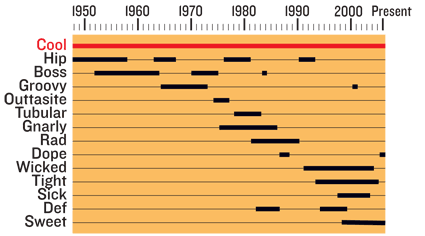
from http://www.fastcompany.com/magazine/107/next-essay-sidebar.html
Cool itself, in its original spelling, is a tenacious piece of slang that has been knocking around for a very long time, much longer than its groovy and rad  brothers as the slightly unscientific but helpful graphic on the right shows.

Michael Quinion has written about cool's development as a slang term here, and there's more from the British Library here, but it's clear that if cool is still evolving, with new uses and spellings, it's a healthy word in a healthy language.

Friday, September 23, 2011

Learn some proper Gypsy rokker, mush

With the Dale Farm eviction set to take place today, Gypsy life and culture is again in the spotlight, but this BBC Kent article takes a look at Gyspy language contributions to English, contributions that go back a long way and are quite deeply embedded in our common language.

A couple of these - mush and cushti - were just normal English slang as far as I was concerned growing up in Wiltshire in the 1980s and it didn't really cross my mind that it was Gypsy dialect/slang until much later.

This page from the BBC Voices site gives a bit more detail about the roots of Romany/Gyspsy/traveller dialects while this 1897 Dictionary of Slang, Jargon and Cant features some great examples from Gypsy and other non-standard varieties.

Thursday, September 22, 2011

Debate of the month: gender and language variation

One of the big topics for debate in English Language A level in recent years has been over whether women and men communicate differently. Since the early 1970s, with the publication of Robin Lakoff’s Language and Woman’s Place , there has been plenty of focus on what might be termed “women’s language” but as Lakoff herself was quick to point out, her observations weren’t based on empirical studies (systematic data collection) but “(data)... gathered mainly by introspection: I have examined my own speech and that of my acquaintances, and have used my own intuitions in analyzing it”.

Lakoff’s observations included some that have made it into pretty much every A level student’s (and teacher’s) list of key facts about gender and language: women use more precise colour terms, more tag questions and more evaluative adjectives than men. But of course, without any actual data to back these claims up, it was hard to work out whether what Lakoff was saying was perceptive and new or just the recycling of fairly standard stereotypes.

While Lakoff herself made some powerful points about the ways in which girls are socialised to behave in ways that are viewed as linguistically female - not talking rough or appearing "unladylike" - other linguists focused a little more on the conversational interactions between men and women. Some chose to look at interruptions and the dominance of men and submissiveness of women in conversational interaction (like Zimmerman and West – pdf here  - in 1975), others at power and status (O’Barr and Atkins - summary here  – in 1980), before Maltz and Borker (1982) started looking in a bit more detail at the ways in which men and women are socialised into different gender roles and how this might affect language patterns.

This was an approach that led to Deborah Tannen’s work – subsequently referred to as the Difference Model -  and her bestselling book You Just Don’t Understand (Tannen talks about it here).

Tannen’s approach focussed on what she called the “cross-cultural communication” between the genders:

For women, as for girls, intimacy is the fabric of relationships, and talk is the thread from which it is woven. Little girls create and maintain friendships by exchanging secrets; similarly, women regard conversation as the cornerstone of friendship. So a woman expects her husband to be a new and improved version of a best friend. What is important is not the individual subjects that are discussed but the sense of closeness, of a life shared, that emerges when people tell their thoughts, feelings, and impressions.

Bonds between boys can be as intense as girls', but they are based less on talking, more on doing things together. Since they don't assume talk is the cement that binds a relationship, men don't know what kind of talk women want, and they don't miss it when it isn't there.

Boys' groups are larger, more inclusive, and more hierarchical, so boys must struggle to avoid the subordinate position in the group. This may play a role in women's complaints that men don't listen to them. Some men really don't like to listen, because being the listener makes them feel one-down, like a child listening to adults or an employee to a boss.

However, Tannen’s approach came in for criticism from some for its broad-brush approach to gender, and the industry spawned by the Tannen book – John Gray’s Men Are From Mars, Women Are From Venus  being one big seller – dumbed everything down to a new low.

Elsewhere, Jennifer Coates produced masses of work on the dynamics of spoken interaction in her excellent books Women Talk and Men Talk, pinning down the details of talk among and between the sexes and interpreting the results with an open mind. It’s about as far removed from the hippy dippy generalisations of John Gray as you can get.

More recent work on gender and language has taken one of two approaches. With advances in neuroscience, some commentators have started to look at how certain characteristics might be hard-wired into us and how men and women might just be built genetically in certain ways that we can’t avoid.

This approach has attracted criticism – this article by Madeline Bunting of The Guardian is really good – and linguists such as Deborah Cameron have argued that gender is just one factor in many that might affect our conversational styles, and that anyway, there are more differences between different men or different women (within the sexes) than there are between most men and women.

Her excellent Myth of Mars and Venus lays into the gender difference industry with an accessible overview of research and an argument that suggests it’s not only women who suffer from the obsession with different speech styles, but men too.

So, over to you. What has your own study and research suggested about gender and language variation? Are you about to embark on an A2 Language Investigation into gender? If so, what are you going to look for and why?

  • What do you think of the whole debate?
  • Is it helpful to generalise about how men and women communicate or should we always look at specific contexts?
  • In your experience, do men and women, boys and girls talk differently?
  • If so, why might this be and how does it show itself in what they say and how they say it?
  • If not, what do you see happening instead?
  • How different are the speech styles within one gender group? Do all boys share similar speech characteristics....girls, football, beer and..err...meat?

Friday, September 16, 2011

Stoking up spelling trubble


Does spelling matter? Residents of Stoke-on-Trent seem to think so, because they're worried that people will think they're thick if they see the name of their new shopping development.

This report from the BBC News website suggests that some locals feel that the name will reflect badly on them, while the agency behind the name thinks it gives the development "stand out quality"...maybe like the "stand out quality" of turning up to a funeral in pink lurex batty-riders, or declaring that your football team's new strip will be birthday suits.

Lots of businesses create deliberately deviant spellings to offer "stand out quality". Take Kwiksave, Kwikfit, Krispy Kreme and my old favourite (sadly no longer with us) Mr Byrite. At some point, a creative in an advertising agency decided that Qu and C were just old-fashioned and that K was where it was happening. K was cool...sorry Kool. Is there something intrinsically more exciting about K than C, or is the act of mis-spelling something part of the rebellious appeal of a brand? Vodafone chooses to use f instead of ph and Toys'R'Us abbreviates too, but do we see them as edgy, unconventional brands? Maybe not.

But is it harmless fun, or is this trendy phonetic spelling something that sends out mixed messages to younger people? Is it leading to an acceptance of bad spelling? One teacher quoted in the BBC piece, Mark Rayner, seems to think so:

In terms of grammar we are fighting a battle on many fronts, from text speak, on the internet, even in emails now you find shortened words are creeping in. Pupils regularly write C for see and U for you. But one hopes schools can still teach the correct spelling and grammar.
The need for an agreed spelling system is something that lies at the heart of the notion of Standard English: an accepted and recognised way of using English that provides mutual intelligibility for all speakers and writers. As we've seen many times though, the discussion around what the standard and accepted rules should be is fraught with other, non-linguistic worries.

Some people see apparently declining spelling standards as a measure of a nation's moral collapse (one minute they're spelling Krispy Kreme wrong the next minute they're looting it) while others argue that the English spelling system is so messed up in the first place that it should be radically overhauled.

So, edgy branding or idiotic illiteracy? The last word goes to a resident of Stoke-on-Trent who just says "It makes us look like the people in Stoke are thick".


Thursday, September 15, 2011

Heated debates

Now the new term has started and I'm back teaching again (huzzah, I think) I'll try to update the blog with relevant material for AQA Language A and B specs a bit more frequently.

The first thing I'd like to set up is a Debate of the Month, which I hope will help A2 students with Language Intervention coursework and the Language Discourses part of the ENGA3 paper. The plan is to highlight a particular topic each month and look at different arguments around the issue, flagging up various style models for written pieces and offering suggestions for different angles on each debate.

I'm hoping that any keen followers of the blog (and I know there are some out there...mother, can you hear me?) will also chip in and join the debate by adding comments and links. We can all dream, I suppose.

The first topic will be gender differences in conversation and I'll kick it off next week with a quick survey of the different positions and some of the recent debates about how men and women are supposedly hard-wired to use different conversational styles and why this is a controversial (and rather dubious) position.

If anyone would like to suggest links to articles, case studies or just offer a view, I'd be interested to hear.


Thursday, September 08, 2011

His and hers

MacMillan Dictionary blog has been running a gender month, taking a look at how gender is represented, constructed and debated in language. If you're studying gender as part of the AQA B spec (ENGB1) you'll find good stuff here and here, and if you're looking at gender and variation for the AQA A spec (ENGA3) this one and this one might be of interest to you.

You can find a complete run-down of gender month posts here and there's lots of good stuff to look through.

Tweets, Tweeps and Twerps

Any new technology that is used for communication is bound to lead to some concern about its impact on language use. In his book, A Better Pencil, the linguist Dennis Baron looks at how writing technologies such as the pencil, pen , typewriter and word processor developed and traces worries about these (then) new forms of communication. So it's not a great surprise to see that digital communication - text messaging, Facebook, MSN and Twitter being four recent examples - has spawned its own set of worries.

Twitter is often viewed as a fairly limited means of communication, forcing its users to transmit simple, terse 140-character messages to their followers, compressing and trimming language to create anodyne, bite-sized chunks, but in an article for The Guardian this week, the poet Carol Ann Duffy argues that texting and tweeting are brilliantly creative tools for helping people think more carefully about how they're communicating.

"The poem is a form of texting ... it's the original text," says Carol Ann Duffy. "It's a perfecting of a feeling in language – it's a way of saying more with less, just as texting is. We've got to realise that the Facebook generation is the future – and, oddly enough, poetry is the perfect form for them. It's a kind of time capsule – it allows feelings and ideas to travel big distances in a very condensed form."

It's an appealing argument and one that I think is very true. Writing creatively is not so much about writing as much as you can in as flowery and dense form as possible but finding the best ways to say what you want to say. Sometimes, the process of editing yourself down to fewer words, or finding a new combination of words, is exactly what you need to make yourself a clearer communicator. Poetry is often prized for its sparing use of telling words, and tweets can be like that too, honing the editing skills of their senders.

Inspired by this (if slightly confused: Duffy was talking more about texting than tweeting) The Guardian has launched its own Twitter poetry challenge which you can find here.

Another creative dimension to Twitter is covered by the BBC News magazine where the new words inspired by Twitter are surveyed. We get: tweeple (or tweeps), a blend of Twitter and people; tweet cred, a compound of tweet and street cred; and twisticuffs (my favourite), a blend of Twitter and fisticuffs, in other words a fight on Twitter.

Exploring the tw- unit (sound? morpheme?) in more depth, the article goes on to look at other words formed with the same letters and makes the point that many of them are deliberately playful, perhaps suggesting that there's something inherently silly in the sound.

Friday, September 02, 2011

iGE - interactive Grammar of English

I've not normally used this blog to plug commercial products and my income from Amazon ads has amounted to a massive 29 pence, but this product's been developed by colleagues of mine at UCL (and if they sell enough, I might just keep my job).

The interactive Grammar of English (iGE) is an app for the iPhone 3 and 4, iPod Touch and iPad, designed to help you develop your understanding of English grammar. It uses examples of real English from ICE-GB, the International Corpus of English and contains many interactive tests and tasks.

If you're looking for a way into understanding grammatical frameworks for A level English Language or for developing your grasp of higher end concepts for undergraduate or post-graduate study, it will definitely be really useful.

One interesting area of debate about language which has already been raised in a 3-star review of the app on the American i-Tunes site is about the use of "incorrect" English in examples of spoken language:


IGE English grammar - ★★★


I'm a substitute teacher and was looking for an app that I could quickly refresh my memory. This is an okay app but there are some errors. I was always taught to not use uhm and ah in a sentence, however, in the test areas the sentences often use uhm as if it had been created by someone dictating. There are also run on sentences and incorrect punctuation in the tests. The glossary seems to be correct and will be a good reference when I need it.


Should a grammar app use "good" English examples which avoid uhms and errs, and run on sentences? Well, we would argue that analysing grammar is not just about analysing "perfect" written English but about looking at all types of English - written and spoken - and studying their grammar. Part of the appeal of an app like this which uses a corpus of genuine English , rather than made-up examples, is that it allows us to look at how English is really used, and to describe its grammar rather than judge it.

Thursday, September 01, 2011

Ringing the changes

Following on from the last post about new words, here's a link to an article in The Daily Telegraph by Henry Hitchings. It's a good antidote to the plethora of grumpy responses to any new words announcement...they're not real words...they'll disappear next year...I've never heard that word so it can't exist...young people these days need a good beating and a hefty dose of national service...you know the kind of thing.

His argument is an interesting one which sees resistance to new vocabulary as a reflection of wider concerns:

Hostility to a new word (candidates from the latest Chambers might include “webisode” and “OMG”) is fraught with unarticulated concerns about class, politics, propriety and taste. Right now, the pace of linguistic change seems high, and those concerns are supercharged. Thanks to modern technology, the volume and rapidity of communication have increased, and the flow of information is constant.
If the comments after many of the recent articles about language change are anything to go by, Hitchings is spot on with his argument. A quick trawl of discussions about David Starkey's deluded comments on "Jafaican", or on the Daily Mail's coverage of Chambers Dictionary reveal racism, class snobbery and the casual denigration of single mothers and most young people, to name a few.

Hitchings is author of the excellent The Language Wars, which I've reviewed for emagazine here (and there's an interview with him in the latest edition if you have a subscription and want to read more about why his book is great for A level English Language students).

Follow EngLangBlog on Bluesky

The old Twitter account has been deleted (because of both the ennazification and enshittification of that site) so is now running on Bluesk...