What do words actually mean? When we want to work out what a word means, we tend to turn to a dictionary, but even in there we might find that multiple meanings are offered. And that's because semantic change - a gradual (or in some cases, very rapid) shift of meaning - occurs over time.
In a really interesting book called Words in Time, Geoffrey Hughes looks at how language change is linked to social change, and examines how words that we use now used to mean something very different a long time ago.
For example, in a section on what he calls the "moralization of status-words" he identifies a time in the Middle English period when "words such as noble and villain change from being terms denoting rank to terms which are evaluative of moral conduct". On the good side, we get noble, gentle, frank, free and liberal, but on the bad side, he goes on to explain, "words which originally denoted inferior social status become terms of disapproval", so we get villain, knave, blackguard, wretch, slave and churl.
Of course, what has driven these words to change is a link between someone's social rank in a hierarchical society and perceptions of those people as being good or bad because of their rank. In essence, if you were working class and poor, you tended to be seen as a lower, less moral kind of person, so the words used to label you tended to shift down the scale of meaning from neutral to pejorative as time went on, while the opposite was true for the richer and higher status people. Quite why an accident of birth should make you a good or a bad person is not clear, but as we know, judgements are easy to make and it's often simpler to denigrate people beneath you on the social ladder than those above who you might one day aspire to be part of.
That's why - to this very day - you will never hear me utter a bad word about David Cameron, George Osborne or those trust-fund Wurzels*, Mumford and Sons.
Not all meaning changes are linked to gradual processes of social change and shifts in attitudes; sometimes they are more rapid. The flipping of ill, sick, bad and wicked are all examples of where a more drastic change has occurred, with a deliberate effort to turn a word into its opposite. I'm old enough to remember genuine confusion on the faces of elderly relatives when they heard something good described as 'sick'. Nowadays, even your mum is demonstrating 'wicked tekkers' when she juggles an i-Phone in one hand and a glass of fizzy wine in the other.
But what about words which are contested? Some words have changed over time to pick up extremely negative connotations: words like hussy and slut, queer and gay. While gay has had quite a long association with sexual appetite, its widespread use as a term to describe (and put down) men who love other men is perhaps more recent, reaching a peak in the 1980s and 90s. Gay then moved on to be a catch-all term of abuse. Trousers were gay (maybe because they looked slightly feminine in style, or perhaps too tight). Chairs were gay (perhaps a bit wonky to sit on or defective in some way). I even set homeworks that were described by my classes as gay.
But is gay homophobic? In other words, can (as Ricky Gervais rather weakly argued with the term mong) the word gay now be seen as having moved so far away from its association with sexuality and negative judgements about others' sexual identities, that it's just another word? Stonewall, the gay rights charity, don't think so and their campaign to address homophobic name-calling and bullying aims to "get the meaning straight".
Brendan O'Neill, a man with a history of provocative articles to his name and a tendency to attack Political Correctness whenever he can, doesn't think so. He argues in today's Daily Telegraph that "gay now means rubbish" and, echoing Stonewall's previous campaign, adds "Get over it".
Is it as simple as either side suggest? Language change doesn't happen at once. Most processes take a while to sink in. They tend to follow a pattern that we often see as a wave (as in C.J.Bailey's wave theory of 1973) with changes spreading out from one core group to wider society as time goes on, like ripples create by a stone thrown into a pond. This means that:
a) it takes time for a new meaning to spread to a group of people at the edge of the pond (perhaps older people who have a meaning that they grew up with - The Flintstones and having a "gay old time" perhaps)
and
b) by the time a change has spread to the edges, the frequency of the use might have dropped off in the centre and a new meaning started to emerge
Interestingly, as Justyna Robinson identifies in her paper on cognitive linguistics and semantic change, Awesome insights into semantic variation, "conceptual links" often exist between the successive senses of a word, so in this case, the semantic shift from gay as "Bright or lively-looking, esp. in colour; brilliant, showy" (OED 1225) has a clear link to "light-hearted, carefree; manifesting, characterized by, or disposed to joy and mirth; exuberantly cheerful, merry; sportive." (OED 1400) and "Originally of persons and later also more widely: dedicated to social pleasures; dissolute, promiscuous; frivolous, hedonistic. Also (esp. in to go gay ): uninhibited; wild, crazy; flamboyant." (OED 1597).
It doesn't take much of a conceptual leap to then get to gay as being involved in the selling of sex (OED 1795 -) and "(a) Of a person: homosexual; (b) (of a place, milieu, way of life, etc.) of or relating to homosexuals" (OED 1922-) before we reach gay as lame or crap via association with a stigmatised group in society.
While Brendan O'Neill claims we should so get over how gay has changed to mean something he views as largely inoffensive, I'd argue that it doesn't just mean one thing at all; it actually means many different things at the same time and that in a pluralistic society we need to be careful to think about how words might carry different meanings for different people.
So, where do you stand on this? Is gay now free of its abusive and homophobic connotations to most people? Is Stonewall just being too sensitive about offending people? Or is there a good argument for suggesting that gay is loaded with negative associations and not yet ready for rehabilitation as a general term of disapproval?
(*copyright Charlie Brooker)
HT to Clarissa for link to Pink News article.
Showing posts with label semantic change. Show all posts
Showing posts with label semantic change. Show all posts
Tuesday, November 19, 2013
Friday, November 16, 2012
The geeks shall inherit the earth
 |
| Sheldon Cooper - reclaiming 'nerd' and 'geek'? |
In this piece for the BBC News Magazine, the history of the words is outlined and examined by lexo-boffins and neologo- nerds, who tell us that the words are subtly different in their meanings and even carry different connotations depending on which side of the Atlantic you live on:
It's easy to argue that "nerd" and "geek", with their very different roots, retain different meanings, arguably with the former still more derogatory than the latter. And some see a transatlantic divide, with "geek" used in US and UK, but "nerd" somehow feeling less British.
And as the writer of the article, Kathryn Westcott, goes on to say, the gradual shifts in meaning are not a new occurrence in language. Yesterday, we looked at the word yid and its changing meanings to Jews and non-Jews, and in other posts over the years, we've considered queer, the n-word, slut and bitch. Are geeks and nerds now reclaiming these once-negative labels and marching proudly under their new banner out of the labs and libraries and into the mainstream?


Thursday, March 15, 2012
Literally the last word on "literally"
For literally gazillions of years pedants have complained that people use language "incorrectly". That is to say they don't use it in quite the same way as the pedants like to use it. And that's fine, because if we didn't have pedants we wouldn't have the tension between progress and conservatism that characterises so much of the history of English language, and our language would literally spiral out of control and become a garbled mishmash of slang, ghetto-speak and missing apostrophes. Or something...
Literally is one of those words that pedants have complained about. Critics argue that the word means "to the letter", so shouldn't be used as a figure of speech. It's a kind of anti-metaphor, if you like. When someone says "When she left me, she literally took a piece of my heart with her" a pedant might jump out of the bushes wagging a finger, responding "But she didn't literally remove part of your heart did she? She didn't actually take a bleeding chunk from your left ventricle and take it away". And you might respond, "Who are you and where did you come from? Put that wagging finger away; it's not even yours".
This piece on the BBC News Magazine's pages offers an enlightening insight into how literally has been used over the years and how it fits into a pattern of semantic shift that we see with many other words. If reading the article itself is too hard and literally going to ruin your day, then have a listen to the interview from Radio 4's Today programme, which is here.
Edited on 19.03.12 to add: Good link here to Polly Curtis in The Guardian discussing this.
Literally is one of those words that pedants have complained about. Critics argue that the word means "to the letter", so shouldn't be used as a figure of speech. It's a kind of anti-metaphor, if you like. When someone says "When she left me, she literally took a piece of my heart with her" a pedant might jump out of the bushes wagging a finger, responding "But she didn't literally remove part of your heart did she? She didn't actually take a bleeding chunk from your left ventricle and take it away". And you might respond, "Who are you and where did you come from? Put that wagging finger away; it's not even yours".
This piece on the BBC News Magazine's pages offers an enlightening insight into how literally has been used over the years and how it fits into a pattern of semantic shift that we see with many other words. If reading the article itself is too hard and literally going to ruin your day, then have a listen to the interview from Radio 4's Today programme, which is here.
Edited on 19.03.12 to add: Good link here to Polly Curtis in The Guardian discussing this.
Thursday, November 17, 2011
Discussing disgusting
There's a good piece here on the BBC News magazine site about the word disgust and its changing meanings and usage in English. As well as being a good case study of semantic change, it offers an interesting angle on how new analytical methods can be used to track language change, in this case Google n-grams and digital corpus searches.
Thursday, September 29, 2011
That's cool. No, that's kewl
The OED's latest online update has ruffled a few prescripivist feathers (again) by including kewl, "an affected or exaggerated pronunciation of cool".
A few months ago, elderly wing commanders in Surrey (and other Telegraph readers) were appalled to discover that the OED had included internet acronym LOL and vaguely blasphemous initialism OMG in its pages, so it's not as if the OED isn't used to causing a bit of controversy. But as Graeme Diamond, chief editor of new words, explains, adding words to the OED is not about trying to change the language but reflect actual usage: "You have to show that the word has been in usage for a decent length of time and, most importantly, that the word is used and understood by a wide audience".
Cool itself, in its original spelling, is a tenacious piece of slang that has been knocking around for a very long time, much longer than its groovy and rad brothers as the slightly unscientific but helpful graphic on the right shows.
Michael Quinion has written about cool's development as a slang term here, and there's more from the British Library here, but it's clear that if cool is still evolving, with new uses and spellings, it's a healthy word in a healthy language.
A few months ago, elderly wing commanders in Surrey (and other Telegraph readers) were appalled to discover that the OED had included internet acronym LOL and vaguely blasphemous initialism OMG in its pages, so it's not as if the OED isn't used to causing a bit of controversy. But as Graeme Diamond, chief editor of new words, explains, adding words to the OED is not about trying to change the language but reflect actual usage: "You have to show that the word has been in usage for a decent length of time and, most importantly, that the word is used and understood by a wide audience".
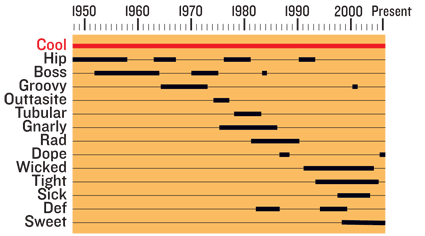 |
| from http://www.fastcompany.com/magazine/107/next-essay-sidebar.html |
Michael Quinion has written about cool's development as a slang term here, and there's more from the British Library here, but it's clear that if cool is still evolving, with new uses and spellings, it's a healthy word in a healthy language.
Tuesday, May 31, 2011
Chav: the semantic broadening of abuse
An article in today's Guardian by Polly Toynbee takes aim at the word chav, describing it as a term of "acceptable class abuse by people asserting superiority over those they despise" and a word that is happily used by those who "would presumably never say the n-word or P*ki". She goes on to say that "wrapped inside this little word is the quintessence of Britain's great social fracture". It's strong stuff, and she argues the case passionately that there's much wrong with the word and of course the prejudices it might be seen to reflect.
It's not the first time that chav has been attacked. In this article, Zoe Williams argues that it's an unpleasant word but that attempts to ban it are silly. Meanwhile, Paul Flynn argues a case very similar to Polly Toynbee's that the use of the word reflects a sneering snobbery towards people with less money and fewer job prospects.
What's a little odd is that Toynbee is writing about this word in 2011, when chav really hit the mainstream around 6-7 years ago. But looking at the example she uses in her article it's fairly clear that for some people the word has now broadened from its fairly specific field of reference - young men and women sporting prison whites, fake burberry, sovereign rings and number 1's (or for the women, a Croydon facelift) - into a much wider reference to the wider working class. To some people, working class = chav, and vice versa.
In fact, that's part of Toynbee's argument: by conflating the entire working class (the majority of the country, in fact) with a small subset of it, it's easy for right wingers to write off a whole section of the population as lazy, feckless and feral, further dividing already fragmented communities.
The wider language point here is, I think, that if we aren't careful, some words drift from their original moorings and if we don't see this taking place we can't challenge it. It's the same with hoodies being used interchangeably for most teenagers or urban for black.
Language change is inevitable, but we can have some say in how far we feel it's appropriate for words to shift and we can exercise some control over challenging their meanings. If language is at least partly a reflection of social attitudes then there has to be some place for arguing about what these words mean to us and why they might be dangerous, and Toynbee's article is a good contribution to that debate.
It's not the first time that chav has been attacked. In this article, Zoe Williams argues that it's an unpleasant word but that attempts to ban it are silly. Meanwhile, Paul Flynn argues a case very similar to Polly Toynbee's that the use of the word reflects a sneering snobbery towards people with less money and fewer job prospects.
What's a little odd is that Toynbee is writing about this word in 2011, when chav really hit the mainstream around 6-7 years ago. But looking at the example she uses in her article it's fairly clear that for some people the word has now broadened from its fairly specific field of reference - young men and women sporting prison whites, fake burberry, sovereign rings and number 1's (or for the women, a Croydon facelift) - into a much wider reference to the wider working class. To some people, working class = chav, and vice versa.
In fact, that's part of Toynbee's argument: by conflating the entire working class (the majority of the country, in fact) with a small subset of it, it's easy for right wingers to write off a whole section of the population as lazy, feckless and feral, further dividing already fragmented communities.
The wider language point here is, I think, that if we aren't careful, some words drift from their original moorings and if we don't see this taking place we can't challenge it. It's the same with hoodies being used interchangeably for most teenagers or urban for black.
Language change is inevitable, but we can have some say in how far we feel it's appropriate for words to shift and we can exercise some control over challenging their meanings. If language is at least partly a reflection of social attitudes then there has to be some place for arguing about what these words mean to us and why they might be dangerous, and Toynbee's article is a good contribution to that debate.
Thursday, May 05, 2011
Sick timing, blud
And as if by magic, or the internet even, this tweet from Oxford Dictionaries appeared on my screen, explaining that the words wicked and sick have had positive meanings for longer than you might think. Read all about it here.
Don't test me, fam

It's a neat little clip because it shows the slippery nature of slang's meanings. When we ran a poll on this blog a few months ago about the word "peak", it was given a range of different meanings. I understand it as meaning something similar to "hectic", which could be good or bad, depending on the context: a party might be hectic (exciting and a little bit cer-azy - perhaps with people chugging Top Deck shandy and robot dancing in the kitchen ), while a job interview might be hectic (scary and overwhelming, just too much, man).
One of the actors explains it as "getting overwhelming, getting too much, there's danger, it's getting peak", but as Joe Cornish explains, with mock-English teacher seriousness at the end, sometimes these words "can be flipped...their meanings can change overnight without any warning at all".
There's a good interview with Cornish here and the Adam and Joe 6Music site is here.
Thursday, April 28, 2011
I'll explain everything to the geeks
If there has been a theme to recent postings (and there doesn't have to be, of course) it's probably something to do with new words, language change and lexicography, so here's a quick link to an OED article by John List about words that don't make it into the dictionary and how they're still words.
Elsewhere on the Oxford Dictionaries site (which is becoming a useful A level Language resource these days) are some good pages on recent lexical and semantic changes, with some interesting discussion of geek, viral and meme, all good examples of how technology and social networking are affecting the language we use and the lifestyles we live.
Elsewhere on the Oxford Dictionaries site (which is becoming a useful A level Language resource these days) are some good pages on recent lexical and semantic changes, with some interesting discussion of geek, viral and meme, all good examples of how technology and social networking are affecting the language we use and the lifestyles we live.
Wednesday, April 27, 2011
From punk'd to skunked...
...and following on from the earlier post about Urban Dictionary and the role of dictionaries in charting language change, here's a link to a really good Ben Zimmer post on Visual Thesaurus about the "skunking" of words. He talks about it in relation to shifts in meaning for the words nonplussed and bemused.
As Ben points out In the case of nonplussed, the old meaning is "bewildered," while the new meaning is "unfazed". And with bemused, it's perhaps a more significant shift:
"Skunked" seems like a good way of describing words that have two slightly different meanings for different groups of people at the same time. Perhaps they are words that are in the process of shifting from meaning 1 to meaning 2 but now just cause confusion because of this ongoing shift, and therefore should be avoided...like a skunk.
Of course, to loads of teenagers in the UK, the word "skunk" has totally different connotations (think "herbal" cigarettes and glazed expressions), so is that a "skunked" meaning itself?
Seeing language change actually happen in front of us is a fascinating thing and should be a reminder to us that language isn't about black and white but gradience. If you're an A level student revising for your Language Change exam, bear in mind that while we often teach you about periods of change (Early Modern English, Middle English etc.) the divides between these periods and the consistency of usage of a particular form at a particular time have never been that smooth. Above all, language is used by real - and often very different - people who don't all act or speak in the same way.
As Ben points out In the case of nonplussed, the old meaning is "bewildered," while the new meaning is "unfazed". And with bemused, it's perhaps a more significant shift:
As the Visual Thesaurus wordmap for bemused indicates, the two primary meanings of bemused are "deeply absorbed in thought" or "perplexed by many conflicting situations or statements." The way that political reporters have used it about Obama, however, is "above it all, with a trace of amusement," in the words of New York Times deputy news editor Philip B. Corbett. Corbett adds, "but that's not what bemused means." Well, it's not what the word has historically meant, but the newer sense, influenced by amused, has become mainstream enough to enter some dictionaries, including Merriam-Webster's Collegiate.
"Skunked" seems like a good way of describing words that have two slightly different meanings for different groups of people at the same time. Perhaps they are words that are in the process of shifting from meaning 1 to meaning 2 but now just cause confusion because of this ongoing shift, and therefore should be avoided...like a skunk.
Of course, to loads of teenagers in the UK, the word "skunk" has totally different connotations (think "herbal" cigarettes and glazed expressions), so is that a "skunked" meaning itself?
Seeing language change actually happen in front of us is a fascinating thing and should be a reminder to us that language isn't about black and white but gradience. If you're an A level student revising for your Language Change exam, bear in mind that while we often teach you about periods of change (Early Modern English, Middle English etc.) the divides between these periods and the consistency of usage of a particular form at a particular time have never been that smooth. Above all, language is used by real - and often very different - people who don't all act or speak in the same way.
Monday, July 26, 2010
Five Go Mad on Mephedrone
The news that Enid Blyton's classics children's series, The Famous Five is to have its language updated has upset some and pleased others. The Famous Five books were originally published over 60 years ago and have been huge sellers since then (I even read them when I was a little boy back in the 1970s.) but have often come under fire for their old-fashioned representations of boys' and girls' social roles and for their apparently class-ridden stereotypes. So, will we see the stories themselves updated to meet the demands of a 21st Century audience: teenagers indulging in binge drinking, chopping out lines of miaow-miaow while updating their Facebook profiles, casual threesomes and the like? Not on your nelly.
While the stories will remain the same, Hodder Children, which is revamping them for publication next month, is planning to update the language. So gone will be "we shall have a gay old time", "he's a queer looking fellow" and "school tunic", and in will come "I is cotching at my yard innit" and "Man's gotta make money y'feel me". Well, not exactly... Apparently the changes are relatively minor ones such as explained by Anne McNeil in this extract from The Guardian's piece last week:
For anyone looking at the A2 topic of Language Change, this would be a fertile area for investigation. Why are some expressions being changed and others left the same? Is there any kind of pattern to some of the words being changed? Are they (for instance) dated slang terms that no one will recognise these days, or words that have shifted in meaning? Later in the article, an opponent of changes to the original books makes an interesting point about the names of characters:
Elsewhere, Zoe Williams of The Guardian argues that we shouldn't change the books, claiming that "In expunging the dated words, you strip out their personality: and even if you don't particularly like that personality, it's better than none at all, a skeletal adventure without the flesh of authorial voice".
While the stories will remain the same, Hodder Children, which is revamping them for publication next month, is planning to update the language. So gone will be "we shall have a gay old time", "he's a queer looking fellow" and "school tunic", and in will come "I is cotching at my yard innit" and "Man's gotta make money y'feel me". Well, not exactly... Apparently the changes are relatively minor ones such as explained by Anne McNeil in this extract from The Guardian's piece last week:
Other changes include "housemistress" becoming "teacher", "awful swotter" becoming "bookworm", "mother and father" becoming "mum and dad", "school tunic" becoming "uniform" and Dick's comment that "she must be jolly lonely all by herself" being changed to "she must get lonely all by herself". McNeil said references to a "tinker" have also been changed to "traveller". "Enid Blyton wouldn't have meant that ['tinker'] pejoratively. It's a description of a person, in order to place the character. So 'dirty tinker' has become traveller."
For anyone looking at the A2 topic of Language Change, this would be a fertile area for investigation. Why are some expressions being changed and others left the same? Is there any kind of pattern to some of the words being changed? Are they (for instance) dated slang terms that no one will recognise these days, or words that have shifted in meaning? Later in the article, an opponent of changes to the original books makes an interesting point about the names of characters:
Tony Summerfield, who runs the Enid Blyton Society, said he was "thoroughly against unnecessary changes just for the sake of it, from adults who underestimate the intelligence of children". He added: "I am in approval of changing language which has perhaps become offensive or has different meanings, or any racist references," he said. "And certain words such as 'gay' or 'queer' obviously have different meanings nowadays and it's fair enough to change them. But changes for the sake of them, I disapprove of."
Summerfield had heard Hodder would change the name of the circus boy, Nobby, in Five Go Off in a Caravan, to Ned, which struck him "as very strange". "How can you change Nobby to Ned and yet leave Dick and Fanny? It doesn't make sense.
Elsewhere, Zoe Williams of The Guardian argues that we shouldn't change the books, claiming that "In expunging the dated words, you strip out their personality: and even if you don't particularly like that personality, it's better than none at all, a skeletal adventure without the flesh of authorial voice".
Wednesday, May 13, 2009
Synecdoche SW12
Fancy stretching your vocabulary a bit further? Like a bit of lexical flexing? Try this 7 question quiz on the BBC website, inspired by the troublesome title of the latest Charlie Kaufman film, Synecdoche, New York.
There's also a brief article in today's Guardian about the word synecdoche, a term we've used in A2 lessons this term when looking at how some words and phrases used to label social groups have been formed ("Nice bit of ass" = an attractive woman etc.). Then there's metonymy, a similar process in which a metaphorical link is made between an object and the thing associated with it (e.g. "hoodie" becomes the person wearing it)
These are words that Sean and Gilberto already use with great perspicacity and aplomb, so see if you too can elevate your lexical performance to match their verbal gymnastics.
There's also a brief article in today's Guardian about the word synecdoche, a term we've used in A2 lessons this term when looking at how some words and phrases used to label social groups have been formed ("Nice bit of ass" = an attractive woman etc.). Then there's metonymy, a similar process in which a metaphorical link is made between an object and the thing associated with it (e.g. "hoodie" becomes the person wearing it)
These are words that Sean and Gilberto already use with great perspicacity and aplomb, so see if you too can elevate your lexical performance to match their verbal gymnastics.
Sunday, February 01, 2009
Keeping it bankster
Words pop in and out of our language as social conditions change. The American gangster, which is still with us, has been around as a noun and a reality since 1896 according to my Shorter Oxford, but it seems to have dropped another Americanism from the 1930s and I think now is the time to revive it. The word is bankster, derived by a marriage of banker and gangster.
So says Harold Evans in his Point of View piece for Radio 4. As he points out, we've absorbed loads of new words from American English, including hijack, hobo, rubbernecker and hitchhiker, but the time is maybe right to revive an older American blend that has dropped out of use: bankster.
It's an interesting article, as the fundamental point about language change reflecting social change is essential to an understanding of the ENA5 Contemporary Language Change essay question, which almost always asks for examples of new words and meanings, and a discussion about why language changes. All bankster needs now is an orthographic shift to become banksta and we'll have a really modern word. Keeping it real estate y'all...
Monday, December 08, 2008
Words turning bad
There's a good piece on the BBC website's magazine about how words often pick up unpleasant meanings as time goes on - semantic change and, in this case, pejoration - and how this happens.
Their focus is on the word "groom" which has shifted from meaning "to beautify oneself or one's steed" (as in "I'm just popping out to groom the pony.") or to prepare someone for a particular position, usually a successor, to having unpleasant connotations of nurturing an unhealthy sexual relationship with (usually) a young person over the internet.
Given the words used in the article (words from, shall we say the "semantic field of Gary Glitter") you might find it a) unpleasant reading and/or b) blocked by your college filter, but if you can reach the link, it's a good read and one that chimes in with many other words that have changed meaning over time.
Their focus is on the word "groom" which has shifted from meaning "to beautify oneself or one's steed" (as in "I'm just popping out to groom the pony.") or to prepare someone for a particular position, usually a successor, to having unpleasant connotations of nurturing an unhealthy sexual relationship with (usually) a young person over the internet.
Given the words used in the article (words from, shall we say the "semantic field of Gary Glitter") you might find it a) unpleasant reading and/or b) blocked by your college filter, but if you can reach the link, it's a good read and one that chimes in with many other words that have changed meaning over time.
Friday, October 24, 2008
Pimping for beginners
 Having looked at the semantic change of fail yesterday, I had a look at some more language articles on Slate and found this excellent one about the word pimp. Again, it's a word that's gone through an interesting process of semantic change, ameliorating into something with quite approving connotations and shifting its grammatical function from noun to verb, as well as broadening to encompass an almost entirely new set of meanings.
As the Slate article points out, the original meaning of pimp appears to be as a noun referring to a person (usually) male who solicits customers for prostitutes in return for a share of their money (from Dictionary.com). Etmology online suggests a possible origin for the term as the verb pimper from French meaning "to dress elegantly" or pimpreneau from French meaning "a knave, rascall, varlet, scoundrell" (ie a bad person). So far so good... or bad depending on whether you're the unfortunate prostitute renting out body parts to desperate men or the elegantly dressed arranger of the liaisons.
But as Slate goes on to discuss, the word has semantically shifted more significantly over recent decades:
But the word has seen a renaissance of sorts, with a strong increase in use in recent years. Media attention to (and glamorization of) the stereotype of the inner-city pimp brought such terms as pimpmobile and pimp walk—an ostentatious swagger affected chiefly by African-American men—to public attention in the 1970s. More recently, we've seen the advent of a range of benign figurative uses. We can now pimp our possessions, making them flashily decorated or customized, a use mainstreamed by MTV's car-detailing show, Pimp My Ride. An attractive or appealing man may be called a pimp, and this is viewed as a positive description. To describe something using the accolade pimping is to mark it as wonderful or exciting. Jay-Z's 2001 hit "Big Pimpin'" used the term as shorthand for a livin'-large lifestyle.
So, a more modern meaning of pimp appears to be as a term of approval for a sexually successful man (in the same way that stud, playa, cassanova, romeo have all been used too) , but the term has broadened in its verbal form to take in anything that is enhanced or made more attractive. But is this a good thing? Can we ever really say that language change is good or bad? (For a brief digression, have a look at this post on Language Log if you want to explore the idea of change being good, bad or just neutral.)
Some people, used to the older meaning of pimp as an immoral and uncaring man making money out of a woman's exploitation, object to the amelioration of the term. It's not a difficult point to understand: if the word pimp is used positively, does it now mean that the whole idea of pimping is seen more favourably? That it's ok to sell women's bodies? Or does it just mean that the word has changed and has little to do with its original meanings? Slate writer Jesse Sheidlower goes on to say:
Many younger speakers find these uses neutral and unobjectionable. Many older speakers think that any positive use of pimp is sexist or demeaning. But you can't make someone feel a certain way about a word. Younger people will continue to use suck ("to be notably bad") or gay ("lame, boring, terrible, stupid") heedless of what their elders think; it's just as hard to get people to reject something they think is OK as to get people to accept something they've been taught is wrong. (Though it's interesting to observe the online trend of writing the pejorative sense of gay as "ghey," to explicitly disassociate it from the homosexual sense.)
So, pimp, pimping, to pimp... what does it mean to you?
Useful for: ENA5 - Language Change ENGA2 - Investigating Representations ENGA3 - Language Explorations
Thursday, October 23, 2008
The definition of FAIL...
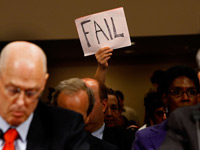 ...is you. Ha ha. Or your mum to be more precise.
But no, what does FAIL mean these days? In this very good article from the American online magazine Slate, Christopher Beam traces the origins of this rather splendid word and how it has changed thanks to its appearance in obscure Japanese video games, online gamer chat and now a brilliant blog dedicated to the art of fail.
We all know what fail used to mean: it existed as a verb. I fail, you fail, she fails, we all fail: you get the general idea. But now it's undergone conversion and can be used as a noun - a fail, a total fail, an epic fail - or even an adjective - you are fail - but it's unclear whether this will last or if it's just another passing language fad.
Have you come across it? Is it part of your vocabulary? Or just another nerdy internet thing like w00t and pwned which two students (Leanne and Henrietta, hello!) and me (hello...oh hang on) know about from our mis-spent time on t'internet?
Useful for:
ENA5 - Language Change
ENGA3 - Language Explorations
Saturday, October 04, 2008
In other words
A piece by John Walsh in The Independent a couple of days ago gives a new "visual dictionary" website, Wordia a bit of a savaging. Wordia claims to be "redefining the dictionary" but is described by Walsh as "misleading", which is no use for a dictionary, and he goes on to wonder...
The idea behind Wordia is explained in the article:
But, as Walsh points out, dictionary definitions aren't decided upon by random celebrities; they're decided upon by qualified language experts who know something about the language and where the actual words derive from. That's not to say that we can't have our own ideas about what certain words mean to us - they're more the connotations of words than their denotations - but that if we don't have accepted and agreed definitions to words we'll be left floundering in a sea of vagueness and, like...whatever.
The other point is that dictionaries do respond to new words and new meanings, but they're a bit more careful to source these than Wordia. Look here and here for more details about what lexicographers actually do.
But Walsh is not entirely negative about different approaches to dictionary compilation. He speaks more approvingly of Urban Dictionary, which collects different meanings from its contributors and is well known for its up to date slang definitions (and its rude words and thinly veiled personal insults e.g. "definition of gay = my stupid English teacher").
And if you think that's sad, have a read about this chap who has just read the OED from cover to cover.
Useful for:
ENA5 - Language Change
ENGA3 - Language Explorations
...whether a dictionary can usefully be run by chat and semi-consensus; and whether it's right for readers to "select" a meaning they find "relevant", rather than one that's actually correct.
The idea behind Wordia is explained in the article:
The everyone-join-in dictionary is called wordia.com, and is the joint offspring of the television producer Edward Baker and Michael Birch, the internet entrepreneur who founded Bebo, the social-networking site. They've linked up with HarperCollins, the blue-chip publisher owned by Rupert Murdoch, to make use of their electronic dictionary of 76,000 headwords and 120,000 definitions. But the unique selling proposition behind wordia.com is visual: they want to compile an archive of videos in which thousands of members of the public will offer their own definitions of favourite words and have them posted on YouTube, with which Baker and Birch are also in partnership.
But, as Walsh points out, dictionary definitions aren't decided upon by random celebrities; they're decided upon by qualified language experts who know something about the language and where the actual words derive from. That's not to say that we can't have our own ideas about what certain words mean to us - they're more the connotations of words than their denotations - but that if we don't have accepted and agreed definitions to words we'll be left floundering in a sea of vagueness and, like...whatever.
The other point is that dictionaries do respond to new words and new meanings, but they're a bit more careful to source these than Wordia. Look here and here for more details about what lexicographers actually do.
But Walsh is not entirely negative about different approaches to dictionary compilation. He speaks more approvingly of Urban Dictionary, which collects different meanings from its contributors and is well known for its up to date slang definitions (and its rude words and thinly veiled personal insults e.g. "definition of gay = my stupid English teacher").
And if you think that's sad, have a read about this chap who has just read the OED from cover to cover.
Useful for:
ENA5 - Language Change
ENGA3 - Language Explorations
Subscribe to:
Posts (Atom)
Follow EngLangBlog on Bluesky
The old Twitter account has been deleted (because of both the ennazification and enshittification of that site) so is now running on Bluesk...

-
 As part of the Original Writing section of the NEA, students will be required to produce a commentary on their piece. This blog post will pr...
 -
As lots of students are embarking on the Language Investigation part of the Non-Exam Assessment, I thought it might be handy to pick up a fe...
-
I'm on a roll. Nothing from me for ages, then three posts come along! This is a lovely story from the Kenya Times about a dialect called...