While some changes to language are roundly condemned by pedants, purists and prescriptivists - creaky voice, rising intonation, split infinitives and literally not actually meaning LITERALLY AT ALL - new words often get an easy ride. People generally like new words and can see why they appear in the language, even if some of them seem a bit silly (Awesome sauce and amazeballs? Really?) or likely to last as long as a David Cameron promise on tax credits (dadbod and mantihose?). In fact, new words now get wall-to-wall media coverage.
So, this week we have seen the latest additions to the Collins Dictionary feature in pieces such as this (from the Dictionary-makers themselves), this from The Guardian, this from the BBC and this from the Daily Fail.
But among the hype and the celebration of an evolving and vibrant language, naysayers complain that some of the new entries are just trendy fads, too ephemeral to be included in esteemed dictionaries.
As Robert Lane Greene explains in a blog for The Economist, the whole process of putting new words in a dictionary is quite an intensive exercise, admittedly now made much easier by the internet: something that early lexicographers could have only dreamt of. A further explanation is given in this helpful video clip from Oxford University Press, which describes how a new word (in this case selfie) might enter their dictionaries. As the clip explains, the naysayers are partly right that things have been changing faster than before, because the new words don't have to have had a very long existence before being added to the online versions of the dictionaries. But in a way, that just reflects the rapid pace of lexical change these days. Perhaps, as John Sutherland argues in this article, language is "evolving
at a faster rate now than at any other time in history because of social media
and instant messaging".
Is this rapid change leaving some behind? One argument often put forward by more prescriptively-minded people is that if language changes too fast, we lose mutual intelligibility; in other words, one generation may not understand the language of another. Older people (anyone over 30) will lose any semblance of understanding of what young people are talking about, goes the argument, and that will lead to social breakdown and chaos. Indeed, this is the argument peddled in rather dubious articles like this one in yesterday's Daily Fail which claims that parents haven't a clue what their kids are saying because they're using a secret sex and drugs code, grandad!
For example, the seemingly innocuous "netflix and chill" now takes on much more sinister connotations. The innocent Snapchat message from your teenage daughter to her bae saying "Do you want to come over? We could Netflix and chill." actually means "Buy drugs, come to my boudoir and let's have hours of dangerous chemsex". Apparently.
The fear that young people's language is constantly evolving as a nefarious means of hoodwinking their prying parents or to hide other dubious activities (smoking tobacco, drinking alcopops and playing CoD until after bedtime) is one that has been around forever. This piece in The Daily Telegraph from 2013, this one from the Daily Fail (again... almost like they don't like young people), or even these from as far back as the 17th Century, all say similar things.
And if people have been complaining about it and we still manage to communicate fairly effectively with each other after all this time, surely the doom-mongers are barking up the wrong tree.
Showing posts with label ENGB3. Show all posts
Showing posts with label ENGB3. Show all posts
Saturday, November 07, 2015
Friday, March 21, 2014
Old goths never die: they just fade to grey.
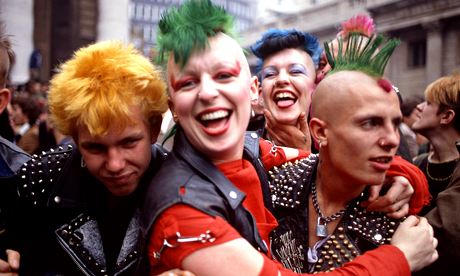 |
| Punks in 1983: probably teaching you English in 2014 |
Each movement has had its own associated look, musical style and even language terminology - as you'd probably expect from any community of practice - and an article by the excellent Alexis Petridis in today's Guardian* tells us all about relatively recent subcultures and some of the language associated with them.
 |
| Sisters of Mercy: none more goth |
If you're looking for material to help you with ENGA3 (or ENGB3) Language Change and the influences, processes and reasons for language changing, it's got plenty of examples. From a word formation angle, we've got compounds such as sea punk and haul girl, clippings such as emo and potential eponyms-in-the-making, Molly Soda. And from the angle of social change and technology driving language, there's lots to talk about in terms of the power of web-based media and different forms of prestige and influence.
*Thanks to Sally F for link


Friday, February 14, 2014
Evolution or decline?
If you are studying Language Change or Language Discourses for either AQA A or B A2 English Language, a recent run of articles should be really helpful to you. One of the big debates - probably the biggest, overarching debate of all - connected to this topic is over the ways in which people view language change. Is it a downward spiral of decline or a natural process of evolution and progression?
As you might expect, it's rarely a simple answer and opinions are often divided. For members of the declinist to-hell-in-a-handcart brigade (aka the prescriptivists), like Simon Heffer and Lynne Truss, our language (usually ours, not theirs) is permanently at risk from the eroding winds of change and the tides of textual degradation.
In a recent piece for The Daily Telegraph (which you'll be reading/working on now if you're in one of my A2 classes), Lynne Truss bemoaned what she saw as the increasingly blurred distinction between single and compound words such as any way/anyway and may be/maybe, declaring - in a slightly hyperbolic and tongue in cheek fashion, I hope - that "the English language as we know it was hereby doomed, and we might as well all go off and kill ourselves". Furthermore, she blames it on technology and the Americanisation of English, those familiar enemies of traditional English throughout time (Remember how the printing press simply ruined English and how American English insists on having more logical spelling?).
Erin Brenner, writing for Visual Thesaurus magazine in the USA (subscription needed, so just a brief quote here) takes issue with Truss, stating that
In today's Guardian, David Marsh (author of For Who The Bell Tolls and one of The Guardian's style gurus) contextualises clashes like those between Truss and Brenner within a much longer struggle between the descriptivists and prescriptivists. In his article, The Pedants' Revolt, he argues that
So, is language like a disease? Or a crumbling castle? And where's the damp spoon? As Aitchison herself pointed out in her Reith Lecture A Web of Worries (still available here as an mp3) rigid systems aren't much help with a changing language and tend to stand in the way of the new language that we need to describe a changing world. As for language as a disease, Aitchison explains that we don't catch change like a nasty dose of flu, but we choose our language styles.
And do descriptivists sit back and allow change to take place, documenting it as everything goes to hell in a handcart or to sh*t in a shovel? Well, language is changing all the time - even the most ardent prescriptivist will acknowledge that - so why not learn to understand and describe those changes? Does doing so, amount to embracing those changes? Not really. Most descriptivists would still argue that Standard English is important because it allows mutual intelligibility (i.e a chance to understand each other through a shared language) but they might disagree that certain uses are 'correct' or 'incorrect'. They argue that it's not a clear cut, black and white distinction. Michael Rosen makes exactly this point in an article about grammar for The Guardian in 2012:
Steven Pinker, whose amazing hair is to heads what David Crystal's beard is to chins, argues in an article for The New Yorker, False Fronts in the Language Wars, that we shouldn't see the world in such simple terms as descriptivist versus prescriptivist:
Instead he argues that - very much like David Marsh in The Guardian - once we accept that the "rules" are not rules at all and instead "tacit conventions", we realise that it's all a matter of taste and appropriacy. If we are educated to a certain level of literacy to make our choices about what we want to say - you and I, me and him, ain't doing nothing - then we have control over our own language and an understanding of others' language.
As Pinker goes on to say, "The rules of standard English are not legislated by a tribunal but emerge as an implicit consensus within a virtual community of writers, readers, and editors. That consensus can change over time in a process as unplanned and uncontrollable as the vagaries of fashion". For Pinker, there's a need for prescriptive rules to help police what has been agreed as being Standard English at a given time, but there's no need for prescriptive points-scoring or for claiming that one form is superior to another.
So, perhaps we should be pleased that there is a debate at all. The tension between prescriptivists and descriptivists is actually exerting a creative force over our language: the prescriptivist urge to keep things together, to make things stay the same, is constantly in opposition to the natural inclination of language to change and vary, and for descriptivists to document and recognise that change. Maybe one can't live without the other.
As you might expect, it's rarely a simple answer and opinions are often divided. For members of the declinist to-hell-in-a-handcart brigade (aka the prescriptivists), like Simon Heffer and Lynne Truss, our language (usually ours, not theirs) is permanently at risk from the eroding winds of change and the tides of textual degradation.
In a recent piece for The Daily Telegraph (which you'll be reading/working on now if you're in one of my A2 classes), Lynne Truss bemoaned what she saw as the increasingly blurred distinction between single and compound words such as any way/anyway and may be/maybe, declaring - in a slightly hyperbolic and tongue in cheek fashion, I hope - that "the English language as we know it was hereby doomed, and we might as well all go off and kill ourselves". Furthermore, she blames it on technology and the Americanisation of English, those familiar enemies of traditional English throughout time (Remember how the printing press simply ruined English and how American English insists on having more logical spelling?).
Erin Brenner, writing for Visual Thesaurus magazine in the USA (subscription needed, so just a brief quote here) takes issue with Truss, stating that
Truss and other language commentators like her bug me. They make proclamations from on high that conform to their ideal of English but have no relationship with how we really use English. They make broad statements about the state of English without any evidence. They offer little to no reasoning for their preferences, and they offer no proof of their statements.
In today's Guardian, David Marsh (author of For Who The Bell Tolls and one of The Guardian's style gurus) contextualises clashes like those between Truss and Brenner within a much longer struggle between the descriptivists and prescriptivists. In his article, The Pedants' Revolt, he argues that
Conservatives long for a golden age, usually about 50 years in the past, when everyone knew their grammar and all was right with the world. "What is more, even Grammar, the basis of all education, baffles the brains of the younger generation today ... There is not a single modern schoolboy who can compose verses or write a decent letter" – not Michael Gove, but William Langland (born 1332!). Sadly, there never was a golden age.For Truss and her prescriptivist pals, descriptivism is a form of laissez-faire, let-it-all-hang-out liberalism that has allowed the language to sink into disrepair and a car crash of OMGs and LOLs. In her Telegraph article she attacks descriptivism. Using not one, but two Jean Aitchison metaphors in the same paragraph, she says:
Imagine if other academic fields were dominated entirely by a “descriptive” ethos: we could have “descriptive” epidemiologists, perhaps, who just sat back with a clipboard and monitored the way we all died from contagious diseases. Or “descriptive” architects, who collected large salaries for watching and making detailed notes while all the buildings fell down.
So, is language like a disease? Or a crumbling castle? And where's the damp spoon? As Aitchison herself pointed out in her Reith Lecture A Web of Worries (still available here as an mp3) rigid systems aren't much help with a changing language and tend to stand in the way of the new language that we need to describe a changing world. As for language as a disease, Aitchison explains that we don't catch change like a nasty dose of flu, but we choose our language styles.
And do descriptivists sit back and allow change to take place, documenting it as everything goes to hell in a handcart or to sh*t in a shovel? Well, language is changing all the time - even the most ardent prescriptivist will acknowledge that - so why not learn to understand and describe those changes? Does doing so, amount to embracing those changes? Not really. Most descriptivists would still argue that Standard English is important because it allows mutual intelligibility (i.e a chance to understand each other through a shared language) but they might disagree that certain uses are 'correct' or 'incorrect'. They argue that it's not a clear cut, black and white distinction. Michael Rosen makes exactly this point in an article about grammar for The Guardian in 2012:
If we are serious about enabling those who want to acquire what we have called standard English then first we should be honest about change and its lack of encoded rules. Then, together with them, we should look closely at how such people's speech and writing diverges from the kind of English that they would like to acquire. There will always be social reasons for this and knowing these helps people take on the dialects they don't fully speak or write.This isn't easy. We shouldn't pretend it's easy.
Steven Pinker, whose amazing hair is to heads what David Crystal's beard is to chins, argues in an article for The New Yorker, False Fronts in the Language Wars, that we shouldn't see the world in such simple terms as descriptivist versus prescriptivist:
According to the sadly standard dichotomy, prescriptivists believe that certain usages are inherently correct and others inherently incorrect, and that to promote correct forms is to uphold truth, morality, excellence, and a respect for the best of our civilization. To indulge incorrect ones, meanwhile, is to encourage relativism, vulgar populism, and the dumbing down of literate culture.
Descriptivists, according to this scheme, believe that norms of correctness are arbitrary shibboleths of the ruling class, designed to keep the masses in their place. Language is an organic product of human creativity, and the people should be given the freedom to write however they please.
Instead he argues that - very much like David Marsh in The Guardian - once we accept that the "rules" are not rules at all and instead "tacit conventions", we realise that it's all a matter of taste and appropriacy. If we are educated to a certain level of literacy to make our choices about what we want to say - you and I, me and him, ain't doing nothing - then we have control over our own language and an understanding of others' language.
As Pinker goes on to say, "The rules of standard English are not legislated by a tribunal but emerge as an implicit consensus within a virtual community of writers, readers, and editors. That consensus can change over time in a process as unplanned and uncontrollable as the vagaries of fashion". For Pinker, there's a need for prescriptive rules to help police what has been agreed as being Standard English at a given time, but there's no need for prescriptive points-scoring or for claiming that one form is superior to another.
So, perhaps we should be pleased that there is a debate at all. The tension between prescriptivists and descriptivists is actually exerting a creative force over our language: the prescriptivist urge to keep things together, to make things stay the same, is constantly in opposition to the natural inclination of language to change and vary, and for descriptivists to document and recognise that change. Maybe one can't live without the other.
Sunday, December 29, 2013
WOTY FTW
It's that time of year again when the newspapers are full of end of year lists, and it wouldn't be complete without their favourite words of the year. So here are a few of them for your delectation and delight (and your ENGA3 and ENGB3 Language Change knowledge).
The Independent charts the events of the year through its new words
Ben Zimmer - linguist and columnist - takes a look for The Wall Street Journal
Steven Poole in The Guardian
The Daily Telegraph on Collins Dictionary's new words of 2013
And to cap it all, here's a best of for a decade from the excellent Kerry Maxwell who charts new words and their meanings for the MacMillan Dictionary blog.
The Independent charts the events of the year through its new words
Ben Zimmer - linguist and columnist - takes a look for The Wall Street Journal
Steven Poole in The Guardian
The Daily Telegraph on Collins Dictionary's new words of 2013
And to cap it all, here's a best of for a decade from the excellent Kerry Maxwell who charts new words and their meanings for the MacMillan Dictionary blog.
Thursday, May 16, 2013
Poetic hustla upsets bearded prescriptivist
 |
| ...because American signs are better than foreign ones |
Which themes can you pick up from this? I can see a bit of damp spoon, a touch of crumbling castle, a whole heap of declinism and even a subtle waft of infectious disease.
Friday, April 19, 2013
Technolexis
If you're looking for examples of how technology shapes our language for your revision on ENGA3 or ENGB3, then you could do worse than check this article by Tom Chatfield which plugs his new book, Netymology: A Linguistic Celebration of the Digital World.
It includes hashtag, which was the American Dialect Society's Word of the Year for 2012, and geek, which is not necessarily new but has certainly shifted in meaning as time has gone on, plus plenty of others.
One of the terms Cupertino, might be new to you (and me), but the basic concept is pretty well known; it's all down to how new technologies sometimes "correct" our language, even when we don't want them to. Ben Zimmer of the excellent Visual Thesaurus website, talks about it in more detail here.
It includes hashtag, which was the American Dialect Society's Word of the Year for 2012, and geek, which is not necessarily new but has certainly shifted in meaning as time has gone on, plus plenty of others.
One of the terms Cupertino, might be new to you (and me), but the basic concept is pretty well known; it's all down to how new technologies sometimes "correct" our language, even when we don't want them to. Ben Zimmer of the excellent Visual Thesaurus website, talks about it in more detail here.
Friday, April 12, 2013
A gap to plug
Yesterday's post on 'The language deficit' picked up on Tina Rosenberg's article in The New York Times about programmes designed to bridge the gap between kids brought up in rich language environments (i.e. those getting a great deal of language used around and towards them) and those in a more impoverished (often economically, as well as well as linguistically) environment.
Ben Zimmer of Visual Thesaurus has written a piece on it too, which can be found in The Boston Globe, and in this he looks at similar territory to Rosenberg but also brings in a bit more of a linguistic focus, quoting Deb Roy, whose Speechome Project is something we've looked at in class (and through the links here and here).
Ben Zimmer of Visual Thesaurus has written a piece on it too, which can be found in The Boston Globe, and in this he looks at similar territory to Rosenberg but also brings in a bit more of a linguistic focus, quoting Deb Roy, whose Speechome Project is something we've looked at in class (and through the links here and here).
Thursday, April 11, 2013
The language deficit
If you're revising child language for ENGA1 (or ENGB3 on the AQA B spec), you might find this link a useful one to have a look at. Tina Rosenberg, writing in The New York Times, takes a detailed look at research into the amount and range of language that children hear around them, or have directed at them, and the gap between rich and poor kids that seems to exist.
Rosenberg refers to the work of Betty Hart and Todd R. Risley (which we referred to here a while ago) and recent programmes designed to close this gap. But what kind of gap are we talking about?
Rosenberg refers to the work of Betty Hart and Todd R. Risley (which we referred to here a while ago) and recent programmes designed to close this gap. But what kind of gap are we talking about?
The disparity was staggering. Children whose families were on welfare heard about 600 words per hour. Working-class children heard 1,200 words per hour, and children from professional families heard 2,100 words. By age 3, a poor child would have heard 30 million fewer words in his home environment than a child from a professional family. And the disparity mattered: the greater the number of words children heard from their parents or caregivers before they were 3, the higher their IQ and the better they did in school. TV talk not only didn’t help, it was detrimental.The programmes to close this gap sound really impressive and are exactly the kind of thing that Sure Start was supposed to help in the UK before its funding was brutally slashed.
We've talked in class a lot about the competing influences of nature and nurture in children's language acquisition, but here's a really interesting approach to improving the quality and range of what children hear, and subsequently it would seem, produce.
More recently, Dana Suskind, a pediatric cochlear implant surgeon at the University of Chicago who founded the school’s Thirty Million Words project, did a study with 17 nannies in Chicago. Each attended a workshop on the importance of talk, strategies for increasing it, and how to use the Lena recorder. Then they used it once a week for six weeks. Suskind found (pdf) that the nannies increased the number of words they used by 32 percent and the number of conversational turns by 25 percent.
Friday, March 22, 2013
Who cares?
Who cares about English? While this is a question I'm increasingly asking myself - especially when I get given A level essays two weeks late, written on Hello Kitty notepaper and handed in with a cheery "It's crap!" - this post isn't part of my usual moaning about students these days and the need to do lots of work for the exam. Well sort of...
Who cares about English? This time, the question isn't aimed at the heavens, but at a panel of experts and kind-of experts. And the answer of course should be, "We all do", or at the very least, "I don't really care, but I can do a very good impression of caring for the purposes of my exam".
Anyway, have a look here where you can watch (and read the answers from) a panel discussion between four language lovers, including one of my favourite people, Henry Hitchings, and the rather unfortunately named Prudence Raper, from the almost as unfortunate Queen's English Society.
The questions they're addressing in this discussion are:“What are the effects of social media, such as Facebook, on English?” and “What is English, given that it is spoken in so many different countries?”, which are exactly the kinds of things a soon-to-be-revising A2 student should be thinking about.
Who cares about English? This time, the question isn't aimed at the heavens, but at a panel of experts and kind-of experts. And the answer of course should be, "We all do", or at the very least, "I don't really care, but I can do a very good impression of caring for the purposes of my exam".
Anyway, have a look here where you can watch (and read the answers from) a panel discussion between four language lovers, including one of my favourite people, Henry Hitchings, and the rather unfortunately named Prudence Raper, from the almost as unfortunate Queen's English Society.
The questions they're addressing in this discussion are:“What are the effects of social media, such as Facebook, on English?” and “What is English, given that it is spoken in so many different countries?”, which are exactly the kinds of things a soon-to-be-revising A2 student should be thinking about.
Sunday, February 24, 2013
Keep buzzing
MacMillan Dictionaries have had a really good web presence for a while now, with plenty of accessible articles for A level students (and normal, everyday people who are just interested in language).
One of the best and most useful features for A level English Language has been its Buzzwords section, a weekly feature in which the ace lexicographer Kerry Maxwell takes a look at a new word that's appeared and explores its origins, formations and uses.
It's exactly the kind of thing that feeds into the work we do on Language Change for ENGA3 (or ENGB3 if you follow the AQA B spec) and provides the kind of up to date and well-referenced examples of words and word formation processes that can make your essays on this topic a much better read, and keep you topped up with new and original illustrations.
Buzzwords is now ten years old, so Kerry has written an overview about what's happened in the world of new words, which you can find here. We'll be looking at this in class in the run-up to the exam in June, but it's definitely worth having a read now and looking back through the Buzzwords for 2012 here and the archive here.
One of the best and most useful features for A level English Language has been its Buzzwords section, a weekly feature in which the ace lexicographer Kerry Maxwell takes a look at a new word that's appeared and explores its origins, formations and uses.
It's exactly the kind of thing that feeds into the work we do on Language Change for ENGA3 (or ENGB3 if you follow the AQA B spec) and provides the kind of up to date and well-referenced examples of words and word formation processes that can make your essays on this topic a much better read, and keep you topped up with new and original illustrations.
Buzzwords is now ten years old, so Kerry has written an overview about what's happened in the world of new words, which you can find here. We'll be looking at this in class in the run-up to the exam in June, but it's definitely worth having a read now and looking back through the Buzzwords for 2012 here and the archive here.
Thursday, January 24, 2013
The phono-morph war
A report about research from Portsmouth University in the Southern Daily Echo suggests that a new approach to literacy teaching, which involves teaching about the structures and meanings of words (morphology) is more effective than the sound system based teaching of phonics that has been promoted over the last decade.
With a morphological approach, children are taught about the units that make up words (like we've been doing in Child Language recently with morphemes like -s, -ed, -ing , -er, -ist and -est):
Phonics has been promoted by successive governments as a means of rapidly improving children's ability to decode the sounds of English, but it's come in for some stick because - as we can all see with words like plough, through and cough - the spelling system in English isn't regular or even very logical. The introduction of phonics testing at Key Stage 1, where nonsense words like wib or vog (or even our old favourite, wug) are given to children to read has provoked yet more concern among many literacy experts, because - they argue - it's articifial and pointless to give children made-up words out of context when readign is not just about individual sounds or words, but about making sense of words and sounds in their specific contexts.
The fact that some people who are quite close to government advisors are set to make a few quid out of phonics schemes is also a cause for scepticism among critics of the phonics-or-bust approach, but plenty of research suggests that phonics can help some children; the argument is not really about if it does but how and why and also in which contexts.
So, what about teaching morphology as this research suggests? It's not necessarily a new approach; back in 2006, Terezinha Nunes and Peter Bryant published Improving Literacy by Teaching Morphemes, which looked at work done in schools to promote the study of morphology as a means of improving spelling and reading. What Victoria Devonshire is doing sounds really interesting and it sounds like it will add another dimension to literacy teaching. Hopefully, there'll be more information about this approach to come out.
With a morphological approach, children are taught about the units that make up words (like we've been doing in Child Language recently with morphemes like -s, -ed, -ing , -er, -ist and -est):
Dr Victoria Devonshire, of the Department of Psychology, trialled a new method of teaching reading and writing with 120 children aged five to seven and found the average reading age increased by 14 months after just six months. She said: ''We were surprised at how compelling the results were.
''When children were taught to understand why English works the way it does, we saw a leap in their ability to learn to read and write.
''The written word is about conveying meaning, not the sound of speech. Expecting children to just figure out the rules of our language is worryingly common and it isn't helping them become as proficient and confident as young children in many other languages.''
Phonics has been promoted by successive governments as a means of rapidly improving children's ability to decode the sounds of English, but it's come in for some stick because - as we can all see with words like plough, through and cough - the spelling system in English isn't regular or even very logical. The introduction of phonics testing at Key Stage 1, where nonsense words like wib or vog (or even our old favourite, wug) are given to children to read has provoked yet more concern among many literacy experts, because - they argue - it's articifial and pointless to give children made-up words out of context when readign is not just about individual sounds or words, but about making sense of words and sounds in their specific contexts.
The fact that some people who are quite close to government advisors are set to make a few quid out of phonics schemes is also a cause for scepticism among critics of the phonics-or-bust approach, but plenty of research suggests that phonics can help some children; the argument is not really about if it does but how and why and also in which contexts.
So, what about teaching morphology as this research suggests? It's not necessarily a new approach; back in 2006, Terezinha Nunes and Peter Bryant published Improving Literacy by Teaching Morphemes, which looked at work done in schools to promote the study of morphology as a means of improving spelling and reading. What Victoria Devonshire is doing sounds really interesting and it sounds like it will add another dimension to literacy teaching. Hopefully, there'll be more information about this approach to come out.
Are you a QUILTBAG?
Labels for different social groups are a shorthand way of defining people and we use a lot of them in our language. Recently, we've looked at terms like handicapped, the handicapped, disabled, people with disabilities and wheelchair users as part of our work on ENGA3 Language Change, but on the Johnson blog they take a look at some of the rapidly evolving acronyms and initialisms for groups defined by their sexuality.
So, we have LGB (Lesbian, Gay and Bisexual) and LGBT (Lesbian, Gay and Bisexual and Transgendered) but in the past the labels weren't quite so neutral. Gay has had a fascinating history as a word, and queer has been reclaimed to some extent, but read more of the piece in Johnson to see where we're going now and what a QUILTBAG is...
For a full set of LGBTQIA (and more) terms, have a look here. A term that's fairly new to me, but seems to have been knocking around for a while, is cisgender (explained, I think, here). The recent media firestorm about Julie Burchill's 'transphobic' article in the Observer (removed from the Observer site but reprinted here) brought this term to my attention and it's another example of how language and identity are closely linked, and the ways in which language can be used to hurt others.
So, we have LGB (Lesbian, Gay and Bisexual) and LGBT (Lesbian, Gay and Bisexual and Transgendered) but in the past the labels weren't quite so neutral. Gay has had a fascinating history as a word, and queer has been reclaimed to some extent, but read more of the piece in Johnson to see where we're going now and what a QUILTBAG is...
For a full set of LGBTQIA (and more) terms, have a look here. A term that's fairly new to me, but seems to have been knocking around for a while, is cisgender (explained, I think, here). The recent media firestorm about Julie Burchill's 'transphobic' article in the Observer (removed from the Observer site but reprinted here) brought this term to my attention and it's another example of how language and identity are closely linked, and the ways in which language can be used to hurt others.
More child language
This week's The Life Scientific on Radio 4 featured an interview with Annette Karmiloff-Smith, who is an expert in children's development. There's some good content here for anyone wanting to look at interaction and language development, as she talks about how exposure to different kinds of language - speech from parents, TV, internet language - shapes children's early development.
The podcast can be found here.
The podcast can be found here.
Thursday, January 17, 2013
Child Language resources
As we're now well under way with the Language Development topic for ENGA1, this link from Jill on the English language List is well timed.
It's the Talking Point website which has masses of material for parents and teachers about children's language development, including a handy set of ages and stages, where you can check what is normally happening in a child's language development at various ages. There's also some useful material on language impairments and the communicative development of children with learning difficulties, which can be really useful for A2 language investigations.
This week's Word of Mouth on Radio 4 had a really good segment on autism and language, which focused not just on the language development of young people with autism but the language used by carers towards people with autism.
It's the Talking Point website which has masses of material for parents and teachers about children's language development, including a handy set of ages and stages, where you can check what is normally happening in a child's language development at various ages. There's also some useful material on language impairments and the communicative development of children with learning difficulties, which can be really useful for A2 language investigations.
This week's Word of Mouth on Radio 4 had a really good segment on autism and language, which focused not just on the language development of young people with autism but the language used by carers towards people with autism.
Thursday, January 10, 2013
#BiffyClyro
 |
| #Jahmazing |
Many recent language stories have picked up on the end of year new word round-ups and votes, so you can find a summary of recently fashionable English words in this Observer piece by Rafael Behr (HT to Jon Dolton for the link) which includes some from popular culture and some from wider social changes. So, we get X Factor's Nicole's shamazing (jahmazing, more likely, given it was invented for Jahmene), the song that had uncles dancing badly everywhere, Gangnam Style, Tory incompetence (rather than their usual malevolence) with Omnishambles, and the big winner this year, Hashtag, becoming not just a ubiquitous octothorpe (#) but a real, spoken expression (just like guest blogger Emma Bertouche said on this blog back in 2011). Fearne Cotton off of that there Radio 1 even slotted "Hashtag Biffy Clyro" into one of her pre-Christmas shows, as a reference to the angular-haired Scottish riff-makers. While it's clearly become accepted as a new way of making reference to something in speech, it still made me choke on my cornflakes and SCOMK (Spit Coffee on My Keyboard).
Hashtag was the winner in the American Dialect Society WOTY 2012 poll. You can read more about the nominations and winners in this pdf, but their choice of hashtag has been celebrated and discussed further here and questioned here.
Meanwhile, the Australian Macquarie Dictionary has its poll still running and there are some crackers on there, including the aforementioned wine flu, and dramality.
What were your winning words of 2012 and which bugged you the most? Personally amazeballs tickled my fancy, but reem irritated me in ways that I can't really explain. Also, what are your predictions for 2013?
Thursday, December 13, 2012
Wrath of the grammarbot
Yesterday's Independent features a story about grammar rage on the net which is well worth looking at if you're studying language change, technology and/or attitudes to change.
Outraged at the apparent upsurge in grammar errors on the web, grammar nerds have programmed deadly (ish) attack bots to roam the Twittersphere looking for mistakes and immediately punishing them with sarcastic replies. Basic homophone errors like their/there, your/you're and where/were are the prime targets, but others are facing the wrath of the grammarbot too, like the overuse of CAPS LOCK or the misspelling of sneak peek as sneak peak.
But are Twitter and other forms of digital communication making us worser and worser with are grammer and spelling? Apparently not, if recent linguistic research is to be believed.
Outraged at the apparent upsurge in grammar errors on the web, grammar nerds have programmed deadly (ish) attack bots to roam the Twittersphere looking for mistakes and immediately punishing them with sarcastic replies. Basic homophone errors like their/there, your/you're and where/were are the prime targets, but others are facing the wrath of the grammarbot too, like the overuse of CAPS LOCK or the misspelling of sneak peek as sneak peak.
But are Twitter and other forms of digital communication making us worser and worser with are grammer and spelling? Apparently not, if recent linguistic research is to be believed.
In fact, (Tim) Stowell says there is no evidence that any form of "specialized speech" has corrupted spoken or written English, and plenty of recent studies have come to the same conclusion. In September, researchers at Coventry University in Britain ruled that there's no link between text-message conventions, which are also used on Twitter, and bad spelling or grammar in other forums. A 2009 study from the University of Alberta concluded that text-speak should be viewed as a dialect that people can switch into and out of.Others disagree - sometimes quite violently - and the whole debate is one that we look at when we study the Language Discourses part of ENGA3. There are masses of posts about this very topic here on the blog, so have a look and fill you're boots.
And on the sixth day He made meggings
Can these ball-crunching jodhpur variants really be the next thing in male fashion, I ask Albus, a balding builder from Lithuania?As if jeggings (jeans + leggings) wasn't a blend too far, we now have meggings (men's leggings). I'm reliably informed that treggings (trousers + leggings, or tramp's leggings, if you prefer) also exist. Blends are nothing new, but what differentiates a man's leggings from a woman's leggings? In other words, why can't a man just wear jeggings? It's something that Patrick Kingsley asks in his short piece on meggings and one that applies equally to other man-words like manbag (a man's handbag), mankini (see below) and mantyhose.
Nah. "I don't like them," says Albus. "I like more traditional designs. Jeans. Combat trousers. Military stuff. It's a personal choice."

Perhaps, given that these items are generally seen as being the preserve of women, men feel more self-conscious about wearing or using such items unless they've been rebranded and renamed as manly clobber. Stan Carey, blogger and contributor to MacMillan Dictionaries excellent language blog, has written about Manguage here and it's worth a read if you're into new words or just fancy some tight-fitting full-length budgie-smugglers.
Thursday, November 22, 2012
Urban tweetz
As we saw last week, Twitter is proving to be a great way of tracking language change and variation, admittedly with a few limitations about tweeters' real identities and the like. This week, New Scientist reports on research by Jacob Eisenstein and his team at Georgia Institute of Technology which seems to indicate that new word formations and abbreviations of older ones are more likely to spread via Twitter from US urban areas with large African-American populations.
Slang - and some of these formations like CTFU (Cracking The F*** Up) and bruh (brother) probably fit under that umbrella term - has long had deep links with the black community. Julie Coleman's excellent book, The Life of Slang looks at how some forms of slang have been created and kept alive in African-American culture, so it's not a great surprise to find that this ethnic group is still leading the way in lexical innovation where a new technology is concerned.
There's more here too.
Slang - and some of these formations like CTFU (Cracking The F*** Up) and bruh (brother) probably fit under that umbrella term - has long had deep links with the black community. Julie Coleman's excellent book, The Life of Slang looks at how some forms of slang have been created and kept alive in African-American culture, so it's not a great surprise to find that this ethnic group is still leading the way in lexical innovation where a new technology is concerned.
There's more here too.
Friday, November 16, 2012
The geeks shall inherit the earth
 |
| Sheldon Cooper - reclaiming 'nerd' and 'geek'? |
In this piece for the BBC News Magazine, the history of the words is outlined and examined by lexo-boffins and neologo- nerds, who tell us that the words are subtly different in their meanings and even carry different connotations depending on which side of the Atlantic you live on:
It's easy to argue that "nerd" and "geek", with their very different roots, retain different meanings, arguably with the former still more derogatory than the latter. And some see a transatlantic divide, with "geek" used in US and UK, but "nerd" somehow feeling less British.
And as the writer of the article, Kathryn Westcott, goes on to say, the gradual shifts in meaning are not a new occurrence in language. Yesterday, we looked at the word yid and its changing meanings to Jews and non-Jews, and in other posts over the years, we've considered queer, the n-word, slut and bitch. Are geeks and nerds now reclaiming these once-negative labels and marching proudly under their new banner out of the labs and libraries and into the mainstream?
Thursday, November 15, 2012
Tracking tweets
Twitter is proving to be a fantastic resource for linguists and you can see several examples of what's been done with it in these previous blog posts.
More recently, researchers at UCL have been looking at what tweets in London reveal about patterns of language use. The people looking at it, Ed Manley and James Cheshire, aren't linguists but an engineer and spatial analysis lecturer (eh?) so they're more interested in where things happen rather than necessarily exploring why - which might be more interesting for English Language students - but it raises good questions about why certain languages don't appear as often as might be expected- Bengali and Somali, for example - while others do make an appearance - Haitian Creole, Basque and Swahili -among them.
But what might be of even greater interest to A level English Language students is how Twitter is proving to be a source of fantastic data on gender and language, and what we might term communities of practice: groups of people that you "do" language with in your various day to day activities and whose language styles influence your own.
This excellent article by Ben Zimmer in the Boston Globe gives you a clear introduction to what Twitter is offering linguists and you can see more of the work of Tyler Schnoebelen and his colleagues in this powerpoint of their presentation to #nwav41 (Warning! Contains advanced statistics to boggle the mind).
In other Twitter-related research, this link to a paper by Rebecca Maybaum gives you a glimpse of how Twitter can be used to track evolving slang: in this case, the words used to describe people on Twitter. Tweeps? Twiends? Tweethearts?
More recently, researchers at UCL have been looking at what tweets in London reveal about patterns of language use. The people looking at it, Ed Manley and James Cheshire, aren't linguists but an engineer and spatial analysis lecturer (eh?) so they're more interested in where things happen rather than necessarily exploring why - which might be more interesting for English Language students - but it raises good questions about why certain languages don't appear as often as might be expected- Bengali and Somali, for example - while others do make an appearance - Haitian Creole, Basque and Swahili -among them.
But what might be of even greater interest to A level English Language students is how Twitter is proving to be a source of fantastic data on gender and language, and what we might term communities of practice: groups of people that you "do" language with in your various day to day activities and whose language styles influence your own.
This excellent article by Ben Zimmer in the Boston Globe gives you a clear introduction to what Twitter is offering linguists and you can see more of the work of Tyler Schnoebelen and his colleagues in this powerpoint of their presentation to #nwav41 (Warning! Contains advanced statistics to boggle the mind).
In other Twitter-related research, this link to a paper by Rebecca Maybaum gives you a glimpse of how Twitter can be used to track evolving slang: in this case, the words used to describe people on Twitter. Tweeps? Twiends? Tweethearts?
Subscribe to:
Posts (Atom)
Follow EngLangBlog on Bluesky
The old Twitter account has been deleted (because of both the ennazification and enshittification of that site) so is now running on Bluesk...

-
 As part of the Original Writing section of the NEA, students will be required to produce a commentary on their piece. This blog post will pr...
 -
As lots of students are embarking on the Language Investigation part of the Non-Exam Assessment, I thought it might be handy to pick up a fe...
-
I'm on a roll. Nothing from me for ages, then three posts come along! This is a lovely story from the Kenya Times about a dialect called...