With new blasphemy laws coming into effect in Britain, where it becomes a form of hate crime to attack another person's religion, a website set out to find out if its predominantly Christian audience were as easily offended as the law suggests. The website asked its readers to send in the most offensive religious jokes they had heard, and were apparently gob-smacked (or god-smacked, perhaps) to discover how gross and outrageous many of the jokes were - but also how little their audience really seemed to care! So are we becoming a society that believes anything is fair game for humour?
In an article in The Guardian earlier this week, several of the jokes are reprinted, while in a follow-up article Emo Philips, the comedian whose joke topped the poll, talks about his response to winning such a high accolade.
So, moving to the serious language point about all of this, how offensive is blasphemy in this day and age? Taking a look at the history of offensive language, you can see that many of the strongest taboo terms used to be oaths and curses with a religious connection. Just take a look at Shakespeare's use of "S'blood!" and "Zounds!" (God's blood and God's wounds, respectively) and you'll see that thses were the strongest expressions of his day.
People nowadays seem more offended by racist terms than religious ones, but as ever this shifts as language and society changes. Perhaps a good topic for a language investigation, if you're still struggling to come up with an idea...
Useful for:
EA4C - Language Investigation
Friday, September 30, 2005
Goo goo ga ga go go?
It's an essential part of being a parent: "Who's a lubbly lickle bubba den?","Do you want some more bubba num nums?", "Oh, has diddums done a poo poo?" etc. ad nauseam...
But according to the BBC, a hospital in Yorkshire has banned people from cooing over babies as it infringes their human rights and might cause infections to spread. Is it "bureaucracy gone mad" as one critic has asserted, or a sensible precaution to prevent nosey visitors poking and prodding your little baby without so much as a by-your-leave?
The whole issue of talking to babies and engaging in what child language theorists call C.D.S. (Child-directed speech) is an important area of study. Many believe that early verbal interaction with a baby (even from a few days old) is crucial in helping them develop interactional skills of their own. Others argue that babies need time and space to develop, without constant gibberish being spouted at them by doting grannies and grandads. And what of the words and sounds we use towards babies? Should we offer them such "poverty of stimulus" as Noam Chomsky famously claimed back in the 1960s: in other words, should we feed babies a diet of broken, half-words and strange gurgling noises? Or should we - as some cultures around the world like those in Samoa - refuse to engage in babytalk and instead treat children as valid conversational partners only when they can speak properly themselves? Have a look at this entry in teh online encyclopedia Wikipedia for more information on this topic.
So is this decision based on sound behavioural and developmental criteria or a case of a hospital fearing litigation if a baby picks up a nasty infection from a flu-ridden visitor? You can follow the discussion on the BBC website and add your views too.
Useful for:
ENA1 - Child Language Acquisition
ENA6 - Language Debates
But according to the BBC, a hospital in Yorkshire has banned people from cooing over babies as it infringes their human rights and might cause infections to spread. Is it "bureaucracy gone mad" as one critic has asserted, or a sensible precaution to prevent nosey visitors poking and prodding your little baby without so much as a by-your-leave?
The whole issue of talking to babies and engaging in what child language theorists call C.D.S. (Child-directed speech) is an important area of study. Many believe that early verbal interaction with a baby (even from a few days old) is crucial in helping them develop interactional skills of their own. Others argue that babies need time and space to develop, without constant gibberish being spouted at them by doting grannies and grandads. And what of the words and sounds we use towards babies? Should we offer them such "poverty of stimulus" as Noam Chomsky famously claimed back in the 1960s: in other words, should we feed babies a diet of broken, half-words and strange gurgling noises? Or should we - as some cultures around the world like those in Samoa - refuse to engage in babytalk and instead treat children as valid conversational partners only when they can speak properly themselves? Have a look at this entry in teh online encyclopedia Wikipedia for more information on this topic.
So is this decision based on sound behavioural and developmental criteria or a case of a hospital fearing litigation if a baby picks up a nasty infection from a flu-ridden visitor? You can follow the discussion on the BBC website and add your views too.
Useful for:
ENA1 - Child Language Acquisition
ENA6 - Language Debates


Sunday, September 25, 2005
It's all geek to me
Do you know the difference between fishing and phishing, a moose and a konglong, keylogging and Kenny Loggins? If you don't then maybe you are joining the ranks of the digital underclass: those people either too poor to get connected to a PC and the internet, or just those that are baffled by all this geeky jargon.
Two recent articles highlight the divide in this fascvinating area of language usage and change. In one, the BBC news website looks at how office workers find themselves baffled by the jargon around computer technology (although a quick look at some of the troublesome terms would suggest to me that they're just being a bit lazy!). An article back in April picks up some of the same themes and is a worthwhile read as background to the whole issue of jargon and occupational Englishes.
Meanwhile, in an article in The Independent about China - the world's most rapidly-developing economy - the divide between computer users and their new slanguage is causing concern to guardians of linguistic purity in the media and government:
Two recent articles highlight the divide in this fascvinating area of language usage and change. In one, the BBC news website looks at how office workers find themselves baffled by the jargon around computer technology (although a quick look at some of the troublesome terms would suggest to me that they're just being a bit lazy!). An article back in April picks up some of the same themes and is a worthwhile read as background to the whole issue of jargon and occupational Englishes.
Meanwhile, in an article in The Independent about China - the world's most rapidly-developing economy - the divide between computer users and their new slanguage is causing concern to guardians of linguistic purity in the media and government:
As internet chat and instant messaging increasingly become a part of life for China's computer-literate youth, the use of internet slang has grown and adoption of the terms has permeated all areas of Chinese life.Like so many debates about language change, attitudes to change remain in an awkward flux, caught between embracing exciting new language - and the currency that holds in the world's marketplace - and an uneasiness about how the new language is altering the essence of the old language, and leaving a whole generation behind.
On the Web, internet slang is convenient and satisfying, but the mainstream media have a responsibility to guide proper and legal language usage," the Shanghai Morning Post quoted Xia Xiurang, the chair of the culture committee of the Shanghai People's Congress, as saying.
Ms Xia said: "Our nation's language needs to develop, but it also needs to be regulated." Although she said there is no reason these words could not be used in other settings, she made it clear the use of the words in an official capacity will not be tolerated. She made no reference to how the ban, which is being drafted, would be enforced.
Useful for:
ENA5 - Language Change
ENA3 - Using Language
EA4C - Language Investigations
Friday, September 23, 2005
Name-calling
What's in a name? Well, judging by some people's attitudes, your whole personality. Reports in today's Times Educational Supplement and Daily Mirror claim that teachers on the TES message board have been exchanging less than complementary comments about the names they fear when they look at their new class lists.
Among the "offenders" are Liam, Ashley, Mason, Connor and Chantelle. Well that's me told then, with at least two of those appearing somewhere in my sons' first or middle names!
As you might expect, this brainless stereotyping hasn't gone down too well with parents, who have suggested that class snobbery and even racism might be behind these attitudes (Liam and Connor are Irish names, while Chantelle is popular among families of Afro-Caribbean backgrounds; Mason and Ashley might be seen by many as working class names).
Why we can't all call our children Tarquin and Gaylord and avoid these vulgar, oikish names, I don't know...
But names are an interesting area of English Language. A quick look at the article on this blog, Bloodlines, earlier this year tells us a lot about surnames and how they reflect family history and the prevalent attitudes of the time (as well as encoding such ideas as patriarchy and male ownership of women, some would argue), but first names are a different matter.
You might remember the jokes when the Beckhams named their son Brooklyn, but what about Britney's baby Preston (apparently?!). An article on the BBC website from last week takes a look at some of these strange celebrity names. Elsewhere on the same site, we have an article that examines some of the weird-and-not-so-wonderful names that celebrities have burdened their children with over the years. Dweezil and Moon Unit Zappa anyone?
Useful for:
EA4C - Language Investigation
Among the "offenders" are Liam, Ashley, Mason, Connor and Chantelle. Well that's me told then, with at least two of those appearing somewhere in my sons' first or middle names!
As you might expect, this brainless stereotyping hasn't gone down too well with parents, who have suggested that class snobbery and even racism might be behind these attitudes (Liam and Connor are Irish names, while Chantelle is popular among families of Afro-Caribbean backgrounds; Mason and Ashley might be seen by many as working class names).
Why we can't all call our children Tarquin and Gaylord and avoid these vulgar, oikish names, I don't know...
But names are an interesting area of English Language. A quick look at the article on this blog, Bloodlines, earlier this year tells us a lot about surnames and how they reflect family history and the prevalent attitudes of the time (as well as encoding such ideas as patriarchy and male ownership of women, some would argue), but first names are a different matter.
You might remember the jokes when the Beckhams named their son Brooklyn, but what about Britney's baby Preston (apparently?!). An article on the BBC website from last week takes a look at some of these strange celebrity names. Elsewhere on the same site, we have an article that examines some of the weird-and-not-so-wonderful names that celebrities have burdened their children with over the years. Dweezil and Moon Unit Zappa anyone?
Useful for:
EA4C - Language Investigation
Friday, September 16, 2005
Harry's bottom and the half-arsed prince
Apparently someone called Prince Harry is 21 this week. While my personal hope is that the only words I ever hear a member of the royal family say are "Where did that guillotine come from?", for purely linguistic reasons it's quite interesting to listen to his speech and the reaction to it.
Why? Well, Harry's arse has a lot to do with it. Yes that's right, I said "arse" - or rather that's what Prince Harry said. Such profanity has shocked some people who have commented that a member of the royal family should not be using such vulgar expressions. But as Mark Lawson's Front Row programme on Radio 4 was quick to point out yesterday, royals have been swearing for some time now. From "B*gger Bognor" to "Naff orf!" the royals have been swearing like troopers for centuries.
But, as Lawson points out on his show (which you can listen to here - the bit you want is 27 minutes into the programme), this outburst might have been more calculated than previous royal bloomers. Could it be that Prince Harry is swearing so he comes across as "one of us", a normal down-to-earth geezer, not some over-privileged, inbred good-for-nothing sponger (as I once heard someone describe him)?
For a different perspective on this and a quick look at the word he used, have a butcher's at this article by Oliver Burkeman in The Guardian
To read more about Prince Harry's speech, check here and if you're interested in looking at how prestige forms of speech - both Standard English and Received Pronunciation - have lost part of their appeal, there's a very good piece on the BBC website which traces the rise and fall of RP.
Useful for:
ENA5 - Language Varieties
ENA6 - Language Debates
Why? Well, Harry's arse has a lot to do with it. Yes that's right, I said "arse" - or rather that's what Prince Harry said. Such profanity has shocked some people who have commented that a member of the royal family should not be using such vulgar expressions. But as Mark Lawson's Front Row programme on Radio 4 was quick to point out yesterday, royals have been swearing for some time now. From "B*gger Bognor" to "Naff orf!" the royals have been swearing like troopers for centuries.
But, as Lawson points out on his show (which you can listen to here - the bit you want is 27 minutes into the programme), this outburst might have been more calculated than previous royal bloomers. Could it be that Prince Harry is swearing so he comes across as "one of us", a normal down-to-earth geezer, not some over-privileged, inbred good-for-nothing sponger (as I once heard someone describe him)?
For a different perspective on this and a quick look at the word he used, have a butcher's at this article by Oliver Burkeman in The Guardian
To read more about Prince Harry's speech, check here and if you're interested in looking at how prestige forms of speech - both Standard English and Received Pronunciation - have lost part of their appeal, there's a very good piece on the BBC website which traces the rise and fall of RP.
Useful for:
ENA5 - Language Varieties
ENA6 - Language Debates
Monday, September 12, 2005
From geek to god
Even though it's a bizarre and disturbing article in so many ways, this is worth a look. The Observer last weekend ran a feature in its magazine on Neil Strauss, author of a book called The Game, which claims to lift the lid on proven seduction and chat-up techniques for men to use on women. If this all sounds a bit too much like those annoying spam emails which promise "You to Can pull a sexie women in just FREE days if you give me your bank account detayls" (and they don't work, believe me) then you might be right.
Strauss comes across like a once desperate loser who's since converted to a new religion and is now convinced that his is the one true path. He also sounds like he revels in his single-minded pursuit of some vulnerable and rather insecure women who don't feel very good about themselves (and that - to me at least - makes him a creepoid and freako).
So what has this to do with language? Everything, apparently: Strauss claims that men can follow a "yes ladder" to capture even a woman like Britney Spears. And he reprints the transcript of his interview to "prove" it! Don't worry though moral guardians, he got her number but didn't call her - phew!
The link to The Observer article is here while the new lexicon of lurve is covered here.
Useful for:
ENA3 - Male/ Female Conversation
ENA5 - Language Change
Strauss comes across like a once desperate loser who's since converted to a new religion and is now convinced that his is the one true path. He also sounds like he revels in his single-minded pursuit of some vulnerable and rather insecure women who don't feel very good about themselves (and that - to me at least - makes him a creepoid and freako).
So what has this to do with language? Everything, apparently: Strauss claims that men can follow a "yes ladder" to capture even a woman like Britney Spears. And he reprints the transcript of his interview to "prove" it! Don't worry though moral guardians, he got her number but didn't call her - phew!
The link to The Observer article is here while the new lexicon of lurve is covered here.
Useful for:
ENA3 - Male/ Female Conversation
ENA5 - Language Change
OK, yaar
No, not a throwback to the days of the 1980s Sloane Rangers and their ridiculously posh accents, but a reference to the changing nature of Indian English in India.
In an article supplied by the brilliant Language Feed (which you can subscibe to here), Ranjita Biswas talks about the way Indians have adapted to the influence of other languages upon their own version of English. As she says in the article:
This article goes well with the Sue Fox research in the article Cockney Translation which looks at the influence of Bengali accent and dialect on East End English.
Useful for:
ENA5 - Language Varieties and Language Change
In an article supplied by the brilliant Language Feed (which you can subscibe to here), Ranjita Biswas talks about the way Indians have adapted to the influence of other languages upon their own version of English. As she says in the article:
If the UK takes pride in its multiculturalism, urban Indians are comfortable too with a language from across the seas becoming a part of their own day-to-day life. Indeed, any casual observer of the current social scenario would know that the language, which may not be Queen’s English, has become the communication language among young and old alike.
This article goes well with the Sue Fox research in the article Cockney Translation which looks at the influence of Bengali accent and dialect on East End English.
Useful for:
ENA5 - Language Varieties and Language Change
Saturday, September 10, 2005
Refugees
The aftermath of Hurricane Katrina has stirred a linguistic debate about the term "refugee" and a range of other words that have been used in the reporting of the whole catastrophe. Here's a link to The Language Legend's piece on it, while below I've cut'n'pasted a few choice quotes from an article in Michael Quinion's World Wide Words newsletter which is a weekly round-up of discussions about the world of words.
Elsewhere, in an article called When Words Break Down, Geoffrey Nunberg looks at discussion around the words and phrases "Looting", "evacuee" and "act of God".
So, to Michael Quinion's article which looks at the terms "refugee", "evacuee" and "displaced persons":
Elsewhere, in an article called When Words Break Down, Geoffrey Nunberg looks at discussion around the words and phrases "Looting", "evacuee" and "act of God".
So, to Michael Quinion's article which looks at the terms "refugee", "evacuee" and "displaced persons":
Most early news reports called them refugees ("Astrodome to become
new home for storm refugees", USA Today, 1 Sep; "Bus refugees
overcome bureaucracy", the Atlanta Journal and Constitution, 2 Sep;
"The refugee emergency is beginning to affect neighboring states,
Texas most of all", New York Times, 4 Sep - just three of many
hundreds of examples). This brought an angry response on CNN from
Democratic Congresswoman Carolyn Cheeks Kilpatrick that no US
citizen could be a refugee in his own country, a view supported by
a member of the Congressional Black Caucus, Elijah Cummings. It was
echoed by Bruce Gordon, the president of the National Association
for the Advancement of Colored People, in an interview for the
Guardian: "I think it's an offensive term. These people are fellow
Americans. Using the word refugees makes it sound like they are not
of us." The Reverend Jesse Jackson called it "racist"; he and other
African-American leaders have even argued the word has criminal
connotations. President Bush also opposed the usage: "The people
we're talking about are not refugees. They are Americans."


"Evacuee" implies an orderly and organised process. "Refugee"
implies a desperate, involuntary and unplanned move. The former
doesn't have the emotive implications or emotional force of the
latter. Whatever its dictionary sense, or the definitions of the
international aid organisations, or the plaints of politicians, or
the lexical views of dictionaries and pedants, for most people
"refugee" sums up the situation of the sufferers more accurately
than any other.
Wednesday, September 07, 2005
All in the mind?
The link between language and thought is a fascinating one. Linguists and psychologists have argued for decades about the effects of language on the way we think and the way we experience the world around us. Linguistic relativists like Sapir and Whorf argue that language can influence thought (so, according to Whorf who worked as a fire prevention officer, if we see a word like "empty" on a barrel we'll assume it contains nothing, even if we know it contains highly flammable petrol fumes, and our behaviour may become more reckless as a result). The relativists also argue that languages are different around the world and reflect different cultural outlooks, so a tribe in one area of the world whose environment contains little need for words describing knives and forks, won't have those words.
On the other side, linguistic universalists argue that all languages are linked by what Noam Chomsky calls a "deep structure", so however different languages like French, Cantonese and English might appear, they share linguistic universals. Universalists argue that the influence of language on thought is negligible, as thought controls language.
A report in The Guardian yesterday (which doesn't seem to be online) offers support to the relativist position. Apparently patients who are told that they will receive "moderate" pain respond less to the pain administered to them than those patienst who are told they will receive "severe" pain. In other words, if you're getting the same amount of pain given to you, the language used to describe that pain seems to have an influence on what you feel. Quite who would want to volunteer for such a bizarre experiment I don't know...
This experiment is supported by another article (which is online - huzzah!) about language and asthma. Similar experiments by the psychologist Elizabeth Loftus also offer support to linguistic relativism:
ENA1 - Language and Representation
ENA6 - Language Debates (esp. Language & Ideology)
On the other side, linguistic universalists argue that all languages are linked by what Noam Chomsky calls a "deep structure", so however different languages like French, Cantonese and English might appear, they share linguistic universals. Universalists argue that the influence of language on thought is negligible, as thought controls language.
A report in The Guardian yesterday (which doesn't seem to be online) offers support to the relativist position. Apparently patients who are told that they will receive "moderate" pain respond less to the pain administered to them than those patienst who are told they will receive "severe" pain. In other words, if you're getting the same amount of pain given to you, the language used to describe that pain seems to have an influence on what you feel. Quite who would want to volunteer for such a bizarre experiment I don't know...
This experiment is supported by another article (which is online - huzzah!) about language and asthma. Similar experiments by the psychologist Elizabeth Loftus also offer support to linguistic relativism:
For more than three decades, I have been studying memory and the ways it can go awry. My first studies of eyewitness testimony addressed several key questions: When someone sees a crime or accident, how accurate is his or her memory? What happens when this person is questioned by police officers, and what if those questions are leading in some way? While others in the field of memory were studying memory for words or nonsense syllables, or sometimes sentences, I began showing people films of traffic accidents and questioning them in various ways. The question “Did you see the broken headlight?” led to more false reports of a broken headlight than the same question asked with the verb hit. “How fast were the cars going when they smashed into each other?” led to higher estimates of speed than a more neutral question that used the verb hit. Moreover, the “smashed” question led more people to later falsely claim that they had seen broken glass when there was none. My early papers concluded that leading questions could contaminate or distort a witness’s memory (see Loftus, 1979/1996, for a summary of this early research).Useful for:
ENA1 - Language and Representation
ENA6 - Language Debates (esp. Language & Ideology)
Friday, September 02, 2005
What's the point?
(No, it's not a beginning of term moan about the state of education, more an intro to what this weblog is about...)
With new students starting at college and current English Language students perhaps using this blog for the first time, I thought it would be useful to explain what the idea is behind it all.
The main idea is to pick out interesting items about English Language use (as reported in various media like the newspapers, radio, TV, websites etc) and post a brief comment on them to stimulate a bit of thought and discussion. I nicked the idea from Julie Blake's Language Legend (which is still the daddy of all language blogs!) but maybe the longer this one goes on and the more students and others contribute, the more this blog's identity will evolve.
Beyond this though, if you're stuck for ideas on your A Level project you can pick one of the topics here as the basis for exploration; or if you want to catch up on the latest research on conversation analysis or child language acquisition, then I'll try to keep you up to date with what's being discussed out there, beyond your text book!
So, if you're a new AS student looking at this for the first time, or a seasoned A2-er (or even someone who's done it all before and gone on to university) then your comments, links and ideas are welcome. Of course, many people outside SFX have been reading and posting here too, so you'll find loads of different ideas and opinions.
Anyway, happy reading - and if you find anything interesting about any aspect of language that you think is worth sharing, post a comment or email me.
With new students starting at college and current English Language students perhaps using this blog for the first time, I thought it would be useful to explain what the idea is behind it all.
The main idea is to pick out interesting items about English Language use (as reported in various media like the newspapers, radio, TV, websites etc) and post a brief comment on them to stimulate a bit of thought and discussion. I nicked the idea from Julie Blake's Language Legend (which is still the daddy of all language blogs!) but maybe the longer this one goes on and the more students and others contribute, the more this blog's identity will evolve.
Beyond this though, if you're stuck for ideas on your A Level project you can pick one of the topics here as the basis for exploration; or if you want to catch up on the latest research on conversation analysis or child language acquisition, then I'll try to keep you up to date with what's being discussed out there, beyond your text book!
So, if you're a new AS student looking at this for the first time, or a seasoned A2-er (or even someone who's done it all before and gone on to university) then your comments, links and ideas are welcome. Of course, many people outside SFX have been reading and posting here too, so you'll find loads of different ideas and opinions.
Anyway, happy reading - and if you find anything interesting about any aspect of language that you think is worth sharing, post a comment or email me.
Join the snoutcasts
When some lists of new words appear, it's interesting to see how many of them you've come across before and what kind of context they're used in, but sometimes lists appear and you have to assume that a group of workshy advertising executives have just sat themselves round a table at lunch, opened a few bottles of over-priced Canary Wharf Rioja and made up as many silly words as they could think of, in an attempt to market some non-descript company to the media. And (after a lengthy preamble...) that's what this article seems to be like.
Today's BBC website carries a feature on "Office Talk". Apparently office workers who have a crafty cigarette out the front of the building are "snoutcasts", while those who sip on a furtive coffee when they should be chained to their desks are "sneakaccinos". Hmm....
Whether you believe the provenance (or even existence!) of these words or not, there's always a bit of fun to be had dissecting them and looking at their etymologies. What's "snoutcast" derived from? Seems to be a blend of "outcast" and "snout" (East End/Cockney/Prison slang for tobacco). "Goodjobist" seems to be a rather clumsy morphological construction, chucking on an "-ist" suffix to the phrase "good job". Anyway, I'll leave the rest for you to work out...
Useful for:
ENA5 - Language Change
ENA3 - Spoken Language (power, identity, occupation etc.)
Today's BBC website carries a feature on "Office Talk". Apparently office workers who have a crafty cigarette out the front of the building are "snoutcasts", while those who sip on a furtive coffee when they should be chained to their desks are "sneakaccinos". Hmm....
Whether you believe the provenance (or even existence!) of these words or not, there's always a bit of fun to be had dissecting them and looking at their etymologies. What's "snoutcast" derived from? Seems to be a blend of "outcast" and "snout" (East End/Cockney/Prison slang for tobacco). "Goodjobist" seems to be a rather clumsy morphological construction, chucking on an "-ist" suffix to the phrase "good job". Anyway, I'll leave the rest for you to work out...
Useful for:
ENA5 - Language Change
ENA3 - Spoken Language (power, identity, occupation etc.)
Monday, August 29, 2005
You f***ing beauty
Wayne Rooney has hit the headlines again, but this time it's for shouting rude words rather than "courting" old ladies in latex suits.
After scoring a goal for his little-known north western team, he is alleged to have yelled "Get in there, you f***ing beauty", prompting an apology from a Sky Sports commentator. And Rooney's excuse? According to The Mirror, it's down to his youthful enthusiasm.
But shock horror! He's not the only one in the news for swearing. I know it's hard to believe, but some Australians have been swearing too. And a school in Northamptonshire has imposed a "five f***s a day rule" in an attempt to cut down swearing in its classes.
So what is it with all this f***ing swearing? One academic claims it's all part of language change - old swearwords lose their power, new swearwords and taboo terms become unacceptable. Others argue that swearing is losing its power to outrage.
Useful for:
ENA5 - Language Change and Language Varieties
ENA6 - Language Debates
EA4C - Language Investigations
After scoring a goal for his little-known north western team, he is alleged to have yelled "Get in there, you f***ing beauty", prompting an apology from a Sky Sports commentator. And Rooney's excuse? According to The Mirror, it's down to his youthful enthusiasm.
But shock horror! He's not the only one in the news for swearing. I know it's hard to believe, but some Australians have been swearing too. And a school in Northamptonshire has imposed a "five f***s a day rule" in an attempt to cut down swearing in its classes.
So what is it with all this f***ing swearing? One academic claims it's all part of language change - old swearwords lose their power, new swearwords and taboo terms become unacceptable. Others argue that swearing is losing its power to outrage.
Useful for:
ENA5 - Language Change and Language Varieties
ENA6 - Language Debates
EA4C - Language Investigations
Friday, August 26, 2005
Fluent in human
Andrew Marr, the former BBC political editor and soon-to-be replacement for David Frost on Sunday mornings, has criticised politicians for their inability to "speak human". In a report in today's Guardian Marr claims that politicians' jargon prevents them from communicating clearly to the general public and that many MPs lacked the power to speak "crisply, clearly and vividly".
Fair enough, you might say: most of us know that politicians live on another planet. But isn't this a bit naive from someone who's used to the devious doublespeak of today's PR-conscious self-publicists ? Maybe politicians are perfectly aware they're not making sense to us, because they know we'll switch off and let them get on with their dodgy dealings unhindered. After all, voter turnout has slumped over the last decade and has reached almost laughable levels in some working class areas where none of the main parties are seen as being able to deliver anything worthwhile.
So why talk straight when you can carry on talking rubbish?
For a great insight into the language of politics - its obfuscations, euphemisms and hoodwinking newspeak - take a look at this link to George Orwell's brilliant essay, Politics and the English Language, written 60 years ago but still pertinent today.
Useful for:
ENA1 - Language and Representation
ENA6 - Language Debates (language and ideology)
Fair enough, you might say: most of us know that politicians live on another planet. But isn't this a bit naive from someone who's used to the devious doublespeak of today's PR-conscious self-publicists ? Maybe politicians are perfectly aware they're not making sense to us, because they know we'll switch off and let them get on with their dodgy dealings unhindered. After all, voter turnout has slumped over the last decade and has reached almost laughable levels in some working class areas where none of the main parties are seen as being able to deliver anything worthwhile.
So why talk straight when you can carry on talking rubbish?
For a great insight into the language of politics - its obfuscations, euphemisms and hoodwinking newspeak - take a look at this link to George Orwell's brilliant essay, Politics and the English Language, written 60 years ago but still pertinent today.
Useful for:
ENA1 - Language and Representation
ENA6 - Language Debates (language and ideology)
Cockney Translation
The Cockney accent is fading and being replaced with a hybrid of London and Bangladeshi accents in parts of East London, it's claimed in research by Sue Fox of Queen Mary University.
In her research, Fox has studied changing accents and dialect in a youth club in Tower Hamlets over a 9 month period and found that a new generation of Bangladeshi-influenced dialect has grown and spread into the speech patterns of many young East Londoners, Asian, white and black alike.
Three articles give you the tabloid, broadsheet and BBC website take on this research:
East End Cockney Accent Fading
Bangney New Voice of East End
It's All Kent and Dover for Cockney
As Julie points out in her Language Legend blog, it's interesting to see how this change of dialect is represented in the media. Many see the fading of cockney as a terrible loss to British culture, while others treat the dialect as a bizarre and unfathomable anachronism (much as they do the white working class who use it, I suppose).
In an article in The Daily Telegraph the spread of Bangla-dialect is even couched in terms of an invasion, getting a bit "Infectious Disease" model on us (Jean Aitchison fans, take note!).
While Sue Fox's research is fascinating in its depth and detail (and we hope to get her to speak at our next Language Conference in 2006!) this sort of language change is nothing new, just part of a wider pattern of immigration, demographic shifts and linguistic accommodation.
On the day these articles were printed, we were on holiday in Italy staying with friends who are big reggae fans. As luck would have it, one of the records I heard that day was Smiley Culture's Cockney Translation, a hit from the early 1980s which blends cockney rhyming slang and Jamaican slang into a witty commentary on shared culture in London. I've tried to track down the lyrics on google with no luck as yet, so if someone can find them I'd be grateful, but there are some great lines in the song which show just how normal the blending of cultures and languages is in youth culture.
Useful for:
ENA5 - Language Change and Varieties
ENA6 - Language Debates
In her research, Fox has studied changing accents and dialect in a youth club in Tower Hamlets over a 9 month period and found that a new generation of Bangladeshi-influenced dialect has grown and spread into the speech patterns of many young East Londoners, Asian, white and black alike.
Three articles give you the tabloid, broadsheet and BBC website take on this research:
East End Cockney Accent Fading
Bangney New Voice of East End
It's All Kent and Dover for Cockney
As Julie points out in her Language Legend blog, it's interesting to see how this change of dialect is represented in the media. Many see the fading of cockney as a terrible loss to British culture, while others treat the dialect as a bizarre and unfathomable anachronism (much as they do the white working class who use it, I suppose).
In an article in The Daily Telegraph the spread of Bangla-dialect is even couched in terms of an invasion, getting a bit "Infectious Disease" model on us (Jean Aitchison fans, take note!).
While Sue Fox's research is fascinating in its depth and detail (and we hope to get her to speak at our next Language Conference in 2006!) this sort of language change is nothing new, just part of a wider pattern of immigration, demographic shifts and linguistic accommodation.
On the day these articles were printed, we were on holiday in Italy staying with friends who are big reggae fans. As luck would have it, one of the records I heard that day was Smiley Culture's Cockney Translation, a hit from the early 1980s which blends cockney rhyming slang and Jamaican slang into a witty commentary on shared culture in London. I've tried to track down the lyrics on google with no luck as yet, so if someone can find them I'd be grateful, but there are some great lines in the song which show just how normal the blending of cultures and languages is in youth culture.
11, 10 ,9, 8, 7, 6, 5, 4, 3, 2, 1
Its I Smiley Culture with the Mic in me hand
Me come to teach you the right and not the wrong
In a de cockney translation
Cockney's not a language it is only a slang
And was originated ya so inna England
The first place it was used was over East London
It was respect for different style pronounciation
But it wasn't really used by any and any man
Me say strictly con-man also the villain
But through me full up of lyrics and education
Right here now you go get a little translation.
Cockney have names like Terry, Arthur and Del Boy
We have names like Winston, Lloyd and Leroy
We bawl out YOW while cockneys say OI!
What cockneys call a jacks we call a blue bwoy.
Say cockney have mates while we have Spa
Cockney live in a drum, while we live in a yard
Say we get nyam while cockney get capture
Cockney say Guv'nor We say Big bout ya
In de cockney translation x2
Well watch a man.......
The translation of cockney to understand is easy
So long as you aint deaf and you listen me keenly
You should pick it up like a youth who find some money
Go tell it to your friends and also your family
No matter if a English or a Yardy
Ca' you never know when them might buck up a cockney
Remember warn dem dem deh man dem don't easy
Dem no fire sling shot a me say strictly double B
Dem run protection racket and control 'nuff CID
Say cockney fire shooter, we bus' gun
Cockney say tea leaf. We just say sticks man.
You know dem have wedge while we have corn
Say cockney say Be first my son! we just say Gwan!
Cockney say grass we say informer man
When dem talk about Iron dem really mean batty man
Rope chain and choparita me say cockney call tom
Cockney say Old Bill we say dutty Babylon
In a de Cockney Translation x2
Well watch a man
Slam bam
Jah man
Hear dem
Fasion
Smiley
Culture
Organisation
But let me first tell you more about the Cockney
Who live comfortably and have a yacht by the sea
And when it come to money most of them have plenty
But where dem spent it? In de bookie
Lose it all on the dogs ot on the gee gees
Or paying off fe dem bribes to the Sweeney
So dem nah get no time fe Armed Robbery
Or catching anything that fell off the back of a lorry
Slam bam
Jah man
Hear dem
Fasion
Me strong
Me long
Me at the mike stand
More time
In a dance
Me chat
'pon a sound
But sometimes me shake out and leave me home town
And thats when me travel a East London
Where I have to speak as a different man
So that the Cockney can unserstand
So black man and white man hear dem fashion
Cockney say Scarper we say Scatter
Cockney say rabbit, we chatter
We say bleach, cockney knackered
Cocknay say triffic, we say waaaacked!
Cockney say blokes we say guys
Cockney say alright, we say Ites
We say pants, cockney say strides
sweet as a nut.... just level vibes seen?
Its I Smiley Culture with the Mic in me hand
Me come to teach you the right and not the wrong
In a de cockney translation
Cockney's not a language it is only a slang
And was originated ya so inna England
The first place it was used was over East London
It was respect for different style pronounciation
But it wasn't really used by any and any man
Me say strictly con-man also the villain
But through me full up of lyrics and education
Right here now you go get a little translation.
Cockney have names like Terry, Arthur and Del Boy
We have names like Winston, Lloyd and Leroy
We bawl out YOW while cockneys say OI!
What cockneys call a jacks we call a blue bwoy.
Say cockney have mates while we have Spa
Cockney live in a drum, while we live in a yard
Say we get nyam while cockney get capture
Cockney say Guv'nor We say Big bout ya
In de cockney translation x2
Well watch a man.......
The translation of cockney to understand is easy
So long as you aint deaf and you listen me keenly
You should pick it up like a youth who find some money
Go tell it to your friends and also your family
No matter if a English or a Yardy
Ca' you never know when them might buck up a cockney
Remember warn dem dem deh man dem don't easy
Dem no fire sling shot a me say strictly double B
Dem run protection racket and control 'nuff CID
Say cockney fire shooter, we bus' gun
Cockney say tea leaf. We just say sticks man.
You know dem have wedge while we have corn
Say cockney say Be first my son! we just say Gwan!
Cockney say grass we say informer man
When dem talk about Iron dem really mean batty man
Rope chain and choparita me say cockney call tom
Cockney say Old Bill we say dutty Babylon
In a de Cockney Translation x2
Well watch a man
Slam bam
Jah man
Hear dem
Fasion
Smiley
Culture
Organisation
But let me first tell you more about the Cockney
Who live comfortably and have a yacht by the sea
And when it come to money most of them have plenty
But where dem spent it? In de bookie
Lose it all on the dogs ot on the gee gees
Or paying off fe dem bribes to the Sweeney
So dem nah get no time fe Armed Robbery
Or catching anything that fell off the back of a lorry
Slam bam
Jah man
Hear dem
Fasion
Me strong
Me long
Me at the mike stand
More time
In a dance
Me chat
'pon a sound
But sometimes me shake out and leave me home town
And thats when me travel a East London
Where I have to speak as a different man
So that the Cockney can unserstand
So black man and white man hear dem fashion
Cockney say Scarper we say Scatter
Cockney say rabbit, we chatter
We say bleach, cockney knackered
Cocknay say triffic, we say waaaacked!
Cockney say blokes we say guys
Cockney say alright, we say Ites
We say pants, cockney say strides
sweet as a nut.... just level vibes seen?
(thanks to King Biscuit Time & Tank Girl on Urban 75 for getting these lyrics!)
ENA5 - Language Change and Varieties
ENA6 - Language Debates
Wednesday, August 17, 2005
A level results
For all of you waiting for those dreaded results tomorrow, good luck. The fact that I'm leaving the country today for a week-long holiday is not a reflection of my confidence in your abilities. And I'm not running scared, oh no...
Most of you will get the grades you deserve, and most of you will get the grades you need. Even if some people don't get the results they deserve/hope for/need, it's not the end of the world. There's plenty of good advice in the broadsheet newspapers about what to do if things don't go well tomorrow.
Most importantly, whatever you do, don't look at the Daily Mail or you'll get upset. Every year they try to rubbish students' performances at A levels, claiming that the exams are easier, the students are dumber and the teachers are lazier. The Daily Mail once supported Oswald Moseley's fascists and longs for a return of the "glory days" of the Empire, when men were men and women stayed at home and did the washing. So ignore whatever it says!
For some sense on A levels, how they've changed and why some people think they're actually more demanding than the old A levels that my generation and older took, you could do worse than look here at The Guardian's A level special.
In the mean time, don't get too worried and enjoy the rest of the summer holiday.
Most of you will get the grades you deserve, and most of you will get the grades you need. Even if some people don't get the results they deserve/hope for/need, it's not the end of the world. There's plenty of good advice in the broadsheet newspapers about what to do if things don't go well tomorrow.
Most importantly, whatever you do, don't look at the Daily Mail or you'll get upset. Every year they try to rubbish students' performances at A levels, claiming that the exams are easier, the students are dumber and the teachers are lazier. The Daily Mail once supported Oswald Moseley's fascists and longs for a return of the "glory days" of the Empire, when men were men and women stayed at home and did the washing. So ignore whatever it says!
For some sense on A levels, how they've changed and why some people think they're actually more demanding than the old A levels that my generation and older took, you could do worse than look here at The Guardian's A level special.
In the mean time, don't get too worried and enjoy the rest of the summer holiday.
Monday, August 15, 2005
Fighting fat?
Thanks to Chrissyfloss for suggesting this one. The Magic Numbers, a popular beat combo (whose singer Romeo Stoddard is described by Amazon in a review of their album as having "the girth of a bear, the hair and beard of a friendly fairy-tale giant and the voice of a mouse") recently walked out of their debut Top of the Pops performance after a "derogatory" introduction by host Richard Bacon (best known as XFM DJ and ex-Blue Peter presenter, once caught by the News of the World snorting coke, and subsequently not a Blue Peter presenter anymore).
Bacon is reported as saying that the band had been put in a big "fat melting pot of talent". Irked at this apparent jibe at their weight, the band refused to perform.
So, is it wrong to use "derogatory" expressions such as "fat" about other people? Is this just people who eat too much getting touchy about their size, political correctness gone too far ("they're not fat, they're abdominally-challenged"), or a fair point from a band who should be judged on their music not their belly sizes? Is "skinny" just as bad, and what about "bald"? Not that I'm worried, obviously...
I think I can promise you that this will be her first - and last - appearance on this blog, but Anne Widdecombe (AKA Doris Karloff) had something interesting to say about this in last week's Guardian while, if you want to see what The Magic Numbers had to say about it all you could look at the NME article about it.
Useful for:
ENA1 - Language and Representation
ENA6 - Language Debates (political correctness)
Bacon is reported as saying that the band had been put in a big "fat melting pot of talent". Irked at this apparent jibe at their weight, the band refused to perform.
So, is it wrong to use "derogatory" expressions such as "fat" about other people? Is this just people who eat too much getting touchy about their size, political correctness gone too far ("they're not fat, they're abdominally-challenged"), or a fair point from a band who should be judged on their music not their belly sizes? Is "skinny" just as bad, and what about "bald"? Not that I'm worried, obviously...
I think I can promise you that this will be her first - and last - appearance on this blog, but Anne Widdecombe (AKA Doris Karloff) had something interesting to say about this in last week's Guardian while, if you want to see what The Magic Numbers had to say about it all you could look at the NME article about it.
Useful for:
ENA1 - Language and Representation
ENA6 - Language Debates (political correctness)
"I'm sorry, I can't hear you - you're a woman"
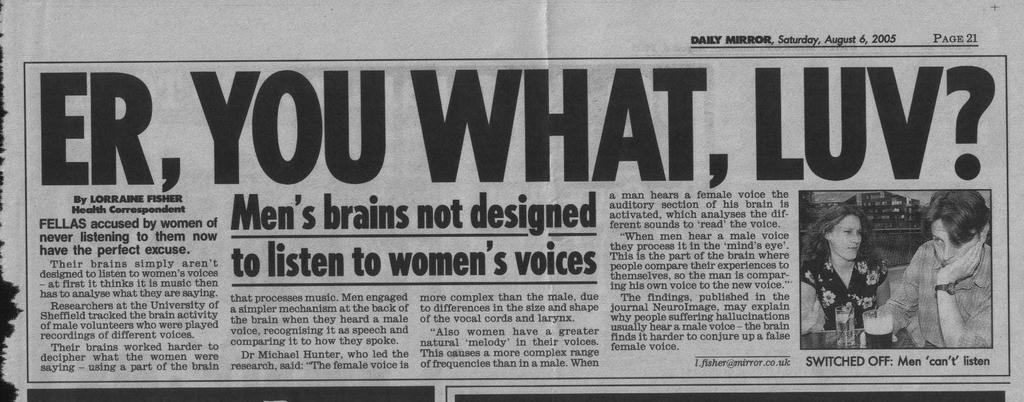
According to new research from Sheffield University, men's brains are not tuned in as accurately to the sounds of female speech as they are to those of other males. Needless to say, this has given many unreconstructed blokes a scientific reason not to listen to the women around them ("I can't hear you - it's genetic") and some female commentators like India Knight in The Sunday Times the opportunity to look at how your voice can affect how others take you seriously (or not).
The image file here is from an article in The Daily Mirror a week or so ago, giving a slightly more populist slant on the whole issue.
Useful for:
ENA3 Male and Female conversation
The image file here is from an article in The Daily Mirror a week or so ago, giving a slightly more populist slant on the whole issue.
Useful for:
ENA3 Male and Female conversation
BBC Voices
The BBC is running a week-long series of programmes from August 20, as part of its Voices series, which looks at different accents, dialects and all manner of varieties of English across the British Isles.
The last series was a great resource for any budding linguists and allowed huge numbers of people to get involved and talking about their own use of English. This time round looks just as good, and the broadsheets have already started running articles on youth slang and dialect revival which link to the series and the issues covered in it. The main BBC Voices site contains a wealth of information and views on the way we speak and is a brilliant resource.
Meanwhile, The Daily Mirror's coverage of Voices consists of a cartoon dialect map of Britain, reproduced below (full version on Englang@SFX Resource site):

Useful for:
ENA5 Language Varieties and Language Change
The last series was a great resource for any budding linguists and allowed huge numbers of people to get involved and talking about their own use of English. This time round looks just as good, and the broadsheets have already started running articles on youth slang and dialect revival which link to the series and the issues covered in it. The main BBC Voices site contains a wealth of information and views on the way we speak and is a brilliant resource.
Meanwhile, The Daily Mirror's coverage of Voices consists of a cartoon dialect map of Britain, reproduced below (full version on Englang@SFX Resource site):
Useful for:
ENA5 Language Varieties and Language Change
Wednesday, August 10, 2005
Bloodlines
The fascinating series The Slavery Business is still running on BBC2, and the BBC website linked to the programme is a great resource for social historians, but one particular part of it is especially of interest to linguists, and indeed anyone interested in the crossover of history, race and language.
In an article on the history of his own family, Dr Robert Beckford of Birmingham University looks at the origins of his surname and how he came to be "branded" with the slaveowner's name.
The article is well worth a read and also reminds me of how at a previous college with a largely white intake, it was fairly straightforward and uncontentious to look at the histories of family surnames, linking them to areas of the country, geographical features ("Cliff" or "Rivers") or even physical characteristics ("Fox" often meaning red-haired), but how, when moving to work at a much more racially mixed college, the whole discussion became much more sensitive.
Beckford's article (like the whole series) is a timely reminder about the legacy of slavery and its impact on the world today.
In an article on the history of his own family, Dr Robert Beckford of Birmingham University looks at the origins of his surname and how he came to be "branded" with the slaveowner's name.
The article is well worth a read and also reminds me of how at a previous college with a largely white intake, it was fairly straightforward and uncontentious to look at the histories of family surnames, linking them to areas of the country, geographical features ("Cliff" or "Rivers") or even physical characteristics ("Fox" often meaning red-haired), but how, when moving to work at a much more racially mixed college, the whole discussion became much more sensitive.
Beckford's article (like the whole series) is a timely reminder about the legacy of slavery and its impact on the world today.
New words - again
The latest edition of the Oxford Dictionary is out and the usual media coverage accompanies it. An article on the BBC website, draws attention to the range of new blends such as Lollywood (the Pakistani version of Bollywood, which combines the -wood part of Hollywood and the L standing for Lahore), podcast ( a blend of I-Pod and broadcast) and chugger (charity + mugger).
The full article is here and there are more in the rest of the national press, such as The Guardian's take on it here.
The Daily Mirror meanwhile covers it here, choosing to focus on the trend towards more derogatory words than complimentary ones. Fans of Julia Stanley's research into lexical over-representation (more derogatory terms for women than men in the English language) may be interested to see that, according to The Mirror "There are 50 words for pretty women, such as babe, cutie and eye-candy with just 20 for hunky men".
Meanwhile, if podcasting is so last year for you, you can now get Godcasting: spiritually-themed podcasts. More on this here.
Useful for:
ENA5 - language change (esp. contemporary language change essay topic)
The full article is here and there are more in the rest of the national press, such as The Guardian's take on it here.
The Daily Mirror meanwhile covers it here, choosing to focus on the trend towards more derogatory words than complimentary ones. Fans of Julia Stanley's research into lexical over-representation (more derogatory terms for women than men in the English language) may be interested to see that, according to The Mirror "There are 50 words for pretty women, such as babe, cutie and eye-candy with just 20 for hunky men".
Meanwhile, if podcasting is so last year for you, you can now get Godcasting: spiritually-themed podcasts. More on this here.
Useful for:
ENA5 - language change (esp. contemporary language change essay topic)
Tuesday, August 09, 2005
VJ Day
To coincide with the 60th anniversary of VJ Day and the dropping of the atom bomb on Hiroshima, The Daily Mirror is reprinting its front covers from editions at the time.
They're interesting as pieces of history in their own right, but would make a very good project for analysis of Language Change. I've scanned and saved two of the pages onto the resources website here in case anyone is interested in looking at them and working on them.
They're interesting as pieces of history in their own right, but would make a very good project for analysis of Language Change. I've scanned and saved two of the pages onto the resources website here in case anyone is interested in looking at them and working on them.
Thursday, August 04, 2005
Dick and Dom destroy kids' lives!
A report in last week's Independent confirms the worst fears of parents across the country: Dick and Dom in da Bungalow is indeed the work of the dark lord, Satan. Or at least that's how it appears to 76 year-old Joyce Watts, of non-striking (and slightly loony, right wing) teachers' union, the P.A.T.!
According to the Mrs Watts, "Presenters who say "yeah" instead of "yes" and "nar" instead of "no" throughout children's favourite programmes make it much harder for teachers and parents to enforce the correct pronunciation"
And just to show how in touch with the times she is, Watts goes on argue that "The pendulum has swung from the BBC English of the Fifties ... and we have seen a growth in the incorrect use of grammar. Today's heroes are Rodney andDel 9pm watershed."
Read the full article here for the true horror of these dinosaurs' ramblings.
According to the Mrs Watts, "Presenters who say "yeah" instead of "yes" and "nar" instead of "no" throughout children's favourite programmes make it much harder for teachers and parents to enforce the correct pronunciation"
And just to show how in touch with the times she is, Watts goes on argue that "The pendulum has swung from the BBC English of the Fifties ... and we have seen a growth in the incorrect use of grammar. Today's heroes are Rodney and
Read the full article here for the true horror of these dinosaurs' ramblings.
Tuesday, August 02, 2005
Normalisation
The recent announcement of an end to the "armed struggle" in Northern Ireland/ 6 Counties (word choice depends on your political outlook) has led to some interesting terms being bandied about by a range of people. Many of these are fascinating to look at because of their inventive morphology, but others are just interesting for their clear intention to hide real meaning and obfuscate the truth.
Take "normalisation" for example: ostensibly this is a term to describe the process of make life normal in Northern Ireland, but why "normalisation" (the "isation" suffix suggesting it's a noun describing the process of making normal)? Why not "renormalisation" suggesting that it's a process of returning life to normal? Or would that suggest life has ever been normal?
Then there's "demilitarisation": its root word word seems to be "military", and then you've got "militarise" (to turn into having military qualities), "militarisation" (the process of turning something into having military qualities) and finally "demilitarisation" (the opposite of this process). So what if you're like the Rev Ian Paisley and opposed to this (and well, everything else by the sound of it...), then you might be an "antidemilitarisationist". I could think of other, shorter, words to describe him but this is a family (sorry, college) blog!
And how about "jihadist" or "jihadi"? What a great combination of loan words and morphological madness. Jihad (from the Arabic "to exert or struggle") is given an English twist with the addition of the "-ist" suffix (meaning someone who "does jihad") or an Italian twist (I might be wrong) with the "-i" suffix. On top of that, there's been a semantic shift among many users to specifically denote "jihad" as some kind of violent struggle, while others cling to its more metaphorical meaning. Meanwhile the Arabic language actually has a word for this type of person "Mujahid" (according to the ever-helpful Wikipedia online encyclopedia). Again, I can think of many other, shorter and much ruder, words to describe such demented fundamentalists but once again, family blog and all that ...
All this is before we even get onto the subject of the word "terrorist" and what it means. "Freedom fighter"? "Member of teh armed struggle against an oppressive regime"? "Murderer"?
I suppose what this goes to show is that our language is flexible enough to chop and change words, with prefixes, suffixes and even infixes, as well as pilfering them from other languages. One loan word I find hard to get my head round is "alcohol", which is apparently taken from Arabic again. But considering that Muslims don't drink, I can't see how we got it. But of course, very thankful to them for letting us "borrow" it.
Take "normalisation" for example: ostensibly this is a term to describe the process of make life normal in Northern Ireland, but why "normalisation" (the "isation" suffix suggesting it's a noun describing the process of making normal)? Why not "renormalisation" suggesting that it's a process of returning life to normal? Or would that suggest life has ever been normal?
Then there's "demilitarisation": its root word word seems to be "military", and then you've got "militarise" (to turn into having military qualities), "militarisation" (the process of turning something into having military qualities) and finally "demilitarisation" (the opposite of this process). So what if you're like the Rev Ian Paisley and opposed to this (and well, everything else by the sound of it...), then you might be an "antidemilitarisationist". I could think of other, shorter, words to describe him but this is a family (sorry, college) blog!
And how about "jihadist" or "jihadi"? What a great combination of loan words and morphological madness. Jihad (from the Arabic "to exert or struggle") is given an English twist with the addition of the "-ist" suffix (meaning someone who "does jihad") or an Italian twist (I might be wrong) with the "-i" suffix. On top of that, there's been a semantic shift among many users to specifically denote "jihad" as some kind of violent struggle, while others cling to its more metaphorical meaning. Meanwhile the Arabic language actually has a word for this type of person "Mujahid" (according to the ever-helpful Wikipedia online encyclopedia). Again, I can think of many other, shorter and much ruder, words to describe such demented fundamentalists but once again, family blog and all that ...
All this is before we even get onto the subject of the word "terrorist" and what it means. "Freedom fighter"? "Member of teh armed struggle against an oppressive regime"? "Murderer"?
I suppose what this goes to show is that our language is flexible enough to chop and change words, with prefixes, suffixes and even infixes, as well as pilfering them from other languages. One loan word I find hard to get my head round is "alcohol", which is apparently taken from Arabic again. But considering that Muslims don't drink, I can't see how we got it. But of course, very thankful to them for letting us "borrow" it.
Monday, August 01, 2005
Back to the future...
Two news stories about "classic" English literary icons appear on the BBC website this week. In one story, it's reported that the Globe Theatre are due to perform an "authentic dialect" version of Shakespeare's Troilus and Cressida, while in a second story, a Canadian rapper (yes, there's more than just that terrible Snow bloke of "Informer" fame) claims to be performing rap versions of some of Chaucer's greatest Canterbury Tales.
Why? While it's fascinating to see how many times these classics can be recycled for different audiences, and exciting for those of us who're fans of both great writers, it seems a touch desperate to keep trying to flog the traditional English literary canon to us year after year, century after century. They may be great stories which can be re-told time and again, but aren't there more relevant ways of telling stories to young (and old) people in the 21st Century?
Much of this coincides with a debate going on about the future of English teaching at the moment. The government has set up a project called English 21 which apparently seeks input from teachers, students and anyone interested in English as a subject. Whether it listens to those contributions or becomes yet another New Labour consultation exercise (tell us what you think and if we don't like it we'll ignore it) remains to be seen.
But with an ever-changing language creating its own new forms of communication, and fewer and fewer young people reading the "classics" of English literature, is there really a place for literature at the heart of English teaching any more?
Much as I love to read Chaucer and Shakespeare (and even - occasionally - watch one of his plays) I can't personally see the need to insist on Shakespeare plays being part of the the GCSE syllabus for English. In fact, I can't really see a good argument for insisting that any of "the greats" of English Lit are taught at all at GCSE. After all, what's the point of trying to teach what is essentially a foreign language (Early Modern English of the 1600s) to 15 and 16 year olds today, when many of them struggle with Standard English in its written form, or don't speak Standrad English as a first language anyway?
I'd be interested to know what your views are on this subject. And I'd also be interested to hear what you think of my latest effort at turning the Miller's Tale into rap. Please imagine this is performed in a Tim Westwood stylee:
"Fo shnizzle my nizzle", cried the student to the ho
Who was sticking her big ass out the open window.
So he climbed the ladder with a rat-a-tat-tat,
Perchance to get Medieval like a spitting gat
But as he closed his eyes and assumed the position,
Alisoun's butt went on a mission,
And Absoloun's dreams of being in da club
Flopped as she gave his face a rub...
But of course, as our new favourite Canadian rapper, Baba Brinkman says, some scenes have had to be toned down for a young audience. So, if you want the full, rude version of Geoffrey Chaucer's Miller's Tale, have a look on google. Key words: Miller Chaucer fart window face
Why? While it's fascinating to see how many times these classics can be recycled for different audiences, and exciting for those of us who're fans of both great writers, it seems a touch desperate to keep trying to flog the traditional English literary canon to us year after year, century after century. They may be great stories which can be re-told time and again, but aren't there more relevant ways of telling stories to young (and old) people in the 21st Century?
Much of this coincides with a debate going on about the future of English teaching at the moment. The government has set up a project called English 21 which apparently seeks input from teachers, students and anyone interested in English as a subject. Whether it listens to those contributions or becomes yet another New Labour consultation exercise (tell us what you think and if we don't like it we'll ignore it) remains to be seen.
But with an ever-changing language creating its own new forms of communication, and fewer and fewer young people reading the "classics" of English literature, is there really a place for literature at the heart of English teaching any more?
Much as I love to read Chaucer and Shakespeare (and even - occasionally - watch one of his plays) I can't personally see the need to insist on Shakespeare plays being part of the the GCSE syllabus for English. In fact, I can't really see a good argument for insisting that any of "the greats" of English Lit are taught at all at GCSE. After all, what's the point of trying to teach what is essentially a foreign language (Early Modern English of the 1600s) to 15 and 16 year olds today, when many of them struggle with Standard English in its written form, or don't speak Standrad English as a first language anyway?
I'd be interested to know what your views are on this subject. And I'd also be interested to hear what you think of my latest effort at turning the Miller's Tale into rap. Please imagine this is performed in a Tim Westwood stylee:
"Fo shnizzle my nizzle", cried the student to the ho
Who was sticking her big ass out the open window.
So he climbed the ladder with a rat-a-tat-tat,
Perchance to get Medieval like a spitting gat
But as he closed his eyes and assumed the position,
Alisoun's butt went on a mission,
And Absoloun's dreams of being in da club
Flopped as she gave his face a rub...
But of course, as our new favourite Canadian rapper, Baba Brinkman says, some scenes have had to be toned down for a young audience. So, if you want the full, rude version of Geoffrey Chaucer's Miller's Tale, have a look on google. Key words: Miller Chaucer fart window face
Potty-mouthed parrots and muthafunking madonnas
Following on from the articles about swearing last month, here are two more pieces (from The Times online) about outbreaks of swearing in polite society.
Firstly, there's the foul-mouthed parrot, Barney, who's been in trouble for swearing at the local vicar and police officers. And then there's another old bird (sorry), Madonna, whose recent outburst of swearing during her afternoon performance at Live 8 caused many a maiden aunt to clutch their pacemakers and get up to "make a cup of tea" for a few minutes.
While both are silly stories, there's perhaps some mileage to be gained from looking at the response to swearing from different groups in society (parents, children, media) and the importance of context in each of these cases.
Firstly, there's the foul-mouthed parrot, Barney, who's been in trouble for swearing at the local vicar and police officers. And then there's another old bird (sorry), Madonna, whose recent outburst of swearing during her afternoon performance at Live 8 caused many a maiden aunt to clutch their pacemakers and get up to "make a cup of tea" for a few minutes.
While both are silly stories, there's perhaps some mileage to be gained from looking at the response to swearing from different groups in society (parents, children, media) and the importance of context in each of these cases.
Parrot placed in solitary for swearing at vicar
By Jenny Booth, Times Online
A foul-mouthed parrot who stands on top of his cage shouting rude words at passers-by has been isolated after swearing at the mayoress, a lady vicar and two police officers.
Stacey Clark, who works at Warwickshire Wildlife Sanctuary in
"We don't know who taught him the words, but he seems to have a problem with authority figures," said Ms Clark.
"When he saw the policemen coming, he said: 'Hello, you two w*****s'. He told the mayoress and the lady vicar to f*** off. He stands on the top of his cage swaying his head backwards and forwards, singing 'B*****ks', "B*****ks'."
Normally Barney flaps around in a pen in the back
But Ms Clark said that Barney had now been locked in the front room to keep him away from visitors to the sanctuary after the incidents. He was still shouting abuse at people through the window.
"The lady vicar came to borrow a bird cage, because she was preaching a sermon about the birds," she explained. "She was speaking to Barney really nicely when he said 'F*** off', clear as a bell, so you could tell exactly what he was saying. The vicar was a bit shocked but luckily she didn't mind. She even put it in her sermon on Sunday, saying she had never been told where to go by a parrot before."
Ms Clark said that Barney seemed to know what he was saying as he always picked the wrong person to insult.
"He always swears when you don't want him to," she said. "But when BBC West Midlands came round to film him, he point blank refused to say it. The reporter repeated it to him over and over and over, and he wouldn't say it back to her, so I think he knows.
"I can't wait to hear what he says when he sees himself on television tonight."
*!@**! Where did that come from?
Unexpected swearing incidents are breaking out all over mainstream songs. Giles Hattersley asks the producers why
As if it were not difficult enough to protect children from video games, fatty foods and athlete’s foot, parents have a new problem to confront. Unexpected Swearing Incidents (USIs) seem to occur with worrying frequency. They can surprise you in the car or the comfort of your home and the worst always end with someone in Boden dungarees asking, “Daddy, what’s a motherf*****?”
Nobody could claim to be surprised by popular music’s desire to be outré. Elvis, the Who and the Sex Pistols certainly pushed some buttons. Hell, even Brian Wilson raised eyebrows when he dug a French bikini on California Girls. But latterly the frisson of a rare rude song has been eclipsed by a taste-crushing onslaught of sexually explicit, violence-promoting popular music so pervasive that four-letter foes are turning up in places they never used to.
Wednesday morning and I am in a music shop. As it’s the summer holidays, and raining, a few 9 to 13-year-olds are browsing the plastic racks, killing time discussing this rapper or that pop babe.
“Wicked fit” is the consensus on Cheryl Tweedy of Girls Aloud, whose leathers and suggestive stare would make a yummy mummy blanch. “Crazy tough” is the verdict on 50 Cent, the world’s biggest rap star, whose bullet-scarred torso adorns the cover of his album Get Rich or Die Tryin’.
Despite such temptations, a well turned out 10-year-old girl instead splurges £1.99 on James Blunt’s sweet bestseller Beautiful. Unlike Tweedy or 50, Blunt, a wan-looking Old Harrovian, does not seem the type that parents need to worry about. His hair may be a little longer than necessary, but at least he is free of piercings. They might even buy his album themselves.
She skips to a waiting car where, I imagine, mum, eager to assert her grooviness, will pop Beautiful into her Volvo estate’s CD player. The gentle love song will wash over them, she will think how nice it is to share such moments, then over the speakers will come: “Yes she caught my eye as I walked on by. She could see from my face that I was f****** high.”
Bang — USI! The only question is: who is squirming more? “This is why I never let my
Kate Fielder, a
“I had the same thing when we were watching Live 8,” says Liz Johncox, 44. “Madonna said f*** on the BBC in the middle of the afternoon. Here’s this woman, who’s my age by the way, swearing during a charity concert.” Johncox tried to explain to her eight-year-old that saying “f***” at home was not on. “She said, ‘Why not, mum? Madonna does.’”
Of the 100 most downloaded songs on the internet last week, one in six contained explicit lyrics. In the record shop Charlie’s friend Anna says, “The rudest thing I’ve bought was Khia.” It takes some persuading to get her to tell me how it goes. Finally the 13-year-old rappily sings, starting, “Right now, lick it good . . .” followed by a lyric too shocking to repeat.
How did this stuff get into the mainstream? “When we compare music today to the past, we can see there is now a total lack of self- censorship,” says Professor Franco Fabbri from
Simon Frith, chairman of the Mercury music prize, agrees: “Even five years ago I think a record company might have told James Blunt he would have to edit (the bad language), because otherwise people will complain about it.
“The fact they no longer think that necessary does tell you something. The Streets, for example, write songs that sound like conversations, and if everyday conversation includes more swearing, then that will be reflected in the music.”
Theories are not much use to overloaded parents who are too busy to police their children’s record collections. Helen Whitehead, a 46-year-old mother of two, works full time and worries more about school work than tastes in pop: “They download music for free off the internet, burn it on CDs and listen to it on headphones and I never know what goes on. I only ever get suspicious when they buy a CD and it’s got a parental warning sticker on it.”
British law has it that children of any age may buy any music CD they like. Record companies are advised by the British Phonographic Industry (BPI) to put parental advisory stickers on material with explicit content, but it is not compulsory. Even when they do feel like it, a four-year-old is free to walk into HMV and buy any stickered Blink-182 album (sample lyric begins “s*** p*** f***).
“That’s mad, isn’t it?” says Frith. “Music has never been subjected to the same kind of censorship as film.” In Borders only last week, Eminem’s Marshall Mathers LP could be bought by toddlers, but if you want to see him perform the same songs on his Anger Management DVD, you need to be 15.
“They’re very different mediums,” says Steve Redmond of the BPI when I raise this. So it is okay for four-year-olds to experience Reservoir Dogs if they throw a tablecloth over their television set?
That parents dread what their children listen to is nothing new. What has changed is their involvement in a shared culture with their kids. In the same way that fathers and sons will both be reading Harry Potter this week, they might both be listening to the Red Hot Chili Peppers.
“We do listen to some of the same music,” says Brian Allen, a 41-year-old father of three. “But lots of it has bad language that I wouldn’t let my youngest listen to, though.” This did not stop the five-year-old saying “s***” — he had heard it on his brother’s stereo.
Frith believes that modern music suffers for the inclusion of thoughtless vulgarity: “The songs become less interesting when language is no longer used in an inventive way. In a time when people couldn’t use bad language freely, they had to be much more imaginative with metaphors and word games.”
Frith and Fabbri think we can expect more artists to resort to bad language. Meanwhile the record industry, claiming that you encounter worse on Big Brother, will continue to insist that children — their biggest market — should listen to whatever filth they like.
Saturday, July 23, 2005
Birds'n'words?
An article on the University of Toronto website points towards young women being trendsetters in language change. According to Professor Sali Tagliamonte "women lead the change" when it comes to new slang terms and that girls' language changes as they grow older to include more terms such as "like", "so" and "just".
But is this true? And if it is true, is it down to the fact that these expressions gain some sort of cultural currency that doesn't apply to male slang (often so coarse and vulgar as to never make it into respectable print, apparently)?
Perhaps it goes deeper and it's down to the fact that these terms are actually useful, often serving as adverbials, intensifying or diminishing effects of verbs or adjectives, or allowing speakers to relate more accurately how someone else has spoken. But, like, whatever...
article
But is this true? And if it is true, is it down to the fact that these expressions gain some sort of cultural currency that doesn't apply to male slang (often so coarse and vulgar as to never make it into respectable print, apparently)?
Perhaps it goes deeper and it's down to the fact that these terms are actually useful, often serving as adverbials, intensifying or diminishing effects of verbs or adjectives, or allowing speakers to relate more accurately how someone else has spoken. But, like, whatever...
article
Wednesday, July 20, 2005
Blogs, podcasts and camera phones
An article in today's Guardian heralds a new era of "consumers" like you and me changing the way we communicate and access information through the new technologies of Blogs (like what you're reading now), podcasts (you'd better read it, as I'm a bit slow on this and my MP3 stores a grand total of 30 tracks, all of them angst-rock and stuff I should have grown out of when I was 15) and camera phones (I have one and can even use it!).
Is this technology really transforming the way we communicate or are we being duped by big business into thinking that the more new gadgets we buy, the more cutting edge we are? It's a tricky one. David Crystal in this link on the Bangor University website and in this longer article seems to think language is changing because of technologies like the internet, and I'm not going to argue with him (after all, he has a beard and looks like God) but not only changing English, but preserving smaller, threatened languages by creating a virtual community for users of that language.
But is this change for the better or is our language shifting into a new era of laziness and ambiguity? Sounds like the prescripitivist vs. descriptivist debate all over again...
Useful for:
ENA5 Language Change (esp. essay question on Contemporary Language Change, attitudes towards language change, influence of technology on language change)
ENA6 Language Debates (attitudes towards language change)
EA4C Language Investigation (how different styles of language are used on the internet, the language of texting, the language of discussion boards/chatsites/MSN etc)
Is this technology really transforming the way we communicate or are we being duped by big business into thinking that the more new gadgets we buy, the more cutting edge we are? It's a tricky one. David Crystal in this link on the Bangor University website and in this longer article seems to think language is changing because of technologies like the internet, and I'm not going to argue with him (after all, he has a beard and looks like God) but not only changing English, but preserving smaller, threatened languages by creating a virtual community for users of that language.
But is this change for the better or is our language shifting into a new era of laziness and ambiguity? Sounds like the prescripitivist vs. descriptivist debate all over again...
Useful for:
ENA5 Language Change (esp. essay question on Contemporary Language Change, attitudes towards language change, influence of technology on language change)
ENA6 Language Debates (attitudes towards language change)
EA4C Language Investigation (how different styles of language are used on the internet, the language of texting, the language of discussion boards/chatsites/MSN etc)
Brain sex
No, not a dyslexic Westlife fan's lustful desires (Brain - Brian - geddit? Oh dear...) but the catchy title given to the BBC's new webpages based on their Secrets of the Sexes series.
The first programme in the series focussed on the differences between how men and women responded emotionally and linguistically to a whole series of stimulae, and proved interesting for those of us who like to look at how gender influences communication. According to the programme, men and women often use completely different parts of the brain when processing words, and even "hear" words differently when two sounds are sent through different channels on headphones.
So is it all in our genes - and maybe our jeans - or can we break the mould and behave in other ways? It's worth thinking about all of this in the context of Roehampton University professor, Jennifer Coates's, most recent book Men Talk. She set out to explore how men communicate with each other (following on from her earlier book, Women Talk) and found that men from all social backgrounds and age groups tended to fulfil the stereotypes that are expected of us: competitive; bantering over topics like beer, sex and actions of dubious legality; and unwilling to share emotions openly unless with very close friends.
So are we bound by our genes or is it a matter of socialisation? Jennifer Coates also looked at this in an earlier study of how boys and girls pick up gendered characteristics in their speech very early on in their lives (I think it can be found in A Feminist Critique of Language).
For some light relief, you could also have a look at the other episodes of the BBC series which will cover attraction and love, including the importance of language (body language and spoken language) in flirting (or "chirpsing" as I believe some young whippersnappers in south London call it).
Hubba hubba.
Useful for:
ENA3 Gender & Spoken Language
ENA6 Language Debates (male and female communication)
EA4C Language Investigation (lots of good possibilities for investigations into how men and women "perform" - or flout - their gender identities in conversations, in their writing etc. )
The first programme in the series focussed on the differences between how men and women responded emotionally and linguistically to a whole series of stimulae, and proved interesting for those of us who like to look at how gender influences communication. According to the programme, men and women often use completely different parts of the brain when processing words, and even "hear" words differently when two sounds are sent through different channels on headphones.
So is it all in our genes - and maybe our jeans - or can we break the mould and behave in other ways? It's worth thinking about all of this in the context of Roehampton University professor, Jennifer Coates's, most recent book Men Talk. She set out to explore how men communicate with each other (following on from her earlier book, Women Talk) and found that men from all social backgrounds and age groups tended to fulfil the stereotypes that are expected of us: competitive; bantering over topics like beer, sex and actions of dubious legality; and unwilling to share emotions openly unless with very close friends.
So are we bound by our genes or is it a matter of socialisation? Jennifer Coates also looked at this in an earlier study of how boys and girls pick up gendered characteristics in their speech very early on in their lives (I think it can be found in A Feminist Critique of Language).
For some light relief, you could also have a look at the other episodes of the BBC series which will cover attraction and love, including the importance of language (body language and spoken language) in flirting (or "chirpsing" as I believe some young whippersnappers in south London call it).
Hubba hubba.
Useful for:
ENA3 Gender & Spoken Language
ENA6 Language Debates (male and female communication)
EA4C Language Investigation (lots of good possibilities for investigations into how men and women "perform" - or flout - their gender identities in conversations, in their writing etc. )
Wednesday, July 13, 2005
Straight from the heart
It's difficult to know how to approach something as horrific as last week's bombings in London, or today's news of 24 children killed in Baghdad in a terrorist attack, so the article linked to below contains one person's attempt to make sense of it all.
In it is the transcript of the speech given by Marie Fatayi-Williams, whose son Anthony has probably died in the bus bomb, and comment by Tim Collins, the British army colonel who himself gave a powerful speech on the eve of the Iraq war. From a linguistic point of view, looking at the differences in the two speeches gives us a chance to see the variety of emotions and ideas that can be expressed through different rhetorical styles, ideolects and motivations; on a political level it's maybe grimly ironic that the war that followed the speech by Tim Collins could be one of the main reasons why suicide bombers are now targetting Britain.
Straight From The Heart
Tim Collins' speech to troops in Iraq
In it is the transcript of the speech given by Marie Fatayi-Williams, whose son Anthony has probably died in the bus bomb, and comment by Tim Collins, the British army colonel who himself gave a powerful speech on the eve of the Iraq war. From a linguistic point of view, looking at the differences in the two speeches gives us a chance to see the variety of emotions and ideas that can be expressed through different rhetorical styles, ideolects and motivations; on a political level it's maybe grimly ironic that the war that followed the speech by Tim Collins could be one of the main reasons why suicide bombers are now targetting Britain.
Straight From The Heart
Tim Collins' speech to troops in Iraq
Monday, July 11, 2005
It is big and it is clever
As a teenager, I was constantly told off for swearing too much and told, "People who swear are just showing they have a small vocabulary". My own personal response was to prove this wrong and demonstrate that you could swear and have a big vocabulary, so I set out to find as many grossly offensive and fiendishly inventive swearwords as I could. I was helped in my quest by various foul-mouthed friends, Viz comic and the novels of Irvine Welsh. Obviously, I've matured since then and see a place for swearing in particular contexts and at particular moments. Ahem...
So imagine my joy when I discovered research in the British Psychological Society's weekly digest (available free from here), that suggests swearing is actually effective at making people believe what you're saying. The extract is copied below along with a couple of links to sites which look at the history of particular rude words:
Sir Bob Geldof's penchant for the odd swearword or two, might be a shrewder oratory strategy than we realise. Eric Rassin and Simon Van Der Heijden at Erasmus University in The Netherlands report evidence that people are more likely to rate a statement as believable when it contains swearwords.
First Rassin and Van Der Heijden asked 76 students whether they thought the inclusion of swearing in a statement would increase its credibility or reduce it. Forty-six per cent said it wouldn't make any difference, 36 per cent thought it would make a statement less credible, and only 16 per cent thought it would increase a statement's credibility.
But then the researchers asked 70 students to read a fictional account of a statement made by a suspect burglar during a police interview. The 35 students who read the version in which the suspect swore rated his statement as more believable than the 35 students who read a version that was identical in every respect but with the swearwords removed.
In a further study, 54 students read a statement made by an alleged robbery victim. Again, the students who read the version in which the victim swore rated his statements as more believable than the students who read a version without swearwords.
"If one wants to appear more credible, it is recommendable to utter an occasional swearword", the researchers advised.
Links to websites on swearing. Warning! These sites contain foul and abusive language. Look at them only in the spirit of linguistic exploration, not for cheap thrills!
The history of profanity
BBC - origins and common usage of British swear words
Mark Lawson article on Guardian on overuse of profanity
Useful for:
ENA5 Language Change (esp. essay question on Contemporary Language Change)
ENA1 Language and Representation (esp. linguistic reflectionism)
ENA3 Gender & Spoken Language
ENA6 Language Debates (attitudes towards language change, debates about language and society)
EA4C Language Investigation (students have done very good pieces of coursework on swearing, attitudes towards it and the histories of particular expressions)
So imagine my joy when I discovered research in the British Psychological Society's weekly digest (available free from here), that suggests swearing is actually effective at making people believe what you're saying. The extract is copied below along with a couple of links to sites which look at the history of particular rude words:
Sir Bob Geldof's penchant for the odd swearword or two, might be a shrewder oratory strategy than we realise. Eric Rassin and Simon Van Der Heijden at Erasmus University in The Netherlands report evidence that people are more likely to rate a statement as believable when it contains swearwords.
First Rassin and Van Der Heijden asked 76 students whether they thought the inclusion of swearing in a statement would increase its credibility or reduce it. Forty-six per cent said it wouldn't make any difference, 36 per cent thought it would make a statement less credible, and only 16 per cent thought it would increase a statement's credibility.
But then the researchers asked 70 students to read a fictional account of a statement made by a suspect burglar during a police interview. The 35 students who read the version in which the suspect swore rated his statement as more believable than the 35 students who read a version that was identical in every respect but with the swearwords removed.
In a further study, 54 students read a statement made by an alleged robbery victim. Again, the students who read the version in which the victim swore rated his statements as more believable than the students who read a version without swearwords.
"If one wants to appear more credible, it is recommendable to utter an occasional swearword", the researchers advised.
Links to websites on swearing. Warning! These sites contain foul and abusive language. Look at them only in the spirit of linguistic exploration, not for cheap thrills!
The history of profanity
BBC - origins and common usage of British swear words
Mark Lawson article on Guardian on overuse of profanity
Useful for:
ENA5 Language Change (esp. essay question on Contemporary Language Change)
ENA1 Language and Representation (esp. linguistic reflectionism)
ENA3 Gender & Spoken Language
ENA6 Language Debates (attitudes towards language change, debates about language and society)
EA4C Language Investigation (students have done very good pieces of coursework on swearing, attitudes towards it and the histories of particular expressions)
Tuesday, July 05, 2005
Forked tongues
A new book, reviewed in The Observer at the weekend, gives an account of how languages develop over time and why certain patterns always seem to emerge.
Language change is a topic that allows us to look at the origins and devlopment of English (and other languages) tracing the roots of the language, but it also allows us to see why the language is changing. Some theorists believe that the language is constantly altering to make it more streamlined, while others point to a degeneration in language over time (again, a bit like Aitchison's "Crumbling Castle" model of language) , but a more radical suggestion is that language has a parasitic relationship with humans and has evolved alongside us, constantly adapting to allow itself to be passed on through generations. Spooky stuff...and not something that Deutscher in his book, The Unfolding of Language, looks at in the review below, but an idea you'll find in a book called The Symbolic Species by Terence Deacon (reviewed here and here).
Forked tongues
Saturday July 2, 2005
by Guy Deutscher
360pp, William Heinemann, £20
Language change is a topic that allows us to look at the origins and devlopment of English (and other languages) tracing the roots of the language, but it also allows us to see why the language is changing. Some theorists believe that the language is constantly altering to make it more streamlined, while others point to a degeneration in language over time (again, a bit like Aitchison's "Crumbling Castle" model of language) , but a more radical suggestion is that language has a parasitic relationship with humans and has evolved alongside us, constantly adapting to allow itself to be passed on through generations. Spooky stuff...and not something that Deutscher in his book, The Unfolding of Language, looks at in the review below, but an idea you'll find in a book called The Symbolic Species by Terence Deacon (reviewed here and here).
Forked tongues
Deborah Cameron on Guy Deutscher's account of linguistic evolution, The Unfolding of Language
Deborah CameronSaturday July 2, 2005
Observer
The Unfolding of Languageby Guy Deutscher
360pp, William Heinemann, £20
"Language seems so skilfully crafted," writes Guy Deutscher, "that it appears to be the work of a master architect - and yet its complex structure must somehow have arisen of its own accord." Nobody ever invented human language: its structures are not the result of any purposeful design. The aim of this book is to explain how, in the absence of any architect or plan, complex linguistic systems develop.
Although there is no master plan driving the process, it is clear that language change is a universal phenomenon, and patterned rather than random: certain kinds of changes recur in widely separated languages. Deutscher seeks to explain the underlying principles at work here, drawing on evidence from both real and reconstructed "proto" languages. He also seeks to show how those principles could account for a much earlier development, one linguists can only speculate about, since if it happened it took place so far back in prehistory as to be beyond reconstruction - the formation of human languages as we know them from the simpler systems that were their hypothetical precursors.
Deutscher imagines what he dubs a "Me Tarzan" stage of linguistic evolution, when humans communicated using a small number of words and some basic rules for ordering them, and applies what we know about language change to explain how such a "primitive" system might have acquired the complexity that is evident in even the oldest languages known to scholarship.
In fact, the most ancient languages for which we have records often look more grammatically complex than their modern descendants: think of Latin, with its profusion of case endings, compared with modern Italian or French. This observation led earlier scholars to argue that language change was essentially degeneration. August Schleicher declared in 1850: "The further back we can follow a language, the more perfect we find it ... languages as such go backwards." But more recent scholarship has rejected this view on the grounds that decay and renewal, creation and destruction, are two sides of a single coin: the same mechanisms are responsible for both.
Case endings, for instance, may be lost because of the tendency of speakers to follow an "economy" or "least effort" principle, lopping off final syllables or pronouncing them so indistinctly as to obscure whatever grammatical information they contain. In saving themselves the effort of pronouncing their endings clearly, speakers effectively destroy the case system. But as Deutscher explains, it was the same kind of laziness that created case endings in the first place. These endings were originally separate words, called postpositions (like prepositions, but placed after rather than before nouns). Speakers following the "least effort" principle simply fused postpositions with their preceding nouns, reducing two words (like "house to") to one ("house [dative]").
But if the principle of least effort were all there was to language change, we would presumably end up communicating in monosyllabic grunts. The reason this doesn't happen is that there are countervailing tendencies, among them what Deutscher calls the principle of expressiveness, the drive to extend a language's communicative range. One typical manifestation of this is the metaphorical use of concrete terms in more abstract senses. For instance, everyday discourse is full of body-part terms applied to concepts other than the body itself: we meet the "head of department", get to the "heart of the matter" and travel to the "back of beyond".
Expressiveness also lies behind the tendency to elaborate commonplace words and phrases in a bid to give them emphasis or freshness. Then, as the elaborated forms themselves become commonplace, the whole cycle begins again. Deutscher gives the example of the French word "aujourd'hui" ("today"). "Hui" is a reduced form of the Latin word "hodie", itself reduced from "hoc die", "this day". So "aujourd'hui" literally means "on the day of this day". But just as "hui" seemed insufficiently expressive to their ancestors, who added "au jour de", so present-day French speakers, unaware of its history, have become dissatisfied with the fused form "aujourd'hui". In colloquial speech people have started saying "au jour d'aujourd'- hui" - "on the day of on the day of this day".
The other principle Deutscher discusses is analogy, a tendency to create order by tidying up exceptions, anomalies and irregularities. In English, for instance, there are two kinds of verbs: "strong" ones which make past tenses by changing the vowel ("drink/drank") and "weak" ones which mark past tenses with the ending -ed. Since in modern English the weak type is commoner, it is not unusual for speakers to start putting weak past tense endings on historically strong verbs - saying "dreamed" instead of "dreamt", for instance. But the opposite may also happen: an example is the weak verb "dive", which has recently developed a strong past tense form, "dove", presumably on the analogy of "drive/drove". This illustrates the point that there is no overall design driving language change.
The subject matter of Deutscher's book is well chosen to engage a non-specialist audience, and his presentation is generally lucid. I was slightly disappointed by certain omissions: he does not discuss the role of social motivations in advancing or inhibiting change, nor - except in a footnote disputing their relevance - the auxiliary languages, jargons and pidgins, whose development might offer concrete historical evidence about the growth of grammatical complexity.
But my real reservations are more about manner than matter. A popular book on an academic subject must speak to the lay reader, but without talking down: Deutscher seems to find this a struggle. In his efforts to be entertaining he sometimes comes across as patronising. When he explains the principle of economy - scarcely a concept you need a degree in linguistics to grasp - by inventing little fables about the lazy inhabitants of "Idleford" and "Santa Siesta", the effect is laboured. I was also irritated by the prefatory warnings with which he flags certain topics as particularly demanding. We are advised that the Semitic verb "does not make for light bedtime reading", and that a discussion of the origins of syntax will be taxing enough to require special preparation: "So make yourself a strong cup of coffee, and read on."
The Unfolding of Language would be a much better book without these arch distractions; but for readers who want to know what modern scholarship has to say about the development of language, it is still an informative and thought-provoking guide.
· Deborah Cameron is professor of language and communication at Oxford University. To order The Unfolding of Language for £18 with free UK p&p call Guardian book service on 0870 836 0875.
Subscribe to:
Posts (Atom)
Follow EngLangBlog on Bluesky
The old Twitter account has been deleted (because of both the ennazification and enshittification of that site) so is now running on Bluesk...

-
 As part of the Original Writing section of the NEA, students will be required to produce a commentary on their piece. This blog post will pr...
 -
As lots of students are embarking on the Language Investigation part of the Non-Exam Assessment, I thought it might be handy to pick up a fe...
-
I'm on a roll. Nothing from me for ages, then three posts come along! This is a lovely story from the Kenya Times about a dialect called...