Thursday, February 23, 2012

Click here

We've recently been covering children's acquisition of the sounds of English in AS classes, and I made a passing reference to how very young children can make any sound in any language (like the clicks of Xhosa in South Africa) but gradually tune in to their mother tongue as they grow older.

This fascinating post by Julie Sedivy in Discover magazine tells us a lot more about Xhosa and its clicks but also makes a number of interesting points about how we perceive sounds. Sedivy points out that to an outsider, the clicks of Xhosa sound "a bit like highly-skilled beatboxing, mixing recognizeable speech with what sounds like the clacking of objects striking each other". Of course, to a Xhosa speaker, the sounds are as familiar as t,s, and d are to English speakers.


In terms of children's acquisition of sounds, the article raises some good points to consider. We often treat the phonological part of a child's language development as mostly to do with the production of sounds and patterns of "errors" in those sounds (deletion, consonant cluster reduction, deletion of unstressed syllables, for example), at least I know I do when I teach it. But what about how we hear sounds as children and how we process those sounds and create a mental representation of what they mean?

Sedivy tells us that "your brain cares as much about how sounds function in a language than about their actual physical properties, so the same acoustic input can be interpreted very differently by the brain depending on its role in a language", so when toddlers are listening to speech all around them, they're not just parroting or imitating it, but making sense of how sounds are used, where they appear and what they might mean. It's as much to do with fathoming out meanings as it is to do with trying to replicate the production of the sound.

Wednesday, February 22, 2012

Mandarin, language of the future?

Well, probably not, if this BBC article is anything to go by. We're moving on to look at World Englishes soon, so this is a timely reminder of some of the reasons why English is spoken so widely around the world and how it has achieved such success.

Tuesday, February 21, 2012

Toddler talk

Yesterday's Telegraph featured an article about recent research by Leslie Rescorla into children's acquisition of vocabulary in the early years. Rescorla may be familiar to some A level English Language students for her work on acquisition of lexis and semantics and the different categories of over-extension that some children make.

The article takes a look at some of the recent ideas about a child's language environment and how the language used around a child might influence their vocabulary and understanding. It also includes a checklist of some simple words that most children would be using by the time they're 2 years of age.


The 15-year project followed 40 children from privileged backgrounds who were diagnosed as late talkers but were otherwise developing normally.
While most of the children had caught up and developed an average range of vocabulary by four or five they remained slightly behind peers from the same background in vocabulary, grammar and reading throughout their school years, suggesting that their late development of speech had put them at a disadvantage.
The word test devised by Prof Rescorla can be completed in ten minutes and doctors can tell at a glance whether a child's speaking ability is poor for their age.


Personally, I think it discriminates against yokels from Norfolk who would not know many of these, but would probably be able to label several types of tractor.

"Sheffieldish" and more on slang bans

Here's a link to a Sheffield Telegraph article on the recent "slang ban". I would have added it to the last post, but my access to the blog is a bit limited from college.

Friday, February 17, 2012

"This is where moral relativism leads us."

Terence Blacker of The Independent wades unhelpfully into the slang ban row, blaming negative reactions to the proposed "ban" (which didn't really seem to be a ban in the first place) on "moral relativism".

Thursday, February 16, 2012

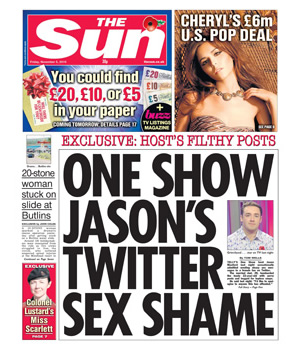
The Sun says


Last night's 10 O'Clock Live show has a really excellent Charlie Brooker poem/polemic (poemic?) about The Sun newspaper, followed by discussion about the language the paper uses. So it's tragic tot, lewd sex act, troubled songbird, trousering the cash, claimed and boasted rather than said, and many others.

They don't do any linguistic analysis on the words themselves, but that's a job for A level students rather than comedians, and there's got to be a language investigation in there somewhere.

You can see it here via 4OD and The Sun section begins at about 5 minutes into the show.

Playground prescriptivism?

A story doing the rounds yesterday suggested that a school in Sheffield was attempting to prevent its students from using slang. It was covered in the local Sheffield Star here, with a reference to one of Sheffield's most famous exports, Sean Bean (aka Boromir , Ned Stark and Sharpe) and in yesterday's Daily Telegraph, Daily Mail and Guardian.

Like many other arguments about language use, this one has become a bit muddied. In this case, the original story about the school - Sheffield Springs Academy - seemed to focus on slang (which might de defined as a type of extremely informal language used by specific groups of people) and a desire on behalf of the school to show its students that different styles of language suit different situations (what linguists often call the notion of appropriacy). However, the reporting of the story also refers to dialect being banned and regional pronunciations being frowned upon, and that's before you chuck in text speak too.

So what is actually happening here and can schools really control what their students say? The story is very similar to one we featured on this blog a few years ago about a school in Manchester which had banned street slang from its classrooms (covered here and in the Radio 4 programme Mind Your Slanguage which featured interviews with some SFX students) so it's perhaps not a big surprise to find that the head of the academy sponsors behind the Sheffield Springs Academy is the woman who was head teacher at the Manchester Academy when it introduced its ban, none other than Kathy August.

Her argument makes some sort of sense and goes something like this, according to the Telegraph report:

What we want to make sure of is that they are confident in using standard English. Slang doesn't really give the right impression of the person.

Youngsters going to interviews for their first job need to make a good impression so that employers have confidence in them. It's not difficult to get youngster out of the habit of using slang.

Mrs August said it was preferable for pupils to say "thank you" instead of the more colloquial "ta", and "goodbye" rather than "see ya".

The trust said its policy on slang was part of its "street stops at the gate" ethos.

It also asks sixth formers to dress in suits rather than school uniform to encourage professionalism.

Mrs August added: "It is about knowing what language is acceptable between friends and what is required in more formal situations.

We want to give each of our students the best start possible; understanding when it is and is not acceptable to use slang or colloquial language is just one part of this. 
So, according to August, it's all about reinforcing the students' grasp of Standard English and code-switching. The problem is - as several of the reports show - who defines what slang and regional dialect are? The references from parents in the Sheffield Star to teachers disliking regional accents and local dialect terms, and the strange notion brought up by August in the Mail's version of the story that "...when youngsters are talking together they use text speak..."(like B4,H8 and BTW? I doubt it...) suggest that there's much confusion over what actually constitutes slang.

This isn't a new confusion, and it's one that the linguist, Paul Kerswill noted in his response to a report on non-standard English in schools.The problem is that if all non-standard forms of English are lumped together there's a risk that the debate itself loses its focus. Are we talking about text speak in spoken conversations? Really? Or are we talking about the ways in which people from Sheffield might say about and right differently to those in the south? If it's slang then there might be a good argument for explaining how it is viewed or understood (or not) outside particular social groups, but there's also a decent argument put forward by Christopher Howse in today's Telegraph (albeit in his usual verbose style) that language play should be encouraged at school and that slang can be part of that.

No one is really going to argue that students don't need Standard English, but is their grasp of it so shaky that they should be encouraged not to use any other varieties of English that might interfere with the standard form? Is it really that bad? Obviously, the Daily Mail might want us to think it is, because that supports their reactionary, declinist agenda - English is in tatters thanks to immigrants, teachers who don't wear ties and Brussels bureaucrats - a classic "crumbling castle" argument. But are young people so vulnerable to the pernicious influence of non-standard forms that they should be protected from them at school?

What do you think? Comments (in Standard English, please - no text speak or ghetto grammar) are welcome.


Thursday, February 09, 2012

New approaches to child language acquisition

http://www.instablogsimages.com
This probably isn't a link to follow if you're still struggling with the basics of child language on your A level course, but it's a really fascinating way of looking at how languages are acquired that offers a challenge to the Chomskyan model of a language acquisition device that's specifically designed to process the rules of grammar.

Construction grammar is a relatively new field of linguistics to me and one I can't claim to fully grasp as yet, but in this blog post, the expert grammarian and ELT specialist, Scott Thornbury takes a look at how construction grammar might be applied to language acquisition.

Instead of looking at language as words and rules (lexis and grammar) as we often do when looking at stages of acquisition and how children move from one word to two words to telegraphic talk, and the rest of it, construction grammar offers a model in which children pick up chunks of language from those they hear around them. It's not a simple parroting of input, as per Skinner's behaviourist model, but a more subtle processing of meaningful units of language that they hear around them.

As Thornbury explains here, language learners are not just picking up words from around them like leaves and sticking them back onto a pre-programmed grammar tree:

Rather than mapping individual words on to a pre-specified grammatical ‘architecture’ (as in a Chomskyan, generative grammar view), speakers construct utterances out of these routinised sequences – the operative word being construct.

It's therefore an active process, one which involves putting together chunks of meaning rather than piecing together individual units and linking them by grammar rules to other bits.  Where this differs markedly from Chomsky's model is that he sees a child's language environment as linguistically impoverished: this is the poverty of the stimulus argument in which a child can't be simply taking in language data from around them and regurgitating it because what they hear is so fragmented and often apparently ungrammatical. Construction grammar offers a different approach which seems to be arguing that a child can make much more sense of this language input and that by hearing enough language they tune in to the patterns that emerge and can start to spot the most frequent structures, using them in their own language soon after.

Thornbury points to the fact that so many of English's phrase and clause structures are repeated patterns, where if you know the first part you can have an educated guess at what the second part will consist of. He points to structures such as:

  • take the [noun] for a [noun] (e.g. take the dog for a walk, take the cure for an illness, etc.)
  • [prep] the [sing N] of the [sing N] (e.g. on the top of the mountain, in the middle of the night, on the tip of the tongue)
So, perhaps what young children acquiring language hear around them isn't quite the jumbled mess of  random noises and unfinished structures that the poverty of the stimulus argument posits, but a rather regular system that can be picked up more quickly than previously thought.

Monday, February 06, 2012

People first and PC

This link on the excellent Linguistics Research Digest blog takes a look at the "people first" movement in Politically Correct (PC) language reform, which (as Jenny Amos explains) involved a switch in the type of noun phrase being used to label social groups, from pre-modified noun phrases to post-modified noun phrases. Pre-to-the-what-now?

It's quite a simple idea. If you look at a noun phrase such as disabled people, the adjective disabled premodifies the noun people. The people first approach would be to shift the noun to the front and add the modification afterwards in the form of a prepositional phrase, so it becomes people with disabilities. The argument here was that the former version placed emphasis on the condition - and by extension defined the people by their disability - while the latter foregrounded the people themselves, with the disability coming after.Jenny Amos's blog post then looks at some interesting research by Helena Halmari into the use of such terms in news reporting.

PC is clearly about more than just rearranging words; it's primarily about rearranging ways of thinking about different groups in society, and specifically it's about removing offensive and derogatory words from the language. The arguments about PC were recently surveyed in an interesting Observer article by Miranda Sawyer, where she looked at some of the background to the PC movement and its more modern manifestations: Twitter spats, rape "jokes" and the bandying around of terms like mong and sket "for a laugh". If you're looking for material to bolster your ENGA3 Language Discourses understanding, go no further.

Last few tickets...

There are a few more tickets available today for the excellent emagazine English Language conference in March. If you haven't already booked , then phone (020 7359 8080) or email the EMC today to get some reserved.

Click here for more details of the conference.

Child Language research updates and summaries

We've started Language Development in my AS classes and - snow permitting - will carry on with it this week and up to Easter.

Here are some useful links to clips of TV programmes, You Tube presentations and research  papers that should complement your class work on the topic.

One of the most handy links is this You Tube presentation (powerpoint plus handy voiceover) outlining the key arguments about child language.

Then you'll find the impressively-mustachioed Robert Winston presenting this short extract from his series, The Human Body a good intro to the main developmental stages of child language acquisition. 

The Horizon documentary Why Do We Talk which we watched in class a week or two back is split into five separate You Tube clips which can be found here.

Did you shed a little tear at the plight of the lickle baby Zebra Finches? I did, but I weep when I hear Black Eyed Peas lyrics, so ignore me. If you want to find out more about the impressively-consonanted OferTchernichovski and his work on the fluffy birds, have a look here. Or here.

If you're ready for some hard stuff, then go to these clips from the big daddy of language acquisition, the living man-god that is Noam Chomsky. In this clip he talks about his theories of language acqusition (Universal Grammar and the Language Acquisition Device) while in this one (only for the hardcore ravers, it has to be said) he talks in more detail about how his ideas on UG have changed.

I've just found this Patricia Kuhl lecture about the critical period hypothesis on TED, which is a very clear explanation about what goes on in the first year of a child's language development.

If all of that is too much for you (or you are from Ipswich and struggle with anything beyond grunts) then check out this clip of cute twins talking to each other.

Edited to add Kuhl lecture link on 09.02.12

Sunday, February 05, 2012

Not loving "love"

There's a piece in The Sun from last week taking a look at Brighton and Hove Council's decision to "ban" sexist terms of address on public transport. Given that Brighton has a Green Party-led council whose politics are progressive and anti-sexist, I'd be a bit sceptical of The Sun's position on this - its track record for inventing tales of "loony left" attacks on free speech  in the 1980s was pretty disgraceful - so I'd advise a bit of research into this before assuming it's all true.

The Daily Mail covers it here in a slightly different, PC Gone Mad, way here.

Whatever the whys and wherefores of this though, it at least gives The Sun a chance to look at regional dialect and how terms of endearment vary from place to place, which has got to be of use to A2 AQA A spec students looking at Language Variation.

Monday, January 23, 2012

Workshop for teachers

The University of Salford is hosting a workshop for English Language teachers in April. Organised by Sue Fox and Heike Pichler, it looks like covering a range of really interesting material for teachers who are keen to keep up with recent developments in spoken language analysis and digital corpora.

More details can be found here, and Jenny Cheshire and Sue Fox's Linguistics Research Digest, which runs regular updates about recent linguistic research, can be found here.

Knowing your leet from your pwned

This link has a look at some internet jargon and helps explain the origins of some of the language on the net. If you're studying Language Change or Language and Technology it should be handy.

Friday, January 20, 2012

Ace DC

Your English Language teacher may well be a snappy dresser, a master of wit, or a pedagogical dynamo who brings light to your otherwise darkened life (Business Studies, Accounting and PE A levels in other words), but does he or she have a beard like David Crystal? She does? Cripes...


Professor David Crystal is one of the biggest cheeses in the world of linguistics and he's speaking at March's emagazine English Language conference in London. To get a taste of the range of his knowledge (and frankly his bare skillage) have a look here on the emagazine conference blog where we've posted some links to some of his TV and lecture performances.

Thursday, January 19, 2012

Prescriptivists' piffle versus descriptivists' data

With Language Discourses at the heart of the ENGA3 paper, it's always useful to scour the media to find examples of writers getting themselves worked up about language change or what they see as declining standards. If you've done any work on this topic so far, you'll already know that prescriptivists have always bemoaned changes to the English language but have rarely been successful in stopping its evolution.

And you'll probably already know that most linguists - those who study language - are rarely of a prescriptive mindset. They tend to see their role as describing language, pointing out how it's used and by whom, rather than judging its use as good or bad. That's why we - your English Language teachers - generally tell you to talk about standard and non-standard instead of good or bad. Hark at us telling you what to do: how prescriptive...

This week there are two or three different pieces about changing language and attitudes towards it. Simon Kelner of The Independent writes not one but two articles about things he doesn't like in language: grocer's apostrophes (potatoe's, for example), split infinitives (to prissily prescriptivise, perhaps), Waterstone's dropping its possessive apostrophe, Americanisms, and all the usual suspects. It's a load of old gubbins really and reheats some frankly rather overcooked quibbles about language, most of which get dismissed by proper linguists.

A quick read of Henry Hitchings' The Language Wars or Robert Lane Greene's chapter A Brief History of Sticklers in You Are What You Speak (or better still, a long read of both) will tell you that nearly every prescriptive argument about declining standards can be successfully debunked. There's nothing wrong with splitting infinitives (it's a an old canard based on the misapplication of Latin grammar to English), most of the supposed "Americanisms" moaned about here (for example) are not really from America at all and apostrophes are a recent and rather inconsistent form of punctuation (as David Crystal explains here).

Elsewhere, Sali Tagliamonte, who is a leading light in the field of technology and language, talks some sense about how technologies such as texting create a repertoire for young people to draw upon, rather than necessarily restricting them or dumbing them down. In her interview with the St Catharine Standard, she talks about how young language users switch between language styles depending on their understanding of what's appropriate in a given situation, making the point that "They don't just adapt haphazardly. They adapt systemically".

This is clearly a much more descriptive standpoint and one that is supported by her detailed research in the field, more of which can be found here.You can also watch a clip of Sali Tagliamonte talking about her new book (complete with tinkly electric piano music) here.

The whole prescriptive versus descriptive debate is one that we have covered many times on this blog and one that always has some relevance to the A2 year of the English Language course (be it ENGA3 or ENGB3). If you click on the labels for language discourses and language debates after this post, you can find many of the relevant articles.

Edited on 20.01.12 to correct embarrassing apostrophe error. I blame my teecherz.

Thursday, January 12, 2012

#WOTY

2011 is over and 2012 has already been going for a couple of weeks, so I'm a bit slow in adding these links to 2011's Words of the Year.

The American Dialect Society hosts the biggest, and probably most linguistically-informed, end of year poll for new words, and they opted for Occupy as their Word of the Year. As Ben Zimmer explains in the ADS press release, “It’s a very old word, but over the course of just a few months it took on another life
and moved in new and unexpected directions, thanks to a national and global movement.The movement itself was powered by the word”.

The event was live-tweeted throughout with the WOTY hashtag, and for me # has been the word of the year, even if it isn't really a word. So much of last year's political activism was fuelled by or commented upon as it happened by social media - the occupy movement, the summer riots in the UK, the Arab Spring - that it seems natural to have words and symbols from these fields creeping into our everyday language. It was an uncanny feeling to be sitting in the sunny south of France on holiday reading tweets about some of my favourite bits of London getting destroyed, so Twitter words loomed large in my new words of the year, even though I'm a bit late to catch onto it.

The ADS Word of the Year poll also included some less serious entries, such as assholocracy (rule by obnoxious millionaires, or for those of us in the UK, Tories), humblebrag (an expression of false humility) and amazeballs (a slang term for amazing which appears to be totally unnecessary).

Elsewhere,the ever excellent MacMillan Dictionary blog pulled together other contenders, the Evening Standard ran its own list of new or pimped up words and the OED had squeezed middle as its word of the year (despite it being two words).

And if you're looking to keep up to date with the new words of 2012 you can do no better than Kerry Maxwell's excellent Buzzwords column for MacMillan Dictionary, which is always full of proper linguistic analysis and up to date examples.

Apostrophe disappears: world ends

Apostrophe-lovers are up in arms over Waterstones' ...Waterstone's's...the decision of Waterstone's bookshop to remove the apostrophe from its name. In a move that some punctuation purists have likened to the end of the world, Waterstone's (named so because it used to be the firm of one Tim Waterstone, therefore - like Sainsbury's and McDonald's - a possessive apostrophe) have decided to ditch the dinky little punctaution mark.

This article in the Daily Mail gives you more information and offers some hilariously unintentional punctuation errors in its readers' comments after the piece. One interesting angle is that the apostrophe is a useful shibboleth, allowing the (ahem) better-educated to look down upon their inferiors with wry disdain. But what use is the apostrophe? It's a relatively new invention, punctuation-wise, and doesn't conform to its own rules (it's ...its...see I'm confused now), but perhaps still serves a helpful disambiguating role in contractions like I'm and she'll, where the pronunciation of a word might be affected if there were no apostrophe.

We've looked at apostrophes before on this blog (here and here, for a start) and I'm increasingly of the view that they're dying and we should probably just get rid of them once and for all to save confusion. It's a good topic for ENGA3 Language Discourses questions (probably as part of Language Change) and would make a suitable topic for a Language Intervention on ENGA4 too.

ENGA1 January 2012

Good luck to anyone taking the ENGA1 paper tomorrow (Friday 13th - yikes!).

You might find some of the previous posts on this unit helpful if you're doing last-minute revision. Have a look here.

Sunday, December 18, 2011

Language Police

Just a quick link to a good piece in yesterday's Guardian Weekend by Oliver Burkeman about attitudes to language mistakes, grammatical errors and other abuses.

Thursday, December 15, 2011

Unfriended for grammar fails

There's a good article here on ZDNet by Charlie Osborne about grammar, spelling and punctuation on social networking sites. She takes a look at how technology has been blamed for grammar failures, but how the fault might lie with how we teach English in schools.

While it's clearly important to teach grammar as part of secondary English, the problem lies in how we teach it. If it's just a dry naming of parts with little sense of what the effects of grammar choices are then we're probably doomed to the nightmare back to the future scenario that Simon Heffer (and his chum, Michael Gove) longs for.

One problem is that many of the gripes about grammar that are often brought up are either matters of taste, rather than "rules" which affect how we actually understand one another, so one person's error is another person's normal usage. That's not to excuse basic errors like you're/your, their/there (which bug me, even though I'm what Heffer would probably call a trendy-lefty linguist).

One explanation for such errors is that in a time of much higher basic literacy rates than ever before, we're seeing more and more people using forms of communication like Facebook, Twitter and texting than we would ever have known before, and while basic literacy is higher, not everyone is as highly educated as those who wrote for public consumption in the past.

So while the footballer, Joey Barton tweets about his interest in Noam Chomsky and Euroscepticism to about one million followers, you'd have needed decades of formal education and a university degree to communicate with that many people in 1870 or 1950.

Not surprising really, because a footballer like Joey Barton generally talks with an educated right foot (and in Barton's case, the occasional headbutt) rather than an educated lexicon. And as a follower of Barton on Twitter and admirer of his genuine interest in exploring the world of knowledge - not something footballers are well known for - I don't mean to criticise or patronise him in any way, but when you look at the history of language, working class men like Barton have rarely had such a public platform for their words.

It's an argument that also links with Joshua Foer's piece in the New York Times in which he looks at how our reading habits have changed from "intensive" knowledge of a limited range of books to "extensive" reading of many texts, including books, newspapers and text messages. And as more and more people write and text in English around the world, perhaps the centrifugal force that has previously bound English usage to the core values of Standard English begins to lose its power, with more and more mis-spellings and grammatical errors circulating, growing in influence and perhaps changing the language beyond recognition. A doomsday scenario for Standard English, or the natural evolution of a growing language?


Thursday, December 08, 2011

Small words that mean a lot


When we talk about controversial words on this blog, most of them are “big words”: ones loaded with connotations and steeped in contentious history, such as the dreaded n-word, housewife, slut and mong. Fair enough, they can often be very controversial. But little words are also important and a couple of those little words – so and thank you – have come in for a bit of analysis of late.

Last week, Radio 4 took a look at how so is increasingly being used as a discourse marker. It’s also been looked at here and here. According to some suggestions, so is making the move from webpage to spoken discourse in the kind of text to talk style that has given us LOL and OMG as everyday spoken expressions.
Elsewhere, the changing face of British politeness was beingexplored by the Daily Mail, which – as you might imagine – saw a future of doom and rudeness (not to mention nasty illegal immigrants, sponging single mums and Americans) in the changing place of thank you in our popular politeness lexicon. 

The Daily Mail story wasn’t entirely new, as it was covered by The Daily Telegraph the year before, that time with a slightly different (but still rather spurious) “survey” into changing habits.

Thursday, December 01, 2011

emagazine English Language conference 2012

The second  emagazine English Language conference is now taking bookings and promises to be another really excellent event. We've booked a great line-up, with talks by David Crystal, Angela Goddard, Marcello Giovanelli and the head of Aston University's Centre for Forensic Linguistics, Tim Grant.

The conference blog is here and you can find out more about what we're putting on here on the English and Media Centre's conference page. Also, details of last year's fantastic conference can be found here if you're interested.

Wednesday, November 30, 2011

On strike

This blog is officially on strike today in solidarity with striking public sector workers.


Do not cross the picket line by posting comments!

Tuesday, November 22, 2011

Big and clever, but not insulting

Swearing is bad, right? We're always told it's not big or clever to swear,  but I can't be the only person to find a well-chosen swearword hilariously funny.

Swearing has had a long and rich history in English, partly because of the changing social attitudes we've had to certain taboo terms and the ways in which swear words often reflect a changing world. Mark Lawson in today's Guardian* offers a look at this in the light of recent media worries over Strictly Come Dancing and the X Factor, but he raises other points about the history of swearing too.

Many words have, he points out with the help of Language God, David Crystal, changed from perfectly innocent usage to taboo terms over time (the c-word - the one that isn't Cameron - being a good example of this) but others have gone the other way and lessened in their impact (sod and bugger, for instance).

And it's changing social attitudes that are of interest to the High Court judge, Mister Justice Bean who has rules that police officers being told to "f**k off" are hardly likely to be insulted because they're so used to it, it's water of a f**k's back, sorry, duck's back.

This doesn't appeal to Janet Daley in the Daily Telegraph who sees swearing as a form of abuse and disrespect that our public servants shouldn't be subjected to. For her it's the tip of the iceberg: today swearing  tomorrow anarchy. And it's an argument that Mark Lawson alludes to in his piece as well. If swearing is so widespread that it's no longer insulting, or so ubiquitous that we don't even know we're doing it, what value does it actually have?

We've covered swearing on this blog many times previously, so just click on the label to see all the relevant posts about it.

* thanks to Jon D for the link

edited on  24.11.11 to add: 
My legal adviser (the Mrs) tells me that the issue over Mister Justice Bean's pronouncement is not really that new and is less connected to "insult" than it is to the "alarm, harassment and distress" in the wording of public order charges. 

She tells me that there is a big difference between swearing and swearing at someone in the eyes of the law, so if a suspect were to say "I've never seen that f**king flatscreen!", that would not generally considered to be something that would cause distress to an arresting officer (or imaginary bystander), while "F**k off you idiot; I've never seen that flatscreen before" might be perceived as causing distress as it is directed towards the officer.

This makes an interesting distinction between swearing in general and swearing at someone.

Technology and language change

There's an good article from Natasha Lomas of Silicon.com here which takes a look at how technology has influenced recent language change. It includes contributions from God of language, David Crystal and the OED's John Simpson, so it's got proper linguistics stuff there, plus it gives us some good techy insight into different fields such as text messaging, social networking and Lolcats.

Thursday, November 17, 2011

Tweet to speech

Ben Trawick-Smith's Dialect Blog has got a good range of posts on it about spoken language, often material on accents and dialects, but here he looks at how online language abbreviations such as OMG, LOL and WTF have worked their way into some people's spoken language.

We've had a look at this phenomenon on this blog before, here in a piece by Emma Bertouche on hashtag creeping into spoken forms, and here back in February this year.

Discussing disgusting

There's a good piece here on the BBC News magazine site about the word disgust and its changing meanings and usage in English. As well as being a good case study of semantic change, it offers an interesting angle on how new analytical methods can be used to track language change, in this case Google n-grams and digital corpus searches.

Convergence in action in Australia

There's a neat example here of how accommodation theory can work. When Barack Obama visited Australia he used a few Australianisms to help strike up a rapport with prime minister, Julia Gillard.

Accommodation theory, as theorised by Howard Giles, consists of convergence and divergence, the former involving speakers moving closer to each other in speech style (for example, a teacher downwardly converging with a younger student to speak more on their level), the latter showing the opposite (for example, a speaker deliberately altering their speech style to be more noticeably different from those around her).

Friday, November 04, 2011

English for the English; Englishes for the rest?

Does England have any control of what is called "English" or will, as one Telegraph reader wittily claims, "The English ... have as much control over English as the Italians have over pizza and Indians over chicken korma"?

It might seem like a strange question, given that the general consensus is that English (the language) derives from England (the nation), but it's one that is increasingly being asked as new varieties of English spring up all over the world, each with its own distinct character and linguistic identity.

We've already seen that many English speakers get very worked up about "their" language being taken over by Americanisms, but what about when their language is picked up by Malaysians, Indians, Nigerians, and Chinese? For many, these varieties of English are judged as inferior, broken, stripped down and poorly learnt versions of the original and best form, but that's a view that was never popular among linguists and has been the subject of some fairly strongly-worded arguments in English teaching circles over the last twenty or so years.

For a long time, this neo-colonialist view - that a world English (singular) should be taught and that English English was the gold standard - seemed to be the mindset of many English educators (and perhaps their students too) where the focus was very much on teaching Johnny Foreigner the right sort of English.

But then came along Braj Kachru with his circle model of World Englishes (Note the plural!):

from http://metee-translation.blogspot.com/2010/06/you-are-now-officially-welcomed-to.html
The model has the "traditional bases" of English at its centre - the inner circle - and then widens to include countries in the outer circle where English has had an historical or political role, before moving into the expanding circle where English is generally used as a "lingua franca", a language of convenience to communicate between people who do not have English as their first language.

The model is not without its critics though, and some have argued that it neglects the "norms" of English and lets the Englishes at the fringes drift too far away from the core linguistic values of a standard Global English. In fact, Kachru debated this with Randolph (now Lord) Quirk (founder of the Survey of English Usage at UCL, where I work, so I must be careful what I say!).

From the other side of the linguistic divide, the model has been criticised for not being radical enough. It still places England and the USA at its heart and therefore creates the impression that the English language of the expanding circle orbits around them, that England is still at the centre of the universe.

Now, while Jeremy Clarkson and most of the Conservative Party would probably agree with that notion, sitting in the snug bar of a Tunbridge Wells gentleman's club and polishing their miniature soldier figurines,  it's hard to see how England can really claim any ownership over the Englishes spoken beyond its own borders. Even within those borders the language is in a state of constant flux and has a rich history of regional, social and ethnic variation, and that's before you even set foot on an ocean liner to cross the Atlantic or a prison ship to reach Australia.

The most recent debate has been over just this issue, with Dr. Mario Saraceni, a linguist from Portsmouth University, arguing in the September 2011 edition of Changing English (as reported here) that it's time to get away from the mindset that English is "spreading" and that "the psychological umbilical chord linking English in the world to its arbitrarily identified spatio-temporal and cultural centre be decidedly and conclusively severed". It's a bit of a mouthful, as you can see, but he's essentially calling for a clean break to be made between England and English.

To support his case, he quotes Henry Widdowson who said "How English develops in the world is no business whatever of native speakers in England, or the United States, or anywhere else. They have no say in the matter, no right to intervene or pass judgement. They are irrelevant."

In the interview below, Saraceni talks about a student of his, from Malaysia who says he feels like English is a "borrowed language", an idea that Saraceni develops in his paper, arguing that "Language is intimately connected to one's intellect and one's perception of Self and the idea of using a borrowed language, especially when this language is one's main language, has significant implications for the way one sees him/herself in relation to those considered to be the legitimate owners of that language".

In a sense (and I hope I'm getting this right) we shouldn't really be talking about anyone owning the language, that we should grow up and be less sentimental about what is essentially a tool for billions of people.

That's all well and good, but we know from previous language debates that arguments over language are rarely contained to the words, the sounds and the grammar of a language, but are much more often about our views of other people, their habits, their cultures and our own prejudices. So, in that context and to many linguistic nationalists on the comment pages of the Mail or the opinion pages of the Telegraph, what Saraceni says here is incendiary stuff.


Dr Mario Saraceni from University of Portsmouth on Vimeo.
(source: http://www.physorg.com/news/2011-11-queen-english.html)


Monday, October 31, 2011

Twitterology

don't kill the spares
Just a quick link here to an article in The New York Times by Ben Zimmer of Language Log on the possibilities and pitfalls that Twitter offers for linguistic research. Given that there's been some grumbling and general grumpiness of late (from the man who plays Lord Voldemort in the Harry Potter films) about how Twitter is eroding English (and some neat counterarguments), it's really fascinating to see what potential this reactively new technology can offer us.

Thursday, October 27, 2011

"Twitter generation loses love of lexis"

...or so this story in today's Daily Mail would have you believe. According to the article, words like cripes, shenanigans and cad are all dying out because younger generations simply don't know what they bally mean (And it's perhaps not just the fault of the younger generation but technology as well because my spell-checker has just red-lined both cripes and bally.).

The story seems to be linked to the publication of a survey for the book Planet Word (presumably a tie-in to Stephen Fry's BBC series of the same name) and to be fair, the expert they quote, the author of the book JP Davidson, doesn't bemoan the alleged decline, but has this to say:

This could be viewed as regrettable, as there are some great descriptive words that are being lost and these words would make our everyday language much more colourful and fun if we were to use them.

'But it's only natural that with people trying to fit as much information in 140 characters that words are getting shortened and are even becoming redundant as a result.

'The folly is to try and stem the tide of the new whether they emerge from rap, technology, teenspeak, or the multitude of jargons that we invent to make shortcuts and communication more efficient between groups. 

This sounds like good sense and isn't in any way as prescriptive as the rest of the Mail's tone (managing of course to tie in some aspect of British identity being eroded as it always does), but the comments from Mail readers start to pour scorn on such descriptive views, arguing (among other things) that the once proud language of Shakespeare is now degenerating into a series of txt-grunts (a kind of Crumbling Castle model for the text generation) and that young people are doing it because they "are even allowed to use text speech in exams now", conveniently (or stupidly) misunderstanding the difference between studying and using. D'oh!

But, there is an interesting argument to be had here over the potentially limiting effects of technology on our lexicon - both individual and shared - because as this new app demonstrates, predictive texting has evolved to offer us predictive messaging. 
 
Swift Key screen
 
Instead of just predicting the word we are typing, this app starts to predict the next set of words, offering us phrases or even whole clauses, based on what we have typed before. There's an example here.

And it's even cleverer than it first appears because it can use your existing style from Facebook, email and your previous messages, building a mini-corpus of your own style and then suggesting these back to you when it is appropriate. 
 
So, what's the problem? If your own style is being reinforced, basically echoing your own lexical and grammatical choices, you might end up with an ever-decreasing range of language choices. If, every time you type a message, you're offered a set of choices influenced by your own database of language, will you be railroaded into a restricted set of words?

Ultimately, will this lead us into a reduced set of lexical and grammatical choices, fulfilling the Mail's to hell in a handcart predictions in the article above?

Spray tan, fake boobs and lots of stuff that's like reem.

Paul Kerswill, top linguist and one of the team behind this blog (which has been set up to help students and teachers of A level English Language keep up with the latest research into linguistics) has written a new piece for The Sun this week about the Essex dialect and the role of  The Only Way Is Essex (TOWIE) in spreading the region's twanging tones and lovely lexicon.

He takes a look at the ways in which TOWIE has popularised the adjective reem, the phrase shuuut uuup, and various other linguistic markers such as like and yous and offers a broader perspective on the ways the Essex dialect* has changed from its rural origins to a more cockneyfied sound and vocabulary.

As a (hopefully) soon-to-be Essex resident (and current Essex teacher) I've got to be careful about what I say about the Essex dialect, but as Paul Kerswill  says in the article "As with any accent, an Essex voice evokes an image, or a stereotype, of a certain sort of person — you can fill in what sort" so I'll leave it at that.

There's some debate on The Sun's messageboard about where reem derives from (or whether it should actually be spelt ream). Any ideas?

And as a quick aside, here's a link to an article in today's Metro about an ATM in Leytonstone, East London (original cockney territory) which offers you a choice of languages: English or Cockney. So you can withdraw a Lady Godiva (£5) or a pony (£25), but count your notes as some of these cockneys are proper dodgy geezers.

Thanks to emagazine's Facebook page for the Sun link and Gabriel Ozon at UCL for the Metro one. 

*Dialect here is being used in its broader sense of lexis, semantics, grammar and phonology (so including accent as part of it).

Monday, October 24, 2011

# hashtags - this year's LOL?

Following on from the post about changing punctuation, here's a guest post from Emma Bertouche who is an Online Marketing Executive for a language translations company and writes for several websites and blogs regarding language and social media.


Advances in technology have always added to and changed the way we use the English language. The rise of social media and the regular social network user is the latest example of the internet driving many new or distorted words and phrases into common language, infiltrating themselves into daily use in written and spoken communication.

Many blogs and articles are written every day on how this is perceived to be diluting and misusing the English language – and many other languages for that matter. One phenomenon that needs closer examination is the growing use of the lowly hashtag - ‘#’ – to emphasise an argument, feeling,  or solidarity with a group.

For those people unfamiliar with Twitter and the hashtag phenomenon, words or phrases are prefixed with a hash symbol (#), with multiple words concatenated, such as:
#RealAle is my favourite kind of #beer

Then, a person can search for the string #RealAle and this tagged word will appear in the search engine results. Hashtags are used by people to try and get a topic trending. A trending topic is a word, phrase or topic that is posted (tweeted) multiple times, these trending topics are then shown on websites, including Twitter's own front page. The aim is that  users can then search for any Tweets containing that specific term or phrase and read what other Twitter users across the globe are saying about it.

On the surface this seems to be another internet trend, spreading from person to person within the online culture, which originated on the Twitter social networking site. So when someone in the office recently described themselves (in the spoken word) as “hashtag smug” it was an example of how quickly the language of social media is making an appearance not only in other online communities, but also creeping into everyday spoken conversation.

The phenomenon has also been picked up by The New York Times, which wrote this interesting article about the hashtag making this way into our lives.  We increasingly see instances of the hashtag being implemented on other social networks, where characters are no longer capped(the internet equivalent of shouting)  yet people use it to stress a word or point that they are trying to make. Furthermore, unlike ‘text speak’ and the lingo of teenagers, this trend is not exclusive to a specific demographic of people, and can have universal appeal.

Twitter is, in essence, the 21st Century equivalent of William Tyndale, facilitating the mass distribution of the written word across an era-defining medium; in Tyndale's case, Caxton's printing press, and in the case of Twitter, social media. The messages they communicate may have been different (Tyndale translated the Bible, rather than screamed #WELOVEJUSTINBIEBER) but their aim is the same; for as many people to see their message as possible. Similar to Tyndale, however, there are many clamouring to cry heresy at the implementation of a new language variant, and opposition to the hashtag is growing to levels previously experienced as a result of the rise of texting and email. It is to be hoped those opposed don't follow Pope Clement VII's example, and seek to eradicate the problem as they see it. Thankfully, I don't think nouns are flammable. 

Of course as with any form of publicity, be it self promoting or for business there can often be a downside or even a backlash at attempts to use the hashtag for marketing purposes. People often see the opportunity to use trending topics to spam Twitter with unrelated topics but then include a popular hashtag to ensure their tweet gets seen be a decent number of Twitter users. One of the more documented mistakes was that of Habitat who used hashtags including #IranElection and #Mousavi to promote discounts on their products, making for some heroically non-sensical tweets. The idea behind the madness is not a particularly clever one at the best of times but linking a range of home furniture to  sensitive humanitarian crises is only ever going to anger people. .

Social media trends do not provide the first examples of  ‘moral panic’ regarding language change, either. In fact, there is a long history of alarm at evolving language trends. The rise of the postcard brought with it concerns that, due to the limited amount of space people had to write their messages, the use of the English language would be compromised. Comparisons between the post card and Twitter have already been made by The Daily Mail, back in 2009.

It will be interesting to learn what future language scholars make of the introduction of social media and its effects on the spoken word – there is already debate raging on what to call this new phenomenon.
While researching the hashtag I found a web forum where linguists were asking “Is there a linguistics term for glued-together Twitter hashtags, such as #vacationwishlist, #isawesome, and #wordsthatdescribeme?” The closest answer I could find was portmanteau but a hashtag doesn’t create new words; it just lumps existing words together.

 There doesn’t seem to be an agreed linguistic term for this yet, but people are still able to easily associate meaning to it. Unlike the controversy of ‘text speak’ entering the English Language, which seemed to scythe down language to its most basic construct,  would the inclusion of hashtag English (as indeed with other languages that communicate via Twitter) be as contentious?

In the same way that people now question whether it is acceptable to include ‘smilies’ in emails to colleagues, the fact that the use of #hashtag  is up for discussion means that some people already find it acceptable and do use them - whether others like it or not.

Although I have only heard one example of ‘hashtag’ in spoken communication, it will be interesting to see if this catches on. Social media is presenting a whole new set of questions on the future of language for the students and tutors to solve, and who knows - maybe if I was ‘down with the kids’ I wouldn’t feel so #confused .

Language change: big pictures and little details

Two pieces on language change that have appeared in the press recently offer us a really neat contrast between the big picture of change - David Crystal's The Story of English in 100 Words - and the very small details of it - Henry Hitchings' Wall Street Journal piece on the history and future of punctuation.

Crystal picks one hundred English words and uses them to trace a history of the language, taking in foreign loan words like potato and trek, a homegrown Celtic term like brock or a Scots one like wee, as well as many more recent ones from internet culture, abbreviations and cultural shifts.

Hitchings takes a look at punctuation: where it comes from and where it's going. He considers archaic forms like the pilcrow and hedera, ones that he thinks are on their way out like the apostrophe and semi-colon and ones that are coming back in or just appearing, the snark and the interrobang.

Both articles are a good read and offer some excellent examples of how to take a particular element of language - lexis in Crystal's case, orthography in Hitchings' - and trace its changes over time.

Friday, October 21, 2011

Keeping it street

There's a new wave of TV dramas and UK films on the way which feature gangs, council estates and street crime. It's not surprising that given the summer riots and subsequent moral panic about the state of our nation (and more importantly the state of our estates) these programmes are taking a look at life on the fringes for young people, but what's apparent is that for many writers and directors the key way for them to make their visions of urban Britain look and sound authentic is to get the slang right.

A clued-up young urban audience is not going to believe that the people they see on the screen are genuinely like them unless they speak like them, you get me? So, in order to keep it real they've used slang consultants - what a great job that must be.

This piece on the BBC News magazine site takes a look at some of the slang and its uses among young people, while this is a short article I did for the MacMillan Dictionary blog earlier in the week, looking at how slang gets picked up and appropriated by mainstream society.

I'm not sure how I feel about slang being seen as the one, crucial marker of authenticity, because like so many other aspects of language use, slang is about identity and more than just a series of buzzwords for outsiders to pick up and use for a while. Then again, part of the joy of slang is that it's constantly reinventing itself, with slang innovators generating new words, new meanings all the time to keep a sense of individuality and identity even as their words start to seep into the mainstream.

Maybe it's that cycle of creation - appropriation - recreation that keeps them on their toes, feeding the new slang into the system.


Thursday, October 20, 2011

Heated debates: mongs, spastics and housewives

The comedian Ricky Gervais has attracted criticism from a range of quarters for his use of the word mong in recent comments on Twitter. According to Radio 1 Newsbeat and  The Sun, Gervais's "jokes" have included  references to himself as being monged-up when pulling a face, welcoming his followers with good monging and many more hilarious quips that demonstrate his mastery of sophisticated wordplay.

Gervais claims that the word isn't offensive and has no connection to people who suffer from Down Syndrome (who back in my school days used to - cruelly - be called mongoloids, mongols or mongs, apparently because of the facial resemblance between sufferers and Mongolian people), but he's old enough and clever enough  to know that it is offensive for many many people. His argument - that language changes, get over it - is superficially attractive but ultimately disingenuous.

He knows that the word still carries connotations of abuse and is used to belittle and hurt, so why does he use it? Why not use twit, idiot or fool? And there are plenty of other ones to choose from too.

The Angry Mob blog runs a good feature on the story here and the comedian Richard Herring does a thoughtful post* about the language used to mock disabled people here:

I don't think any of them would do the same with the n-word  or "p*ki" but they're happy to use "mong" or "retard" as a means of getting a laugh. And audiences will laugh at those words too and rarely even complain about them. But I think they do equate with those racial and homophobic epithets that are rarely heard these days. They do confirm the stereotype of disabled people and contribute to their further isolation in a world that already tries to pretend they don't exist.

The argument over offensive words has previously included references the golfer Tiger Woods made about playing "like a spazz" - derived from the word spastic, another term that's been used offensively in playground abuse - terms like retard (a word that landed the Black-Eyed Peas in trouble, when really they should be in jail for their utterly appalling ear pollution, rather than linguistic crimes) and the long debate over the the n-word and its reclamation.

And of course, more recently we've had a big debate over the use of the word slut as part of the slutwalk movement and a revival of arguments over the word chav and its meanings.

Even apparently inoffensive terms like housewife have come in for criticism recently, with a Mothercare survey revealing that two thirds of mothers find the term insulting. In a response to this survey, Lucy Mangan of The Guardian** looks at (not very serious) alternatives to housewife, such as milch cow and baby wrangler, but serious alternatives have been considered in the past, as this story about the Women's Institute back from 2006 shows.

So, is Gervais the victim of the old PC brigade? Are the feminazi and do-gooding liberal elite stormtroopers of the Political Correctness massive swinging into action. Has, for probably the millionth time (if you read the Daily Mail), PC really gone too far this time?

Well, what is PC? Part of the problem with the whole debate around Political Correctness is that the term itself is troublesome and contested by different groups. PC was initially connected to the women's rights movements of the 1970s and sought to draw attention to the inequalities in language that seemed to exist between men and women, changing the language to avoid discrimination and offence. It later grew to take in terms connected to race, sexuality and disability.

Words like chairman were challenged, and uses of language that seemed to exclude or marginalise women and minority groups were discussed, and alternatives proposed. Many caught on in popular usage and have not been problematic since, but others proved more contentious. So when it was noted that a sentence like "Each student must bring his notes to class" might be perceived as sexist, the alternatives "their notes", or even invented gender-neutral pronouns like "hesh", attracted ridicule or grammatical pedantry ("How can their refer to one person when it it is a plural pronoun?" they asked).

As Deborah Cameron points out in her book on language intervention, Verbal Hygiene, the term Politically Correct was initially an ironic, self-mocking label applied by some feminists to poke gentle fun at their own "right-on-ness", but within the space of a few years opponents of PC - those who opposed changing some labels which might be considered offensive or insensitive, and who were often politically right wing and reactionary -  were using it as a term of abuse. In essence what the anti-PCers were arguing against was any attempt to reform the language, because they saw it as part of a radical political agenda with which they disagreed.

If the term PC is used now it's used very much as a term with negative associations. If you're PC you're humourless, probably militant and unbending in your views and more than likely want to ban Christmas and turn it into Winterval to avoid upsetting disabled lesbian Muslims. But regardless, arguments over sensitive and derogatory language usage still rage, and whether we call it PC or just linguistic sensitivity, people will still get upset about certain words and what they can mean, while others argue for their right to say anything they like.

So for this month's heated debate, where do you stand?

Can we control or influence which words are used in society?
Is it a positive step to challenge uses of words like mong and spastic?
Alternatively, is PC just a means of clamping down on freedom of expression?
Does changing language have any effect on wider social issues like racism and sexism?

Over to you...

* Thanks to @SFXEnglish for the link 
** and thanks to Jon Dolton for this one

Thursday, October 13, 2011

Pragmatics: the missing link

We've done a bit on pragmatics in AS classes over the last few weeks, looking at how context often influences language and how language often depends on a grasp of context, but here's a quick round-up of ideas about pragmatics by Stan Carey which you'll definitely find helpful.

Hiding the agent

Liam Fox, the Defence Secretary who is embroiled in a scandal about his relationship with an "adviser", has made some mistakes apparently, not that he would put it that way. He would say "I accept that it was a mistake to allow distinctions to be blurred between my professional responsibilities and my personal loyalties to a friend". And that, as Jonathan Freedland in The Guardian says, is a pretty rubbish way of saying sorry.

Freedland's article looks closely at Fox's slippery language, particularly his abuse of the passive voice, a grammatical technique that he describes as "grammar's way of telling you somebody is hiding something", which is a neat turn of phrase. It's a good bit of textual analysis and something that would make a sound starting point for a language investigation.

Thursday, October 06, 2011

Heated debates 2: the sequel

Thanks to everyone who contributed to the debate on gender and language variation. There'll be another heated debate coming up next week, this time on Political Correctness and language engineering.

This topic ties in with Language Change for A2 AQA A and AQA B, and also for Language Interventions (AQA A) and Language Investigations (AQA B).

If you've got any suggestions for links to articles or have any ideas to kick this off, please post them as comments.

Follow EngLangBlog on Bluesky

The old Twitter account has been deleted (because of both the ennazification and enshittification of that site) so is now running on Bluesk...