Saturday, April 21, 2012
Losing the language war
Just a quick link here to a BBC News Magazine piece on battles over usage. I'll come back to this in a post on ENGA3 Language Discourses exam preparation in a few days.


Thursday, April 12, 2012
Boys will be boys, girls will be girls and hen will be both
Back in 1884, Charles Crozat Converse decided that English needed a new pronoun, a singular and gender neutral pronoun. He proposed it be called thon, apparently a blend of that + one. In 1971, Casey Miller and Kate Swift proposed that we introduce three new pronouns - tey, ter and tem (to operate as singular versions of they, their and them). In 2005, Dr Richard Neal applied for intellectual property rights over two similar pronouns hesh and hir (the former being an alternative to he and she or s/he, the latter her/his). None of these really caught on, as this 2007 OUP blog post by Ben Zimmer explains in more detail.
So, are all such attempts doomed to failure? If new words as varied and inconsequential as jeggings, upcycling, bromance and mankini can be readily accepted, why not new pronouns? Clearly these terms haven't entered standard usage, but there has been an increase (at least, anecdotally and in my own experience) in attempts at gender neutrality through s/he, he or she and the use of they.
Perhaps these words are harder to change because they are so common. Research a few years ago suggested that our most commonly used words are the most resistant to change, despite often being the most irregular. So, while we're happy to adopt jeggings as a word (although the day I wear the actual clothing is the day I die) but slow to adapt our pronoun use.
Perhaps we should all just give up and accept that English was historically built by men, written by men and is probably destined to reflect an imbalance that favours men? Perhaps not.
While prescriptivists will no doubt cry that changing or inventing pronouns to avoid gender bias is "PC gone mad", and pedants will argue that the current best-placed alternative they shouldn't be used for singular subjects (because it's always been a plural pronoun), we know from academic research that gendered terms (including pronouns) do matter.
Words have a huge impact on how gender is constructed and words can often hold the key to how we define ourselves in so many different ways. Just have a look at a catalogue for children's toys and how gender roles are not only differentiated by colours and activities but by words and phrases.Then have a look at this piece of research from 1972:
Swift and Miller (referred to both in the first paragraph and in this quote) later went on to write their influential Handbook of Non-Sexist Writing which played a significant part in drawing attention to the systematic derogation (or outright denial of the existence) of women in some aspects of language. But in an earlier book, Words and Women, they set out to - in the words of Swift in this illuminating interview with the writers - draw attention to the imbalance in language:
When it was released, it garnered favourable reviews and in the words of Benjamin DeMott of the New York Times was...
So, why come back to this 2012? Hen, that's why. Swedish writers have now taken up the cause and produced their own new gender neutral pronoun, hen, which is explained in this Slate article. There's an interesting take on it from this blogger too, who argues that "It is simply another form of domination and since it lacks substantial support among grass roots it will not succeed".
Will hen catch on as thon, hesh, hir, tem, tey and ter failed to? God knows and hesh ain't letting on yet.
So, are all such attempts doomed to failure? If new words as varied and inconsequential as jeggings, upcycling, bromance and mankini can be readily accepted, why not new pronouns? Clearly these terms haven't entered standard usage, but there has been an increase (at least, anecdotally and in my own experience) in attempts at gender neutrality through s/he, he or she and the use of they.
Perhaps these words are harder to change because they are so common. Research a few years ago suggested that our most commonly used words are the most resistant to change, despite often being the most irregular. So, while we're happy to adopt jeggings as a word (although the day I wear the actual clothing is the day I die) but slow to adapt our pronoun use.
Perhaps we should all just give up and accept that English was historically built by men, written by men and is probably destined to reflect an imbalance that favours men? Perhaps not.
While prescriptivists will no doubt cry that changing or inventing pronouns to avoid gender bias is "PC gone mad", and pedants will argue that the current best-placed alternative they shouldn't be used for singular subjects (because it's always been a plural pronoun), we know from academic research that gendered terms (including pronouns) do matter.
Words have a huge impact on how gender is constructed and words can often hold the key to how we define ourselves in so many different ways. Just have a look at a catalogue for children's toys and how gender roles are not only differentiated by colours and activities but by words and phrases.Then have a look at this piece of research from 1972:
In 1972… some three hundred college students were asked to select from magazines and newspapers a variety of pictures that would appropriately illustrate the different chapters of a sociology textbook being prepared for publication. Half the students were assigned chapter headings like “Social Man”, “Industrial Man”, and “Political Man”. The other half was given different but corresponding headings like “Society”, “Industrial Life”, and “Political Behavior”. Analysis of the pictures selected revealed that in the minds of students of both sexes use of the word man evoked, to a statistically significant degree, images of males only — filtering out recognition of women’s participation in these major areas of life — whereas the corresponding headings without man evoked images of both males and females…. The authors concluded, “This is rather convincing evidence that when you use the word man generically, people do tend to think male, and tend not to think female” ([Miller et al. 1980, pages 19-20], quoted by Spertus; emphasis added).
(source: http://jerz.setonhill.edu/writing/grammar-and-syntax/gender-neutral-language/ )
Swift and Miller (referred to both in the first paragraph and in this quote) later went on to write their influential Handbook of Non-Sexist Writing which played a significant part in drawing attention to the systematic derogation (or outright denial of the existence) of women in some aspects of language. But in an earlier book, Words and Women, they set out to - in the words of Swift in this illuminating interview with the writers - draw attention to the imbalance in language:
All we wanted to do was to point out to people that ours was a male-centered language. We all have this male-imposed view when we first acquire language, and it gets reinforced in the recess of using language. We wanted people to think about this and then try to come up with their own ways of solving the problem. There is no set solution such as every 'man' should become 'person,' so we refused to make this a how-to-do-it book.
When it was released, it garnered favourable reviews and in the words of Benjamin DeMott of the New York Times was...
...a complacency shaker. It convinces you, if you need convincing, that belief in the inconsequentiality of many of the customs and conventions under examination is, in fact a species of complicity in the continual humiliation of half of the human world.
So, why come back to this 2012? Hen, that's why. Swedish writers have now taken up the cause and produced their own new gender neutral pronoun, hen, which is explained in this Slate article. There's an interesting take on it from this blogger too, who argues that "It is simply another form of domination and since it lacks substantial support among grass roots it will not succeed".
Will hen catch on as thon, hesh, hir, tem, tey and ter failed to? God knows and hesh ain't letting on yet.
Having a LAFA
Language Variation around the world is the topic that I'm doing with my A2 (ENGA3) students at the moment, so this piece by Afua Hirsch in The Guardian from earlier in the week* is really timely.
In the article, Hirsch looks at the use of Ghanaian English and debates around it, particularly at the ways in which it is pronounced. She outlines the debate early on in the piece:
Conveniently for A level students, this is another very neat example of a language discourse or debate around a variety of English, so it's good territory for an ENGA3 paper. And while for many of my current students in Essex, Ghanaian English may seem a long way away, for my old SFX students in south London it was a lot more common. Even if you're not overly familiar with this particular variety of English and can't really tell your Nigerian pidgins from your Jamaican Creoles, the same bigger arguments are at play here: the same pushing and pulling between forces of change and forces of tradition.
Hirsch explains that part of the argument comes down to prestige:
For Question 2 on the ENGA3 paper, the emphasis tends to be more to do with features of language rather than attitudes towards its use (although there is crossover) so this site, linked to in the article, gives an interesting (and bizarre) range of examples of Ghanaian English phrases for you to analyse.
(*thanks to @JaneSetter (blog here) for the link)
In the article, Hirsch looks at the use of Ghanaian English and debates around it, particularly at the ways in which it is pronounced. She outlines the debate early on in the piece:
On one side of the fence are the old-school Ghanaians who were taught throughout their education to mimic received pronunciation – or BBC English, as it is popularly known – with varying degrees of success. On the other side, a backlash is growing against the old mentality of equating a British accent with prestige. Now the practice has a new acronym, LAFA, or "locally acquired foreign accent", and attracts derision rather than praise.
Conveniently for A level students, this is another very neat example of a language discourse or debate around a variety of English, so it's good territory for an ENGA3 paper. And while for many of my current students in Essex, Ghanaian English may seem a long way away, for my old SFX students in south London it was a lot more common. Even if you're not overly familiar with this particular variety of English and can't really tell your Nigerian pidgins from your Jamaican Creoles, the same bigger arguments are at play here: the same pushing and pulling between forces of change and forces of tradition.
Hirsch explains that part of the argument comes down to prestige:
...the idea that sounding "British" carries prestige also has a long history in Ghanaian society, manifesting itself in the country's struggle for independence in the 1940s and 50s, when an ideological difference emerged between an Oxbridge-educated Ghanaian elite and more radical, left-leaning leaders.As with regional varieties and many other national varieties, the way you say something isn't always treated neutrally. While the sounds themselves don't really mean anything beyond the words they convey, they often signal much more - class, background, outlook and upbringing - so the arguments around how Ghanaian English is pronounced tap into all of these concerns.
For Question 2 on the ENGA3 paper, the emphasis tends to be more to do with features of language rather than attitudes towards its use (although there is crossover) so this site, linked to in the article, gives an interesting (and bizarre) range of examples of Ghanaian English phrases for you to analyse.
(*thanks to @JaneSetter (blog here) for the link)
Updated on Monday 16th April to add:
This Pakistani-based newspaper website also refers to the Afua Hirsch article and adds its own local dimension to the argument. Definitely worth a read if you're working on World Englishes at the moment.
Monday, April 02, 2012
Rhyming slang: they haven't got a Scooby
There have been some interesting responses to last week's story about Cockney Rhyming Slang's supposed death. In The Independent the linguist, Tony Thorne questions whether it actually constituted a genuine dialect and looks at the new slang that's taken its place:
He goes on to describe the language of these "patois-speaking street gangs" as "pseudo-Afro-Caribbean 'Jafaican'", which I'd argue isn't really a good way of describing it, but he has a point about the constant reinvention of slang, and as an author and expert in the field, he knows his onions.
Elsewhere, Jenny McCartney in The Daily Telegraph laments the passing of Cockney Rhyming Slang describing it as "obscure and expansive, relishing the playful drawing-out of speech" (scroll down to last item here). This is worth considering from a Language Change (ENGA3 and ENGB3) perspective, as there are many reasons why people use language and they're not always related to making things quicker and simpler, often being connected to wordplay and acts of identity.
The cliques who occupy the high ground of cool these days, at least in their own minds, are the hipsters of Shoreditch and Hoxton, the patois-speaking street gangs and their imitators, Lady Gaga and Nicky Minaj-fixated teens, and their gloomy emo counterparts. These groups all have one thing in common: they completely lack humour, and rhyming slang is above all a joke, a feature of a mind-set for which cheerful irony, back-and-forth banter and self-mockery are mainstays.
He goes on to describe the language of these "patois-speaking street gangs" as "pseudo-Afro-Caribbean 'Jafaican'", which I'd argue isn't really a good way of describing it, but he has a point about the constant reinvention of slang, and as an author and expert in the field, he knows his onions.
Elsewhere, Jenny McCartney in The Daily Telegraph laments the passing of Cockney Rhyming Slang describing it as "obscure and expansive, relishing the playful drawing-out of speech" (scroll down to last item here). This is worth considering from a Language Change (ENGA3 and ENGB3) perspective, as there are many reasons why people use language and they're not always related to making things quicker and simpler, often being connected to wordplay and acts of identity.
Thursday, March 29, 2012
The death of Cockney (part 175)
 |
| a cockney geezer, yesterday |
The article looks at a recent survey of 2000 people by the Museum of London which suggests that most of them don't encounter much Cockney rhyming slang and would be baffled by terms such as apples and pears for stairs or brown bread for dead (although genuine Cockneys would never use the rhyming part of the term and stick to apples or brown, to confuse the casual listener yet further). It's not really that much of a surprise because, after all, Cockney speakers are and have probably always been a small group, although admittedly one whose influence was greater than their number.
What helps the Mail turn this into a sad tale of prescriptivist woe is not that the dialect is dying a natural death, with its users shuffling off to Romford or drinking too many Britneys and keeling over, but that the good old Cockney dialect is being destroyed by textisms like LOL and OMG. This is the Cockney variety which, if you look back through the decades, has often been damned - by the selfsame mainstream media that now bemoans its loss - for its coarseness, vulgarity and general untrustworthiness. They're having a bubble. A couple of years ago, texting wasn't the threat to Cockney: Multicultural London English was, apparently.
For Language Change students this makes for a great example of a declinism discourse, with some of the "bottom half" - the comments below the story from Daily Mail readers - adding to the sense that this is yet another symptom of a language, a nation, a proud island race in decline. There's not much that doesn't upset some of these commenters: one day it's pasties, the next it's patois. But it's fantastically fertile ground for a bit of Language Discourses analysis...Look there's a Crumbling Castle! And there's an Infectious Disease! OMG, I can even see a Damp Spoon!
Thankfully, the Daily Telegraph takes a slightly more restrained view, quoting the world's favourite linguist, David Crystal who says "Cockney slang was never very widely known as it started as a secret way for people to talk to each other. As soon as the slang became known the Cockney’s stopped using it".
The elevation of Cockney to its place in a theme park of English identity is an odd one. In 1909, S.K.Ratcliffe of the English Association described it as a "debased dialect, which is spreading from our schools and training colleges all over the country", and he added, "in ten years' time the English language will not be worth speaking". Its origins lie in East End criminals developing a language of inclusion among their own (in-group language) and exclusion of outsiders (the out-group), so it was always meant to fox and confuse outsiders and keep the business of the insiders to themselves.
So, why celebrate such a dubious dialect? Will the Daily Mail in thirty years' time be running a headline "Innit dies. Arks is on its last legs. A nation mourns."? I doubt it...
Cockney has become part of a heritage industry, a set of linguistic markers of a passing (or in some cases, passed on to the other side) English identity which some still cling on to. In times of uncertainty over identity - globalisation, mass immigration, economic downturn, social change - people often hang on to those things that signal tradition. And while RP might be a more prestigious marker of Englishness, Cockney has also developed a place in this theme park because it's associated with more innocent, more certain times.
But, as anyone who has looked at language change knows, these certainties, these notions of a shared and communal language identity are a myth. Language has always had different varieties which have pretty much universally been looked down upon by the ruling classes and their media: Cockney is no exception. Working class varieties like Cockney might well signal higher solidarity than more overtly prestigious forms like RP, and therefore trigger feelings of warmth and nostalgia, but when Cockney was in its prime, the users of it probably wouldn't have been looked on as cuddly old-fashioned figures, but unpleasant and antisocial criminals.
So, perhaps Cockney is on its way out - maybe it's been on its way out for a long time already - but if we look at why it's being mourned we can see that so many other strands of concern about change - not just language change - are apparent.
Edited on 30.03.12 to add this link: Take the Cockney Rhyming Slang quiz here.
Thursday, March 15, 2012
Literally the last word on "literally"
For literally gazillions of years pedants have complained that people use language "incorrectly". That is to say they don't use it in quite the same way as the pedants like to use it. And that's fine, because if we didn't have pedants we wouldn't have the tension between progress and conservatism that characterises so much of the history of English language, and our language would literally spiral out of control and become a garbled mishmash of slang, ghetto-speak and missing apostrophes. Or something...
Literally is one of those words that pedants have complained about. Critics argue that the word means "to the letter", so shouldn't be used as a figure of speech. It's a kind of anti-metaphor, if you like. When someone says "When she left me, she literally took a piece of my heart with her" a pedant might jump out of the bushes wagging a finger, responding "But she didn't literally remove part of your heart did she? She didn't actually take a bleeding chunk from your left ventricle and take it away". And you might respond, "Who are you and where did you come from? Put that wagging finger away; it's not even yours".
This piece on the BBC News Magazine's pages offers an enlightening insight into how literally has been used over the years and how it fits into a pattern of semantic shift that we see with many other words. If reading the article itself is too hard and literally going to ruin your day, then have a listen to the interview from Radio 4's Today programme, which is here.
Edited on 19.03.12 to add: Good link here to Polly Curtis in The Guardian discussing this.
Literally is one of those words that pedants have complained about. Critics argue that the word means "to the letter", so shouldn't be used as a figure of speech. It's a kind of anti-metaphor, if you like. When someone says "When she left me, she literally took a piece of my heart with her" a pedant might jump out of the bushes wagging a finger, responding "But she didn't literally remove part of your heart did she? She didn't actually take a bleeding chunk from your left ventricle and take it away". And you might respond, "Who are you and where did you come from? Put that wagging finger away; it's not even yours".
This piece on the BBC News Magazine's pages offers an enlightening insight into how literally has been used over the years and how it fits into a pattern of semantic shift that we see with many other words. If reading the article itself is too hard and literally going to ruin your day, then have a listen to the interview from Radio 4's Today programme, which is here.
Edited on 19.03.12 to add: Good link here to Polly Curtis in The Guardian discussing this.
Thursday, March 08, 2012
Taking a Look at Slang over Time
Professor Julie Coleman's new book, The Life of Slang sounds like a great read. In it (innit? LOL!), she traces the origins of different slang terms and looks at slang's uses in society.
As part of the publicity for the book, she was interviewed on Radio 4's Today programme and you can hear part of it through this link. As you might imagine, some slang terms have had a longer life than most people think, so we find that chav has been knocking around since 1886, to hang out since 1811, and dope has been used to describe illicit drugs since 1872.
One interesting part of the Radio 4 segment is that it relates to arguments about banning slang, so Kathy August (referred to in Playground Prescriptivism) is interviewed about her views on slang and young people's education. Coleman's response produces a nifty quotation that I'm sure ENGA3 students can use in Language Discourses: "It's impossible to stigmatise a style of language without stigmatising the people who use it."
For a quick look at some of the other slang terms Coleman features in her book, have a look at this piece in The Sun.
As part of the publicity for the book, she was interviewed on Radio 4's Today programme and you can hear part of it through this link. As you might imagine, some slang terms have had a longer life than most people think, so we find that chav has been knocking around since 1886, to hang out since 1811, and dope has been used to describe illicit drugs since 1872.
One interesting part of the Radio 4 segment is that it relates to arguments about banning slang, so Kathy August (referred to in Playground Prescriptivism) is interviewed about her views on slang and young people's education. Coleman's response produces a nifty quotation that I'm sure ENGA3 students can use in Language Discourses: "It's impossible to stigmatise a style of language without stigmatising the people who use it."
For a quick look at some of the other slang terms Coleman features in her book, have a look at this piece in The Sun.
Wednesday, February 29, 2012
Multicultural Language Hybrids
It's not just English that absorbs linguistic influences from other cultures and languages. What's happening with German seems to reflect patterns that have been noted in English over the last 20-30 years, where German teens are picking up vocabulary items from Turkish in areas where there is a significant Turkish population and mixing goes on between different ethnic groups. In this report about a study from Pottsdam University, the suggestion is that it's mostly lexical features - a few words - that are picked up by German youths.
So is this similar to Multicultural London English, with a new hybrid language emerging? Or is it more like London (and maybe Birmingham and Liverpool too) in the 1980s when it was more a case of "crossing"? I suspect it's the latter, as there doesn't seem to be quite the same range of lexical, phonological and grammatical features that we see in the research of Paul Kerswill, Sue Fox and Jenny Cheshire into MLE (as seen being explained by Paul Kerswill here in a TED lecture).
So is this similar to Multicultural London English, with a new hybrid language emerging? Or is it more like London (and maybe Birmingham and Liverpool too) in the 1980s when it was more a case of "crossing"? I suspect it's the latter, as there doesn't seem to be quite the same range of lexical, phonological and grammatical features that we see in the research of Paul Kerswill, Sue Fox and Jenny Cheshire into MLE (as seen being explained by Paul Kerswill here in a TED lecture).
Thursday, February 23, 2012
Click here
We've recently been covering children's acquisition of the sounds of English in AS classes, and I made a passing reference to how very young children can make any sound in any language (like the clicks of Xhosa in South Africa) but gradually tune in to their mother tongue as they grow older.
This fascinating post by Julie Sedivy in Discover magazine tells us a lot more about Xhosa and its clicks but also makes a number of interesting points about how we perceive sounds. Sedivy points out that to an outsider, the clicks of Xhosa sound "a bit like highly-skilled beatboxing, mixing recognizeable speech with what sounds like the clacking of objects striking each other". Of course, to a Xhosa speaker, the sounds are as familiar as t,s, and d are to English speakers.
In terms of children's acquisition of sounds, the article raises some good points to consider. We often treat the phonological part of a child's language development as mostly to do with the production of sounds and patterns of "errors" in those sounds (deletion, consonant cluster reduction, deletion of unstressed syllables, for example), at least I know I do when I teach it. But what about how we hear sounds as children and how we process those sounds and create a mental representation of what they mean?
Sedivy tells us that "your brain cares as much about how sounds function in a language than about their actual physical properties, so the same acoustic input can be interpreted very differently by the brain depending on its role in a language", so when toddlers are listening to speech all around them, they're not just parroting or imitating it, but making sense of how sounds are used, where they appear and what they might mean. It's as much to do with fathoming out meanings as it is to do with trying to replicate the production of the sound.
This fascinating post by Julie Sedivy in Discover magazine tells us a lot more about Xhosa and its clicks but also makes a number of interesting points about how we perceive sounds. Sedivy points out that to an outsider, the clicks of Xhosa sound "a bit like highly-skilled beatboxing, mixing recognizeable speech with what sounds like the clacking of objects striking each other". Of course, to a Xhosa speaker, the sounds are as familiar as t,s, and d are to English speakers.
In terms of children's acquisition of sounds, the article raises some good points to consider. We often treat the phonological part of a child's language development as mostly to do with the production of sounds and patterns of "errors" in those sounds (deletion, consonant cluster reduction, deletion of unstressed syllables, for example), at least I know I do when I teach it. But what about how we hear sounds as children and how we process those sounds and create a mental representation of what they mean?
Sedivy tells us that "your brain cares as much about how sounds function in a language than about their actual physical properties, so the same acoustic input can be interpreted very differently by the brain depending on its role in a language", so when toddlers are listening to speech all around them, they're not just parroting or imitating it, but making sense of how sounds are used, where they appear and what they might mean. It's as much to do with fathoming out meanings as it is to do with trying to replicate the production of the sound.
Wednesday, February 22, 2012
Mandarin, language of the future?
Well, probably not, if this BBC article is anything to go by. We're moving on to look at World Englishes soon, so this is a timely reminder of some of the reasons why English is spoken so widely around the world and how it has achieved such success.
Tuesday, February 21, 2012
Toddler talk
Yesterday's Telegraph featured an article about recent research by Leslie Rescorla into children's acquisition of vocabulary in the early years. Rescorla may be familiar to some A level English Language students for her work on acquisition of lexis and semantics and the different categories of over-extension that some children make.
The article takes a look at some of the recent ideas about a child's language environment and how the language used around a child might influence their vocabulary and understanding. It also includes a checklist of some simple words that most children would be using by the time they're 2 years of age.
Personally, I think it discriminates against yokels from Norfolk who would not know many of these, but would probably be able to label several types of tractor.
The article takes a look at some of the recent ideas about a child's language environment and how the language used around a child might influence their vocabulary and understanding. It also includes a checklist of some simple words that most children would be using by the time they're 2 years of age.
The 15-year project followed 40 children from privileged backgrounds who were diagnosed as late talkers but were otherwise developing normally.
While most of the children had caught up and developed an average range of vocabulary by four or five they remained slightly behind peers from the same background in vocabulary, grammar and reading throughout their school years, suggesting that their late development of speech had put them at a disadvantage.
The word test devised by Prof Rescorla can be completed in ten minutes and doctors can tell at a glance whether a child's speaking ability is poor for their age.
Personally, I think it discriminates against yokels from Norfolk who would not know many of these, but would probably be able to label several types of tractor.
"Sheffieldish" and more on slang bans
Here's a link to a Sheffield Telegraph article on the recent "slang ban". I would have added it to the last post, but my access to the blog is a bit limited from college.
Friday, February 17, 2012
"This is where moral relativism leads us."
Terence Blacker of The Independent wades unhelpfully into the slang ban row, blaming negative reactions to the proposed "ban" (which didn't really seem to be a ban in the first place) on "moral relativism".
Thursday, February 16, 2012
The Sun says
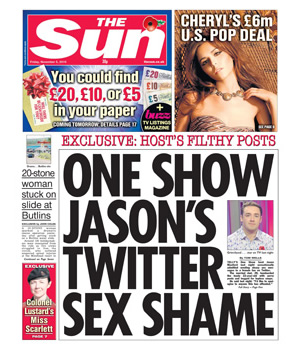
Last night's 10 O'Clock Live show has a really excellent Charlie Brooker poem/polemic (poemic?) about The Sun newspaper, followed by discussion about the language the paper uses. So it's tragic tot, lewd sex act, troubled songbird, trousering the cash, claimed and boasted rather than said, and many others.
They don't do any linguistic analysis on the words themselves, but that's a job for A level students rather than comedians, and there's got to be a language investigation in there somewhere.
You can see it here via 4OD and The Sun section begins at about 5 minutes into the show.
Playground prescriptivism?
A story doing the rounds yesterday suggested that a school in Sheffield was attempting to prevent its students from using slang. It was covered in the local Sheffield Star here, with a reference to one of Sheffield's most famous exports, Sean Bean (aka Boromir , Ned Stark and Sharpe) and in yesterday's Daily Telegraph, Daily Mail and Guardian.
Like many other arguments about language use, this one has become a bit muddied. In this case, the original story about the school - Sheffield Springs Academy - seemed to focus on slang (which might de defined as a type of extremely informal language used by specific groups of people) and a desire on behalf of the school to show its students that different styles of language suit different situations (what linguists often call the notion of appropriacy). However, the reporting of the story also refers to dialect being banned and regional pronunciations being frowned upon, and that's before you chuck in text speak too.
So what is actually happening here and can schools really control what their students say? The story is very similar to one we featured on this blog a few years ago about a school in Manchester which had banned street slang from its classrooms (covered here and in the Radio 4 programme Mind Your Slanguage which featured interviews with some SFX students) so it's perhaps not a big surprise to find that the head of the academy sponsors behind the Sheffield Springs Academy is the woman who was head teacher at the Manchester Academy when it introduced its ban, none other than Kathy August.
Her argument makes some sort of sense and goes something like this, according to the Telegraph report:
This isn't a new confusion, and it's one that the linguist, Paul Kerswill noted in his response to a report on non-standard English in schools.The problem is that if all non-standard forms of English are lumped together there's a risk that the debate itself loses its focus. Are we talking about text speak in spoken conversations? Really? Or are we talking about the ways in which people from Sheffield might say about and right differently to those in the south? If it's slang then there might be a good argument for explaining how it is viewed or understood (or not) outside particular social groups, but there's also a decent argument put forward by Christopher Howse in today's Telegraph (albeit in his usual verbose style) that language play should be encouraged at school and that slang can be part of that.
No one is really going to argue that students don't need Standard English, but is their grasp of it so shaky that they should be encouraged not to use any other varieties of English that might interfere with the standard form? Is it really that bad? Obviously, the Daily Mail might want us to think it is, because that supports their reactionary, declinist agenda - English is in tatters thanks to immigrants, teachers who don't wear ties and Brussels bureaucrats - a classic "crumbling castle" argument. But are young people so vulnerable to the pernicious influence of non-standard forms that they should be protected from them at school?
What do you think? Comments (in Standard English, please - no text speak or ghetto grammar) are welcome.
Like many other arguments about language use, this one has become a bit muddied. In this case, the original story about the school - Sheffield Springs Academy - seemed to focus on slang (which might de defined as a type of extremely informal language used by specific groups of people) and a desire on behalf of the school to show its students that different styles of language suit different situations (what linguists often call the notion of appropriacy). However, the reporting of the story also refers to dialect being banned and regional pronunciations being frowned upon, and that's before you chuck in text speak too.
So what is actually happening here and can schools really control what their students say? The story is very similar to one we featured on this blog a few years ago about a school in Manchester which had banned street slang from its classrooms (covered here and in the Radio 4 programme Mind Your Slanguage which featured interviews with some SFX students) so it's perhaps not a big surprise to find that the head of the academy sponsors behind the Sheffield Springs Academy is the woman who was head teacher at the Manchester Academy when it introduced its ban, none other than Kathy August.
Her argument makes some sort of sense and goes something like this, according to the Telegraph report:
What we want to make sure of is that they are confident in using standard English. Slang doesn't really give the right impression of the person.So, according to August, it's all about reinforcing the students' grasp of Standard English and code-switching. The problem is - as several of the reports show - who defines what slang and regional dialect are? The references from parents in the Sheffield Star to teachers disliking regional accents and local dialect terms, and the strange notion brought up by August in the Mail's version of the story that "...when youngsters are talking together they use text speak..."(like B4,H8 and BTW? I doubt it...) suggest that there's much confusion over what actually constitutes slang.
Youngsters going to interviews for their first job need to make a good impression so that employers have confidence in them. It's not difficult to get youngster out of the habit of using slang.
Mrs August said it was preferable for pupils to say "thank you" instead of the more colloquial "ta", and "goodbye" rather than "see ya".
The trust said its policy on slang was part of its "street stops at the gate" ethos.
It also asks sixth formers to dress in suits rather than school uniform to encourage professionalism.
Mrs August added: "It is about knowing what language is acceptable between friends and what is required in more formal situations.
We want to give each of our students the best start possible; understanding when it is and is not acceptable to use slang or colloquial language is just one part of this.
This isn't a new confusion, and it's one that the linguist, Paul Kerswill noted in his response to a report on non-standard English in schools.The problem is that if all non-standard forms of English are lumped together there's a risk that the debate itself loses its focus. Are we talking about text speak in spoken conversations? Really? Or are we talking about the ways in which people from Sheffield might say about and right differently to those in the south? If it's slang then there might be a good argument for explaining how it is viewed or understood (or not) outside particular social groups, but there's also a decent argument put forward by Christopher Howse in today's Telegraph (albeit in his usual verbose style) that language play should be encouraged at school and that slang can be part of that.
No one is really going to argue that students don't need Standard English, but is their grasp of it so shaky that they should be encouraged not to use any other varieties of English that might interfere with the standard form? Is it really that bad? Obviously, the Daily Mail might want us to think it is, because that supports their reactionary, declinist agenda - English is in tatters thanks to immigrants, teachers who don't wear ties and Brussels bureaucrats - a classic "crumbling castle" argument. But are young people so vulnerable to the pernicious influence of non-standard forms that they should be protected from them at school?
What do you think? Comments (in Standard English, please - no text speak or ghetto grammar) are welcome.
Thursday, February 09, 2012
New approaches to child language acquisition
 |
| http://www.instablogsimages.com |
Construction grammar is a relatively new field of linguistics to me and one I can't claim to fully grasp as yet, but in this blog post, the expert grammarian and ELT specialist, Scott Thornbury takes a look at how construction grammar might be applied to language acquisition.
Instead of looking at language as words and rules (lexis and grammar) as we often do when looking at stages of acquisition and how children move from one word to two words to telegraphic talk, and the rest of it, construction grammar offers a model in which children pick up chunks of language from those they hear around them. It's not a simple parroting of input, as per Skinner's behaviourist model, but a more subtle processing of meaningful units of language that they hear around them.
As Thornbury explains here, language learners are not just picking up words from around them like leaves and sticking them back onto a pre-programmed grammar tree:
Rather than mapping individual words on to a pre-specified grammatical ‘architecture’ (as in a Chomskyan, generative grammar view), speakers construct utterances out of these routinised sequences – the operative word being construct.
It's therefore an active process, one which involves putting together chunks of meaning rather than piecing together individual units and linking them by grammar rules to other bits. Where this differs markedly from Chomsky's model is that he sees a child's language environment as linguistically impoverished: this is the poverty of the stimulus argument in which a child can't be simply taking in language data from around them and regurgitating it because what they hear is so fragmented and often apparently ungrammatical. Construction grammar offers a different approach which seems to be arguing that a child can make much more sense of this language input and that by hearing enough language they tune in to the patterns that emerge and can start to spot the most frequent structures, using them in their own language soon after.
Thornbury points to the fact that so many of English's phrase and clause structures are repeated patterns, where if you know the first part you can have an educated guess at what the second part will consist of. He points to structures such as:
- take the [noun] for a [noun] (e.g. take the dog for a walk, take the cure for an illness, etc.)
- [prep] the [sing N] of the [sing N] (e.g. on the top of the mountain, in the middle of the night, on the tip of the tongue)
Monday, February 06, 2012
People first and PC
This link on the excellent Linguistics Research Digest blog takes a look at the "people first" movement in Politically Correct (PC) language reform, which (as Jenny Amos explains) involved a switch in the type of noun phrase being used to label social groups, from pre-modified noun phrases to post-modified noun phrases. Pre-to-the-what-now?
It's quite a simple idea. If you look at a noun phrase such as disabled people, the adjective disabled premodifies the noun people. The people first approach would be to shift the noun to the front and add the modification afterwards in the form of a prepositional phrase, so it becomes people with disabilities. The argument here was that the former version placed emphasis on the condition - and by extension defined the people by their disability - while the latter foregrounded the people themselves, with the disability coming after.Jenny Amos's blog post then looks at some interesting research by Helena Halmari into the use of such terms in news reporting.
PC is clearly about more than just rearranging words; it's primarily about rearranging ways of thinking about different groups in society, and specifically it's about removing offensive and derogatory words from the language. The arguments about PC were recently surveyed in an interesting Observer article by Miranda Sawyer, where she looked at some of the background to the PC movement and its more modern manifestations: Twitter spats, rape "jokes" and the bandying around of terms like mong and sket "for a laugh". If you're looking for material to bolster your ENGA3 Language Discourses understanding, go no further.
It's quite a simple idea. If you look at a noun phrase such as disabled people, the adjective disabled premodifies the noun people. The people first approach would be to shift the noun to the front and add the modification afterwards in the form of a prepositional phrase, so it becomes people with disabilities. The argument here was that the former version placed emphasis on the condition - and by extension defined the people by their disability - while the latter foregrounded the people themselves, with the disability coming after.Jenny Amos's blog post then looks at some interesting research by Helena Halmari into the use of such terms in news reporting.
PC is clearly about more than just rearranging words; it's primarily about rearranging ways of thinking about different groups in society, and specifically it's about removing offensive and derogatory words from the language. The arguments about PC were recently surveyed in an interesting Observer article by Miranda Sawyer, where she looked at some of the background to the PC movement and its more modern manifestations: Twitter spats, rape "jokes" and the bandying around of terms like mong and sket "for a laugh". If you're looking for material to bolster your ENGA3 Language Discourses understanding, go no further.
Last few tickets...
There are a few more tickets available today for the excellent emagazine English Language conference in March. If you haven't already booked , then phone (020 7359 8080) or email the EMC today to get some reserved.
Click here for more details of the conference.
Click here for more details of the conference.
Child Language research updates and summaries
We've started Language Development in my AS classes and - snow permitting - will carry on with it this week and up to Easter.
Here are some useful links to clips of TV programmes, You Tube presentations and research papers that should complement your class work on the topic.
One of the most handy links is this You Tube presentation (powerpoint plus handy voiceover) outlining the key arguments about child language.
Then you'll find the impressively-mustachioed Robert Winston presenting this short extract from his series, The Human Body a good intro to the main developmental stages of child language acquisition.
The Horizon documentary Why Do We Talk which we watched in class a week or two back is split into five separate You Tube clips which can be found here.
Did you shed a little tear at the plight of the lickle baby Zebra Finches? I did, but I weep when I hear Black Eyed Peas lyrics, so ignore me. If you want to find out more about the impressively-consonanted OferTchernichovski and his work on the fluffy birds, have a look here. Or here.
If you're ready for some hard stuff, then go to these clips from the big daddy of language acquisition, the living man-god that is Noam Chomsky. In this clip he talks about his theories of language acqusition (Universal Grammar and the Language Acquisition Device) while in this one (only for the hardcore ravers, it has to be said) he talks in more detail about how his ideas on UG have changed.
I've just found this Patricia Kuhl lecture about the critical period hypothesis on TED, which is a very clear explanation about what goes on in the first year of a child's language development.
If all of that is too much for you (or you are from Ipswich and struggle with anything beyond grunts) then check out this clip of cute twins talking to each other.
Edited to add Kuhl lecture link on 09.02.12
Here are some useful links to clips of TV programmes, You Tube presentations and research papers that should complement your class work on the topic.
One of the most handy links is this You Tube presentation (powerpoint plus handy voiceover) outlining the key arguments about child language.
Then you'll find the impressively-mustachioed Robert Winston presenting this short extract from his series, The Human Body a good intro to the main developmental stages of child language acquisition.
The Horizon documentary Why Do We Talk which we watched in class a week or two back is split into five separate You Tube clips which can be found here.
Did you shed a little tear at the plight of the lickle baby Zebra Finches? I did, but I weep when I hear Black Eyed Peas lyrics, so ignore me. If you want to find out more about the impressively-consonanted OferTchernichovski and his work on the fluffy birds, have a look here. Or here.
If you're ready for some hard stuff, then go to these clips from the big daddy of language acquisition, the living man-god that is Noam Chomsky. In this clip he talks about his theories of language acqusition (Universal Grammar and the Language Acquisition Device) while in this one (only for the hardcore ravers, it has to be said) he talks in more detail about how his ideas on UG have changed.
I've just found this Patricia Kuhl lecture about the critical period hypothesis on TED, which is a very clear explanation about what goes on in the first year of a child's language development.
If all of that is too much for you (or you are from Ipswich and struggle with anything beyond grunts) then check out this clip of cute twins talking to each other.
Edited to add Kuhl lecture link on 09.02.12
Sunday, February 05, 2012
Not loving "love"
There's a piece in The Sun from last week taking a look at Brighton and Hove Council's decision to "ban" sexist terms of address on public transport. Given that Brighton has a Green Party-led council whose politics are progressive and anti-sexist, I'd be a bit sceptical of The Sun's position on this - its track record for inventing tales of "loony left" attacks on free speech in the 1980s was pretty disgraceful - so I'd advise a bit of research into this before assuming it's all true.
The Daily Mail covers it here in a slightly different, PC Gone Mad, way here.
Whatever the whys and wherefores of this though, it at least gives The Sun a chance to look at regional dialect and how terms of endearment vary from place to place, which has got to be of use to A2 AQA A spec students looking at Language Variation.
The Daily Mail covers it here in a slightly different, PC Gone Mad, way here.
Whatever the whys and wherefores of this though, it at least gives The Sun a chance to look at regional dialect and how terms of endearment vary from place to place, which has got to be of use to A2 AQA A spec students looking at Language Variation.
Subscribe to:
Posts (Atom)
Follow EngLangBlog on Bluesky
The old Twitter account has been deleted (because of both the ennazification and enshittification of that site) so is now running on Bluesk...

-
 As part of the Original Writing section of the NEA, students will be required to produce a commentary on their piece. This blog post will pr...
 -
As lots of students are embarking on the Language Investigation part of the Non-Exam Assessment, I thought it might be handy to pick up a fe...
-
I'm on a roll. Nothing from me for ages, then three posts come along! This is a lovely story from the Kenya Times about a dialect called...