Showing posts with label mode. Show all posts

Saturday, May 16, 2015

Mode mini-moments mark 1

In the run-up to the ENGA1 exam in a couple of weeks, here's the first in a short series of short posts on Language and Mode. Today it's about Mode...

What is mode? If you can't answer that question by now, I'd respectfully suggest that you should do some basic work on the topic. After all, the first part of the paper is called "Language and Mode", so you might be advised to understand what it's all about.

So, what is it? Mode, on a really basic level, is how a text producer conveys something to a text receiver. The text producer could be a person writing, texting, tweeting, talking face-to-face or telephoning and the text receiver could be one person or a much bigger audience. So, the mode part of this is what is in the middle - how it gets from A to B. Historically, mode has been separated into spoken and written forms, based upon the channel through which the text is received (visual - i.e. read or auditory i.e. heard) but that's too binary, so the way we generally conceptualise mode for this course is along a continuum. This approach owes a lot to the linguists Doug Biber and Dick Hudson who have both written about the ways in which certain texts exhibit particular mode characteristics or dimensions.

Jarvis Cocker demonstrates his knowledge of 2nd person
pronouns & multi-modality through gesture
More recently, a wider view of mode has been suggested (by, among others, Gunther Kress) in which mode does not apply simply to speech and writing but to other forms of meaning making too, such as gesture and images. This means that a written text with pictures might be seen as multi-modal, as would a spoken lecture accompanied by a power point and gestures (not the kind of gestures I am fond of making to my students to demonstrate first and second person pronouns).

So, if you think about mode early on when addressing the texts you are given in the ENGA1 exam, you can start to make some useful observations about the nature of each text before you start considering more familiar elements such as genre, audience, subject and purpose.

Thursday, May 10, 2012

ENGA1: quick revision tips 3

Mode is the name of the game in this quick revision post.

The first section on ENGA1 is called Language and Mode, so you'd have to be a mug not to mention it, but what is it? At its simplest, mode is basically the way language passes from text producer to text receiver. So, that can be via the visual channel in the form of written texts, or the aural channel in the form of spoken texts.Simples, no?

But mode is also quite a slippery concept in that it relates to the ways in which we understand other ideas about how texts are produced and received, so we use the notion of the mode continuum to talk about different dimensions along which we can place texts. The clickable graphic of this can offer you a few pointers as to which dimensions are most relevant at this level. You might have used different terms for some of these (e.g. asynchronous for delayed, or synchronous for immediate) but it's all the same really.

How do you address mode in the exam? I'd suggest tackling it head-on at the earliest stage. You've probably been told how to structure an essay for this question already, but an approach I always like is to use the acronym GASP: Genre, Audience, Subject, Purpose. This allows you to think about the type of texts, who they're aimed at, what they're about, and what purposes they serve; so I'd suggest that mode is dealt with as a concept as part of Genre. For example, you could talk about Text A or B being an example of a spoken mode anecdote, a written mode piece of fiction, a blended mode Twitter timeline, etc..

The other thing about mode is that examiners are keen to reward students who see the subtleties of mode across different texts, or even within the same ones. I'm always banging on at my students about not treating texts as "uniform blobs" - homogeneous, unchanging, fixed and straightforward - but as places where different things can happen.

For example, in a spoken interaction it would be daft to assume that each speaker used the same degree of standard/non-standard language or to assume that a speaker was always being interactional rather than transactional, so the same is true to an extent for written texts: they may exhibit some features of one mode dimension at one point and then another aspect of that mode dimension at another point. A written text might start as a formal and transactional piece, but develop into something more informal and interactional. Look for shifts within texts, but also of course between them. Always provide evidence for your observations though, because you need to show the examiner that what you are saying is linked to actual examples of language in the texts, rather than vague generalities plucked from thin air.

The other interesting area of mode is, I think, that of Computer-Mediated Communication (CMC) where we see texts which are primarily visual in their channel, but quite spoken in their style: tweets, emails, online chat and message forums, and text messages perhaps. However, these texts pose their own questions and again examiners like to see students who can respond to what's put in front of them, rather than make blanket judgements about CMC texts always being (say) non-standard, informal and instant.

We see, for instance, a huge range of language styles in emails, depending on who has sent them, to whom they've been sent and what they're about. If you're a Colchester Sixth Form College student you'll soon be able to look on Moodle to see the excellent presentations done by AS classes where they pulled apart different emails to see how they varied in style and structure. If not, bad luck, but you can easily find a few examples of your own.

Overall, I think mode is a really interesting area of language to look at and one that allows you to open up texts for really careful scrutiny. It helps if you can combine discussing it with other ideas about the texts' contexts - very much as Marcello Giovanelli explained at the recent EMC Language conference - but it's also something that can be linked neatly to specific language features for AO1:

  • minor sentences used as a form of elliptical, abbreviated, rapid writing/typing (e.g. "Well done!" used in an email from parent to son about a new job)
  • syntactical reordering of spoken language to put emphasis on particular bits of a sentence (e.g. "That one I really like, that one I don't")
  • inclusive first person plural pronouns being used in written texts to create synthetic personalisation and position the text producer as a friend or ally ("It seems that we can't get enough of Kirsty Allsop")

The next post will be on meaning...


Thursday, May 03, 2012

ENGA1: quick revision tips 2

Today's top tip post is a very quick one connected to AO1.

This AO assesses two things: your ability to use language frameworks and your ability to write accurately*. In this paper, you can be rewarded for simply picking out a feature and giving it the right label, and I think that's a good thing. Knowing stuff is important, and being able to apply your knowledge deserves reward. So, feature spotting language in the texts can actually get you quite a few marks for AO1 (which is worth 15/45 marks in the Language and Mode part of the exam).

In an ideal world, you would then make links between the language features you've noted and the modes of the texts, and their meanings, but picking out a few key language features which always get rewarded highly can help you score a few more marks. One really good thing about the ENGA1 mark scheme is how transparent it is. If you correctly identify a noun, that'll put you in the 5-8 band, but if you add more detail and label it as an abstract noun, that bumps you into the 9-12 band. The more detail you offer, the more marks you get...so long as you are accurate.

Here are a few to look out for:

Modal auxiliary verbs. There are only 9 of these, so they are easy enough to remember. If you're not sure what they are or what they do, look here. The good thing about modals is that they often have a very clear effect, helping you link to AO3ii (meaning).

Minor sentences. These are sentences which aren't really sentences. They are often fragments of speech or elliptical structures like noun phrases that are punctuated like sentences (e.g. Nice one.) or clauses missing a subject (e.g. Going out later.). Again, these can be pretty easy to spot and are often good for linking to mode, be it CMC texts like Tweets, emails or text messages, or spoken texts in which utterances rather than sentences are the basic unit of meaning.

If-clauses (clauses of condition) and because-clauses (clauses of reason). Even if you're not entirely clear about clause level analysis, these types of clause are quite easy to spot and again, while they can give you lots of AO1 marks, they often link to meaning nicely too. If you want to find out more about these, check here.

 Next time, we'll look at Mode and why it's so important.

(*It's a bit of a silly combination, because they aren't really the same thing at all. For example, you could write really well, but say nothing interesting about the language of a text, or write really badly yet be full of insightful language points. But anyway, that's not AQA's fault; it's the fault of the people who made the awarding bodies jump through hoops to create new specifications.)

Wednesday, October 20, 2010

The mode map

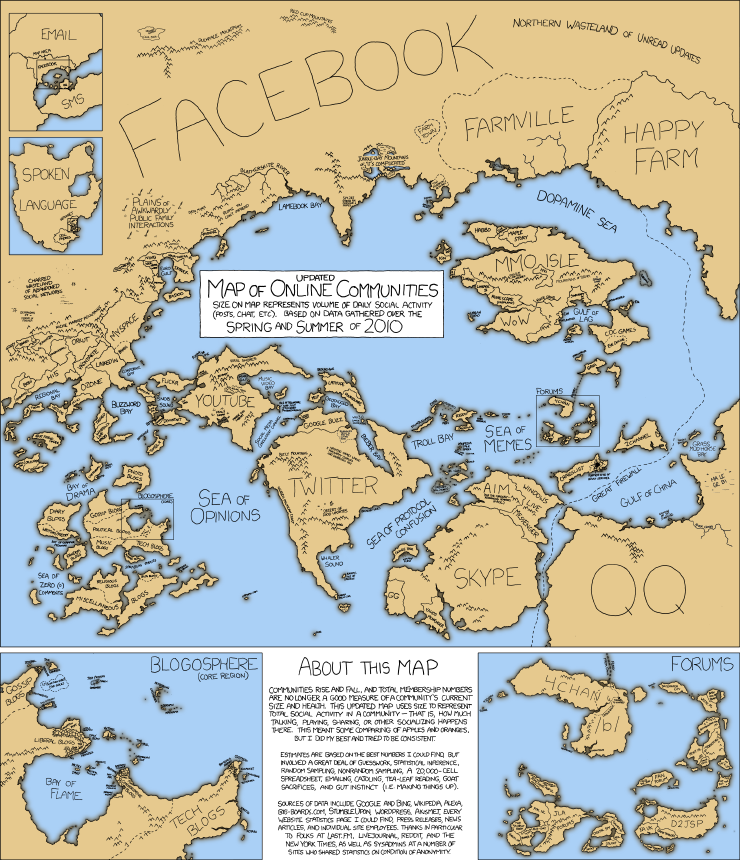
While it doesn't quite cover all modes, this map by the cartoonist, Randall Munroe, is a really great way of visualising the different forms of communication available to us in 2010. He's chosen to make the land masses' sizes proportional to their number of users, as this article in The Independent explains.

The full image of the map can be found here. You'll see me bobbing up and down in the Gulf of Lag, just off the south coast of the MMO Isle.

Wednesday, February 11, 2009

Battle of the texters

Gender and text messaging come under the spotlight in a recent piece of research from Indiana University carried out by Susan Herring and Asta Zelenkauskaite, reported here in Science Daily.

According to the summary on Science Daily, the usual patterns of gender interaction* - men talking for longer and using more non-standard forms - are reversed when men and women use text messaging to interact in public forums.

Expecting findings consistent with past research on gender-patterned public communication, Herring and Zelenkauskaite were predicting men would post more and longer text messages, and that men would also employ more non-standard techniques. Instead, the opposite was true when it came to communication within a new, convergent medium that mixes interactive television (iTV) with SMS or texting.

The study found women used more non-standard language such as abbreviations or expressive insertions that represented characteristics including enthusiasm, sadness, emphasis and individuality. And while women were both more economical and expressive, they also came closer to maxing out, or did max out, on the 160-character message limit more often than their male counterparts.

So, according to this research, if the length of a text message equates to the length of an utterance in spoken mode, then it's actually women who are "saying" more and "saying" it more often. But of course, this isn't quite the texting we're used to here, because (as they explain in the article) the texts are used as part of an interactive TV forum, rather than phone to phone. Presumably you text in and your message appears on the screen.

Would the same patterns hold true in phone to phone texting or would the usual patterns* of gender and spoken language kick back in? And might this research throw up these findings because the nature of the text "conversation" is flirtatious and expressive in nature?

But whatever the quibbles over the possible differences between this and "proper" texting, it does raise lots of interesting questions about how we negotiate computer-mediated communication and blended modes, and whether the patterns sometimes noted in spoken interaction can be seen directly translated over onto these newer modes.

(*I'm using this term with some qualification, because as you can see here and here, generalising about gender and language is a bit of a mug's game)

Saturday, September 13, 2008

CSI Nokia

Forensic linguistics is a growing field and one that directly applies skills of textual analysis to a range of everyday communications - letters, texts, internet discussions, recordings of speech - in a bid to accurately trace the user's identity.

Science Daily reports on one particular case in which a man was convicted for the murder of his ex-partner largely through the evidence of messages sent on her mobile phone. Dr Tim Grant of Aston University explains:

‘Jenny Nicholl disappeared on 30th June 2005. A linguistic analysis showed that text messages sent from her phone were unlikely to have been written by her but, rather, were more likely to have been written by her ex-lover, David Hodgson. A number of stylistic points identified within texts known to have been written by Jenny Nicholl were not present in the suspect messages. Instead, these were stylistically close to the undisputed messages of David Hodgson.

Hodgson was convicted partly because, in text messages he sent on her phone after she disappeared, he spelled "myself" as "meself". In her own text messages, Nicholl had spelled the word "myself".

‘The kind of features we were interested in were the shortening of “im” in the texts from Nicholl contrasting with “I am” in the suspect messages and the lack of space after the digit substitution in items such as “go2shop” contrasting with “ave 2 go”’.


So, while your skills of textual analysis and understanding of new modes of technology will obviously help you do well in your A Levels, they might also help you become a crime-fighting super sleuth.

Useful for:
ENGA1 - Language and Mode
ENGA3 - Language Explorations
ENA5 (old spec) - Language Change

Friday, August 22, 2008

Serious pwnage

The internet has speeded up the pace of language change and led to new varieties of English which are often limited to relatively small communities of practice (groups of language users linked by a shared interest or practice, such as online gaming, hacking, phishing, 419 scams etc) but which often leak out into wider society and affect the mainstream.

Many of the words associated with online gaming in particular are interesting from a language change point of view, often consisting of the usual blends, acronyms and initialisms, but also a weird range of semantic changes and random fluctuations and errors which become "real" words in their own right.

One word, the blend playbourer - a person employed to "farm" gold in a MMORPG (Massive Multiplayer Online Roleplaying Game) and then sell it on to other gamers - is reported on in today's BBC News. It's a form of sweatshop labour that fuels a black economy of gold-spammers (people who send you endless spam messages about buying virtual gold with real money) but I can't see a World of Warcraft fairtrade movement springing up any time soon.

Elsewhere terms like owned and pwned have grown in popularity. Owned has a similar meaning to the London slang boyed: defeated, beaten or humiliated. So, to get owned (the passive form of the verb) is is to be beaten. In gaming this seems to refer to any dramatic defeat at the hands of NPC (non-player character) enemies or other players. The obvious link to the traditional sense of to own - to possess or have - suggests that this usage might be seen as a broadening, a form of semantic shift where a word changes its meaning while leaving the original word with its original meaning. And rather like to boy, or even to merk/murk (generally meaning to beat up, destroy or kill, possibly* derived from a shortened version of mercenary, a paid soldier), slang terms with connotations of victory, violence and competitive prowess often move into use in areas of sexual behaviour. Take the recent Dizzee Rascal and Calvin Harris track Dance Wiv Me, which features the romantic chat-up line "You've got a body to die for: let me merk it"...

Pwned is a weirder and maybe more interesting example of how keyboard technology can lead to variations in language use. According to this definition and this one, pwned was probably a typo (with 0 and p being adjacent keys on a QWERTY keyboard) but has now become a word in its own right. A similar example is book to mean cool, created by the predictive text on mobile phones selecting book as the first option. Again, despite originating in a mistake, this has taken off as a slang term (or at least did for a while).

And what do linguists make of this? This week's Word of Mouth on Radio 4 (listen again here) includes an interview with renowned linguist David Crystal who makes the point that the internet is spreading language change so quickly that the days of prescriptivism (the movement to regulate and "fix" spelling, grammar and meaning) are numbered as we let our fingers do the talking.

Useful for:
ENA5/ENGA3 - Language Change
ENGA1 - Language and Mode

*I say possibly as there are loads of different ideas about where this word comes from

Saturday, May 17, 2008

Electronic renaissance

Thanks to Mr G for this one; it's a report about research into instant messaging, a blended mode of communication like text language that's somewhere between spoken and written. Parents, teachers and prescriptivists have long been concerned that this sort of electronic communication will lead to falling literacy standards, poor spelling and sloppy communication. But as the report in New Scientist tells us, this panic seems unjustified: young people seem to be much more standard in their IM language than might have been expected. They use fewer abbreviations than the stereotype of lazy teens might suggest: LOL, TTYL, KMT, OMG only making up 2.4% of the vocabulary studied.

Perhaps this shouldn't really come as a great surprise. As we've studied in the Language Change topic, many prescriptive views about falling standards have little basis in fact and have been floating around for centuries in one form or another. Have a look at Julie Blake's excellent Bilious Pigeon article in emagazine for a survey of such attitudes and how they're often founded in prejudice and snobbery.

So, as one of the Toronto University researchers puts it, IMing is "an expansive new linguistic renaissance" rather than a slide into illiteracy, short attention spans and moral depravity.

Useful for:
ENA5 - Language Change
ENGA1 (next year's AS spec) - Language and Mode

Saturday, September 22, 2007

Death to the emoticon ;-)

...the computer keyboard, especially for touch-typists, is an invisible piano on which we play instantly ... First musings race into fully-formed words and sentences with no pause for revision, let alone perfection. As soon as they are on screen they acquire validity. Over them hovers the dreaded send button, itching to be pressed and behind which lurk a hundred links, addresses and possible misdirections. Send is always pressed too soon.

So says Guardian columnist Simon Jenkins in a passionate attack on the language of emails. His comment piece begins by pointing out that emoticons (the little symbols which smile, frown, wink or glow with shame) are now 25 years old and that their use has spread with the growth of online communication. He then goes on to make the point that all mechanical or electronic forms of communication have used some form of abbreviation, but that emails are a blunt tool causing "unintentional pain and embarrassment" and that even emoticons can't make up for the lack of subtlety or nuance in email communication.

Jenkins' article is interesting for a number of reasons. Firstly, his argument that email is less subtle than the handwritten word is perhaps true, but then each serves a different purpose - for the time being anyway. The written word (pen on paper) is still given more credibility and status than the word processed or emailed word: take birthday cards, legal documents and contracts, for example. Perhaps all this will change as e-communications take over the world.

One of his other points, that email doesn't provide an interaction is a little more dubious. While it's true that email isn't the same as face to face talk in its potential to be shaped and re-shaped depending on cues like facial expression, body language and eye contact, it is still pretty quick. Replies can zip across the internet backwards and forwards as quickly as you can read them and type them.

Then again, unlike MSN where conversations can be tracked in real time, there is often a time lag in reading and responding to emails which means that it can lead to misunderstandings and lost threads.

The discussion about Jenkins' views is taken up in a debate at the end of his article, and the responses are well worth looking at for some different angles.

Useful for:
ENA3 - spoken and written language
ENA5 - Language Change
2008 AQA A spec - Language & Mode

Follow EngLangBlog on Bluesky

The old Twitter account has been deleted (because of both the ennazification and enshittification of that site) so is now running on Bluesk...