Showing posts with label new words. Show all posts

Friday, December 16, 2022

Getting the Word Out 2022

WOTY (Word of the Year) Season is in full swing and the lists from the various dictionaries and organisations who produce them, along with the blogs, the explainers and articles in the press about them are always a useful resource for the A Level, especially when looking at Language Change. 

I'll put together a fairly comprehensive set of links next week to all the stories I've come across, but in the meantime, here's a link to a piece I wrote for The Independent about WOTY2022. 

These stories (that aren't mentioned in my article) are also worth a look:

Gaslighting

Woman and woman again

Goblin mode and more goblin mode

Hybrid work

There's also the American Dialect Society's WOTY2022 to look forward to which is probably one of the most exciting dates on the linguistic calendar. Last year's overall WOTY for them was insurrection

Saturday, November 07, 2015

A Word of Warning

While some changes to language are roundly condemned by pedants, purists and prescriptivists - creaky voice, rising intonation, split infinitives and literally not actually meaning LITERALLY AT ALL - new words often get an easy ride. People generally like new words and can see why they appear in the language, even if some of them seem a bit silly (Awesome sauce and amazeballs? Really?) or likely to last as long as a David Cameron promise on tax credits (dadbod and mantihose?). In fact, new words now get wall-to-wall media coverage.

So, this week we have seen the latest additions to the Collins Dictionary feature in pieces such as this (from the Dictionary-makers themselves), this from The Guardianthis from the BBC and this from the Daily Fail.

But among the hype and the celebration of an evolving and vibrant language, naysayers complain that some of the new entries are just trendy fads, too ephemeral to be included in esteemed dictionaries.

As Robert Lane Greene explains in a blog for The Economist, the whole process of putting new words in a dictionary is quite an intensive exercise, admittedly now made much easier by the internet: something that early lexicographers could have only dreamt of. A further explanation is given in this helpful video clip from Oxford University Press, which describes how a new word (in this case selfie) might enter their dictionaries. As the clip explains, the naysayers are partly right that things have been changing faster than before, because the new words don't have to have had a very long existence before being added to the online versions of the dictionaries. But in a way, that just reflects the rapid pace of lexical change these days. Perhaps, as John Sutherland argues in this article, language is "evolving at a faster rate now than at any other time in history because of social media and instant messaging".

Is this rapid change leaving some behind? One argument often put forward by more prescriptively-minded people is that if language changes too fast, we lose mutual intelligibility; in other words, one generation may not understand the language of another. Older people (anyone over 30) will lose any semblance of understanding of what young people are talking about, goes the argument, and that will lead to social breakdown and chaos. Indeed, this is the argument peddled in rather dubious articles like this one in yesterday's Daily Fail which claims that parents haven't a clue what their kids are saying because they're using a secret sex and drugs code, grandad!

For example, the seemingly innocuous "netflix and chill" now takes on much more sinister connotations. The innocent Snapchat message from your teenage daughter to her bae saying "Do you want to come over? We could Netflix and chill." actually means "Buy drugs, come to my boudoir and let's have hours of dangerous chemsex". Apparently.

The fear that young people's language is constantly evolving as a nefarious means of hoodwinking their prying parents or to hide other dubious activities (smoking tobacco, drinking alcopops and playing CoD until after bedtime) is one that has been around forever. This piece in The Daily Telegraph from 2013, this one from the Daily Fail (again... almost like they don't like young people), or even these from as far back as the 17th Century, all say similar things.

And if people have been complaining about it and we still manage to communicate fairly effectively with each other after all this time, surely the doom-mongers are barking up the wrong tree.

Friday, May 22, 2015

Everybae People

The recent news stories about Scrabble are a gift to A2 students revising Language Change and Discourses, so have a look at these links for some good stuff on new words, and lots of "OMG, how can that even be called a word?!" reactions.

Here's Ben Farren of The Guardian listing lots of them.
Here's The Daily Telegraph looking at both sides: from Sue Bowman of the Association of British Scrabble Players who reckons it's "an abuse of the English language" to Gyles Brandreth, founder of the National Scrabble Competition who says "hang loose and get down on the street". Yeesh!
Meanwhile, Elaine Higgleton offers a staunchly descriptive defence of the new entries in this Radio 4 clip.

Language change hit the headlines a little while ago too in the aftermath of a thinly-disguised marketing exercise for a new Samsung phone, with several articles looking at how older generations claim to feel completely bamboozled about young people's new slang.

Here we have The Guardian explaining how language is changing faster than ever before.
Then, there's The Daily Telegraph saying the same thing in a slightly older and more baffled way.
The Daily Mail reckons it's all the fault of trades unions, gay marriage, Red Ed and immigrants (probably).
The Huffington Post keeps it fleek.

But just to prove that older people have always struggled with young people's language, here's Ben Zimmer looking at an American newspaper from 1911 saying nearly the same thing.

Thanks to various Twitter people for the links (@languagepigeon @agwilliams9 @tonythorne007 @bgzimmer)


Friday, January 16, 2015

Oh man!

While sitting at home, feeling sorry for myself with a bout of man-flu, this article about a curious phenomenon called manterrupting popped up on Twitter. Apparently, manterrupting is when males interrupt women in meetings and/or co-opt (or bropropriate*) their ideas as their own.


It's a man-word like these explained here by Stan Carey on the MacMillan Dictionaries blog and makes use of the man- prefix that has become so productive in recent years. So far we've had...

  • mansplaining: patronising explanations delivered by men to women of things that women probably already know more about (Urban Dictionary definition here)
  • manspreading: sitting on public transport and spreading one's sweaty flannels in order to secure more seat space (Collins Dictionary definition here)
  • manscaping: removing unsightly body hair to make oneself more attractive (Oxford Dictionaries definition here)
  • manslamming:aggressive pavement action involving a man barging into people (often women) who he believes to be in his way (explained and illustrated in The Daily Telegraph)

But what others can you can come up with? A couple of possible ones suggested on Twitter have been:

manterpreting: (a male way of interpreting a woman's words...although when @sooze8968 suggested this I perhaps did my own manterpretation of it).
manter: (pointless chat amongst men possibly making them both late for whatever)

Any more?


*And I'm also doing just that, because Sally Flower at Colchester was the first person to mention some of these this week. Anyway, I can't help it: I'm a man and it's in my genes. 


Friday, May 30, 2014

Despicable Minecraft Minions in the Nether

And another quick link to a BBC Radio 4 Today clip about the changing language of children. Here, the OUP language expert Sam Armstrong and comedian & writer Charlie Higson discuss the influence of popular culture and video gaming on young people's language.

While the presenter is keen to get them moaning about young children using terms like minion, nether, LOL and OMG, the experts are good at seeing the benefits to young people of new forms of language and their ability to code-switch. Take that, Radio 4 curmudgeons!

Nice stuff on lexis, morphology, word formation processes and the joys of technology, too.

Friday, March 21, 2014

Old goths never die: they just fade to grey.

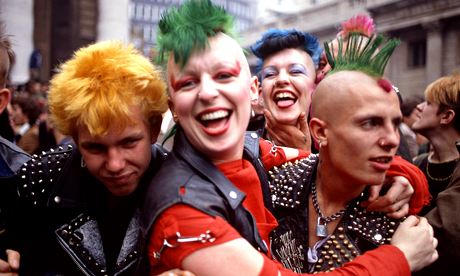
Punks in 1983: probably teaching you English in 2014
Youth culture, and the various sub-cultures that it spawns, has been a hugely productive area of new language for several decades. We've had teddy boys, mods, rockers, hippies, grungers, emos, ravers, nu-ravers (and cheesy quavers), shoegazers, indie kids, grebos, psychobillies, punks, skinheads, redskins, post-punks and goths, among many others. And that's before you start factoring in those which have come from the USA and Jamaica (gangstas, rude boys, natty dreads and even backpack hiphoppers).

Each movement has had its own associated look, musical style and even language terminology - as you'd probably expect from any community of practice - and an article by the excellent Alexis Petridis in today's Guardian* tells us all about relatively recent subcultures and some of the language associated with them.
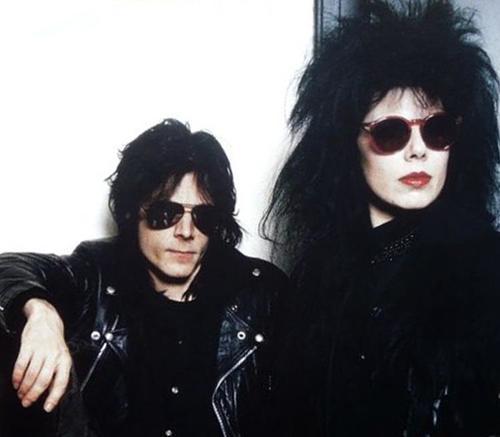
Sisters of Mercy: none more goth


If you're looking for material to help you with ENGA3 (or ENGB3) Language Change and the influences, processes and reasons for language changing, it's got plenty of examples. From a word formation angle, we've got compounds such as sea punk and haul girl, clippings such as emo and potential eponyms-in-the-making, Molly Soda. And from the angle of social change and technology driving language, there's lots to talk about in terms of the power of web-based media and different forms of prestige and influence.


*Thanks to Sally F for link


Tuesday, February 18, 2014

The age of the LOLcat is over; the time of Doge has come

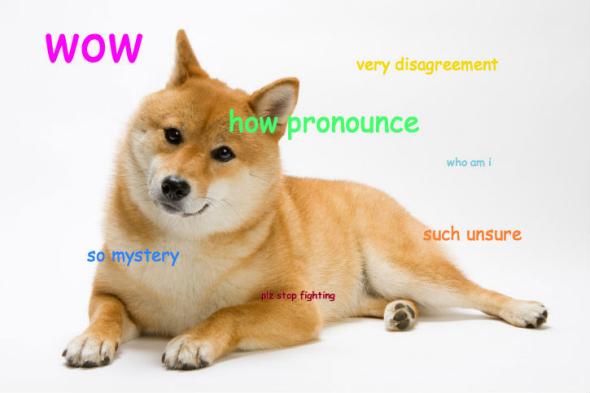
Dogs are better than cats - it has been scientifically proven, by scientists using science - so it's no surprise that LOLcats are so last year when it comes to language memes and dogs are where it's at just now. Well, not dogs exactly, but Doge, a weird variant of English (some use of wow, a deliberate mis-spelling or two, a strange unnatural combination of an adverb plus a noun, for example) that exists on the internet in pictures like this one below.


If you're still not sure what Doge is or why you should care, you can have a look here for a more detailed update, read this link on Superlinguo, or listen to this clip from this morning's Radio 4 Today programme.

(HT to @suewalder for Toast link and @StanCarey for LOLcats article)

Sunday, December 29, 2013

WOTY FTW

It's that time of year again when the newspapers are full of end of year lists, and it wouldn't be complete without their favourite words of the year. So here are a few of them for your delectation and delight (and your ENGA3 and ENGB3 Language Change knowledge).

The Independent charts the events of the year through its new words
Ben Zimmer - linguist and columnist - takes a look for The Wall Street Journal
Steven Poole in The Guardian
The Daily Telegraph on Collins Dictionary's new words of 2013


And to cap it all, here's a best of for a decade from the excellent Kerry Maxwell who charts new words and their meanings for the MacMillan Dictionary blog.

Tuesday, November 19, 2013

Selfie

The Oxford Dictionaries Word of the Year is selfie. Read all about it everywhere.

BBC News site
The Guardian
Oxford Dictionaries
Daily Mail

And Jonathan Freedland in The Guardian describes it as "like so much else in the digital world – all about "me," but revealing a sometimes desperate urge to find an "us"".

Friday, April 19, 2013

Technolexis

If you're looking for examples of how technology shapes our language for your revision on ENGA3 or ENGB3, then you could do worse than check this article by Tom Chatfield which plugs his new book, Netymology: A Linguistic Celebration of the Digital World.

It includes hashtag, which was the American Dialect Society's Word of the Year for 2012, and geek, which is not necessarily new but has certainly shifted in meaning as time has gone on, plus plenty of others.

One of the terms Cupertino, might be new to you (and me), but the basic concept is pretty well known; it's all down to how new technologies sometimes "correct" our language, even when we don't want them to. Ben Zimmer of the excellent Visual Thesaurus website, talks about it in more detail here.

Sunday, February 24, 2013

Keep buzzing

MacMillan Dictionaries have had a really good web presence for a while now, with plenty of accessible articles for A level students (and normal, everyday people who are just interested in language).

One of the best and most useful features for A level English Language has been its Buzzwords section, a weekly feature in which the ace lexicographer Kerry Maxwell takes a look at a new word that's appeared and explores its origins, formations and uses.

It's exactly the kind of thing that feeds into the work we do on Language Change for ENGA3 (or ENGB3 if you follow the AQA B spec) and provides the kind of up to date and well-referenced examples of words and word formation processes that can make your essays on this topic a much better read, and keep you topped up with new and original illustrations.

Buzzwords is now ten years old, so Kerry has written an overview about what's happened in the world of new words, which you can find here. We'll be looking at this in class in the run-up to the exam in June, but it's definitely worth having a read now and looking back through the Buzzwords for 2012 here and the archive here.


Thursday, January 10, 2013

#BiffyClyro

#Jahmazing
Sorry for taking such a long break from blogging over Christmas and New Year; this was partly down to lots of work and partly down to a bad case of man flu (not wine flu, which is one of the Australian Macquarie Dictionary's nominations for Word of the Year 2012).

Many recent language stories have picked up on the end of year new word round-ups and votes, so you can find a summary of recently fashionable English words in this Observer piece by Rafael Behr (HT to Jon Dolton for the link) which includes some from popular culture and some from wider social changes. So, we get X Factor's Nicole's shamazing (jahmazing, more likely, given it was invented for Jahmene), the song that had uncles dancing badly everywhere, Gangnam Style, Tory incompetence (rather than their usual malevolence) with Omnishambles, and the big winner this year, Hashtag, becoming not just a ubiquitous octothorpe (#) but a real, spoken expression (just like guest blogger Emma Bertouche said on this blog back in 2011). Fearne Cotton off of that there Radio 1 even slotted "Hashtag Biffy Clyro" into one of her pre-Christmas shows, as a reference to the angular-haired Scottish riff-makers. While it's clearly become accepted as a new way of making reference to something in speech, it still made me choke on my cornflakes and SCOMK (Spit Coffee on My Keyboard).

Hashtag was the winner in the American Dialect Society WOTY 2012 poll. You can read more about the nominations and winners in this pdf, but their choice of hashtag has been celebrated and discussed further here and questioned here.

Meanwhile, the Australian Macquarie Dictionary has its poll still running and there are some crackers on there, including the aforementioned wine flu, and  dramality.

What were your winning words of 2012 and which bugged you the most? Personally amazeballs tickled my fancy, but reem irritated me in ways that I can't really explain. Also, what are your predictions for 2013?

Thursday, December 13, 2012

And on the sixth day He made meggings

Can these ball-crunching jodhpur variants really be the next thing in male fashion, I ask Albus, a balding builder from Lithuania?
Nah. "I don't like them," says Albus. "I like more traditional designs. Jeans. Combat trousers. Military stuff. It's a personal choice."
As if jeggings (jeans + leggings) wasn't a blend too far, we now have meggings (men's leggings). I'm reliably informed that treggings (trousers + leggings, or tramp's leggings, if you prefer) also exist. Blends are nothing new, but what differentiates a man's leggings from a woman's leggings? In other words, why can't a man just wear jeggings? It's something that Patrick Kingsley asks in his short piece on meggings and one that applies equally to other man-words like manbag (a man's handbag), mankini (see below) and mantyhose.


Perhaps, given that these items are generally seen as being the preserve of women, men feel more self-conscious about wearing or using such items unless they've been rebranded and renamed as manly clobber. Stan Carey, blogger and contributor to MacMillan Dictionaries excellent language blog, has written about Manguage here and it's worth a read if you're into new words or just fancy some tight-fitting full-length budgie-smugglers.

Wednesday, November 14, 2012

WOTY not YOLO but GIF? KMBCT

It's reaching that time of year when the dictionary publishers and lexophiles start assessing the new words that have popped up and bobbed around in the public's consciousness over the last 12 months and select their favourites. There's often a difference between the ones that the UK and US dictionaries go for and so far we've had the following:

The Oxford English Dictionary has gone for Omnishambles which is also considered here on the BBC site.

Oxford Dictionaries USA have plumped, controversially and rather strangely, for the verb 'to gif' (an acronym to noun to verb conversion, apparently) which is a choice criticised here on Slate's website.

Meanwhile, the American Dialect Society get very serious about this (while enjoying the silliness too, I'm sure) and vote for their WOTY at a big ceremony/party. Last year they chose Occupy, and this year the contenders might be frankenstorm, romnesia and robama, among others.

Soon, we'll have plenty of lists appearing in the papers, so have a think back to the words (and by words we can actually include noun phrases like squeezed middle and fiscal cliff) that have made an impression on you. Perhaps it's going to be gangnam style or even an old word that has been made popular again, pleb.

Saturday, October 27, 2012

Make yourself better with slang

This quick link (with more discussion on the audio link) gives some good reasons why we should treat slang as a positive, creative form of language use.

Michael Adams' book, Slang, The People's Poetry, is a damn good read, as is Julie Coleman's The Life of Slang, which focuses a  bit more on UK slang.

Monday, September 24, 2012

Say Yah to the Rahs

It's that time of year again, when new students are starting to flock to universities for their two weeks of seminars before it's reading week and then Christmas holidays, so it must also be time for the student-friendly Guardian to run its dictionary of student slang. So, here it is.

Given that today's students are from a much more representative demographic than twenty or thirty years ago, the slang is not really limited to just the upper middle classes any more, and now draws on much more eclectic influences - Caribbean patois, US teenspeak and TOWIE - so it could be argued that what students speak isn't really their slang at all. Then again, there are some examples - BNOC and chundergrad - which seem fairly restricted to campus life, so do seem to fit a strict definition of student slang.

And while we're on the subject of slang, a really excellent new book called The Life of Slang: A History of Slang by Professor Julie Coleman of Leicester University, is definitely worth a read for anyone thinking of investigating the topic further. It's funny, informative and frankly possesses a level of bare teckers that is hard to match in this field.

Thursday, September 20, 2012

#TOMA, ITKers and WUMs

If you are unlucky enough to be a fellow Leeds United supporter, then this summer will have introduced you to a whole new world of anxiety, anticipation and moments of near-euphoria followed by crushing disappointment. And that's before you even go to a game, watch Ross McCormack get scythed down,  or see the "highlights" of another dreary defeat on TV. For this summer has been #TOMA summer.

TOMA? Yes TOMA. Take Over? My Arse. With the proposed takeover of Leeds United by a Bahraini/Saudi Arabian consortium now into its well over one hundredth day of negotiations and no deal with megalomaniac owner Ken Bates yet signed, Leeds fans have become used to TOMA fever. It consists of dripfeeds of information from ITKers (In The Know people) on WACCOE (We Are the Champions Champions Of Europe chat forum) who often turn out to be WUMs (Wind Up Merchants), campaign updates from LUST (Leeds United Supprters Trust) and the constant hitting of F5 (refresh).As well as nail-biting tension (and inevitable despair) it's been a hotbed of linguistic innovation.

The flexibility of initialisms and acronyms gives language the chance to express ideas very quickly and it's a really productive area of word formation. What's also interesting from a linguistic point of view is the ones which stay in use and the ones that don't. Will we still be ROFLing and LOLing in ten years, for example? Do we even realise that Radar, Laser and Scuba were once acronyms? And will we ever find out who was really ITK and who was just a WUM?

Thursday, September 13, 2012

Tweeps, LOLZ and the continuing bastardisation of English

Following on from the Collins new words post earlier today, here's one on August 2012's new additions to Oxford Dictionaries.

While the words aren't a great surprise to anyone who has kept their eyes and ears open over the last year or two (tweeps, ridic, hat tip and Essex's very own, vajazzle) the discussion that follows them in the comments section provides a nice snapshot of some of the arguments that rage about language usage (arguments we will look at when we do ENGA3 Language Discourses and ENGA4 Language Interventions).

Doughnut Guy is upset about the continuing "bastardisation" of the English language, while John List sees it all as part of language evolution, and the role of the dictionaries as being to reflect what's being written, said and tweeted out there in the real world.

So, in weeks to come we'll start this year's Heated Debates and kick off with the topic of new words, dictionaries and the changing face of English...

Bang tidy and totes amazeballs

Collins Dictionaries have been looking for innovative ways to develop their dictionary and have taken to crowdsourcing new entries over the last few months (as reported back in July in The Guardian). The latest version of their online dictionary can be seen here and includes 86 new words (or word senses) out of about 4000 entries submitted. Among the new words are amazeballs, hangry and K-pop, terms that we never knew we needed, but that will go on to become massive (or not, if you believe this cartoon)

You can still submit suggestions to them through this link. I'm waiting for my suggestion of wi-five to be approved.

The mainstream press have responded with various articles, including this one from The Daily Telegraph and this one from The Huffington Post which also poses the question, which words do we want to get rid of? You can submit your suggestions after the article.


Thursday, May 31, 2012

Totes droolworthy new words

Lots of new words have been added to Oxford Dictionaries Online. You can look them all up here and find out more about what they mean and where they come from. But why no Amazeballs?

Follow EngLangBlog on Bluesky

The old Twitter account has been deleted (because of both the ennazification and enshittification of that site) so is now running on Bluesk...