Showing posts with label language and technology. Show all posts

Saturday, January 30, 2016

#TwitterTwang

One of the big topic areas on the new AQA English Language AS level (and the A level) is Language Diversity, in which we look at how language varies from person to person and place to place. Much of the work done on this topic has focused on spoken language - accents and dialects, for example - but language can vary in written and electronic forms too.

Twitter has proved a really useful way of both producing and collecting this kind of data and more is explained in an article looking at the work of Brice Russ at Ohio University, who examined the language in some 400,000 tweets, looking initially for how people in different parts of the USA used either soda or pop to describe fizzy drinks.

Gabriel Doyle explains some of the ways in which Twitter can be used to chart change in language and how changes in language spread in this lecture clip.


Rachael Tatman, blogging from the Northwest Linguistics Conference in April of 2015, also noted how Twitter cold be used to identify not just lexical but phonological differences in how people used Twitter: in other words, the ways in which people used different spellings on Twitter to represent the ways they spoke with an accent:

Ok, so people will sometimes spell things differently on Twitter based on their spoken language dialect. What’s the big deal? Well, for linguists this is pretty exciting. There’s a lot of language data available on Twitter and my research suggests that we can use it to look at variation in sound patterns.

So, how is this relevant to those us doing English Language at A level? Here's the plan...

With #TwitterTwang we'll try to gather data from UK A level students using Twitter and a few helpful teachers. Over a 3-4 week period before the end of the Spring term, we'll identify a handful of ways in which data can be elicited in similar ways from students in different places and ask each group of students to hashtag their tweets with #TwitterTwang and a number to indicate where they're from (Essex as 1, Leicester as 2, Hackney as 3, Southport as 4, East Norfolk as 5 etc.). We can then make use of the data collected to see if there are patterns in regional dialect and/or accent apparent in the tweets.

I'm still thinking about different elicitation techniques and open to ideas (so please tweet me @EngLangBlog) if you have good ideas or think mine are rubbish, but here's the tentative plan:


  • a post-lunch tweet to describe what each student has had for lunch
  • a Gogglebox-style tweet/series of tweets about a programme that everyone agrees to either watch at a given time or on catch-up (e.g. Britain's Got Talent, The Voice, Take Me Out etc.)
  • a tweet about a picture/photo that we can all agree on an share
If we can agree on exactly which of these (or all?) to use, we'll have something to start with. We then need to identify a time to get this started. One of the best things about using Twitter for this is that we don't necessarily have to deal with the data as it comes in but can catalogue it using the different hashtags and save it for later. We could even use it for different things (language change, gender, individual tweeting styles) as the course goes on, or use it to compare with data in future years to see if language styles change.

Anyway, that's a start, I hope. If we could work out a plan in more detail through @EngLangBlog that would be great.

Tuesday, May 19, 2015

Language Change: political correctness and technology

Recent Language Change questions on ENGA3 have featured pairs of texts (one old, one contemporary) on the same topic and offered you the chance to analyse how they use language to create different representations of whatever it is they are focusing on: rugby matches, the city of Bradford or coffee, in recent years. You are also expected to think about how the times the texts are from might have influenced their language. It's worth remembering though, that this isn't the only type of question for ENGA3, so you might want to think about some others. Remember too, that any topic that turns up in Section A of the paper can also appear on Section B as a Language Discourses question.

Political correctness (PC) is worth a look at as a language change topic. It's a movement to change language and redress some of the perceived inequalities in how language represents traditionally less powerful groups in society, but it's always controversial. A question on PC could offer you examples of words that have been changed to make them more inclusive and/or less discriminatory (like this) and perhaps extracts from a text like this one which offers a range of opinions and arguments about how homophobic language can affect people.

Even in Section A, it would be hard to avoid addressing attitudes to PC and there's no reason to steer clear of this kind of debate, because it is covered in the mark scheme. However, what you need to bear in mind is that it's Section B where you will find texts that offer opinions and discussions about language and this is where you can engage more fully with debates and discourses.

The following texts are worth a look to help you think about the arguments.
Gender-neutral language and arguments around PC
Simon Heffer gets wound up about PC (from this page)


Feminist academics upset the Daily Mail and its readers by suggesting that 'Miss' is less respectful than 'Sir'. Full story here.

The other kind of question that has cropped up before is where texts show evidence of the use of new language. Back in June 2011 the paper had an extract from a review of a digital camera. Here you would be looking at how new words are being used and how they reflect technological change (amongst other things), but as with any question on this paper, you're also looking at how language represents the topic, in this case, how the reviewer represents the digital camera. Don't forget either, that - as with the PC questions above or the ones on pairs of texts in recent years - any analysis of the text is also expected to cover how the writer represents him/herself and how s/he addresses the ideal reader. These ideas around positioning and stance are always worth mugging up on to help you secure AO3 marks, whatever kind of text you have to analyse.

It would be quite possible to get a question that had a text featuring a lot of slang and/or new words from popular culture, so you would apply the same analytical skills but perhaps focus in BP2 on a few other areas of language change. Have a look at these examples of news pieces on emojis for some ideas about this.
Emojis on the up
Emoticons are changing the language

As with PC, it's quite possible you could get a Language Discourses question on Technology and Language, so here are a few pieces to have a look at.
Is the internet destroying English?
A similar one from Steven Poole in The Guardian
Robert McCrum updates George Orwell's famous attack on poor English to cover the internet


Friday, November 21, 2014

Technology traumas: language discourses for ENGA3

Just a quick post to flag up this nice clip from the excellent Ben Zimmer talking about technology, language and fears about language change. If you're doing your ENGA4 investigation at the moment (and you blinking well should be if I teach you) this is the sort of thing we'll be spending more time on after Christmas as we start to look in more depth at Language Discourses. Meanwhile, if you're an AQA B teacher, this is the sort of debate that will feature on the new AQA English Language spec that's coming in from September 2015.

Tuesday, April 01, 2014

Internet fragments and new language

Just a quick round-up of recent articles about language...

Internet language and the prevalence of very short "fragments" of language are discussed in this New York Times article by Teddy Wayne. He considers how the constraints of Twitter often lead to compressed grammar and the growth of what he sees as questions being formed by simply adding question marks to statements, or just one word tweets (like "This" or "Adorable") appearing. Worth a look for both Language and Mode and Language Change.

The innovations associated with Multicultural London English (MLE) continue apace. We've already seen some interesting discourse-pragmatic features such as quotatives and tag questions along with phonological features, but it's grammar that's focused on in this piece by Jenny Cheshire on the Linguistics Research Digest, and specifically the appearance of a new pronoun "man" (as in the example, "(1) didn’t I tell you man wanna come see you . I don’t date your friends I date you (Alex)"). Man's been hearing this for bare time in south London, but it's good to see it getting a closer look from the team who have done so much to put MLE on the map.

This Guardian article by Gary Nunn offers a fascinating take on different views about slang, as well as the ways in which slang is used by different groups, including older people. Tony Thorne, one of the country's top slang experts (along with the mighty Jonathon Green) makes the point that "Slang, considered objectively, is not a defective or substandard form of language, but one that creatively mobilises all the technical potential of the English language". So, we get to see granny-slang, yoof-slang, generational and international undercurrents influencing the language we use and an age-old favourite like cool.

Tuesday, February 18, 2014

The age of the LOLcat is over; the time of Doge has come

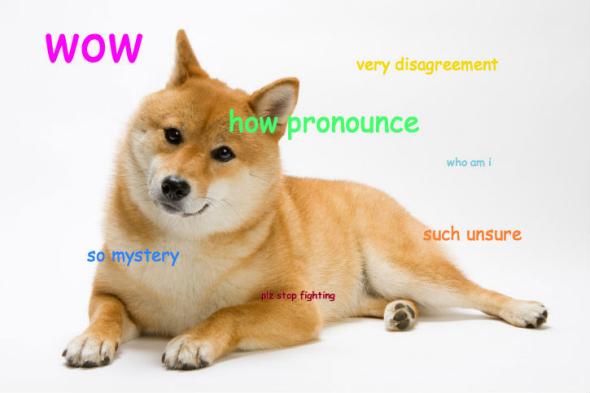
Dogs are better than cats - it has been scientifically proven, by scientists using science - so it's no surprise that LOLcats are so last year when it comes to language memes and dogs are where it's at just now. Well, not dogs exactly, but Doge, a weird variant of English (some use of wow, a deliberate mis-spelling or two, a strange unnatural combination of an adverb plus a noun, for example) that exists on the internet in pictures like this one below.


If you're still not sure what Doge is or why you should care, you can have a look here for a more detailed update, read this link on Superlinguo, or listen to this clip from this morning's Radio 4 Today programme.

(HT to @suewalder for Toast link and @StanCarey for LOLcats article)

Friday, September 27, 2013

When autocorrect attacks

The AS English Language course involves a pretty steep learning curve for many students coming from GCSE, what with its terminology, its theories, its terminology and its... err...terminology. But, there is a light at the end of the tunnel, and no, it's not Noam Chomsky dancing with a glo-stick; we'll soon be looking at technology and communication and the ways in which technology offers us scope to communicate in new ways (its affordances) against the limitations that can sometimes be caused by the devices we use and the kittens - sorry, keyboards - we type on (i.e. the constraints of technology).

So, just for a taster of what can happen when technology constrains us more than usual, have a look at this link showing what can happen when autocorrect attacks.

Monday, April 22, 2013

Some words in your ear

If revising ENGA1 using the visual channel (your eyes) is too much for you, then try something through the aural channel (your ears).

Here's a new episode of Radio 4's Digital Human which talks about how the internet has changed some of the ways we interact. It's not specifically about language throughout, but it's good background for Language and Mode.

Then this is a 15-minute lecture by acclaimed US linguist, John McWhorter on texting and language change. You can read more about it here too. It's very useful for both AS Language and Mode or A2 Language Change and Discourses.

Last Friday's The One Show had a great segment on the changing accents of London, with particular focus on MLE and Cockney, so that fits very nicely with the topic we've just started in ENGA3. You can catch it here until Friday 26th April and the bit you want is from 11 minutes in.

Friday, April 19, 2013

Texting and language discourses

Susan Boyle wants you to come to a party. But what kind of party?
In recent lessons for AS English Language we've been looking at the affordances and limitations of new communication technologies like texts, tweets and message boards as part of work on ENGA1. So, we've seen how technologies allow near-synchronous communication across huge distances, give us the chance to interact with journalists and readers in collaborative acts of communication, rant uncontrollably on the Daily Mail message board, and more worryingly we've stumbled across internet trolls, misunderstood text messages and emails and Susan Boyle's unfortunately ambiguous hashtag (#susanalbumparty).

But as well as being a topic for AS, these new technologies (Can we really call texting new, any more, by the way?) are fair game for work on ENGA3 as well, both in Section A, where we look at change, but also in Section B, where it's more to do with attitudes people have towards changes in language.

This article from the Daily Telegraph is a good example of a prescriptive language discourse around technology and change. Anne Merritt, an ESL lecturer, argues that - despite evidence to contrary from people who have studied texting and literacy - texting is bad for young people:

Call me a traditionalist, but it doesn’t look like a revolution to me. Instead, it looks like a simple decline in proper language skills, born out of a digitally literate culture that has grown too comfortable in an age of abbreviations and spellchecks.

It's worth a read, as it's exactly the kind of article that holds a language topic up for discussion and takes a side: in this case, a side you'd be perfectl;y entitled to agree or disagree with if you were putting an answer together on ENGA3.

For those of you doing ENGA1 Language and Mode (or maybe the AQA B spec's ENGB1 Language and Technology topic), it's interesting to have a look at the abbreviations mentioned at the end. Are these still widely used, or falling by the wayside as technology develops further?

Technolexis

If you're looking for examples of how technology shapes our language for your revision on ENGA3 or ENGB3, then you could do worse than check this article by Tom Chatfield which plugs his new book, Netymology: A Linguistic Celebration of the Digital World.

It includes hashtag, which was the American Dialect Society's Word of the Year for 2012, and geek, which is not necessarily new but has certainly shifted in meaning as time has gone on, plus plenty of others.

One of the terms Cupertino, might be new to you (and me), but the basic concept is pretty well known; it's all down to how new technologies sometimes "correct" our language, even when we don't want them to. Ben Zimmer of the excellent Visual Thesaurus website, talks about it in more detail here.

Thursday, December 13, 2012

Wrath of the grammarbot

Yesterday's Independent features a story about grammar rage on the net which is well worth looking at if you're studying language change, technology and/or attitudes to change.

Outraged at the apparent upsurge in grammar errors on the web, grammar nerds have programmed deadly (ish) attack bots to roam the Twittersphere looking for mistakes and immediately punishing them with sarcastic replies. Basic homophone errors like their/there, your/you're and where/were are the prime targets, but others are facing the wrath of the grammarbot too, like the overuse of CAPS LOCK or the misspelling of sneak peek as sneak peak.

But are Twitter and other forms of digital communication making us worser and worser with are grammer and spelling? Apparently not, if recent linguistic research is to be believed.

In fact, (Tim) Stowell says there is no evidence that any form of "specialized speech" has corrupted spoken or written English, and plenty of recent studies have come to the same conclusion. In September, researchers at Coventry University in Britain ruled that there's no link between text-message conventions, which are also used on Twitter, and bad spelling or grammar in other forums. A 2009 study from the University of Alberta concluded that text-speak should be viewed as a dialect that people can switch into and out of.
Others disagree - sometimes quite violently - and the whole debate is one that we look at when we study the Language Discourses part of ENGA3. There are masses of posts about this very topic here on the blog, so have a look and fill you're boots.

Thursday, November 15, 2012

Tracking tweets

Twitter is proving to be a fantastic resource for linguists and you can see several examples of what's been done with it in these previous blog posts.

More recently, researchers at UCL have been looking at what tweets in London reveal about patterns of language use. The people looking at it, Ed Manley and James Cheshire, aren't linguists but an engineer and spatial analysis lecturer (eh?) so they're more interested in where things happen rather than necessarily exploring why - which might be more interesting for English Language students - but it raises good questions about why certain languages don't appear as often as might be expected- Bengali and Somali, for example - while others do make an appearance - Haitian Creole, Basque and Swahili -among them.

But what might be of even greater interest to A level English Language students is how Twitter is proving to be a source of fantastic data on gender and language, and what we might term communities of practice: groups of people that you "do" language with in your various day to day activities and whose language styles influence your own.

This excellent article by Ben Zimmer in the Boston Globe gives you a clear introduction to what Twitter is offering linguists and you can see more of the work of Tyler Schnoebelen and his colleagues in this powerpoint of their presentation to #nwav41 (Warning! Contains advanced statistics to boggle the mind).

In other Twitter-related research, this link to a paper by Rebecca Maybaum  gives you a glimpse of how Twitter can be used to track evolving slang: in this case, the words used to describe people on Twitter. Tweeps? Twiends? Tweethearts?

Friday, October 12, 2012

Giving the old folks airtime

Habits of telephone use are changing, according to research carried out by the US media research organisation, Nielsen and covered in The Washington Post.

On the whole, the number of voice calls made and the length of the calls themselves, particularly among younger age groups (late teens to mid-30s...so not me any more), are falling. Meanwhile, the older generations still seem to prefer the phone to the text message, but for how long?

Language is clearly being affected in different ways by advances in technology, with many arguments raging about the effects (positive or negative) of text messaging on literacy levels, but as with so many other things, phone use is a type of technology too. Perhaps it's because it's been around for so long that we forget it too caused genuine concern about what would happen to people's relationships and even the language itself.

Of course, mobile phones have changed the way we used to talk on landlines, because a) we know who is calling us (and therefore can avoid all the old-fashioned rituals of "Hello, you are speaking to Bartholomew Smythe-Gherkin; to whom do I have the pleasure of speaking?") and b) we can talk nearly anywhere we like (apart from in Norfolk, where mobile phone use is viewed as akin to witchcraft).

But if mobile use is now changing too, what is it about voice calls (and that expression itself didn't really exist, as far as I'm aware, until video calls came along, since all calls were voice calls back then) that puts off younger people? Some talk about them as being more intrusive than a text message, others that they're less convenient. I know that I've never really liked talking on the phone, conference calls give me the shakes and I don't even want to start talking about Skype because it drives me to despair, but is this down to a lack of social skills or a justified belief that words come out better when texted on a phone? I don't know. Perhaps, in the near future, very few of us will talk at all on the phone and all communication will be via messages. Anyway, go to go now as I need to give my mum and dad their weekly call.

Thursday, September 13, 2012

Texting does/doesn't affect* kids' language skills

*Delete as appropriate

Two conflicting studies have been published about the perils or potential of texting. In one US study, it is reported that "Tweens who frequently use language adaptations - techspeak - when they text performed poorly on a grammar test", and the summary on Science Daily suggests that this might be down to young people's exposure to, and then imitation of, abbreviated grammar and spelling in texts. There's more on the study here and here.

Elsewhere, it was reported in The Daily Telegraph that researchers from Coventry University (who have been studying texting and literacy for a good few years now) had looked at "the spelling, grammar, understanding of English and IQ of primary and secondary schoolchildren and compared those skills with a sample of their text messages" and found "no evidence of any significant relationships between poor grammar in text messages and their understanding of written or spoken grammar". This ties in with their previous findings (search under texting labels on this blog for links to their work) and seems to flatly contradict the findings of the Penn. State study above.


Wednesday, May 23, 2012

ENGA3 revision: some links

Here are a few links to recent articles about different topics relevant to ENGA3.

@backwellengdept have provided this link to an article about World Englishes.
Professor Julie Coleman (whose book The Life of Slang is on my summer reading list) has written this short piece about 7 slang words.
Autocorrect is making us bad spellers, apparently from this article...
...or not, if you believe this take on the same story.

Monday, January 23, 2012

Knowing your leet from your pwned

This link has a look at some internet jargon and helps explain the origins of some of the language on the net. If you're studying Language Change or Language and Technology it should be handy.

Thursday, December 15, 2011

Unfriended for grammar fails

There's a good article here on ZDNet by Charlie Osborne about grammar, spelling and punctuation on social networking sites. She takes a look at how technology has been blamed for grammar failures, but how the fault might lie with how we teach English in schools.

While it's clearly important to teach grammar as part of secondary English, the problem lies in how we teach it. If it's just a dry naming of parts with little sense of what the effects of grammar choices are then we're probably doomed to the nightmare back to the future scenario that Simon Heffer (and his chum, Michael Gove) longs for.

One problem is that many of the gripes about grammar that are often brought up are either matters of taste, rather than "rules" which affect how we actually understand one another, so one person's error is another person's normal usage. That's not to excuse basic errors like you're/your, their/there (which bug me, even though I'm what Heffer would probably call a trendy-lefty linguist).

One explanation for such errors is that in a time of much higher basic literacy rates than ever before, we're seeing more and more people using forms of communication like Facebook, Twitter and texting than we would ever have known before, and while basic literacy is higher, not everyone is as highly educated as those who wrote for public consumption in the past.

So while the footballer, Joey Barton tweets about his interest in Noam Chomsky and Euroscepticism to about one million followers, you'd have needed decades of formal education and a university degree to communicate with that many people in 1870 or 1950.

Not surprising really, because a footballer like Joey Barton generally talks with an educated right foot (and in Barton's case, the occasional headbutt) rather than an educated lexicon. And as a follower of Barton on Twitter and admirer of his genuine interest in exploring the world of knowledge - not something footballers are well known for - I don't mean to criticise or patronise him in any way, but when you look at the history of language, working class men like Barton have rarely had such a public platform for their words.

It's an argument that also links with Joshua Foer's piece in the New York Times in which he looks at how our reading habits have changed from "intensive" knowledge of a limited range of books to "extensive" reading of many texts, including books, newspapers and text messages. And as more and more people write and text in English around the world, perhaps the centrifugal force that has previously bound English usage to the core values of Standard English begins to lose its power, with more and more mis-spellings and grammatical errors circulating, growing in influence and perhaps changing the language beyond recognition. A doomsday scenario for Standard English, or the natural evolution of a growing language?


Tuesday, November 22, 2011

Technology and language change

There's an good article from Natasha Lomas of Silicon.com here which takes a look at how technology has influenced recent language change. It includes contributions from God of language, David Crystal and the OED's John Simpson, so it's got proper linguistics stuff there, plus it gives us some good techy insight into different fields such as text messaging, social networking and Lolcats.

Thursday, October 27, 2011

"Twitter generation loses love of lexis"

...or so this story in today's Daily Mail would have you believe. According to the article, words like cripes, shenanigans and cad are all dying out because younger generations simply don't know what they bally mean (And it's perhaps not just the fault of the younger generation but technology as well because my spell-checker has just red-lined both cripes and bally.).

The story seems to be linked to the publication of a survey for the book Planet Word (presumably a tie-in to Stephen Fry's BBC series of the same name) and to be fair, the expert they quote, the author of the book JP Davidson, doesn't bemoan the alleged decline, but has this to say:

This could be viewed as regrettable, as there are some great descriptive words that are being lost and these words would make our everyday language much more colourful and fun if we were to use them.

'But it's only natural that with people trying to fit as much information in 140 characters that words are getting shortened and are even becoming redundant as a result.

'The folly is to try and stem the tide of the new whether they emerge from rap, technology, teenspeak, or the multitude of jargons that we invent to make shortcuts and communication more efficient between groups. 

This sounds like good sense and isn't in any way as prescriptive as the rest of the Mail's tone (managing of course to tie in some aspect of British identity being eroded as it always does), but the comments from Mail readers start to pour scorn on such descriptive views, arguing (among other things) that the once proud language of Shakespeare is now degenerating into a series of txt-grunts (a kind of Crumbling Castle model for the text generation) and that young people are doing it because they "are even allowed to use text speech in exams now", conveniently (or stupidly) misunderstanding the difference between studying and using. D'oh!

But, there is an interesting argument to be had here over the potentially limiting effects of technology on our lexicon - both individual and shared - because as this new app demonstrates, predictive texting has evolved to offer us predictive messaging. 
 
Swift Key screen
 
Instead of just predicting the word we are typing, this app starts to predict the next set of words, offering us phrases or even whole clauses, based on what we have typed before. There's an example here.

And it's even cleverer than it first appears because it can use your existing style from Facebook, email and your previous messages, building a mini-corpus of your own style and then suggesting these back to you when it is appropriate. 
 
So, what's the problem? If your own style is being reinforced, basically echoing your own lexical and grammatical choices, you might end up with an ever-decreasing range of language choices. If, every time you type a message, you're offered a set of choices influenced by your own database of language, will you be railroaded into a restricted set of words?

Ultimately, will this lead us into a reduced set of lexical and grammatical choices, fulfilling the Mail's to hell in a handcart predictions in the article above?

Tuesday, July 19, 2011

Hackgate

Given that we're in the middle of what's becoming known as Hackgate with its mass of resignations and revelations, this post from John List over on the Oxford Words blog offers a helpful discussion of what hacking means to him.

According to List, being a hacker is not about secretly accessing someone's voicemail, or taking down a website (however funny that might be) and everything to do with taking pride in your geekiness, or as Oxford Dictionaries Online defines it, "an enthusiastic and skilful computer programmer or user".

Monday, April 11, 2011

LOL For The Win

The OED's decision to add LOL, OMG and the verb to heart to its latest update has already been covered here on this blog, but this BBC News Magazine piece about LOL is a really good read, not just for its content but also its form and style, which make it a neat example of how a Language Intervention (ENGA4) or Media Text (ENGB4) might work. It's also a good example of the sort of short article that can appear on the ENGA3 paper for Language Change, offering plenty of scope for discussion about attitudes to change, reasons for change and processes that help changes spread.

Follow EngLangBlog on Bluesky

The old Twitter account has been deleted (because of both the ennazification and enshittification of that site) so is now running on Bluesk...