Friday, January 21, 2011

txtng: some more db8

Today's Daily Telegraph upsets its readers with a report on new research from Coventry University about the effects of texting and mobile phone use on young people's literacy, namely the beneficial effects texting can have.

The research comes from Clare Wood and her team at Coventry (members of which came to SFX two years ago to talk about their work) and is part of a series of projects they have been involved in. Click on the texting label underneath this post to find all the other SFX blog posts about their work (and related articles).

To give you a taste of the reaction to this research from the Daily Telegraph readership, or at least the part of it that feels compelled to contribute to a message board, have a look at these extracts:

Really? These academics need to get out more and see the result of the texting game, many young people are not only unable to spell and write but sometimes incapable of expressing themselves. Wossit', innit' wha'ever, shu'up!!! 

I can only assume the researchers are from the same genetic pool that fill in recruitment forms for my company!?

This is just an attempt to cover up the failure of the teaching community to teach correct spelling and grammar.

The bankers get (rightly) criticised for wasting our money, it's about time these pseudo-scientific research studies get stamped-out. 

How on EARTH can "U alrite m8" boost spelling SKILLS?
What a load of stupid HOGWASH. 

Luckily, there are also some sane readers (OK, ones that I agree with) who have made a few interesting points about prescriptive attitudes to language change and the influence of technology, or about phonetic spelling actually being any use to English:

There have been numerous historical examples of shorthand writing that are reminiscent of texting, without civilisation coming to an end. It's just nothing new.

...you can always be sure with any technology that some will view it as the end of all things, and future generations will laugh at them. 

If English was a vaguely phonetic language, the article might make some sense. However, since we have 40 sounds in English but more than 200 ways of spelling them, I very much doubt that texting helps. 

David Crystal's Txtng: the Gr8 Db8 is a good introduction to some of the arguments about technology and language change, and he is of course one of the speakers at the Emagazine A  level English Language conference in March. Have a look here for more details about the conference and here for more links to articles and arguments about texting.

And, of course, all of this glosses over the true dangers of texting that can be seen here.

Thursday, January 13, 2011

Blood libel: language change in a heartbeat

Following on from the post about violent rhetoric and metaphors of conflict, Sarah Palin has now come out with a bizarre phrase - "blood libel" - to describe "slurs" upon her and her Tea Party movement by those who've linked their inflammatory language to the Arizona shootings.

"Blood libel", had until fairly recently, only ever been used as a term to describe the unpleasant myth that Jewish people killed Christian children as part of some bizarre ritual. It's one of many racist slurs that Jewish people have had to put up with during an extended period of persecution. So why did Palin choose to use such an esoteric expression to respond to her accusers?

This article offers some suggestions and makes some fascinating points about how language changes as a result of social networking technologies and the web.


The first use of the phrase I uncovered came on January 9, one day after the shooting, on the website Renew America. As conservative activist Adam Graham put it: “When someone on the left says that the Tea Party movement is responsible for the shooting in Tucson, they are leveling the political equivalent of a blood libel that blames an entire political movement for the actions of a person who in all likelihood had no connection to the movement.” Note that Graham links to the Wikipedia page on “blood libel,” demonstrating knowledge of the traditional meaning of the term.

They also link to this article which makes the intriguing suggestion that internet "memes" spread more like a heartbeat than a virus, a model for language change that might start to rival the traditional wave and S-curve models.

Wednesday, January 12, 2011

Tired AF so just a short post

Computer scientists at Carnegie Mellon University have been analysing Twitter messages in the USA and found some interesting regional variations, which linguists have started to pick apart.

This report (which I found via this site) tells us more. It's no surprise that tweets reflect the regional, social, ethnic and age variations of the tweeter, but it's intriguing that such variations can be mapped so closely. For example, to find that intensifiers like hella, meaning really/very (as in hella tired) or dead ass (as in dead ass tired), or even a comparative version like AF (as in tired as f**k) can be traced to specific cities or states is quite a neat idea.

So, as we pointed out back here, Twitter is actually working to preserve some regional variation rather than lead to the dialect levelling that so many people predicted.

edited on 13.01.11 to add:
There's another blog post about Twitter that fits in with this recent research here.

edited later on 13.01.11 to add:
For an LA blog's take on their Twitter slang/dialect try here.

Murder and metaphor

The gun rampage in Arizona that has left six dead and Congresswoman Gabrielle Giffords critically injured has initiated a great deal of discussion in the media in the USA and elsewhere. Many commentators have focused on Arizona's gun laws, while others have chosen to focus on the language of political debate and whether or not the febrile atmosphere stoked up by the right wing Tea Party might have contributed to a climate in which such an attack was inevitable.

Today's Guardian features an article by Jonathan Freedland in which he explores the language of conflict and warfare that has been used in recent political discourse in the USA. He picks up on Sarah Palin's visual imagery of crosshairs targeting Giffords' congressional seat as well as the combative streak that runs through her rhetoric, including her exhortation for her supporters not to retreat but to "reload": a bit ironic really, given that for all her love of guns, Palin is reputed to be a hopeless shot (as well as an imbecile, obviously).

Freedland makes a number of interesting points about the language of politics, one of which being that politics is saturated with violent metaphors:

...Palin is hardly the first politician to use the language of combat. She could argue that anyone who has ever referred to "battleground" constituencies, talked of candidates "wounded" by "fatal blows" or arguments "shot down" is just as guilty as she is. In this, she could cite the unlikeliest examples. It was the sainted Obama who revved up a crowd in 2008 by declaring of his Republican opponents: "If they bring a knife to the fight, we bring a gun."

Elsewhere, the linguist John McWhorter  takes a look at the ways he thinks the internet is partly responsible for glib soundbites, rather than reasoned and nuanced rhetorical debate, taking hold of politics.

Friday, January 07, 2011

Emagazine conference site now up and running

The site to support the forthcoming Emagazine A level Language conference is now up and running. You can find it here.

At the moment, you can see the programme, the speakers' details and how to get there, and you can also book tickets for your school or college (if you are a teacher).

There is also a blog running alongside the site to help collect data from you for Jonnie Robinson's session and to submit your questions about language to David Crystal for his Q and A session. We'll be updating the blog regularly with information about each speaker, links to interesting research and some follow-up activities after the conference. You can find the blog here.

We're very excited about the conference, so get your tickets now!!!

Wednesday, January 05, 2011

Media texts and Language interventions

As loads of A level Language students (and teachers) are currently looking for style models to use for the A and B spec A2 coursework, I thought I'd try to make the search a bit easier by pulling together links to articles and stories that might be good to use.

I'll try to group these into broad areas that have been helpful for me in the past, but if you'd like to suggest other categories or argue about how I've grouped or defined these, just say.

(Updated with new links on Monday 17th October 2011)

Op-eds (opinion/comment pieces by named writers)

News stories


Feature articles


    OK, that's a start for now, and I'll add more over the coming days. You can also look for the blog posts where these articles were first mentioned by putting various keywords and phrases such as language intervention, media text, style models, texting, slang, new words, political correctness in the search bar on the top left of the screen, or by clicking on the labels below.

    You might also find this link helpful as it gives more info about what an op-ed is. I've always told my students it's an opinion editorial, but this link says that's not the case. Ho hum.

    This is quite interesting on different types of feature article too.

    Tuesday, January 04, 2011

    All that junk inside your trunk

    Happy New Year and all that. Just a couple of quick links here about new words for 2010 (junk being a potential word of the year) and reasons for English's continuing lexical growth. And here's one from today's Independent about political and professional language.

    Normal service will be resumed once I've recovered from back to work depression and the experience of a Barbie Princess Castle alarm clock going off at 2am, causing my daughter to scream and think that the world had ended.

    Monday, December 20, 2010

    English, Englishes, Elves and Latin

    There's a good introduction by Michael Rosen to the role of English as a world language in the BBC News magazine this week. He looks at the role of Latin as one of the first "world" languages (sort of...) before moving on to think about the ways in which English and its various Englishes have spread around the globe.

    Some of the most recent debates around this issue have centred around the existence of a standard form of the language (Global English) or different versions of it (Global Englishes), or more recently around a phenomenon called ELF (English as a Lingua Franca). Anyway, Michael Rosen's article is a good start if you want to find out more about the background to the debate, and you can find some more discussion on this blog post.

    Friday, December 17, 2010

    Hit Me Up with some culturomics: new words for 2010

    Moustache + November = Movember
    As we get closer to New Year and the alcopocalypse that is the Christmas party season, many language enthusiasts like to have a look at the new words that have emerged or gained new prominence in the year so far.

    It's been a good year for new words, with one of my favourites being a renaming of a whole month as Movember ( a blend of the clipped mo for moustache and November). Having spent a rare night out in Hoxton a few weeks ago, it was hard to distinguish the brave Movemberists from the usual hipsters who normally sport a pathetic caterpillar atop their upper lips.

    Wiki- has grown in popularity as a prefix too, with Wikileaks being all across the news over the last month. We looked at the wiki- prefix a while ago on the SFX Moodle ENGA3 unit (and if you're an SFX student, it's still there and you can contribute to the new words wiki), but for those who aren't SFX students the etymology is here. At the other end of a word, you'll find a suffix, and the -gate suffix which first appeared, not as a separate morpheme but as part of the proper name Watergate, has been applied ever since as a suffix to any type of scandal. So earlier this year when the General Election was taking place (You must remember: it was when and Nick Clegg was telling students that he would scrap tuition fees and David Cameron promised that EMA was safe.) Gordon Brown got himself involved in Bigotgate. And connected to Wikileaks, we have cablegate, where the cables that were intercepted have had -gate tacked on the end.

    Connected to Wikileaks again is hacktivism, which is a blend of hack (as in its computer hacker meaning rather than its other ones) and activism. The Visual Thesaurus article on new words has more on this and loads of other words, and, like most things on VT, is a really good read.

     The role of  social networking tools like Facebook and Twitter in spreading language and creating new trends (trending as a verb being revived thanks to Twitter) has continued to have power over many people, with the initialism HMU (Hit Me Up i.e. call me/contact me/ping me/BBM me/message me/give us a bell) coming top in the Facebook status updates top 10 list. Until the day I saw that report, I had never heard of or used HMU, but now I will. Every day.

    Pamela Stephenson - a true GILF?
    Another new word, which may well have existed for a little while, but came up at a recent teachers' reunion in a Soho pub (which probably tells you a lot about the ages and mental states of those involved) was GILF. If you already know what a MILF is then you should have a fairly good idea of what a GILF might be. And if you were to then think Pamela Stephenson on Strictly Come Dancing, you'd be close to the real meaning. What can I say? There are some sick people out there. I prefer the X Factor.

    On a much bigger and more educationally respected scale, this report in today's Guardian reveals how a project at Harvard University is creating a database of billions of words by digitising more than 5 million books. They call  it culturomics: presumably a blend of culture and economics, with a bit of linguistics thrown in? a blend of culture and genomics (as pointed out by Ben Zimmer in his comment below).

    What's particularly revealing from a lexical point of view is that the vocabulary of English is seen to be expanding rapidly. The figures quoted in the study show that in 1900 there were an estimated 544,000 words and then in 2000, 1,022,000 words, with an estimated growth of approximately 8500 words a year.  The report's abstract can be found here and there's a lot of good reading in there, including how grammar is changing over time. One of the most striking points about grammar is in the section on the regularization of past tense endings:

    ...each year, a population the size of Cambridge adopts “burned” in lieu of “burnt”...1% of the English speaking population switches from “sneaked” to “snuck” every year: someone will have snuck off while you read this sentence.

    On that bombshell, I'll sign off. This will probably be the last blog post this year, so have a good Christmas break and New Year.

    Tuesday, December 14, 2010

    Pim-holes and Jeremy Hunts

    Swearing is all over the media, literally in the case of Radio 4 last week which delighted/shocked (delete as appropriate) its listeners with two unintended utterances of one of the rudest words in the English language. It's a word so rude that if I typed it here, you would never again be able to read this blog at a school or a college, so I won't*.

    Anyway, the use of this dreaded word appeared to be a genuine mistake on the part of the Today programme's James Naughtie, as he tried to trail the appearance of Jeremy Hunt, the Culture Secretary (as you can hear from this clip of his slip). Later that morning, on the same station, Andrew Marr repeated the word while talking about the error Naughtie had made. Naughtie later made an apology, claiming that the mistake was a Spoonerism, a substitution of initial sounds between two words (try swapping the initial consonants of "shining wit" or the name of circus accessories store, "Cunning stunts" and you'll see what I mean).

    So, why the outrage? Well, swearing still upsets lots of people even though lots of us do it and have done for centuries. This article by Jonathan Margolis from back in 2002 looks at how attitudes to swearing have changed over the years and provides a bit of background, but if you want a really detailed look at bad language, you could do no worse than put Peter Silverton's Filthy English on your Christmas list.

    Sometimes though, our willingness to be shocked can be rather odd. This report on the UK Polling Report site tells us that 61% of respondents in a recent survey thought that the word pim-hole should either never be broadcast on TV or only ever broadcast after the watershed. That's pim-hole. It doesn't actually exist as a real word, outside this 1990 Fry and Laurie sketch about swearing. The full report is available from YouGov here and contains strong language. Obviously.

    We've looked at swearing before and you can find some interesting stuff here and here. Also, Steven Pinker's most recent book, The Stuff of Thought, features some really interesting stuff on the links between swearing and language evolution, which these short lectures throw a bit of light upon:

    and:

    *But what I can tell you is that it's a word most sensible people say whenever George Osborne appears on TV.

    Friday, December 10, 2010

    Variety is the spice of language acquisition

    Some new research into children's acquisition of language, reported here, suggests that children who are presented with more diverse objects of a similar type are quicker at developing their grasp of nouns than those who are shown a smaller range. The report explains further:

    Two toddlers are learning the word "cup." One sees three nearly identical cups; the other sees a tea cup, a sippy cup and a Styrofoam cup. Chances are, the second child will have a better sense of what a cup is and -- according to a new University of Iowa study -- may even have an advantage as he learns new words.

    This might not strike you as such a great surprise, but it's a study that sheds a bit of light on the processes children go through as they develop a sense of what a word means and the limits to which they can stretch that word's range of meanings. The linguist and child language expert, Jean Aitchison, talks about children acquiring words and their meanings as going through a process of labelling, packaging and network building. As you can probably see from this research, showing children a range of different objects, all with similar characteristics, seems to help them with the packaging and network building elements of their language acquisition.

    The research goes on to suggest that a knock-on effect of this early boost to lexico-semantic acquisition is an enhanced ability to generalise. So, when children were later asked to identify objects that they hadn't seen before (or types of objects that they had seen in slightly different forms) they were better able to label them:

    When tested on unfamiliar objects that fit into the categories they'd been taught -- such as a bucket they'd never seen before -- kids in the variable group performed better. This showed an ability to generalize the knowledge. "We believe the variable training gave them a better idea of what a bucket was. They discovered that the buckets were all alike in general shape, but that having a handle or being a particular texture didn't matter," Perry said. "In contrast, the children exposed to a tightly organized group of objects developed such strict criteria for what constitutes a bucket that they were reluctant to call it a bucket if it was different from what they'd learned."

    Thursday, December 09, 2010

    emagazine A Level Language Student Conference

    Sorry for not posting much recently, but I've been busy with various things including some A level workshops, the day job (doing neeky grammar things) and organising (or organising how to avoid) trips to Mr Tumble in pantomine. The other thing I've been doing is helping the English and Media Centre organise what we hope will be a brilliant conference for A level English Language students.

    All the details are here and if you want to attend as an A level student then badger your teacher to get a booking made. If you are a teacher, email Barbara Bleiman (barbara@englishandmedia.co.uk) at the EMC to express your interest and provisionally book some places. If you are a university student, there will probably be individual tickets available and more details will be made available soon after Christmas.

    The details:
    Wednesday March 16th 2011 – with David Crystal, Deborah Cameron and others...
    At the Logan Hall, Institute of Education, London WC1 (10 min walk from Euston)
    Following the success of the Literature and Media Studies student conferences in the Autumn Term, emagazine is planning a conference for A Level Language students in the Spring Term, for AS and A2. We are working with Dan Clayton to plan the day.

    The programme will include lectures, a session on approaches to investigation, with an interactive element, and a short session modelling how to respond to data in an exam. At lunchtime, we are hoping to organise a ‘Language Fair’, with stalls from one or two university departments, a surgery held by the emag editors for anyone wanting to write for the magazine and a ‘resident linguist’ who will answer students’ questions and chat to them. We’re also hoping to set up a Conference blog, in advance of the Conference, to get students involved before the day.

    Speakers confirmed so far:
    • Deborah Cameron
    • David Crystal (including a Q&A session, with David Crystal, based on students’ questions, sent in advance, and submitted on the day)

    Programme: 10.30 – 3.15 to allow for ease of travel
    Cost: £20 per school/college student. 1 teacher per 10 students goes free. £50 for teachers wanting to attend without students, as CPD.
    A conference website will be set up at the beginning of next term, (accessible from the EMC and emagazine websites) with full details and the facility to make provisional and confirmed bookings. In the meantime, put it in your diaries and if you would like us to keep you informed, please email barbara@englishandmedia.co.ukwith ‘Emagazine Language A Level Conference’ in the subject line.

    Hash, octothorpe or pound?

    Several articles have picked up on the rebirth of the # symbol thanks to its use as a hashtag on Twitter. This article looks at its history and return to fame, while this brief piece in today's Guardian does something similar. It's also called a number sign on Wikipedia.

    Other punctuation marks have had similar histories and undergone revivals thanks to multimodal forms of communication. Previously on this blog we've looked at the exclamation mark !!!, the l'il apostrophe , the hyphen and you can also read more about the @ here)

    Friday, November 26, 2010

    Right-sizing the workforce

    I used to try to add regular blog posts about the evils of corporate and management jargon, but in many ways this kind of language has become so mainstream that it's often no longer jargon. Sadly, the jargon has won. This article from today's Guardian takes a look at the jargon used in corporate law and it's a depressing read. If you thought Melissa from The Apprentice had swallowed a dictionary of drivel and was talking utter nonsense, then some of the expressions mentioned in the article will probably make you think she was actually normal.

    One example is particularly egregious: right-sizing. When used as a noun - "We have to implement some right-sizing to meet our profit forecast" (or some such cobblers) it both hides and confuses meaning. What it really means, of course, is cutting staff - making them redundant - and cutting them to the level that is "right" for the business, or more accurately, the business's profits.

    Grammatically, it seems to be a form of nominalisation: a term used to describe a process, that usually involves a verb, becoming a noun. So instead of it being an action or ongoing process, the noun becomes the label for the entire end result.

    An simple example might be something like describing a person as a "stabbing victim" - a noun phrase which basically carries the information that the person being talked about is the victim of the process of the verb "to stab". By using nominalisation, the focus is taken away from the process or the action itself, and switched to the person affected by the action. By doing so, in a way, the process itself becomes wrapped up with the person who has experienced it: they become bound together.

    Why does this matter? Well, a bit like with the passive voice, if agency (i.e. who did what to who) is hidden, we don't get a full picture of events. We see an end result, but not the process that led us there. It could even be argued that by doing this we are less likely to be able to challenge or prevent the process - we may not even see it - and that hides responsibility and the bigger picture of cause and effect. Still with me? No... Oh well.

    In the case of right-sizing, the process of cutting jobs is condensed into the idea of "sizing" - which almost inevitably means making something smaller - but even more devious is the use of "right" which carries with it connotations of correctness and even virtue. But of course, it's only "right" for the person who makes money out of cutting a job. For the person who has been a victim of right-sizing, it's probably very wrong!

    Thursday, November 25, 2010

    Rage, riots and representation

    The student demonstrations in London the other week, and all over Britain yesterday are not only (in my personal view) a positive sign of resistance to massive cuts in education, which students should be proud of themselves for taking part in, but a great chance for language students to look at how the media represents protests, protesters and police.

    Today's Daily Mail for example, has decided that the most notable thing about yesterday's demonstration was not the fact that it involved university, sixth form and school students in many different cities and towns across the UK, but that girls were involved in violence and vandalism. Under the headline Rage of the Girl Rioters, they describe female protesters as "the disturbing new face of the riots". So, they seem to be suggesting that if you're a male protester who gets a bit angry and launches a flying kick at a police van it's par for the course, but if you're a girl, that's simply unladylike. Unless of course, Facebook is involved, in which case the females were not "the disturbing new face of the riots" but frivolous young floozies, there only to take a few pictures and pose fashionably amid scenes of urban vandalism. Girls, know your place!

    What's interesting from a language point of view is how grammatical and lexical choices can be used to offer very different representations of events.

    Take these two lines from the Mail's coverage and have a look at the use of active and passive voice:


    (Rioting girls) threatened to overturn a police riot squad van as they smashed windows, looted riot shields, uniforms and helmets and daubed the sides with graffiti.
    Here, the girls are the subject and agent of the sentence, responsible for four verbs (threaten to overturn, smash, loot and daub), which themselves are chosen to represent wild and unrestrained behaviour.

    As tensions ran high, police were forced to ‘kettle’ 5,000 protesters for hours just a short distance from the Houses of Parliament.
    But in this example, the subject of the sentence - the noun phrase police - is receiving the action of the verb ("to force"), suggesting that they were not responsible for the kettling taking place (itself an interesting noun- verb conversion). So, who was? We don't know because there isn't an agent in this sentence: the sentence seems to be suggesting that a mighty force beyond the police's control (God...Doctor Evil...Jay-Z) might have forced them to comply. But no, it was probably the senior police officer who was responsible.

    Of course, it doesn't take a genius to know that the media would generally rather focus on a dramatic image of violence - a masked protester smashing a window, a fire extinguisher dangerously close to police lines, a student urinating on a police van - so it's also a good idea to look at how the largely peaceful and orderly protests in places like Leeds, Sheffield, Colchester and Winchester were reported upon in local papers, where a more balanced and thoughtful representation might be offered.

    Monday, November 22, 2010

    Gang slang: a response

    The article by Lindsay Johns in the Evening Standard the other week has already kicked up a fair bit of discussion here and elsewhere, but The Voice has a brief response to it here. As well as being an interesting debate about language, there's plenty of material in the original article, the comments after it and this piece to help any English Language A level student who's putting together a Language Intervention for ENGA4 or a Media Text for ENGB4.

    A prescriptivist pot-pourri

    Conservative governments - even ones that barely scraped into power and find themselves propped up by Lib Dem MPs - tend to like their pronouncements about "tradition", especially when it comes to cultural touchstones like the English language itself and the traditions of the language. So, it's not much of a surprise to find that Michael Gove, the Tory Education Minister, has started to talk tough about spelling and grammar in school students' work. According to Friday's Daily Telegraph, students will lose up to 5% of their marks at GCSE (in any subject) if their spelling, punctuation and grammar aren't up to scratch.

    Now, you'd be hard-pressed to find an English teacher who doesn't think that clear communication is vital to the education of a student, and I think most students would probably agree too. But dig a little deeper into what Gove and his supporters say and you get a much more muddled picture of what "clear communication" means. Take the comments on this page of the Daily Telegraph's site, where posters bring up many of their own pet hates about language usage - "sloppy speech", innit, we was, slang of all colours (but mostly black and/or American), anyone who doesn't speak RP -  and you can see that to the Conservative Party's natural support base, the perception is that the English language has been wrested away from them and placed in the hands of the infidels and chavvy proletarians, but now they can claim it back as their own.

    The horrible prescriptivist pot-pourri that appears on pages like this shows us what confusion there is about grammar and how we should be studying it in more detail: not studying it to be prescriptive and claim that one should never dangle a participle or split an infinitive, but to learn more about the language in all its fantastic variety. The approach I'd support is the one outlined here on the UCL project blog and here in an article for the TES that Professor Dick Hudson and I wrote the other week.

    More grammar - yes please, but not the kind of "grammar" that should remain in the Victorian schoolbook or in the snug of some Surrey village pub where the bar is propped up by retired wing-commanders and investment bankers whose grammar is basically prejudice dressed up to look like knowledge.

    Tuesday, November 16, 2010

    An adapting language

    Today's Independent celebrates the forthcoming World Languages Day by running a fascinating article about world languages and the "discovery" of a previously unknown language from the Himalayas. The article is well worth a read for its overview of the decline of world languages - it is estimated that about half of the world's 7,000 languages will be extinct by 2100 - but also because of the light it sheds on new theories of language acquisition.

    One of the most striking bits of the article (for me, at least) is the suggestion from evolutionary biologist Mark Pagel that language is not a product of an inbuilt language acquisition device or language instinct, but should be viewed as similar to an organism in its own right, adapting to the human brain in order to survive:

    All humans have the same brain, which is why successful languages tend to resemble one another, giving the illusion of a universal grammar. But, Pagel says, they may have arrived at that similarity via different routes, and solved the problem of being easy to learn in different ways. 

    I'm not much an evolutionary linguist (or much of any sort of linguist, if truth be told) but this is a weird and rather wonderful idea that really appeals. There's some more about Pagel's research here and here, if you want to look further.

    edited to add:
    A colleague at UCL (thanks, Jill) tells me that Simon Kirby at Edinburgh is also interested in this language evolution approach. For those of you who have seen the excellent Why Do We Talk? Horizon documentary on language acquisition from last year (and available here last time I looked), Simon Kirby appears towards the end to talk about the experiment in which students are asked to name different coloured fruits. One of his papers is available here.

    Monday, November 15, 2010

    Hard-wired or softly spoken

    The debate about gender and language use is one that has been a hot topic in linguistics for the best part of 40 years. From Robin Lakoff's "Women's Language Hypothesis", through to the staunchly feminist dominance model, into the difference model of Maltz & Borker popularised by Deborah Tannen and then John Gray, before recently heading into a discourse and diversity approach championed by Deborah Cameron, the debate has developed apace.

    Today's Guardian features a strong comment piece by Madeleine Bunting that focuses on the recent clashes between followers of a "hard-wired" approach to gender differences, and those who suggest that context and individual differences are more important. Deborah Cameron is a key reference point in the article and it's exactly the kind of debate about language (and other things) that underpins the ENGA3 unit on the AQA A spec, and the ENGA4 Language Intervention. It's also an interesting read for anyone who wants to mug up on some of the latest arguments about biological determinism and the influence of culture and upbringing.

    Friday, November 12, 2010

    Quick links

    I'll be adding  a few more links to the sidebar soon, but until then, these websites and blogs are definitely worth a look.

    BBC2's Culture Show featured a good segment on the British Library's Evolving English exhibition which you can find on YouTube here.

    Ben Zimmer's On Language column in the New York Times is always a good read and he has recently looked at youth slang and the growth of the word relatable (which even as a self-proclaimed anything-goes-trendy-leftist-linguist bugs me more than I know it should).

    Dennis Baron's The Web of Language site is new to me so I haven't got much to say about it yet, although I'm reading his A Better Pencil at the moment, a book about technology and writing, which is interesting for anyone looking at multimodal forms.

    Stan Carey's Sentence First is already listed in our sidebar links, and it's a very informative blog.

    Also, here's a link to the Daily Telegraph's review of the British Library Evolving English exhibition.

    Thursday, November 11, 2010

    The decline and fall of English?

    This morning's Radio 4 Today programme had a good segment on the future of the English language featuring expert opinion from top applied linguist, David Graddol (whose excellent Open University books on language change and diversity, I'd thoroughly recommend). Is English going to remain the world's favourite language, or will it decline as other world powers, like India and China, start to dominate the globe?

    You can listen to the clip here.

    The tweeting of birds (and blokes)

    The MacMillan Dictionary blog has always got good stuff for English Language students and this post is particularly interesting if you're looking at Language and Gender on ENGB1 or Language Variation for ENGA3.

    They link to a fascinating project at the University of Trento in Italy which analyses the lexis of Twitter tweets and breaks them down into gendered usage. So, you can search for Robin Lakoff's famous "women's language" features - words like adorable, gorgeous, lovely, divine - and even two word "compounds" - really gorgeous, so cute - to see which gender uses them more in their sample. They've also got a collocate tool that allows you to look for the most common words associated with other search items. So you could look for "pie" and find that on of its male users' most favoured collocates is the Homer Simpson-esque "pizza pie" (mmm... pizza) while one of the favourite female collocates is "sweetie pie".

    Of course, all the usual caveats apply to this kind of broadbrush approach. We don't get much context, we don't get much sense of what types of men and women are tweeting and we don't get to see raw data to explore it further, but all in all it's an interesting approach and worth having a look at.

    Tuesday, November 09, 2010

    Woop woop - it's the sound of the gavvers/boy dem/po po/filth/coppers/babylon

    Here's the real sound of the police, but for those of you who don't want to travel back in time to the prehistoric days when hip hop meant something, just go straight to yesterday's Guardian which ran a short item on the slang used by some British police: you can find it here.

    The whole area of occupational language is a good one to study. Doctors, teachers, soldiers, call centre workers and firefighters are all likely to have their own occupational varieties, which themselves might be affected by the speech styles of the individuals in the job, or the geographical area that people work in. The police are no exception to this and their occupational variety is probably one of the more widely scrutinised forms because it often appears in transcript form in court, or (perhaps more glamorously) on TV dramas and even reality police shows.

    So is this sort of occupational variety a slang or a form of jargon? To what extent might we call the police a "community of practice"? According to the definition given by Graeme Trousdale in his excellent new book, An Introduction to English Sociolinguistics, a community of practice is defined by three characteristics: mutual engagement, a jointly negotiated enterprise, and a shared repertoire. He uses the example of a school rock band to illustrate these characteristics.

    Here, a number of individuals come together in face-to-face contact (mutual engagement) for a particular purpose, that is, to play music (jointly negotiated enterprise), often conversing using jargon common in discourse on popular music, such as riff, bridge, amp, bass guitar and so on (shared repertoire).

    Is the same true for the police? I think so. And like other communities of practice, there is pressure from within to use language in the accepted way, meaning that members of the community of practice become institutionalised in the language of the organisation.

    Quite where this leaves the firearms police involved in this case, I don't know. they seem to have developed their own discourse, which apparently consists of slotting in as many song titles as possible into their witness testimony...

    If you're interested in the language of the police, this link to a forum about police slang/jargon might be of interest.

    Also, the many different words used to describe the police can be found here.

    edited to add: 
    While on the subject of communities of practice, this short article about the language used on message boards by divorced women discussing their relationships is quite a good one. There's the usual mix of acronyms and initialisms that we tend to see online (although I'm not sure LOL has been correctly defined here) along with a  smattering of new ones like STBXH (Soon to be ex-husband) and OW (other woman).

    Tuesday, November 02, 2010

    Evolving English - lots of languagey stuff

    The British Library's Evolving English exhibition starts next week and looks really amazing. Here's a link to the evening talks and events. There's slang, swearing, the language of the Bible, Multicultural London English, gender and language. It's all there and blooming exciting.

    Gang slang is not nang but don't be prang...

    ...and other desperate attempts to use slang in a headline in a(nother) post about slang.

    There's now quite a number of comments that have been added to the article in Yesterday's Evening Standard, and they make for an interesting read, especially if you are an AQA A spec student looking at Language Discourses on ENGA3.

    We've got some fairly rabid anti-immigrant postings, where the link between young black people, slang and crime seems to have got a few EDL/BNP types all upset. We've got some "crumbling castle" views, suggesting that our once beautiful language has been reduced to a vile slang code understood only by debased urban raggamuffins. We've got some descriptivists arguing that slang has always been around and is just one code that people use in certain contexts. We've also got a few others arguing the toss over the meanings of certain slang terms that have appeared in the glossary in the article. It's quite a range. Why not contribute yourself and add to the debate?

    The writer of the article, Lindsay Johns, has a track record of  attacking slang and defending what he calls "proper English", as you can see from this article from 2009.

    Finally (until I get worked up again and start ranting about slang) I've added a poll to the right of the blog homepage where you can add your view to what "peak" actually means to you. If you feel particularly passionately about this latest bit of London slang you can add a comment too.

    Monday, November 01, 2010

    Gang slang: not peak, just moist

    Today's Evening Standard features an article by Lindsay Johns which sports the terrible headline "The secret world of gang slang". It's a terrible headline for two reasons. Firstly, the article isn't really about "gang slang"  (whatever that is supposed to mean): it's more to do with youth slang in general. Secondly, the headline gives the impression that slang is linked to gangs and violence: it can be - as anyone who has studied slang should know, some forms of it have their origins in the secret language of criminals - but more often than not has nothing to do with criminal behaviour.

    The article itself is a bit of a let-down. Instead of talking to linguists (you know, the people who actually spend their lives studying language and looking at its usage), instead of talking to slang lexicographers (the people who put together and research dictionaries about slang, people like Jonathon Green and Tony Thorne), the writer talks to people who have opinions about slang but don't really have much to say about it: people like Simon Heffer, a man who knows virtually nothing about slang but has lots of views about how awful teaching is these days and how slang is a bad thing.

    What really bugs me about the article is that it casts young people as some kind of alien species, whose language is so different from that of mainstream society that they are unintelligible. That may be the case for one or two unfortunate individuals who can barely pass a bus without saying "Dat's peak, bruv" but for most young people this really isn't the case at all. Code-switching - moving between languages or registers of languages - is something that people do all the time. Young people are especially adept at it.

    So, to cast youth slang as simply gang-related and sinister just adds another dimension to the alienation already felt by a lot of teenagers. But I'm 41 years old and a "trendy leftist", that breed of linguist that Simon Heffer blames for the collapse of standards in teaching, so what do I know?

    To be fair, there are some interesting bits in the article, but I'm just a bit jaded after reading so many articles about slang that say the same thing. So have a read and see what you make of it yourselves, I suppose.

    Thursday, October 28, 2010

    Attitudes to foreign accents

    With the post earlier today focussing on changing English accents and pronunciation, here's something different. A piece of psychological research from the USA and covered on the BPS research digest shows that in a study of "believability" heavier foreign accents came out lower in their score than light accents or "normal" ones.

    The researchers suggest that it isn't just down to prejudice, but might have something to do with what they refer to as the "fluency effect" (Wikipedia defines and explains it here). Perhaps if we struggle to process a heavier, less familiar accent, we tend to believe the content of it less. The study referred to by the BPS seems to suggest that the fluency effect really has an impact.

    A while ago (1971 to be precise) Howard Giles carried out a famous sociolinguistic study when he looked at attitudes towards different accents in the UK. He used a matched guise structure for his study (read more about this methodology here) and the American study is similar in many respects.

    Edited on 26.11.10 to add:
    This piece of research into the brain's activity when faced with foreign accents is also quite interesting.

    Why we love i and simples

    There's lots of good stuff for students of language change in today's papers and online, with the latest additions to the Collins English Dictionary getting some coverage. The Scotsman gets some expert opinion from Edinburgh University's Geoff Pullum on the new entries to the dictionary and you can read more here. Elsewhere, the BBC covers it here and The Guardian here.

    For many of these articles, the highlight is the inclusion of a humorous Russian meerkat and his use of "simples". Linked to new words and their formation, the BBC News magazine also has an interesting look at the way i- has entered the language as a kind of trendy prefix. According to the article, now we have the iPod, the i-Player and the i-Phone (well I don't have an i-Phone but I wish I did) but soon we will have i-everything. In the same way that e took off as a briefly funky prefix to add to anything you wanted to pretend was modern (e-commerce, e-marketing, email...) i- has become the new must-have prefix. It's a good read and features the wisdom of Tony Thorne from King's College, London, a man who knows his onions when it comes to language change and new words.

    Getting in a pickle with lickle Mr Tickle

    The forthcoming British Library Evolving English exhibition is looking like a brilliant event for anyone who is interested in our language, and it's receiving some national coverage today for its focus on our evolving accents.

    This morning's Radio 4 Today programme featured Jonnie Robinson from the British Library and John Wells, the UCL phonetician, talking about how our pronunciation of different words changes and how people feel about those changes. You can listen to it on i-Player here and if you're an SFX student try the link through Moodle that will appear later this week.

    The BBC News website covers the exhibition's focus on collecting pronunciation here and they explain how the Mr Men story, Mr Tickle, is being used to collect our regional, social and ethnic differences in pronunciation.

    So, how do you say little? Is it li??el (with glottal stops), littel (with Ts in your mouth), lickle (if you're Jamaican...or Tim Westwood)? And what about the eighth letter in our alphabet: is it Haitch or Aitch? The British Library wants to know. There's more about it here as well.

    Wednesday, October 27, 2010

    So, farewell then, Melissa. Those who dissed you will be retributed.

    It's with great sadness that we wave farewell to Melissa from this season's Apprentice. Not only did she have the charisma of a young Amy Winehouse, the self-belief of Gordon Gecko and the haircut of a porcupine, but she also changed our language.

    Today's fantastic moments included (following on from the other week's comfortability where adding an "-ity" suffix to a word makes it even more serious than just plain comfort) professionality , manoeuvrement (not manoeuvrability)and (at the end of the show where she claimed to have been ganged up against by her fellow boardroom candidates) the bloodcurdling threat that for their behaviour... "karmically they'll be retributed".WTF?

    Goodbye, Melissa. We salute you for making up random new words.

    edited the morning after to add:
    ...but are they random? A colleague says that, while they appear random, Melissa is actually following some rules with her use of -ity and -ment. But what are those rules and why should professional, the adjective, take -ism to make it a noun, or manoeuvre, the verb, take -ability rather than -ment?

    Friday, October 22, 2010

    Representation of celebrities

    There's a good piece in today's Independent about the ways in which celebrities are represented in the media. It looks at the cycles of build-em-up-and-knock-em-down that are so common in the press and focuses particularly on Cheryl Cole and Wayne Rooney.

    Definitely some good material here for an ENGA2 Investigating Representations task, I think.

    Wednesday, October 20, 2010

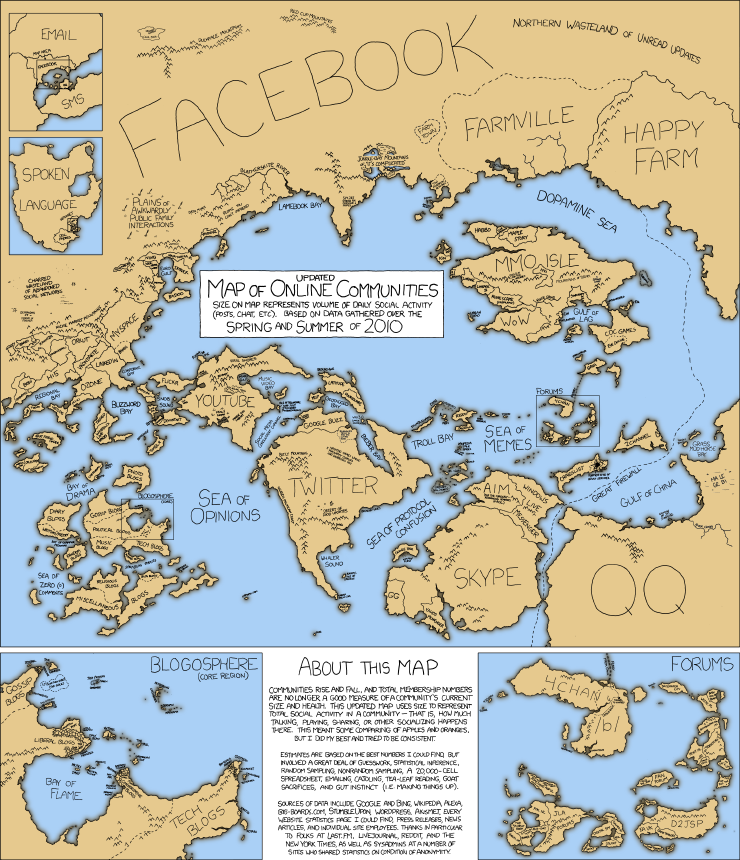
    The mode map

    While it doesn't quite cover all modes, this map by the cartoonist, Randall Munroe, is a really great way of visualising the different forms of communication available to us in 2010. He's chosen to make the land masses' sizes proportional to their number of users, as this article in The Independent explains.

    The full image of the map can be found here. You'll see me bobbing up and down in the Gulf of Lag, just off the south coast of the MMO Isle.

    Thursday, October 14, 2010

    Comfortability?

    I nearly choked on my Chilean Merlot last night (drunk to celebrate the rescue of the trapped Chilean miners rather than out of any dependence on the tranquilising effects of alcohol, honest) when Apprentice contestant Melissa used the expression "to find comfortability" while referring to her team's hopeless product the Book-Eze, designed to make reading on the beach less onerous (watch from about 30-31 minutes into this episode if you want to hear it for yourself).Am I getting prescriptive in my old age?

    "Comfortability"? Is it a real word? When I type it wrongly, my Blogger spellcheck corrects it, so Blogger thinks it's real. I've checked it on WebCorp and it seems to appear on several US business websites and it gets used  by American footballer, Shawne Merriman here. But what does it mean? And why not just "comfort"?

    This guy claims he coined it to refer to an ability to be "fully present/comfortable in an uncomfortable situation". I can't find it in the OED or Merriam-Webster, but it appears as long ago as 1984 as part of a medical test, "A Comfortability Level Scale for Performance of Cardiopulmonary Resuscitation". Weird...

    So, is this like conversate: a word that might have originally just been a mistake, a slip of the tongue, and which gets picked up and spread into wider usage because of its apparently impressive sound? Is it better than "comfort", and, more importantly, will I be able to read my Girl With The Dragon Tattoo on Bognor beach in comfortability?

    Tube tips for women revisited

    Back in 2005, Transport For London issues a leaflet called Tube Tips For Women which set out to help women "get the most out of the tube and stay safe". It contained such brilliant and original advice as minding your step on the escalator if you're wearing "party shoes", always carry a cereal bar (fits well in even the tiniest of handbags, apparently) and capped it all with graphology straight from the high street perfume counters, all lippie and pink squiggles. Zoe Williams of The Guardian didn't like it and after a few complaints it was withdrawn.

    The original link to the leaflet died after the leaflet was pulled, but I've uploaded it as a clickable image on the original post from 2005, which you can find here. If you're looking at representation of gender for ENGA2, the leaflet, Williams' response and 2 or 3 other short extracts about the same theme would probably make a good set of materials for an investigation.

    Monday, October 11, 2010

    More on slang and correcting dodgy grammar

    Here's a couple of follow-ups to recent stories featured on this blog.

    For starters, this is a comment piece by Bob Nicholson in The Guardian which looks at how Victorian English took in American slang, and how the Americanisation of English is hardly a recent phenomenon.

    Then there's this piece by Belinda Webb, also from The Guardian, that takes a look at reactions to slang. It's not a particularly brilliant article as the writer appears to confuse dialect and slang, but it's an intervention in the debate about language, so worth a look.

    Finally, there's this article about Queen's English Society arch-pedant, Bernard Lamb in last month's Times Higher.

    Thursday, October 07, 2010

    The English Language: it's not doing great

    Each day seems to bring another argument about language and how it should be used. It is a great time to be an English Language student, huzzah!

    Today's Independent features an opinion piece by Dr. Bernard Lamb, the President of the Queen's English Society (Surely that's a dangerously republican title for a staunchly royalist organisation?) who argues, among other things, for an end to the inverted snobbery and deliberate dumbing down of language that have led to a generation of nitwits not knowing the difference between they're and their. He rails against many other things too: the glottal stop; the lack of capitalisation of proper nouns; using great as an adverb when it's an adjective (Stop press! It's been used as an adverb for a long time. Deal with it!).

    And as a professor of genetics, he's obviously eminently qualified to talk about... genetics. So why is he holding forth about language?

    Anyway, he does make some sensible points too. There is a really good argument that we all need Standard English as it is a mutually intelligible dialect for all English speakers. If we all have access to Standard English then we all have a chance to communicate with each other, regardless of the region, the social class, the ethnic group or the age group we come from. I wouldn't argue against any of that. But when the definition of Standard English (or the Queen's English as Lamb insists on calling it) spreads like a BP oil slick to cover strong regional accents, glottal stops and the "misuse" of literally, then it's no longer really about a mutually intelligible means of communication and much more to do with personal prejudices.

    Tuesday, October 05, 2010

    Slang: now the teachers don't know nuffink neither

    Yesterday's Daily Mail featured a brief story about a school in Portsmouth where two teaching assistants have been criticised in an OFSTED report for their "poor grammar". As usual, the Daily Mail's message boards seem to act like a magnet to every droooling, knuckledragging dimwit in the universe (as well as the occasional rational human) so within a day 100 comments about the state of the British education system had been posted, ranging from those that blame Nigerians, Alesha Dixon and Tony Blair to those that are sure it's the fault of scruffy (male) teachers and Alan Sugar.

    The story actually turns out to have very little to do with slang (despite the Mail and this blog's headline) and much more to do with dialect. The teaching assistants had apparently used the local construction "I likes football" (which shows a different subject verb agreement from Standard English's "I like football", or more accurately "I hate Millwall"). But again, and like so many other stories about aspects of language, the anger isn't really directed at the feature itself (which is pretty harmless) but at the users of it and those that are perceived as letting it ruin young people's education.

    I've done a (slightly) more technical post about this over on the Teaching English Grammar in Schools blog if anyone's interested, but is it really such a bad thing to have a couple of teaching assistants using a local variety of English in the classrroom?

    And wouldn't it be good if next time the Daily Mail ran a story like this, a mass language intervention of intelligent comments from A level English Language students drowned out the nutty ramblings of the usual message board trolls?

    Thursday, September 30, 2010

    Slang: evil or nice?

    Let's follow up the recent stories about Emma Thompson's views on slang with a quick poll. What's your view on the slang debate?

    Does it make young people sound stupid, like Emma Thompson suggests?
    Is it a normal part of language that we should accept and celebrate?
    Is it only stupid when used by 40 year-old English Language teachers trying to like bond with da yoot dem, ya get me?

    You can vote to the right of this post*.

    Edited to add: The Observer has a debate on this very issue in today's paper. Have a look here.

    *Calls cost 20 Czech Kroner and lines close at 8am. Calls after this time will not be counted towards the vote and you will be charged. Double.

    Wednesday, September 29, 2010

    The benefits of slang

    Emma Thompson's attack on young people's slang has been covered in a range of newspapers and websites, with an interesting one here in today's Daily Telegraph and another here on the BBC News Magazine pages here. There was even a feature on Channel 4 news last night.

    To listen to David Crystal talk about this story, go here (BBC World Service interview: about 10 mins 30seconds into it).

    Edited to add this link from the Daily Mirror: quite a nice style model for a language intervention on ENGA4, or media text on ENGB4, perhaps.

    Tuesday, September 28, 2010

    Learn to code-switch or "look like a knob"

    ...so says Emma Thompson, actor and ex-pupil of Camden School For Girls. Despite sounding like it should be an exclusive private school for the daughters of city bankers and royal equerries, CSFG is actually a north London comprehensive and therefore reflects - to some extent (exorbitant local house prices aside) - the social and ethnic make-up of that part of London. So when Emma Thompson went back there to a charity evening, she was struck by the slang being used by the pupils (says The Independent).

    "I went to give a talk at my old school and the girls were all doing 'likes' and 'innits?' and 'it aint's', which drives me insane," she told the Radio Times. "I told them, 'Don't do it because it makes you sound stupid and you're not stupid.' There is the necessity to have two languages – one you use with your mates and the other that you need in any official capacity. Or you're going to sound like a knob."

    Thompson's point about having two languages is a fair one, but to write off a few slang terms as  making you sound "stupid" seems to me to be a step or two too far. Fair enough, if you don't like those expressions, then you've got a right to say so, but to equate slang with stupidity is just narrow-minded. To make matters worse, Thompson then slips into her own generation's slang when she says that saying "like" and "innit" makes you "sound like a knob".

    Why is it OK for Emma Thompson to mix her codes in the pages of a national publication, while it's apparently not OK for teenagers at her old school to switch codes? Sounds to me like the old prescriptivist stance that younger people's use of language is a degraded form: a crumbling castle idea, that Jean Aitchison effectively nails in her famous Reith Lectures.

    The Independent has a good leader article on the story, which you can find here.

    Friday, September 24, 2010

    English RIP

    If you're looking for style models to help you with media texts for ENGB4 or language interventions for ENGA4, this fake obituary for the English language is a nice example. While the content is pretty standard prescriptivist fare (The language is doomed! People make spelling errors! Newspapers print bad English!) the style in which it's written is quite interesting. Here's the first paragraph:

    The English language, which arose from humble Anglo-Saxon roots to become the lingua franca of 600 million people worldwide and the dominant lexicon of international discourse, is dead. It succumbed last month at the age of 1,617 after a long illness. It is survived by an ignominiously diminished form of itself.

    Tuesday, September 21, 2010

    Has feminism caused obesity epidemic?

    It's all too easy to mock the Daily Mail, but yesterday's headline about feminism killing home cooking and therefore being responsible for the current "obesity epidemic" was a gem. Elsewhere in the Mail, Philip Norman got very upset about some words and phrases - Americanisms and sloppy phrasing - that he doesn't like.

    ROFLMAO @ attempts to use LOLspk in blog headlinez. WTF

    Moderate (and sometimes vaguely illiterate) outrage has been sparked on message boards in the USA with the announcement that the latest edition of the Oxford American Dictionary will now include examples of webspeak, such as Twitter's mighty hashtag (#) and TTYL.

    AOL news's Carl Frantzen has a look at the changes here and compares the new entries to those on the always interesting but sometimes stupid Urban Dictionary.

    An Introduction to Language: David Crystal event in south London

    David Crystal will be appearing at King's College (just near Waterloo) on the afternoon of October 20th and his publishers want A-level students to attend. He's being filmed for a new Routledge DVD called an Introduction To Language so it will be a lecture that will undoubtedly suit AS and A2 level students very well.

    If you're interested in attending either as a student, or as teacher bringing students along, please email me through this link and I'll get back to you.

    Friday, September 17, 2010

    More effin' Heffer

    Just in case you've not had enough of this man's bumptious prescriptivism, here's a link to the fourth extract from his book and another link to a piece on Radio 4's site. And better still, here's a link to Bad Linguistics where the linguist, Pauline Foster, lays out her criticisms of Heffer's brand of dubious pedantry.

    Wednesday, September 15, 2010

    Destructivism: the death of languages

    The BBC News Magazine (always a good source of language stories) has a feature on dying languages this week. It's a good read that starts to raise questions about the links between language, culture and identity. For example, when a language dies, does part of human culture go with it? Or should we just treat the death of an obscure language as an inevitable and unlamented consequence of progress?

    Given the rise of English (or Globish...or ELF) around the world, it's a process that will occur more and more frequently as time goes by.

    Friday, September 10, 2010

    Two postscripts

    Just two quick follow-ups to yesterday's posts.

    Firstly, Kira Cochrane in The Guardian has picked up the David Haye "as one-sided as a gang-rape" story and put together a more wide-reaching piece on the word "rape" itself and its changing uses. It's an interesting read which touches on many issues to do with language reflecting and shaping social attitudes, while also making some good points about how the casual use of the word can both emphasise the horror of the act itself and also diminish its significance. The etymology of the word itself though is worth a look. According to Etymology online, the original (late 14th Century) meaning of "to rape" was to "seize" or "take by force" and it had no clear sexual connotation. It was only later (late 16th Century) that sexual meanings became applied to the word, and then in the sense that the woman was treated as any other "object" that had been taken by force, perhaps revealing the attitude that women were the property of men and the violation of a woman was actually a crime against the man who "owned" her.

    Secondly, in response to the Simon Heffer piece on Radio 4's Today yesterday, Emeritus Professor of Linguistics at UCL, Dick Hudson, points out that the example Heffer gives of "I will, you shall, he shall" is not actually right if he is talking about the rule of "simple futurity" that he has referred to seconds before. Was this dodgy editing by Radio 4, or should Mr Heffer go back to school? Where this stuff isn't actually taught anyway...

    Thursday, September 09, 2010

    The grumbling appendix of prescriptivism

    "The teaching of English has left most pupils with nothing but a random and often erroneous understanding of the components of language." So began John Humphrys on this morning's Today programme on Radio 4* as he introduced an item about a man he clearly admires, Simon Heffer.

    The opening quotation comes from Heffer's new book, Strictly English, published by Random House (I'm sure Heffer would be appalled at the fairly recent semantic change random has undergone.) and which Heffer's very own Daily Telegraph has been serialising over the last three weeks (part one, part two, part three).

    In his book, and in the Radio 4 interview, Heffer SLAMS the teaching of grammar, RAGES against a generation of linguistic illiterates and BLASTS the exaggerated language of tabloids. He's quite angry, it's fair to say.

    But he's also very big on "correctness", asserting on a number of occasions that we are judged by how we speak and write. This is no doubt true, but who is doing the judging? Heffer mostly. He comes from a long line of prescriptivists (one of whom is John Humphrys himself, whose books have recently appeared in extract in A level exam questions on Language Change) who see a general decline in literacy standards wherever they look. If it's not the tabloid press, then it's teachers wot carnt spell. And if it's not gangster rap, then it's those people who use literally when they don't really mean literally. He's literally frothing at the mouth over that one.

    Clearly, some people do have problems switching between registers, while others aren't really that clear on word etymologies, and it's probably fair to say that, for a minority of young people, formal written English is not a very familiar or comfortable variety to use, but it's always been that way. This generation (or the last, or even mine) is not any worse than the others.

    One point raised by Heffer in the Radio 4 interview is about the distinction between shall and will. He says, "To say I will do something is a statement of resolution: you're saying I am absolutely determined to do it. To say I shall do something is a statement of simple futurity: that it's going to happen. It's I will, you shall, he shall". Frankly, who cares?

    Recent research by linguists suggests that this shall/will distinction is becoming increasingly redundant, with usage of shall falling between 40-50% over the last 30 years. Perhaps we now have other ways of expressing "resolution" and "futurity", and the rather antiquated "rule" - dreamt up by "experts" who based their rules on their own usage, funnily enough - is dying out. It's like the appendix: no one really knows what it does and it sometimes grumbles and causes us pain. A bit like Heffer and his ilk?

    *Listen to it on i-Player here (from 2:36.44 - 2:41.38)
    and thanks to Julia H for tipping me off about this great interview.

    A simile too far

    Boxers speak with their fists, but occasionally one comes out with something poetic and deep from his mouth - float like a butterfly & sting like a bee, maybe. David Haye is not one of those people. His recent comment that his fight with Audley Harrison would be "as one-sided as a gang rape" has been met with outrage. His defence via Twitter? "If I apologised for every stupid/ignorant thing i said, I wouldn't have time for anything else during the day!"

    So that's OK then...

    Tuesday, September 07, 2010

    NY speak

    There's a nifty article in last week's BBC News magazine about changing accents in New York which is well worth a look. While the AQA A spec hasn't tended to cover American varieties in the past, there is now a World Englishes topic on ENGA3 where this might come in handy. From a different perspective you can also see more general patterns of language change in the ways that the NYC accent is reported to have changed over time. Anyway, the story is here and there is some video to go with it.

    Twitter helps regions reign while twitz drop their slang

    It's not every day that I get to write something that links Twitter, regional slang and N'Dubz, but here goes...

    Research from Dr Eric Schleef at the University of Manchester, reported in the Telegraph and Guardian last week, suggests that regional dialects are not dying out quite as quickly as linguists thought they might a couple of decades ago. The argument - called dialect levelling - was that as society became more mobile and people shifted away from smaller communities to larger urban sprawls, their local varieties of language would fade away and in their place would rise regional varieties, and perhaps even ultimately just one homogenous national variety. To some extent, this has already happened, and the story here about regional "super-accents" seems to support it.

    But Schleef argues that social networking and mass media have actually helped spread many regional terms - dialect words and slang - among the wider population. In The Daily Telegraph report he is quoted as saying the following:

    Twitter, Facebook and texting all encourage speed and immediacy of understanding, meaning users type as they speak, using slang, dialect respellings and colloquialisms.The result is we are all becoming exposed to words we may not have otherwise encountered, while absorbing them into everyday speech."

    He added that it was not now uncommon to hear a northerner utter words such as “tidy” or “lush” – Welsh terms for attractive - or to catch southerners describing something good as “mint”, a term coined in Manchester. 


    Fair enough, but does this actually mean that local varieties are here to stay or that we're adopting a buffet-style approach to our language choices, picking words we like from the table (like nice, tasty, breaded prawns) and ignoring ones we find odd or unpleasant (bits of limp cheese flan)?

    Meanwhile, in news that will upset 12 year old girls all over limited parts of north London, the poor man's answer to the Black-Eyed Peas, N'Dubz, have decided to drop some of their trademark slang in order to appeal to the American market. In this article from The Sun, you can find out more...admittedly not much more, as it's a very short article, but presumably the reporter couldn't understand much of what they were saying as Dappy only seems to communicate through an elaborate series of hand gestures these days.

    Whatever you think of E3's finest export, Dizzee Rascal, and his rise to pop fame at the expense of some of his musical credibility, at least he's kept his linguistic identity. So what are N'Dubz playing at? Will they gain a bigger audience in the USA because they don't say "bruv" and "innit" in their lyrics, or will the American audience take one listen to their lyrics and turn to each other saying, "These lyrics are as characterless as the rather anodyne music that accompanies them. I shall no longer listen to the so-called N'Dubz and instead invest my hard-earned dollars in some Kano and Wiley, artists who remain true to their linguistic roots. And whose music is better. Bruv."? On a slightly more serious level, doesn't it suggest that even while we're quite happy to pick-n-mix our vocabulary in casual chats between friends or on social networking sites, when it comes to a wider audience, we accommodate to a more neutral register?
     

    Of course, you have to be careful if you're being rude about N'Dubz or Dappy will send you a poorly-spelled threatening text message, but I say bring it on*.


    *Not really

    Sunday, September 05, 2010

    Stop your bitchin' and get back in the kitchen...

    ...is probably not the sort of headline Bidisha would like, and rightly so: it uses derogatory and belittling language about women and identifies them as complainers who are suited only to domestic roles. But I've used it for a cheap joke, so that's OK isn't it?

    In this forthright and impassioned article about attitudes and words, the Guardian writer lays into the casual sexism of British society and the words that so often carry and propagate these attitudes. It's a provocative article and focusses on a language topic that has been debated before by English Language students, so it's definitely worth a read.

    The writer refers to the "pyramid of egregiousness" - a chart of words offensive to women, ranked in order of their unpleasantness. You can find it here and also find out more about why feminists (and anyone with at least half a brain) find them objectionable.

    Wednesday, September 01, 2010

    I would get NIFOC but PAW

    If you know what the title of this blog post means then you should either be ashamed of yourself or get out more. The answer's at the bottom of the post if you want to know*.

    Different generations have always created new slang terms and with the massive growth of the internet and other forms of electronic communication, the pace of change has been ramped up another level. As ever, those who aren't young (like me) start to get confused about what the yoot dem are saying and think they're up to no good. And if you look at a site like this one, you'd probably fear the worst: that your son/daughter is engaging in pervy behaviour on a webcam in their room while you're reading the paper and picking your bunions in the living room.

    But is the slang of the internet and texting, with all its BRBs and LOLs and ASLs really that different from what different generations used in the past? David Crystal, the bearded God of English Language, thinks not and wrote several chapters in his Txting: the GR8 DB8 about just this. Elsewhere, Ben Zimmer of Visual Thesaurus sees abbreviations in loads of older texts.

    *NIFOC = Naked In Front Of Computer
    PAW = Parents Are Watching

    Follow EngLangBlog on Bluesky

    The old Twitter account has been deleted (because of both the ennazification and enshittification of that site) so is now running on Bluesk...