There's a new wave of TV dramas and UK films on the way which feature gangs, council estates and street crime. It's not surprising that given the summer riots and subsequent moral panic about the state of our nation (and more importantly the state of our estates) these programmes are taking a look at life on the fringes for young people, but what's apparent is that for many writers and directors the key way for them to make their visions of urban Britain look and sound authentic is to get the slang right.
A clued-up young urban audience is not going to believe that the people they see on the screen are genuinely like them unless they speak like them, you get me? So, in order to keep it real they've used slang consultants - what a great job that must be.
This piece on the BBC News magazine site takes a look at some of the slang and its uses among young people, while this is a short article I did for the MacMillan Dictionary blog earlier in the week, looking at how slang gets picked up and appropriated by mainstream society.
I'm not sure how I feel about slang being seen as the one, crucial marker of authenticity, because like so many other aspects of language use, slang is about identity and more than just a series of buzzwords for outsiders to pick up and use for a while. Then again, part of the joy of slang is that it's constantly reinventing itself, with slang innovators generating new words, new meanings all the time to keep a sense of individuality and identity even as their words start to seep into the mainstream.
Maybe it's that cycle of creation - appropriation - recreation that keeps them on their toes, feeding the new slang into the system.
Friday, October 21, 2011
Thursday, October 20, 2011
Heated debates: mongs, spastics and housewives
The comedian Ricky Gervais has attracted criticism from a range of quarters for his use of the word mong in recent comments on Twitter. According to Radio 1 Newsbeat and The Sun, Gervais's "jokes" have included references to himself as being monged-up when pulling a face, welcoming his followers with good monging and many more hilarious quips that demonstrate his mastery of sophisticated wordplay.
Gervais claims that the word isn't offensive and has no connection to people who suffer from Down Syndrome (who back in my school days used to - cruelly - be called mongoloids, mongols or mongs, apparently because of the facial resemblance between sufferers and Mongolian people), but he's old enough and clever enough to know that it is offensive for many many people. His argument - that language changes, get over it - is superficially attractive but ultimately disingenuous.
He knows that the word still carries connotations of abuse and is used to belittle and hurt, so why does he use it? Why not use twit, idiot or fool? And there are plenty of other ones to choose from too.
The Angry Mob blog runs a good feature on the story here and the comedian Richard Herring does a thoughtful post* about the language used to mock disabled people here:
The argument over offensive words has previously included references the golfer Tiger Woods made about playing "like a spazz" - derived from the word spastic, another term that's been used offensively in playground abuse - terms like retard (a word that landed the Black-Eyed Peas in trouble, when really they should be in jail for their utterly appalling ear pollution, rather than linguistic crimes) and the long debate over the the n-word and its reclamation.
And of course, more recently we've had a big debate over the use of the word slut as part of the slutwalk movement and a revival of arguments over the word chav and its meanings.
Even apparently inoffensive terms like housewife have come in for criticism recently, with a Mothercare survey revealing that two thirds of mothers find the term insulting. In a response to this survey, Lucy Mangan of The Guardian** looks at (not very serious) alternatives to housewife, such as milch cow and baby wrangler, but serious alternatives have been considered in the past, as this story about the Women's Institute back from 2006 shows.
So, is Gervais the victim of the old PC brigade? Are the feminazi and do-gooding liberal elite stormtroopers of the Political Correctness massive swinging into action. Has, for probably the millionth time (if you read the Daily Mail), PC really gone too far this time?
Well, what is PC? Part of the problem with the whole debate around Political Correctness is that the term itself is troublesome and contested by different groups. PC was initially connected to the women's rights movements of the 1970s and sought to draw attention to the inequalities in language that seemed to exist between men and women, changing the language to avoid discrimination and offence. It later grew to take in terms connected to race, sexuality and disability.
Words like chairman were challenged, and uses of language that seemed to exclude or marginalise women and minority groups were discussed, and alternatives proposed. Many caught on in popular usage and have not been problematic since, but others proved more contentious. So when it was noted that a sentence like "Each student must bring his notes to class" might be perceived as sexist, the alternatives "their notes", or even invented gender-neutral pronouns like "hesh", attracted ridicule or grammatical pedantry ("How can their refer to one person when it it is a plural pronoun?" they asked).
As Deborah Cameron points out in her book on language intervention, Verbal Hygiene, the term Politically Correct was initially an ironic, self-mocking label applied by some feminists to poke gentle fun at their own "right-on-ness", but within the space of a few years opponents of PC - those who opposed changing some labels which might be considered offensive or insensitive, and who were often politically right wing and reactionary - were using it as a term of abuse. In essence what the anti-PCers were arguing against was any attempt to reform the language, because they saw it as part of a radical political agenda with which they disagreed.
If the term PC is used now it's used very much as a term with negative associations. If you're PC you're humourless, probably militant and unbending in your views and more than likely want to ban Christmas and turn it into Winterval to avoid upsetting disabled lesbian Muslims. But regardless, arguments over sensitive and derogatory language usage still rage, and whether we call it PC or just linguistic sensitivity, people will still get upset about certain words and what they can mean, while others argue for their right to say anything they like.
So for this month's heated debate, where do you stand?
Can we control or influence which words are used in society?
Is it a positive step to challenge uses of words like mong and spastic?
Alternatively, is PC just a means of clamping down on freedom of expression?
Does changing language have any effect on wider social issues like racism and sexism?
Over to you...
* Thanks to @SFXEnglish for the link
** and thanks to Jon Dolton for this one
Gervais claims that the word isn't offensive and has no connection to people who suffer from Down Syndrome (who back in my school days used to - cruelly - be called mongoloids, mongols or mongs, apparently because of the facial resemblance between sufferers and Mongolian people), but he's old enough and clever enough to know that it is offensive for many many people. His argument - that language changes, get over it - is superficially attractive but ultimately disingenuous.
He knows that the word still carries connotations of abuse and is used to belittle and hurt, so why does he use it? Why not use twit, idiot or fool? And there are plenty of other ones to choose from too.
The Angry Mob blog runs a good feature on the story here and the comedian Richard Herring does a thoughtful post* about the language used to mock disabled people here:
I don't think any of them would do the same with the n-word or "p*ki" but they're happy to use "mong" or "retard" as a means of getting a laugh. And audiences will laugh at those words too and rarely even complain about them. But I think they do equate with those racial and homophobic epithets that are rarely heard these days. They do confirm the stereotype of disabled people and contribute to their further isolation in a world that already tries to pretend they don't exist.
The argument over offensive words has previously included references the golfer Tiger Woods made about playing "like a spazz" - derived from the word spastic, another term that's been used offensively in playground abuse - terms like retard (a word that landed the Black-Eyed Peas in trouble, when really they should be in jail for their utterly appalling ear pollution, rather than linguistic crimes) and the long debate over the the n-word and its reclamation.
And of course, more recently we've had a big debate over the use of the word slut as part of the slutwalk movement and a revival of arguments over the word chav and its meanings.
Even apparently inoffensive terms like housewife have come in for criticism recently, with a Mothercare survey revealing that two thirds of mothers find the term insulting. In a response to this survey, Lucy Mangan of The Guardian** looks at (not very serious) alternatives to housewife, such as milch cow and baby wrangler, but serious alternatives have been considered in the past, as this story about the Women's Institute back from 2006 shows.
So, is Gervais the victim of the old PC brigade? Are the feminazi and do-gooding liberal elite stormtroopers of the Political Correctness massive swinging into action. Has, for probably the millionth time (if you read the Daily Mail), PC really gone too far this time?
Well, what is PC? Part of the problem with the whole debate around Political Correctness is that the term itself is troublesome and contested by different groups. PC was initially connected to the women's rights movements of the 1970s and sought to draw attention to the inequalities in language that seemed to exist between men and women, changing the language to avoid discrimination and offence. It later grew to take in terms connected to race, sexuality and disability.
Words like chairman were challenged, and uses of language that seemed to exclude or marginalise women and minority groups were discussed, and alternatives proposed. Many caught on in popular usage and have not been problematic since, but others proved more contentious. So when it was noted that a sentence like "Each student must bring his notes to class" might be perceived as sexist, the alternatives "their notes", or even invented gender-neutral pronouns like "hesh", attracted ridicule or grammatical pedantry ("How can their refer to one person when it it is a plural pronoun?" they asked).
As Deborah Cameron points out in her book on language intervention, Verbal Hygiene, the term Politically Correct was initially an ironic, self-mocking label applied by some feminists to poke gentle fun at their own "right-on-ness", but within the space of a few years opponents of PC - those who opposed changing some labels which might be considered offensive or insensitive, and who were often politically right wing and reactionary - were using it as a term of abuse. In essence what the anti-PCers were arguing against was any attempt to reform the language, because they saw it as part of a radical political agenda with which they disagreed.
If the term PC is used now it's used very much as a term with negative associations. If you're PC you're humourless, probably militant and unbending in your views and more than likely want to ban Christmas and turn it into Winterval to avoid upsetting disabled lesbian Muslims. But regardless, arguments over sensitive and derogatory language usage still rage, and whether we call it PC or just linguistic sensitivity, people will still get upset about certain words and what they can mean, while others argue for their right to say anything they like.
So for this month's heated debate, where do you stand?
Can we control or influence which words are used in society?
Is it a positive step to challenge uses of words like mong and spastic?
Alternatively, is PC just a means of clamping down on freedom of expression?
Does changing language have any effect on wider social issues like racism and sexism?
Over to you...
* Thanks to @SFXEnglish for the link
** and thanks to Jon Dolton for this one


Thursday, October 13, 2011
Pragmatics: the missing link
We've done a bit on pragmatics in AS classes over the last few weeks, looking at how context often influences language and how language often depends on a grasp of context, but here's a quick round-up of ideas about pragmatics by Stan Carey which you'll definitely find helpful.
Hiding the agent
Liam Fox, the Defence Secretary who is embroiled in a scandal about his relationship with an "adviser", has made some mistakes apparently, not that he would put it that way. He would say "I accept that it was a mistake to allow distinctions to be blurred
between my professional responsibilities and my personal loyalties to a
friend". And that, as Jonathan Freedland in The Guardian says, is a pretty rubbish way of saying sorry.
Freedland's article looks closely at Fox's slippery language, particularly his abuse of the passive voice, a grammatical technique that he describes as "grammar's way of telling you somebody is hiding something", which is a neat turn of phrase. It's a good bit of textual analysis and something that would make a sound starting point for a language investigation.
Thursday, October 06, 2011
Heated debates 2: the sequel
Thanks to everyone who contributed to the debate on gender and language variation. There'll be another heated debate coming up next week, this time on Political Correctness and language engineering.
This topic ties in with Language Change for A2 AQA A and AQA B, and also for Language Interventions (AQA A) and Language Investigations (AQA B).
If you've got any suggestions for links to articles or have any ideas to kick this off, please post them as comments.
Thursday, September 29, 2011
New blog for English Language A level teachers and students
Sue Fox and Jenny Cheshire at Queen Mary University, London have set up a new blog to help students and teachers of A Level English Language. It's called the Linguistics Research Digest and is part of their From Sociolinguistic Research to English Language Teaching ESRC Knowledge Transfer Project (more details of which can be found here).
The blog features accessible summaries of recent research in linguistics and offers a way into some of the most relevant areas of recent study. Their plan is also to set up a resource site to run alongside the blog, but for the time being there's already some very useful material on there for teachers and students alike.
That's cool. No, that's kewl
The OED's latest online update has ruffled a few prescripivist feathers (again) by including kewl, "an affected or exaggerated pronunciation of cool".
A few months ago, elderly wing commanders in Surrey (and other Telegraph readers) were appalled to discover that the OED had included internet acronym LOL and vaguely blasphemous initialism OMG in its pages, so it's not as if the OED isn't used to causing a bit of controversy. But as Graeme Diamond, chief editor of new words, explains, adding words to the OED is not about trying to change the language but reflect actual usage: "You have to show that the word has been in usage for a decent length of time and, most importantly, that the word is used and understood by a wide audience".
Cool itself, in its original spelling, is a tenacious piece of slang that has been knocking around for a very long time, much longer than its groovy and rad brothers as the slightly unscientific but helpful graphic on the right shows.
Michael Quinion has written about cool's development as a slang term here, and there's more from the British Library here, but it's clear that if cool is still evolving, with new uses and spellings, it's a healthy word in a healthy language.
A few months ago, elderly wing commanders in Surrey (and other Telegraph readers) were appalled to discover that the OED had included internet acronym LOL and vaguely blasphemous initialism OMG in its pages, so it's not as if the OED isn't used to causing a bit of controversy. But as Graeme Diamond, chief editor of new words, explains, adding words to the OED is not about trying to change the language but reflect actual usage: "You have to show that the word has been in usage for a decent length of time and, most importantly, that the word is used and understood by a wide audience".
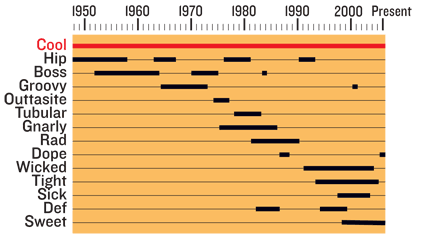 |
| from http://www.fastcompany.com/magazine/107/next-essay-sidebar.html |
Michael Quinion has written about cool's development as a slang term here, and there's more from the British Library here, but it's clear that if cool is still evolving, with new uses and spellings, it's a healthy word in a healthy language.
Friday, September 23, 2011
Learn some proper Gypsy rokker, mush
With the Dale Farm eviction set to take place today, Gypsy life and culture is again in the spotlight, but this BBC Kent article takes a look at Gyspy language contributions to English, contributions that go back a long way and are quite deeply embedded in our common language.
A couple of these - mush and cushti - were just normal English slang as far as I was concerned growing up in Wiltshire in the 1980s and it didn't really cross my mind that it was Gypsy dialect/slang until much later.
This page from the BBC Voices site gives a bit more detail about the roots of Romany/Gyspsy/traveller dialects while this 1897 Dictionary of Slang, Jargon and Cant features some great examples from Gypsy and other non-standard varieties.
Thursday, September 22, 2011
Debate of the month: gender and language variation
One of the big topics for debate in English Language A level in recent years has been over whether women and men communicate differently. Since the early 1970s, with the publication of Robin Lakoff’s Language and Woman’s Place , there has been plenty of focus on what might be termed “women’s language” but as Lakoff herself was quick to point out, her observations weren’t based on empirical studies (systematic data collection) but “(data)... gathered mainly by introspection: I have examined my own speech and that of my acquaintances, and have used my own intuitions in analyzing it”.
Lakoff’s observations included some that have made it into pretty much every A level student’s (and teacher’s) list of key facts about gender and language: women use more precise colour terms, more tag questions and more evaluative adjectives than men. But of course, without any actual data to back these claims up, it was hard to work out whether what Lakoff was saying was perceptive and new or just the recycling of fairly standard stereotypes.
While Lakoff herself made some powerful points about the ways in which girls are socialised to behave in ways that are viewed as linguistically female - not talking rough or appearing "unladylike" - other linguists focused a little more on the conversational interactions between men and women. Some chose to look at interruptions and the dominance of men and submissiveness of women in conversational interaction (like Zimmerman and West – pdf here - in 1975), others at power and status (O’Barr and Atkins - summary here – in 1980), before Maltz and Borker (1982) started looking in a bit more detail at the ways in which men and women are socialised into different gender roles and how this might affect language patterns.
This was an approach that led to Deborah Tannen’s work – subsequently referred to as the Difference Model - and her bestselling book You Just Don’t Understand (Tannen talks about it here).
Tannen’s approach focussed on what she called the “cross-cultural communication” between the genders:
However, Tannen’s approach came in for criticism from some for its broad-brush approach to gender, and the industry spawned by the Tannen book – John Gray’s Men Are From Mars, Women Are From Venus being one big seller – dumbed everything down to a new low.
Elsewhere, Jennifer Coates produced masses of work on the dynamics of spoken interaction in her excellent books Women Talk and Men Talk, pinning down the details of talk among and between the sexes and interpreting the results with an open mind. It’s about as far removed from the hippy dippy generalisations of John Gray as you can get.
More recent work on gender and language has taken one of two approaches. With advances in neuroscience, some commentators have started to look at how certain characteristics might be hard-wired into us and how men and women might just be built genetically in certain ways that we can’t avoid.
This approach has attracted criticism – this article by Madeline Bunting of The Guardian is really good – and linguists such as Deborah Cameron have argued that gender is just one factor in many that might affect our conversational styles, and that anyway, there are more differences between different men or different women (within the sexes) than there are between most men and women.
Her excellent Myth of Mars and Venus lays into the gender difference industry with an accessible overview of research and an argument that suggests it’s not only women who suffer from the obsession with different speech styles, but men too.
So, over to you. What has your own study and research suggested about gender and language variation? Are you about to embark on an A2 Language Investigation into gender? If so, what are you going to look for and why?
Lakoff’s observations included some that have made it into pretty much every A level student’s (and teacher’s) list of key facts about gender and language: women use more precise colour terms, more tag questions and more evaluative adjectives than men. But of course, without any actual data to back these claims up, it was hard to work out whether what Lakoff was saying was perceptive and new or just the recycling of fairly standard stereotypes.
While Lakoff herself made some powerful points about the ways in which girls are socialised to behave in ways that are viewed as linguistically female - not talking rough or appearing "unladylike" - other linguists focused a little more on the conversational interactions between men and women. Some chose to look at interruptions and the dominance of men and submissiveness of women in conversational interaction (like Zimmerman and West – pdf here - in 1975), others at power and status (O’Barr and Atkins - summary here – in 1980), before Maltz and Borker (1982) started looking in a bit more detail at the ways in which men and women are socialised into different gender roles and how this might affect language patterns.
This was an approach that led to Deborah Tannen’s work – subsequently referred to as the Difference Model - and her bestselling book You Just Don’t Understand (Tannen talks about it here).
Tannen’s approach focussed on what she called the “cross-cultural communication” between the genders:
For women, as for girls, intimacy is the fabric of relationships, and talk is the thread from which it is woven. Little girls create and maintain friendships by exchanging secrets; similarly, women regard conversation as the cornerstone of friendship. So a woman expects her husband to be a new and improved version of a best friend. What is important is not the individual subjects that are discussed but the sense of closeness, of a life shared, that emerges when people tell their thoughts, feelings, and impressions.
Bonds between boys can be as intense as girls', but they are based less on talking, more on doing things together. Since they don't assume talk is the cement that binds a relationship, men don't know what kind of talk women want, and they don't miss it when it isn't there.
Boys' groups are larger, more inclusive, and more hierarchical, so boys must struggle to avoid the subordinate position in the group. This may play a role in women's complaints that men don't listen to them. Some men really don't like to listen, because being the listener makes them feel one-down, like a child listening to adults or an employee to a boss.
However, Tannen’s approach came in for criticism from some for its broad-brush approach to gender, and the industry spawned by the Tannen book – John Gray’s Men Are From Mars, Women Are From Venus being one big seller – dumbed everything down to a new low.
Elsewhere, Jennifer Coates produced masses of work on the dynamics of spoken interaction in her excellent books Women Talk and Men Talk, pinning down the details of talk among and between the sexes and interpreting the results with an open mind. It’s about as far removed from the hippy dippy generalisations of John Gray as you can get.
More recent work on gender and language has taken one of two approaches. With advances in neuroscience, some commentators have started to look at how certain characteristics might be hard-wired into us and how men and women might just be built genetically in certain ways that we can’t avoid.
This approach has attracted criticism – this article by Madeline Bunting of The Guardian is really good – and linguists such as Deborah Cameron have argued that gender is just one factor in many that might affect our conversational styles, and that anyway, there are more differences between different men or different women (within the sexes) than there are between most men and women.
Her excellent Myth of Mars and Venus lays into the gender difference industry with an accessible overview of research and an argument that suggests it’s not only women who suffer from the obsession with different speech styles, but men too.
So, over to you. What has your own study and research suggested about gender and language variation? Are you about to embark on an A2 Language Investigation into gender? If so, what are you going to look for and why?
- What do you think of the whole debate?
- Is it helpful to generalise about how men and women communicate or should we always look at specific contexts?
- In your experience, do men and women, boys and girls talk differently?
- If so, why might this be and how does it show itself in what they say and how they say it?
- If not, what do you see happening instead?
- How different are the speech styles within one gender group? Do all boys share similar speech characteristics....girls, football, beer and..err...meat?
Wednesday, September 21, 2011
Quick and dirty
Just a few quick links to really good new language stuff that might be exciting for you.
How awesome changed and grew
How "Britishisms" started to invade the USA
Why slang is a sign of a healthy language
Enjoy!
Friday, September 16, 2011
Stoking up spelling trubble

Does spelling matter? Residents of Stoke-on-Trent seem to think so, because they're worried that people will think they're thick if they see the name of their new shopping development.
This report from the BBC News website suggests that some locals feel that the name will reflect badly on them, while the agency behind the name thinks it gives the development "stand out quality"...maybe like the "stand out quality" of turning up to a funeral in pink lurex batty-riders, or declaring that your football team's new strip will be birthday suits.
Lots of businesses create deliberately deviant spellings to offer "stand out quality". Take Kwiksave, Kwikfit, Krispy Kreme and my old favourite (sadly no longer with us) Mr Byrite. At some point, a creative in an advertising agency decided that Qu and C were just old-fashioned and that K was where it was happening. K was cool...sorry Kool. Is there something intrinsically more exciting about K than C, or is the act of mis-spelling something part of the rebellious appeal of a brand? Vodafone chooses to use f instead of ph and Toys'R'Us abbreviates too, but do we see them as edgy, unconventional brands? Maybe not.
But is it harmless fun, or is this trendy phonetic spelling something that sends out mixed messages to younger people? Is it leading to an acceptance of bad spelling? One teacher quoted in the BBC piece, Mark Rayner, seems to think so:
In terms of grammar we are fighting a battle on many fronts, from text speak, on the internet, even in emails now you find shortened words are creeping in. Pupils regularly write C for see and U for you. But one hopes schools can still teach the correct spelling and grammar.The need for an agreed spelling system is something that lies at the heart of the notion of Standard English: an accepted and recognised way of using English that provides mutual intelligibility for all speakers and writers. As we've seen many times though, the discussion around what the standard and accepted rules should be is fraught with other, non-linguistic worries.
Some people see apparently declining spelling standards as a measure of a nation's moral collapse (one minute they're spelling Krispy Kreme wrong the next minute they're looting it) while others argue that the English spelling system is so messed up in the first place that it should be radically overhauled.
So, edgy branding or idiotic illiteracy? The last word goes to a resident of Stoke-on-Trent who just says "It makes us look like the people in Stoke are thick".
Thursday, September 15, 2011
Heated debates
Now the new term has started and I'm back teaching again (huzzah, I think) I'll try to update the blog with relevant material for AQA Language A and B specs a bit more frequently.
The first thing I'd like to set up is a Debate of the Month, which I hope will help A2 students with Language Intervention coursework and the Language Discourses part of the ENGA3 paper. The plan is to highlight a particular topic each month and look at different arguments around the issue, flagging up various style models for written pieces and offering suggestions for different angles on each debate.
I'm hoping that any keen followers of the blog (and I know there are some out there...mother, can you hear me?) will also chip in and join the debate by adding comments and links. We can all dream, I suppose.
The first topic will be gender differences in conversation and I'll kick it off next week with a quick survey of the different positions and some of the recent debates about how men and women are supposedly hard-wired to use different conversational styles and why this is a controversial (and rather dubious) position.
If anyone would like to suggest links to articles, case studies or just offer a view, I'd be interested to hear.
Thursday, September 08, 2011
His and hers
MacMillan Dictionary blog has been running a gender month, taking a look at how gender is represented, constructed and debated in language. If you're studying gender as part of the AQA B spec (ENGB1) you'll find good stuff here and here, and if you're looking at gender and variation for the AQA A spec (ENGA3) this one and this one might be of interest to you.
You can find a complete run-down of gender month posts here and there's lots of good stuff to look through.
Tweets, Tweeps and Twerps
Any new technology that is used for communication is bound to lead to some concern about its impact on language use. In his book, A Better Pencil, the linguist Dennis Baron looks at how writing technologies such as the pencil, pen , typewriter and word processor developed and traces worries about these (then) new forms of communication. So it's not a great surprise to see that digital communication - text messaging, Facebook, MSN and Twitter being four recent examples - has spawned its own set of worries.
Twitter is often viewed as a fairly limited means of communication, forcing its users to transmit simple, terse 140-character messages to their followers, compressing and trimming language to create anodyne, bite-sized chunks, but in an article for The Guardian this week, the poet Carol Ann Duffy argues that texting and tweeting are brilliantly creative tools for helping people think more carefully about how they're communicating.
It's an appealing argument and one that I think is very true. Writing creatively is not so much about writing as much as you can in as flowery and dense form as possible but finding the best ways to say what you want to say. Sometimes, the process of editing yourself down to fewer words, or finding a new combination of words, is exactly what you need to make yourself a clearer communicator. Poetry is often prized for its sparing use of telling words, and tweets can be like that too, honing the editing skills of their senders.
Inspired by this (if slightly confused: Duffy was talking more about texting than tweeting) The Guardian has launched its own Twitter poetry challenge which you can find here.
Another creative dimension to Twitter is covered by the BBC News magazine where the new words inspired by Twitter are surveyed. We get: tweeple (or tweeps), a blend of Twitter and people; tweet cred, a compound of tweet and street cred; and twisticuffs (my favourite), a blend of Twitter and fisticuffs, in other words a fight on Twitter.
Exploring the tw- unit (sound? morpheme?) in more depth, the article goes on to look at other words formed with the same letters and makes the point that many of them are deliberately playful, perhaps suggesting that there's something inherently silly in the sound.
Twitter is often viewed as a fairly limited means of communication, forcing its users to transmit simple, terse 140-character messages to their followers, compressing and trimming language to create anodyne, bite-sized chunks, but in an article for The Guardian this week, the poet Carol Ann Duffy argues that texting and tweeting are brilliantly creative tools for helping people think more carefully about how they're communicating.
"The poem is a form of texting ... it's the original text," says Carol Ann Duffy. "It's a perfecting of a feeling in language – it's a way of saying more with less, just as texting is. We've got to realise that the Facebook generation is the future – and, oddly enough, poetry is the perfect form for them. It's a kind of time capsule – it allows feelings and ideas to travel big distances in a very condensed form."
It's an appealing argument and one that I think is very true. Writing creatively is not so much about writing as much as you can in as flowery and dense form as possible but finding the best ways to say what you want to say. Sometimes, the process of editing yourself down to fewer words, or finding a new combination of words, is exactly what you need to make yourself a clearer communicator. Poetry is often prized for its sparing use of telling words, and tweets can be like that too, honing the editing skills of their senders.
Inspired by this (if slightly confused: Duffy was talking more about texting than tweeting) The Guardian has launched its own Twitter poetry challenge which you can find here.
Another creative dimension to Twitter is covered by the BBC News magazine where the new words inspired by Twitter are surveyed. We get: tweeple (or tweeps), a blend of Twitter and people; tweet cred, a compound of tweet and street cred; and twisticuffs (my favourite), a blend of Twitter and fisticuffs, in other words a fight on Twitter.
Exploring the tw- unit (sound? morpheme?) in more depth, the article goes on to look at other words formed with the same letters and makes the point that many of them are deliberately playful, perhaps suggesting that there's something inherently silly in the sound.
Friday, September 02, 2011
iGE - interactive Grammar of English

The interactive Grammar of English (iGE) is an app for the iPhone 3 and 4, iPod Touch and iPad, designed to help you develop your understanding of English grammar. It uses examples of real English from ICE-GB, the International Corpus of English and contains many interactive tests and tasks.
If you're looking for a way into understanding grammatical frameworks for A level English Language or for developing your grasp of higher end concepts for undergraduate or post-graduate study, it will definitely be really useful.
One interesting area of debate about language which has already been raised in a 3-star review of the app on the American i-Tunes site is about the use of "incorrect" English in examples of spoken language:
IGE English grammar - ★★★
I'm a substitute teacher and was looking for an app that I could quickly refresh my memory. This is an okay app but there are some errors. I was always taught to not use uhm and ah in a sentence, however, in the test areas the sentences often use uhm as if it had been created by someone dictating. There are also run on sentences and incorrect punctuation in the tests. The glossary seems to be correct and will be a good reference when I need it.
Should a grammar app use "good" English examples which avoid uhms and errs, and run on sentences? Well, we would argue that analysing grammar is not just about analysing "perfect" written English but about looking at all types of English - written and spoken - and studying their grammar. Part of the appeal of an app like this which uses a corpus of genuine English , rather than made-up examples, is that it allows us to look at how English is really used, and to describe its grammar rather than judge it.
Thursday, September 01, 2011
Ringing the changes
Following on from the last post about new words, here's a link to an article in The Daily Telegraph by Henry Hitchings. It's a good antidote to the plethora of grumpy responses to any new words announcement...they're not real words...they'll disappear next year...I've never heard that word so it can't exist...young people these days need a good beating and a hefty dose of national service...you know the kind of thing.
His argument is an interesting one which sees resistance to new vocabulary as a reflection of wider concerns:
Hitchings is author of the excellent The Language Wars, which I've reviewed for emagazine here (and there's an interview with him in the latest edition if you have a subscription and want to read more about why his book is great for A level English Language students).
His argument is an interesting one which sees resistance to new vocabulary as a reflection of wider concerns:
Hostility to a new word (candidates from the latest Chambers might include “webisode” and “OMG”) is fraught with unarticulated concerns about class, politics, propriety and taste. Right now, the pace of linguistic change seems high, and those concerns are supercharged. Thanks to modern technology, the volume and rapidity of communication have increased, and the flow of information is constant.If the comments after many of the recent articles about language change are anything to go by, Hitchings is spot on with his argument. A quick trawl of discussions about David Starkey's deluded comments on "Jafaican", or on the Daily Mail's coverage of Chambers Dictionary reveal racism, class snobbery and the casual denigration of single mothers and most young people, to name a few.
Hitchings is author of the excellent The Language Wars, which I've reviewed for emagazine here (and there's an interview with him in the latest edition if you have a subscription and want to read more about why his book is great for A level English Language students).
Thursday, August 25, 2011
OMG that's so NEET
Chambers Dictionary is publishing its latest edition and the papers are full of the new words they've included. Here The Daily Mail looks at the inclusion of what they call the acronyms (but which are actually initialisms - shame on you Daily Fail) OMG and BFF, pointing to the dictionary's interest in text-speak and words derived from celebrity culture. But there are loads more mentioned too, some of them less current than others (jeggings, bromance and skank have all been knocking around for a good few years now). They also like the acronym (which is an acronym this time) NEET - Not in Education, Employment or Training - which is nice, given that there are now more NEETs than ever before thanks to cuts and university fees.
Elsewhere, The Scotsman looks at labradoodle and dubstep, among others, but also at wider trends - economic collapse, "men's liberation" and environmental issues, while the BBC focuses more on the role of internet language.
The Chambers press release also points out that among all the new words, they've also highlighted what they see as "rare, literary or quirky" words such as thunder-plump, tickly-benders and mallemaroking, all of which sound brilliant.
Wednesday, August 24, 2011
Glorping the wug
Here's a quick link to a piece of research from University of Liverpool's Child Language Study Centre which points to children having a clear understanding of some grammar functions a long time before they are able to use these functions themselves:
The use of made-up words is interesting as it's a feature of child language research from as far back as 1958 when Jean Berko Gleason's wug test revealed that children are able to apply plural rules to words they've never heard before.
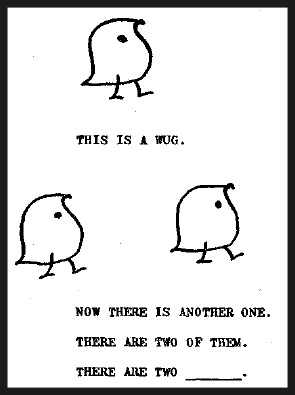 Child Language researcher, Dedre Gentner also used made-up words in her interestingly titled 1978 paper What Looks Like a Jiggy but Acts Like a Zimbo (pdf link).
While the appearance of made-up words in reading tests for primary school children has upset and angered many reading experts, their use in child language experiments is helpful because they can shed light on how patterns and rules are internalised by children and applied to examples of language they haven't heard before, perhaps suggesting that there's an innate capacity for language acquisition (or at least, some sort of generalised puzzle-solving equipment) in all children.
Researchers at the University’s Child Language Study Centre showed children, aged two, sentences containing made-up verbs, such as ‘the rabbit is glorping the duck’, and asked them to match the sentence with a cartoon picture. They found that even the youngest two-year-old could identify the correct image with the correct sentence, more often than would be expected by chance.
The use of made-up words is interesting as it's a feature of child language research from as far back as 1958 when Jean Berko Gleason's wug test revealed that children are able to apply plural rules to words they've never heard before.
While the appearance of made-up words in reading tests for primary school children has upset and angered many reading experts, their use in child language experiments is helpful because they can shed light on how patterns and rules are internalised by children and applied to examples of language they haven't heard before, perhaps suggesting that there's an innate capacity for language acquisition (or at least, some sort of generalised puzzle-solving equipment) in all children.
Wednesday, August 17, 2011
Ghetto grammar
The linguistic fall-out from last week's riots continued yesterday with an article by Lindsay Johns in the Evening Standard proclaiming that "Ghetto grammar robs the young of a proper voice". While Johns' work in Peckham with disadvantaged young people has to be applauded, he's got a very narrow view of street slang and has prescriptive form - this article on supposed "gang slang" and this on "proper English" being cases in point (and covered here on the blog last November).
While Johns talks a lot of sense about the power of language and the need to unlock potential in inner city teenagers who might be stereotyped and demeaned for their use of certain varieties of English, he's also unwilling to accept sound linguistic arguments about code-switching and sets up something of a straw man argument with his attack on what he calls "cultural relativism":
The problem here is two-fold. Firstly, you'd be pretty hard-pressed to find any linguist or educator who doesn't argue that a mastery of Standard English is a prerequisite of a good education. Who are these cultural relativists that Johns is referring to? It smacks of the right wing arguments about the "PC brigade": some nebulous and sinister cabal of liberals and lefties hell-bent on messing up everything about young people's education with their crazy commie views. They don't really exist...
Secondly, code-switching is not that difficult for young people. They do it all the time. But only if they have another form to switch into. That's essentially the point that Johns is missing. The young people he works with - if they have as poor a command of Standard English as he claims - don't have a problem with slang: they have a problem with basic literacy. To lay the blame for these young people's inability to write and speak clearly at the door of street slang and those people who don't condemn it out of hand is a very weak argument.
Blame the education these young people have received so far. Blame the system that values grades above individual achievement. Blame racist and classist stereotyping of young people. Blame the young people themselves for messing around, bunking off and generally taking the piss; but don't blame slang.
Such an argument is made weaker by the seemingly arbitrary list of features that Johns gathers as markers of this "ghetto grammar":
Like so many other arguments about accent, slang and non-standard English, the list just serves to flag up a few personal peeves. A quick look at the comments after the article shows that there are plenty of others happy to jump on the bandwagon and list their personal dislikes in language use. And again, this is part of the wider problem. So many of these features are just down to personal prejudices and individual taste. I don't really have a problem with ain't and innit - perhaps because they're forms that I heard being used around me from quite an early age - but I bristle when I hear feds or po-po for police. So what? As William Labov showed in his studies of New York speech, the post-vocalic "r" (farm, park, card) was often viewed as a marker of upper-class speech , while here in Britain it's often been associated with rural accents and given much less prestige (Drink up thy ciderrrrr, ooo-arrrrrr). There are different ways to pronounce things and different words we like or dislike, but these aren't sound principles on which to build the "rules" of a language.
In many ways, Lindsay Johns adopts a Bernsteinian approach to language, talking about restricted and elaborated codes, and that's an interesting and valid angle, but in other ways he adopts a prescriptivist approach that undermines his wider argument. I can't argue with his desire to increase the linguistic skills of the young people he mentors, to increase their articulacy, self-esteem and employment prospects, but to blame street slang for where they are now just seems plain wrong.
(Edited on 13.11.15 to fix broken links)
While Johns talks a lot of sense about the power of language and the need to unlock potential in inner city teenagers who might be stereotyped and demeaned for their use of certain varieties of English, he's also unwilling to accept sound linguistic arguments about code-switching and sets up something of a straw man argument with his attack on what he calls "cultural relativism":
Some educators take a position of cultural relativism. They assert the legitimacy and value of street talk, or at the very least, the importance of teaching young people to "code switch" - how to differentiate in which milieu it is socially acceptable.
I have no time for such an approach. In my experience, young people find it very hard to code switch. Text-speak, poor grammar and street patois routinely pervade the essays I set them, let alone their conversations with me.
The problem here is two-fold. Firstly, you'd be pretty hard-pressed to find any linguist or educator who doesn't argue that a mastery of Standard English is a prerequisite of a good education. Who are these cultural relativists that Johns is referring to? It smacks of the right wing arguments about the "PC brigade": some nebulous and sinister cabal of liberals and lefties hell-bent on messing up everything about young people's education with their crazy commie views. They don't really exist...
Secondly, code-switching is not that difficult for young people. They do it all the time. But only if they have another form to switch into. That's essentially the point that Johns is missing. The young people he works with - if they have as poor a command of Standard English as he claims - don't have a problem with slang: they have a problem with basic literacy. To lay the blame for these young people's inability to write and speak clearly at the door of street slang and those people who don't condemn it out of hand is a very weak argument.
Blame the education these young people have received so far. Blame the system that values grades above individual achievement. Blame racist and classist stereotyping of young people. Blame the young people themselves for messing around, bunking off and generally taking the piss; but don't blame slang.
Such an argument is made weaker by the seemingly arbitrary list of features that Johns gathers as markers of this "ghetto grammar":
an inarticulate slang full of vacuous words such as "innit" and wilful distortions like "arks" for "ask" or tedious double negatives
Like so many other arguments about accent, slang and non-standard English, the list just serves to flag up a few personal peeves. A quick look at the comments after the article shows that there are plenty of others happy to jump on the bandwagon and list their personal dislikes in language use. And again, this is part of the wider problem. So many of these features are just down to personal prejudices and individual taste. I don't really have a problem with ain't and innit - perhaps because they're forms that I heard being used around me from quite an early age - but I bristle when I hear feds or po-po for police. So what? As William Labov showed in his studies of New York speech, the post-vocalic "r" (farm, park, card) was often viewed as a marker of upper-class speech , while here in Britain it's often been associated with rural accents and given much less prestige (Drink up thy ciderrrrr, ooo-arrrrrr). There are different ways to pronounce things and different words we like or dislike, but these aren't sound principles on which to build the "rules" of a language.
In many ways, Lindsay Johns adopts a Bernsteinian approach to language, talking about restricted and elaborated codes, and that's an interesting and valid angle, but in other ways he adopts a prescriptivist approach that undermines his wider argument. I can't argue with his desire to increase the linguistic skills of the young people he mentors, to increase their articulacy, self-esteem and employment prospects, but to blame street slang for where they are now just seems plain wrong.
(Edited on 13.11.15 to fix broken links)
Tuesday, August 16, 2011
Starkey's "Norman Tebbit moment"
Amid the horrific mayhem and destruction of last week's riots, there were a few moments of grim irony - David Cameron deriding the violence of the British underclass shortly before "declaring war" on gang culture, a Labour MP criticising looters for their "naked greed" having made a claim on his parliamentary expenses the year before for an £8,865 flatscreen TV, Nick Clegg propping up a government who he'd previously warned the public about as being likely to cause riots on the streets - but surely the most bizarre moment of all was historian and TV pundit, David Starkey's appearance on Newsnight last Friday in which he blamed the riots on white people turning black, before clumsily reading out the text of a BBM he said represented the broken English of a looter.
Many media commentators struggled to find the right words to describe what was going on. Were the people smashing up shops and lobbing bricks at the police protesters or looters, scum or terrorists? The Guardian wasn't sure. Were these disturbances race riots, London riots, British riots or English riots? The BBC settled for England riots, which strikes me as odd, given that England weren't even playing. Were the young people using the term feds to describe the police showing the influence of US hip hop and mimicking the antics of the LA rioters back in the early 1990s? The BBC News magazine reflected on these issues and even got some linguists and lexicographers to comment, making it a more informative and nuanced discussion than many others.
But let's go back to David Starkey and his rant on Newsnight. Back in 1996, the linguist Jean Aitchison delivered a series of lectures for the BBC on language (which can be read here or listened to here) in which she talked about the worries that exist for many people about how language changes. In one example, she quoted the then Conservative Minister Norman Tebbit making a direct link between language use and crime:
So, in David Starkey's diatribe against "Jafaican" I think we have this generation's Tebbit moment. Let's look more closely at what Starkey said and unpick why it's not only racist and wrongheaded but linguistically suspect too. The Independent quotes Starkey's words as follows:
Many media commentators struggled to find the right words to describe what was going on. Were the people smashing up shops and lobbing bricks at the police protesters or looters, scum or terrorists? The Guardian wasn't sure. Were these disturbances race riots, London riots, British riots or English riots? The BBC settled for England riots, which strikes me as odd, given that England weren't even playing. Were the young people using the term feds to describe the police showing the influence of US hip hop and mimicking the antics of the LA rioters back in the early 1990s? The BBC News magazine reflected on these issues and even got some linguists and lexicographers to comment, making it a more informative and nuanced discussion than many others.
But let's go back to David Starkey and his rant on Newsnight. Back in 1996, the linguist Jean Aitchison delivered a series of lectures for the BBC on language (which can be read here or listened to here) in which she talked about the worries that exist for many people about how language changes. In one example, she quoted the then Conservative Minister Norman Tebbit making a direct link between language use and crime:
"If you allow standards to slip to the stage where good English is no better than bad English, where people turn up filthy ... at school ... all those things tend to cause people to have no standards at all, and once you lose standards then there's no imperative to stay out of crime."
So, in David Starkey's diatribe against "Jafaican" I think we have this generation's Tebbit moment. Let's look more closely at what Starkey said and unpick why it's not only racist and wrongheaded but linguistically suspect too. The Independent quotes Starkey's words as follows:
"I think what this week has shown is that profound changes have happened. There has been a profound cultural change. I have just been re-reading Enoch Powell. His prophecy was absolutely right in one sense: the Tiber didn't foam with blood, but flames lambent wrapped around Tottenham, wrapped around Clapham.
"But it wasn't intercommunal violence; this was where he was completely wrong. What has happened is that the substantial section of the chavs that you [Mr Jones] wrote about have become black. The whites have become black."A particular sort of violent, destructive, nihilistic gangster culture has become the fashion. Black and white, boy and girl operate in this language together, this language, which is wholly false, which is this Jamaican patois that has intruded in England. This is why so many of us have this sense of literally a foreign country."Listen to David Lammy, an archetypal successful black man. If you turn the screen off, so you were listening to him on radio, you would think he was white."
What strikes me as so twisted is Starkey's leap from the assertion that "the whites have become black" to the apparent linking of "blackness" to "violent, destructive, nihilistic gangster culture". At that point in his argument, he makes no attempt to draw a distinction between skin colour and culture. Later, he offers some (feeble) attempts at mitigation, perhaps when he tries to argue that not all black people - David Lammy, for example - "sound black", but it's still a reductive and idiotic argument. Why? Because in Starkey's mind black = "violent, destructive, nihilistic gangster culture". And your degree of blackness can be identified by the way you talk...
From a linguistic standpoint, his assertion that the "Jamaican patois" that has "intruded in England" and is used by young people involved in the riots is "wholly false" smacks of desperation. As one Twitter user @vivmondo wittily put it, "Asking David Starkey for his views on youth culture is a little like
asking Lady Sovereign for her views on Elizabethan shipping law" but even so he goes ahead and gives us the benefits of his massive knowledge. And that's before he launches into his freestyle, which has been remixed for your pleasure and delight in the You Tube clip here.
As Geoff Pullum explains on Language Log, Starkey's views about the insidious influence of Jamaican patois on the native language are ill-informed and wide of the mark. What Starkey quotes in his poorly performed rap is nothing like Jamaican patois and much closer to Multicultural London English (MLE, MEYD or what some dubiously call "Jafaican").
Even Katherine Birbalsingh (who normally gets my goat about as much as Toby Young and Richard Littlejohn) gets it right when she says that the language Starkey is talking about is "a kind of fusion of many cultures, including
Cockney East End speech. One can also hear some Jamaican influence,
general working-class London influence and so on. Does Starkey really
believe that Jamaicans go around saying “innit”? “Innit” has a Cockney
glottal stop in it! Interestingly, this accent not only is not Jamaican,
but neither is it in American gangster culture. What MTV rapper sounds
like our kids?".
In yesterday's Evening Standard, Sam Leith made a slightly different point about the language of Starkey's rant. Annoyingly, he insists on calling the variety of English in question as "Jafaican" with all its connotations of affectation and mimicry, when any good language student knows that what is emerging in London and has been developing for well over two decades is an organic form of language that has its roots in a range of different varieties brought together by contact in urban areas. He can be forgiven though as he's not a linguist and doesn't claim to be an expert on language. Plus he makes some good points elsewhere.
Discussing Starkey's claim that "so many of us have this sense of literally a foreign country" he agreed that "(Starkey) touches an anxiety more people feel than admit to" before going on to say "it's actually a
class and generational anxiety. It finds its most poisonous outlet in
fears about race" and concluding by saying "Prof Starkey defended his position by saying that in times like this,
"plain speaking" is needed. No. Careful, precise speaking is needed".
Wise words indeed, and all the wiser because Leith - and Birbalsingh - notice that the people who use the language Starkey so derided are actually all around us: they are our students, our own children, us, our communities, not some alien race. To mark them out as a separate group because of their "wholly false" language use is to misunderstand and misrepresent both young people and the ways in which language works.
*Edited 16.08.11 to change title after inadvertently copying Stan Carey's MacMillan blog title from yesterday. Woops!
Thursday, July 21, 2011
-tivism and -geddon
I'm not really sure if this is worth a post of its own, but if I make it number one in a series of occasional new word lists and tag each post in the series with the new words label, by the end of the year we might have lots of new words...and it might be useful to someone.
Anyway, for today:
Clicktivism - blend of click and activism, related to online petition signing (from The Guardian).
Slacktivism - blend of slack/er and activism, related to lazy activism or not doing much but just clicking to sign a petition but but actually getting involved (from The Guardian).
Carmageddon - blend of car and Armageddon, relating to apocalyptic prediction that LA roads would grind to a halt as a bridge was demolished. Didn't come to pass, a bit like the rapture, I suppose.
Eurogeddon - blend of Euro and Armageddon, relating to apocalyptic judgement day for European currency (today, apparently)
Dollargeddon - blend of Dollar and Armageddon, relating to apocalyptic judgement day for USA's currency if braindead republicans don't back down (very soon, apparently)
Wednesday, July 20, 2011
Back in the USA

As picked up on here last week and discussed at much more length and in more academic detail at Language Log, Engel's piece was fairly reactionary in tone and seemed to be rallying the troops to defend the borders against foreign invasion. And it seems to have done its job, because many readers have sent in their contributions, ranging from fanny packs, medal used as a verb to 24/7 instead of the much catchier and quintessentially English all day every day. Jeez....
Edited on 21.07.11 to add: taken to bits on Language Log here!
Tuesday, July 19, 2011
Hackgate
Given that we're in the middle of what's becoming known as Hackgate with its mass of resignations and revelations, this post from John List over on the Oxford Words blog offers a helpful discussion of what hacking means to him.
According to List, being a hacker is not about secretly accessing someone's voicemail, or taking down a website (however funny that might be) and everything to do with taking pride in your geekiness, or as Oxford Dictionaries Online defines it, "an enthusiastic and skilful computer programmer or user".
Wednesday, July 13, 2011
USA! USA!
He tells us at the beginning that "The Americans imported English wholesale, forged it to meet their own needs, then exported their own words back across the Atlantic to be incorporated in the way we speak over here" which is a model that is fairly well-established in existing writing about American English, but one that comes with a few problems attached.
In one sense it still presumes that English English (or British English) is the standard to which all other varieties aspire and that while the Americans have been busy forging away (possibly a loaded metaphor, suggesting that they're making an inferior copy rather than bashing it with lump hammers and making it new) our language remains unchanged, aloof and just better, dammit. And what do we mean by "our" language anyway?
The title of the article is intriguing, because it suggests - as Lynne Murphy has identified in her tweets about this piece - that Americans aren't people, or at least they're not the "people" to whom Engels was addressing his piece. It's a strange piece of audience positioning for an author who must know that the BBC site is read all across the world... even by Americans. It smacks a bit of marking out territory and dividing lines between languages...which is OK, if that's what floats your Mayflower.
Also, towards the end when he makes a point about enjoying the "vigour and vivacity" of American English (words that always get used, often along with "articulate" when describing a language, or speaker of a language, that you think is good at "keeping it real" but probably not as clever as you) Engels states "...what I hate is the sloppy loss of our own distinctive phraseology through sheer idleness, lack of self-awareness and our attitude of cultural cringe. We encourage the diversity offered by Welsh and Gaelic - even Cornish is making a comeback. But we are letting British English wither". This strikes a fairly prescriptivist note, and suggests that as we import American words our home-grown variety dies out. Is it really like that?
I know that I cringe when I hear UK teenagers talk about the feds rather than the old bill, filth or boy dem (all good, old-fashioned British names for the police) but does that mean that the US word has taken the place of an English word, or just that its temporarily occupying its place while fashions come and go?
In one way, Engels is right that American words are creeping in through popular culture and spreading throughout British society, but in other ways he's not: regional varieties of English are apparently growing in strength, with some dialect terms making a comeback. While the bigger picture might be of a drift towards more Americanisms, it's not all one-way traffic and the drift is not uniform.
The article - despite my misgiving here - is certainly worth a read for anyone looking at global Englishes and the spread of American English around the world, as well as those looking for a good topic for a future Language Discourses question on ENGA3.
You can find a lot more about American English (and British English too!) on Lynne Murphy's excellent blog Separated by a Common Language and by following her on Twitter.
Edited and republished 13.07.11 because I've struggled to distinguish between save and publish on Blogger's new interface. D'oh! No, I mean "dash it!"
I walk, I walked, I text, I texed?
There's some interesting discussion on David Crystal's blog about the past tense of the verb to text. In his post, Crystal mentions that the word existed as a verb way back in the 16th Century, long before the appearance of mobile phones and SMS, but back then it had a regular -ed inflection.
More recently, people have begun to notice how the past tense has started to appear as texed rather than texted, and Crystal suggests that this might be down to the xt consonant cluster at the end and how we react when an -ed past tense is tacked onto it:
John Wells, UCL's guru of phonetics, also addressed the issue of the phonology of texted/texed in this blog post a while back.
What strikes me as interesting about this is that - as Crystal points out - so many new words seem to follow regular patterns of inflection. You can pretty much bet your house on new verbs taking -ed in the past tense, so it's odd to see irregular inflections appearing like this and interesting that it's linked to phonology.
What would be the chances of a new noun taking an irregular plural ending like -en (as we have with older words from previous centuries - children, oxen, brethren)?
More recently, people have begun to notice how the past tense has started to appear as texed rather than texted, and Crystal suggests that this might be down to the xt consonant cluster at the end and how we react when an -ed past tense is tacked onto it:
Indeed, there is evidence from the history of English that the 'xt' pronunciation is actually easier than some alternatives, as when we see asked change to axed in many regional dialects. But adding an -ed ending alters the pronunciation dynamic. We now have two /t/ sounds in a rapid sequence, as we had in broadcasted, and that could motivate people to drop the ending. Speakers generally prefer shorter forms.
John Wells, UCL's guru of phonetics, also addressed the issue of the phonology of texted/texed in this blog post a while back.
What strikes me as interesting about this is that - as Crystal points out - so many new words seem to follow regular patterns of inflection. You can pretty much bet your house on new verbs taking -ed in the past tense, so it's odd to see irregular inflections appearing like this and interesting that it's linked to phonology.
What would be the chances of a new noun taking an irregular plural ending like -en (as we have with older words from previous centuries - children, oxen, brethren)?
Thursday, July 07, 2011
Language investigation ideas: rap taxonomies
Following on from last week's quick post about ideas for A2 Language Investigations, here's one that might work for the AQA B spec (It's about written language, so not suitable for the A spec.) and which gives me a chance to point you towards this amazing image of rappers, names, grouped by semantic category.
So, you get rappers who have named themselves after their size (Lil Wayne, Big Pun, Big Boi, Fat Joe), money (Chamillionaire), place of origin (Cypress Hill, Sugar Hill Gang), and many many more. As well as semantic categories, the chart takes in deviant spellings, repetition and err...guys named "Rob".
Why not do your own taxonomy for a genre of your choice - Emo, Goth, Heavy Metal, or Prog Rock... or whatever you young people listen to these days. Perhaps a cross-genre comparison might be a good way to carry out an investigation.
Gurtlush lexis
Thanks to massive piles of AS and A level marking and general tiredness, I've not posted much here recently, so here's a link to Telegraph article on dialect words being collected by the wonderful British Library.
There's some good material here for anyone looking at Language Varieties in the second year of the AQA A course.
Thursday, June 30, 2011
Solidarity
I wasn't going to post on here today, in solidarity with my striking public sector colleagues, but it's not really the same as crossing a picket line, is it? Anyway, good luck to all the teachers out there, and other public sector workers defending their pension rights and the principles of public service.
Language investigation ideas: I am so liking "like"
Seeing as thousands of English Language students are currently being told to come up with great ideas for next year's investigation coursework, I thought I'd offer a series of occasional posts that might help kick start a few projects.
First of all, here's an interesting piece by Mark Liberman on Language Log about how he went about investigating the use of like in spoken language. He was inspired to look at like because of a post by Erin Gloria Ryan entitled My Love Affair With "Like" in which she speculated about how like is used differently depending on age and gender factors.
What could you do with like for an ENGA4/ENGB4 investigation? Well, it's worth thinking about what you'd like to achieve with an investigation like this. Liberman uses a corpus (basically, a database of language) to test out the hypothesis that young women use the discourse-particle like more than men, and he makes this clear from the outset. What he also establishes is that he's not looking at any old mention of like - but a specific function of the word, and this is good advice for anyone about to set up an investigation. So, he's set a research question/ hypothesis and established a clear focus for his investigation.
Another key piece of advice is to approach the investigation with an open mind, and this is what he does: not trying to make his findings fit any preconceived pattern but to see if his original hypothesis was actually right. He says:
Interestingly, he puts forward suggestions here about why there might be a perception that women use like more, and that in turn opens up other areas of investigation. Are women generally seen as more tentative and therefore assumed to use markers of tentativeness more frequently? Are women less assertive in some conversational situations? Are women using a "double voice discourse" (as Judith Baxter suggests) and shying away from confrontational language because of how they will be perceived by men? There are loads of other questions linked to this that would be really fascinating to pursue.
But bringing this back to A level projects, what could you do with something like this?
Perhaps there's a feature of language that you've noticed being used by one group of people and not another. Maybe it's like, innit, awesome, gay, standard or mans and you want to find out more about its usage. You could go to a database of language as Liberman does, set your search terms and get looking, or you could gather your own data and see if there is a pattern.
Recording your own data creates its own issues - most of them easily addressed, if you plan ahead well enough - but it is a great way of getting hold of new material and adding to the store of language data that we can all learn from.
So, over to you: what areas would be potentially interesting to explore?
First of all, here's an interesting piece by Mark Liberman on Language Log about how he went about investigating the use of like in spoken language. He was inspired to look at like because of a post by Erin Gloria Ryan entitled My Love Affair With "Like" in which she speculated about how like is used differently depending on age and gender factors.
What could you do with like for an ENGA4/ENGB4 investigation? Well, it's worth thinking about what you'd like to achieve with an investigation like this. Liberman uses a corpus (basically, a database of language) to test out the hypothesis that young women use the discourse-particle like more than men, and he makes this clear from the outset. What he also establishes is that he's not looking at any old mention of like - but a specific function of the word, and this is good advice for anyone about to set up an investigation. So, he's set a research question/ hypothesis and established a clear focus for his investigation.
Another key piece of advice is to approach the investigation with an open mind, and this is what he does: not trying to make his findings fit any preconceived pattern but to see if his original hypothesis was actually right. He says:
... there's no evidence that women insert non-traditional like into their conversation more often than men do. There may be specific syntactic or pragmatic contexts where this is true; there may be effects in some registers and not others. But so far, I'm inclined to think that this is one of those cases where congruence with pre-existing stereotypes (here that women are less assertive) leads to post-hoc rationalization and confirmation bias.
Interestingly, he puts forward suggestions here about why there might be a perception that women use like more, and that in turn opens up other areas of investigation. Are women generally seen as more tentative and therefore assumed to use markers of tentativeness more frequently? Are women less assertive in some conversational situations? Are women using a "double voice discourse" (as Judith Baxter suggests) and shying away from confrontational language because of how they will be perceived by men? There are loads of other questions linked to this that would be really fascinating to pursue.
But bringing this back to A level projects, what could you do with something like this?
Perhaps there's a feature of language that you've noticed being used by one group of people and not another. Maybe it's like, innit, awesome, gay, standard or mans and you want to find out more about its usage. You could go to a database of language as Liberman does, set your search terms and get looking, or you could gather your own data and see if there is a pattern.
Recording your own data creates its own issues - most of them easily addressed, if you plan ahead well enough - but it is a great way of getting hold of new material and adding to the store of language data that we can all learn from.
So, over to you: what areas would be potentially interesting to explore?
Thursday, June 23, 2011
Performing mouth to mouth on grammar
If you're looking for more language discourses topics in readiness for tomorrow's ENGA3 exam, this might be a good link to have a look at. One of the debates that's been knocking around for a long time (probably forever) is that around the seemingly inevitable decline in standards of English grammar among the general population and whether or not we should care. In this article, the author, Barbara Gunn, suggests we need to "resuscitate" grammar.
As an English teacher, I think grammar is important, but perhaps not for the same reasons that Barbara Gunn puts forward in her article. I can't help but shudder when I read someone using your instead of you're, or there instead of their, but perhaps that's my inner prescriptivist crying out and I should learn to ignore it, a bit like I ignore the cat as it mewls for food seconds after being fed. Prescriptivists have complained about the general public's inability to use grammar properly ever since English came into existence, but is it actually getting any worse?
Henry Hitchings - whose book, The Language Wars I've plugged endlessly on here - makes the point that people have been confusing should have and should of and you were and you was since the 17th Century. Perhaps it's because more of us write now than ever before (tweeting, emailing, texting and even blogging all being new forms of "writing") that these grammatical errors/non-standard forms are being noticed more. Maybe we are becoming less literate. I dont no.
If you have a look through this blog for posts about grammar usage (usually tagged prescriptivism or descriptivism) you'll find a number of articles about Simon Heffer's (appalling) Strictly English, and the Queen's English Society's most recent musings on our language going to the dogs, along with some descriptivist critiques of their arguments. As you're having a look at these, you'll probably notice the familiar models that Jean Aitchison pointed out in her classic Language Web lectures: the crumbling castle, the damp spoon and the infectious disease.
Political Correctness: theories and debates
I wouldn't normally copy a comment from another post over as a new post, but I think this might be helpful for tomorrow's ENGA3 if PC comes up as a topic.
This is in response to a comment by Jessica on the ENGA3 Language Discourses post from earlier in the week, asking about which theorists might be helpful on a question about PC. She'd already mentioned Sapir & Whorf, Miller and Swift and Norman Fairclough. This is just my take on the theories and concepts that might help, so please add any comments or observations/criticisms to it as comments. I'd be interested to hear what anyone else has to say on arguments around PC.
This is in response to a comment by Jessica on the ENGA3 Language Discourses post from earlier in the week, asking about which theorists might be helpful on a question about PC. She'd already mentioned Sapir & Whorf, Miller and Swift and Norman Fairclough. This is just my take on the theories and concepts that might help, so please add any comments or observations/criticisms to it as comments. I'd be interested to hear what anyone else has to say on arguments around PC.
I think you're fine with those theorists really, so long as you're clear that the underpinnings of the PC movement come from a belief that if you remove sexist & racist words from the lexicon, you'll either a) remove the pejorative association of that term, or b) go some way towards changing the discourse around sexism and racism by drawing attention to the problems inherent in those words.
E.g. You could argue that the debate about "slutwalking" has polarised opinion about the word slut and "slutty" dressing, but on a very simple level it has at least made everyone think about the word, what it means and whether or not it should be used. It's also given young feminists the chance to enter the debate about women's rights in a way that might not have been open to them before, thus intervening in the discourse.
I think the other thing is that it's important to realise that PC is quite a rarity in linguistic terms in that there has been a degree of success in imposing a "top-down" model of language change. You could argue to what extent it's been successful, but in many ways it's one of the few attempts at linguistic engineering that's actually worked.
Most of the time, language change is bottom-up - usage leads to adoption and codification of patterns of lexis and grammar - and organic.
This of course means that there are some who would normally see themselves as descriptivists aligning themselves with a rather prescriptivist stance - PC, after all, is all about prescription. So it makes for some unlikely bedfellows: normally prescriptive language commentators arguing that PC is a bad thing because it's telling us what we should and shouldn't say; normally descriptive linguists arguing that PC is a force for good.
That's why I think it's such an interesting debate.
Wednesday, June 22, 2011
Women, Speak Your Mind
Sunday's Observer had an article about new work by the linguist Judith Baxter on speaking patterns of men and women in business. It's a good read and exactly the kind of article that often appears in the ENGA3 Language Discourses question.
What's particularly interesting about this article is that it's based on recent research by a respected linguist, but that it's also been given a populist spin through the incorporation of various quotations from other individuals, some of them non-linguists. It also links in wider discourses about women in the workplace and the impact of status and power.
If gender crops up again in ENGA3 (which I think is unlikely this year) this is the sort of article that I think would appear.
Monday, June 20, 2011
ENGA3 Language Discourses: some pointers
With ENGA3 coming up at the end of this week and several requests for help with section B of the paper, here are some pointers about the topics and what to revise.
There have been three ENGA3 papers set so far, and the topics for language discourses have been as follows:
Jan 2010
Popular psychology/ linguistic self-help books looking at male and female communication
Jun 2010
John Humphrys arguing prescriptivist views about language change
Jan 2011
Will Self and Lynn Truss discussing their attitudes to texting and txt language
There’s no point trying to “question-spot” and putting all your eggs in one basket, by proclaiming that as regional accents haven’t turned up yet it’ll definitively be that topic, but it can be useful to think about the types of questions that have been asked and those that haven’t yet.
So, the topics that haven’t cropped up yet are:
Changing varieties of English. There’s been quite a lot of discussion about how regional accents are thriving and local accents dying out, as well as new ones (like MLE/MEYD/”Jafaican”) emerging, and whether this is a good or a bad thing.
World English/es. This hasn’t cropped up yet and could appear as it’s on the spec. What could be asked about this? Well, there have been quite big debates around the world about the role of Standard English and whether we should be imposing World English (one variety) or showing awareness and understanding of different varieties (World Englishes) and how English changes thanks to local language and culture. There are also several interesting historical angles about why English has spread and whether this will continue in the same way.
New words and attitudes to them. While language change has cropped up before in the form of John Humphrys bemoaning the state of our common language and Truss and Self talking about texting and its impact on language, there is also scope for something on new words. Many new words have entered dictionaries in recent years and some commentators find this deeply discombobulating. “How can OMG and LOL be “words”? “ they cry. Dictionary compilers have argued in response that they’re reflecting the changing nature of our vocabulary and that they have a duty to record new words.
Political correctness and Linguistic engineering. The need (or otherwise) to impose changes on language and remove offensive terms is a very good topic for debate and leads to some very polarised opinions. One man’s throwaway remark about chavs is another’s systematic demonization of the working class. Likewise, terms for gender, race and sexuality have been discussed recently in regard to the changing roles and status of different groups in British society.
Variation that isn’t gender or region-related. The topic of language variation doesn’t just have to cover females and males or regions; other areas on the syllabus that could appear are age-related variation, work-related variation and what might broadly be termed “communities of practice”.
Technology and changing language. Texting cropped up recently, but other technological advances and forms of Computer-Mediated Communication, like Facebook and Twitter, could be a focus for debate.
Knowing something about the topics is only part of the knack to doing well in this exam. Equally, if not more, importantly, you need to know about how to analyse the language used to construct the debates. What are the writers saying and how are they expressing their views? What kinds of wider debates are these discussions tapping into?
Over the next day or two, I'll add some points about what often works on this paper and give some examples of how good students have approached language discourses.
Friday, June 10, 2011
Placing the accent on bigotry
Articles about different accents are often full of judgemental adjectives like "lazy", "pleasant" and "harsh" (and you can see what genuine linguists think of such vocabulary by having a look at Paul Kerswill and John Wells' comments about the recent Economist article on changing accents) but a piece by Telegraph journalist Ed West reaches some new lows.
For him, "Jafaican" (or Multicultural London English) is "rather unpleasant, sinister, idiotic and absurd". His entire premise seems to be built upon the wrongheaded notion that MLE is something people "put on" - that it's a fake accent and one that reflects a desire to be street. As he puts it, "In London the adoption of Jafaican, even among the privately-educated, reflects both a lack of confidence in British cultural values and an aspiration towards some form of ghetto authenticity".
Frankly, this is a pile of steaming cobblers. Underpinning it seems to be a profound dislike for the speakers of MLE and a simmering resentment that otherwise decent posh people (white people, dammit) are picking up this dirty ghetto accent. It's almost like they want to be black. Shame!
The article annoys me too much to string many more sentences together, so I'm glad that a more restrained and analytical response to it is presented here by Ben Trawick-Smith on Dialect blog. He ends by characterises the article as not "a writer bravely fighting against an increasingly “PC” world... just an ignorant rant".
Wednesday, June 08, 2011
Greening the language
Stan Carey, whose stuff on Sentence First is always a good read for Language students, has written a short post about language and environmental concerns for MacMillan Dictionary's Language blog. He looks at how some companies are attempting to greenwash their image - make their public image appear more enviro-friendly than it really is.
As well as some interesting word formation processes for the A2 question on language change (ENGA3 or ENGB3) there's some food for thought about how gullible we might be as consumers when it comes to purchasing eco-products.
Tuesday, June 07, 2011
Berks versus w*nkers
 |
| Some appropriately named "members of the Berkeley Hunt" in action |
In it, he quotes Kingsley Amis who split the world of language commentators up into berks and w*nkers. (I'm asterisking w*nker to avoid this blog getting blocked by various school and college filters, when the etymology of the Cockney rhyming slang berk - short for Berkeley hunt is much ruder...you work out the rhyme or look here.)
It's a neat distinction and much more eloquently put than my own attempt on this blog post which used Hippies and Hitler at each extreme of the spectrum.
Greene concludes by saying
...that wherever we place ourselves on the berk-w*nker spectrum is arbitrary. It can only be defended with an appeal to a sense of style and taste, with a strong dash of self-deprecating humour. Anyone who gets red-faced insisting that their place on the berk-w*nker spectrum is the only place God intended language to be can be safely ignored.
Wise words.
Changing accents
Several newspapers have picked up on an article*
The original Economist article is here under the title Geordie's Still Alreet. The Daily Mail jumped on the Geordie angle and the chance to print a picture of the delightful Cheryl Cole (whose recent tribulations with Simon Cowell and the US X Factor have been covered at length recently and at least partly blamed on her accent being tricky for Americans to understand) and featured the story under the title More than "Alreet".
Kerswill is one of the key linguists in the field and has been involved in a lot of recent work on Multicultural London English, among other things, so he knows what he's talking about. However, not all the articles based on his work are problem-free and it's interesting to see what Kerswill himself, and other linguists, have to say about the ways in which accents are described in the media. You can read more here on John Wells' phonetic blog.
Language Variation is one of the big areas for ENGA3 (sadly, it's not currently covered on the AQA B spec) and there's a decent chance of something about accent and dialect cropping up as a Language Discourses topic too this year. It's therefore worth looking at some of the complaints about the language used to represent different accents. Adjectives like sloppy, lazy, guttural and bland abound in many of these mainstream articles, and that's before you even get onto the readers' comments which are often laced with quite offensive stereotypes about the inhabitants of different regions and the way they speak.
We've covered the main thrust of Kerswill's argument here before, but it's certainly worth having a look at all of this again in preparation for the A2 exam later this month.
* edited on Thursday 9th June to reflect Paul Kerswill's comments below (sorry, Paul!)
Monday, June 06, 2011
From BOLO to ZOMG
The latest list of new additions to Oxford Dictionaries Online is a veritable smorgasbord of delights. You can find new words linked to the global economic crash, so you get casino banking and the bunch of banksters who got us into it. You get words and phrases to do with fashion and lifestyle - mani-pedi and awareness bracelet - but above all you get masses and masses of words to do with new technology - breadcrumb trail, NSFW and permalink being obvious examples.
The range of word formation processes is interesting too, with plenty of blends (bridezilla) and compounds (lifehack), a whole load of affixation taking place (cyber-, perma- and eco- being popular prefixes), and the odd shortening with silly addition at end (laptop becomes lappy).
The full list is here and the accompanying article here.
Edited to add: there's a piece by Lucy Tobin in yesterday's Evening Standard, featuring some dubious commentary from a certain "language researcher" at UCL. Is posting this here, the definition of egosurfing? I'm not sure I quite get why it's newlogism rather than neologism...
ENGA1: good luck today
Good luck to all AQA A English Language students taking ENGA1 this afternoon (especially SFX students). And good luck to any other Language students from other specs who have been using this blog.
Plan your answers, read the texts carefully and use your frameworks!
Edited to add: I know that last minute revision is bad for you, but if you want to double check theories for Child Language, I've added some twitpics of theory posters/sheets on the right navigation bar, at the very bottom of the screen.
Friday, June 03, 2011
Maximum chav-age

Looking at arguments about language change and political correctness is all part of ENGA3 Language Discourses, while the language used to represent social groups - in this case, the working class, or sections of it - is covered in the coursework for ENGA2.
Maximum LOL-age
Unlike much of textspeak it fulfils a useful purpose, for which there was previously no word in the English language and thus earns its place.
David Mitchell's latest Soapbox is an inspired rant about the usefulness of LOL. It is very funny.
Get geeky
Thanks to the wonders of Twitter, I've come across this site which pulls together linguistics lectures from across the internet. I've not had time to use it yet, but there are links to lectures on language acquisition, swearing and language evolution, so they should be good for anyone interested in English Language and Linguistics.
At least be consistent

Kevin Myers, writing in today's Irish Independent, is not one of those people. In his article Omigod, this linguistic gibberish is, like, so gross he gets quite upset about what he calls the spread of "pseudo-American" English among the Irish middle classes and their teenage offspring, but he's initially exercised by the "common and lazy usage" of different than as opposed to different from, something he praises Michelle Obama for getting right while all around her everyone else is getting it wrong.
That's fair enough in many ways. Historically, there's been a pattern of usage that suggests different from is preferred to different than in formal English. However, that's changing and there appears to be a gradual shift taking place - perhaps through slips and errors, but perhaps through analogy with other, similar structures - towards different than. Language change is often a slippery beast and it can happen for all kinds of reasons.
Where Myers is on shakier ground though is in his insistence that "(Michelle Obama) correctly used the preposition rather than the relative conjunction, which -- for example -- the comparative adverb "better" would have attracted: hence, "different from" and "better than"." The problem here is that amid all his seemingly knowledgeable grammar talk, he comes up with a word class - relative conjunctions - that just doesn't exist. We've got relative pronouns (words like which and that, used to introduce relative clauses) and we've got conjunctions (and, but, because, if) but there's no such thing as a relative conjunction.
You could say that this just doesn't matter and I'd be tempted to agree. But if you're trying to come up with a rationale for a "rule" you follow - and more importantly, a prescriptivist rule you seem to want others to follow too - at least get it right.
For more on similar arguments about language usage (Language Discourses on ENGA3), you could have a look at this post about Simon Heffer's terrible Strictly English and this post about Henry Hitchings' excellent The Language Wars.
My get-out clause, before anyone points out any grammatical shortcomings in this (or any other) blog post, is that I'm not telling other people what they should or shouldn't do.
Thursday, June 02, 2011
ENGA1 June 2011: language development questions
Here are the titles of the essay questions set since June 2009 on spoken language development:
Jan 2011
To what extent does acquisition of language depend on children’s experiences of the world about them?
June 2010
How important is interaction between children and adult speakers in the process of language acquisition?
Jan 2010
Discuss the ways in which children develop their grammatical skills.
June 2009
Discuss what you have learnt about language acquisition from children’s early uses of words and meanings.
If you're looking for possible essay titles for June 2011, it's probably a good idea to look through the questions set on the old A spec which are very similar to what's on the current spec. You can find a set of them here.
ENGA1 June 2011 language development
Following on from this week's first revision post on ENGA1, here's a link to the collected language development posts on this blog for the last few years. You'll find revision and exam tips, as well as snippets of new research and links to discussions about theory and case studies.
Subscribe to:
Posts (Atom)
-
 As part of the Original Writing section of the NEA, students will be required to produce a commentary on their piece. This blog post will pr...
-
As lots of students are embarking on the Language Investigation part of the Non-Exam Assessment, I thought it might be handy to pick up a fe...
-
I'm on a roll. Nothing from me for ages, then three posts come along! This is a lovely story from the Kenya Times about a dialect called...