Showing posts with label language and representation. Show all posts

Tuesday, November 05, 2019

Language nuggets: boomer

If you are an English Language student, you are probably being reminded all the time that English is a vibrant, living, constantly evolving force that is always being discussed and debated. And that’s not just your English teacher loving their work and getting tripped out on linguistics: it’s true, dammit.

Stories about language are featured every day in various news outlets and – unlike in my early days of teaching this course – you don’t need to keep yellowing cuttings from newspapers in a folder, you can go on teh interwebz and save them for future reference or just share them via social media with other language nerds.

Sometimes though, the sheer volume of language stories is a bit much to cope with. “Where does it all fit in to what I’m studying?”, “What does this even mean?” and “Why is that pigeon staring at me?” might all be questions you ask yourself as you scan the stories. And I’d like to help you with two of those questions in the next few posts on EngLangBlog. 

What I’m hoping to do is take a few recent news stories about language and see what uses we can put them to. Some of them are just interesting stories about words, some are darker and more politically tinged (Don’t blame me: we’re living in dark times.) and others shed a bit of light on new ways of thinking about an aspect of the course. I used to do this quite a lot on the blog, back in the days before Twitter but gradually social media took over and became the more effective way of sharing such stories, but sometimes at the expense of a slightly more detailed and developed coverage of the story. 

Anyway, here's the first one, and others will (I hope…I plan, anyway…) follow in the next few posts.


Boomer


While the English language is a rich and resourceful tool for expressing humanity’s many and complex needs and wants, it’s also great for slagging off people and calling them names. And ‘boomer’ is one of the latest terms to gain prominence. 

According to the Merriam Webster dictionary, ‘boomer’ is short for ‘baby boomer’: “a person born in a time when there is a marked increase in population; the word is especially used to describe people born in the U.S. between 1946 and 1964. It has been in use since the early 1960s”. 

So, it’s not a new word at all, but one that has been around for a while. If that’s the case, why is it now being used and argued about? Well, it’s the way it’s being used now by younger people (anyone not born between 1946 and 1964), be they millennials, Generation X or Gen Z-ers, to cast Baby Boomers as out-of-touch, easily duped, technologically-naïve, climate destroying, Trump/Brexit-voting, over-privileged idiots that seems to be the clincher. And its appearance in a kind of reflexive, stock retort of "OK Boomer" from young to old seems to have been the catalyst for its recent upsurge. You can read more on the OK Boomer meme here.

Rather like ‘gammon’ a year or two back, ‘boomer’ has become a disputed term. And rather like ‘gammon’, some have argued that using it is JUST AS BAD AS DOING A RACISM!!!

In fact, one tweet – ridiculously - likened it to the n-word. The comparison would be laughable had it not been offered so seriously (apparently, according to another source, by a man who had previous for using racial slurs that got him into trouble as a radio presenter). Dictionary.com thought it was a stupid tweet, anyway.


What does ‘boomer’ offer for discussion in the A level? I’d argue that it fits into two of the main areas of the course quite neatly, the first being ‘meanings and representations’. As part of your study of texts you’ll look at what words mean and how they are used, so thinking about the intention behind using certain terms is really important, and thinking about what words mean to different people runs alongside this. There’s nothing necessarily bad about the word ‘boomer’ – it’s been used as a fairly neutral label for well over 50 years with no overt ill-will apparent in many of its uses – so perhaps it’s the sense that now it’s being used by one group against another (or more accurately, I suppose, most other groups – including my own Generation X-ers – against a particular age group) that makes it seem worse now. Perhaps time has changed its meaning. 

We’re living in a time, you might argue, that could have been very different had the boomers behaved differently and shown some awareness of the impact of their actions on their children and the rest of the planet. Cheap air travel, booming (LOL) property prices meaning that very few young people can afford to buy their own homes and fetishizing gas-guzzling cars all seem to be a feature of the baby boomer generation. So why shouldn’t we blame them? 


Well, let’s have a think why there was a boom that they were part of. The Second World War ended in 1945 so the baby boomers were spawned in the aftermath of a truly global catastrophe that sent millions of people to their graves in a way that just hadn’t been seen before. Having just come out of that, isn’t there perhaps a slight excuse for wanting to live a different life to your parents’ generation? It doesn’t really excuse what many of them went on to do, but you might see a context for their actions. 

And of course, the other thing is that all these labels are completely crass generalisations. As we all know, not everyone born in the same year is going to exhibit the same personality traits or behaviours. We are all individuals with different forces motivating us and different factors influencing us. And that’s where this is relevant to another part of the course: language diversity, and more specifically how language represents different groups. Using any label to categorise a group is bound to be problematic, but we do it all the time. What we need to be careful about is how these labels represent those being labelled.

One of the dynamics you might have studied when looking at how language represents social groups is how much relative power there is between labeller and labelled. Historically - and perhaps a little simplistically for the space we have here -  the power dynamic between white and black, man and woman, straight and gay has been skewed towards the former of each pair (white, male and/or straight). This has often meant that the terms used to label the latter (black, female and/or gay) have been decided by the more powerful groups and have carried more power when used against the less powerful groups. If you take a look at the n-word and other racial terms, and 'slut' and 'faggot' as examples, they have often been powerful terms of abuse, not because of any inherent power in the word but the distance from which it's dropped.

When I used to teach this part of the course I used to compare it to someone chucking a stone from a tower block. It's going to hurt whoever it hits, but the higher you are when you chuck it, the more it's going to hurt. And that's why these terms have become so taboo, as we've seen the power balance shift and those who have previously been labelled gain more power in society and more say in the terms used around and about them.

Which is a roundabout way of saying that I think that 'gammon' and 'boomer' are nothing like the racist, sexist and homophobic terms that they are sometimes compared to. If anything, the sting created from using these words against generally much more powerful and privileged groups, is the sting of surprise. They're shocked - shocked, I tell you - at being the victim of such cruel words when they've been the ones dishing out the abuse for decades previously.

Not all of them, obviously, #NotAllBoomers...

Tuesday, June 05, 2018

Telling porkies about gammon

If you're thinking ahead to Paper 2 at the end of the week and wondering about potential case studies to use for the language change question or even for debates about language for Section B, gammon might be a good place to look. It's one of those words that's been around for a while with one main meaning (a kind of smoked ham) but it's recently developed a newer and more controversial meaning that's been used online and debated in various newspapers by some of the most high profile columnists and sharpest minds of our generation (and Brendan O'Neill from the appalling Spiked Online). It's a neat example of semantic change, polysemy and debates about the potential of language to cause offence. It also ties in quite nicely with the sample paper on 'literally' and attitudes to language change.

'Gammon' has meant other things too and you can find definitions that relate to the police (presumably a link to the pejorative slang terms 'pigs'), to telling lies (probably because of the link to Cockney rhyming slang and 'porkie pies' for 'lies') and a few that are a bit rude about women's body parts that I won't repeat here, as this is a family publication.

So what does this new type of 'gammon' mean? It first appeared on Twitter in 2016 in association with David Cameron, whose face was on occasion described as resembling a boiled ham (and after *that* story about Cameron and a pig's head had been circulated, it took on a slightly more disturbing tinge). But it was in 2017 that it really took off when it was used to describe a post-Brexit vote phenomenon that many had observed but few had been able to nail so accurately: namely, a certain type of man whose anger about the modern world had made them turn the colour of ham or what Urban Dictionary's (now mysteriously removed) top definition describes as "a particular type of Brexit-voting, middle-aged white male, whose meat-faced complexion suggests they are perilously close to a stroke".

You might have seen the "wall of gammon" assembled from the faces of Question Time audience members judged to fit the criteria.


So far so good. You might argue that there's a clear resemblance to a smoked ham product in all those faces and if they're ranting about "Brexit meaning Brexit", immigration and/or EU fishing quotas, then - as the saying goes - if the caps fits... On the other hand, if that's you, your dad or your Uncle Barry, it might not go down so well.

But wait: aren't these all white men? And doesn't that mean that 'gammon' therefore must be a racial slur? That was certainly the argument put forward by the DUP MP Emma Little-Pengelly who claimed that 'gammon' was a term 'based on skin colour and age' and therefore a slur that should not be used. You can read more about it here and about the subsequent debate over the term.

Use of the term has spiked in the last few weeks. And while the original meaning of gammon seems to have been on the decline since its peak in around 1820 as the Google n-gram below shows, its more recent meaning has spread far and wide.


The number of searches for 'gammon' as an insult or 'gammon' as slang can be tracked through Google Trends and they show a spike in 2018.


gammon as slang (via Google Trends)

gammon as an insult (via Google Trends)

So, have we reached peak gammon? Probably, if these charts are anything to go by. And that's an interesting case study in itself, because tracing the spread of a new slang term, or an old word that's been given a new meaning, is a fascinating way of looking at what language is and how it works.

But what about the wider debate about gammon as an insult? Is it - as several have claimed - a racist slur? Is it (sharp intake of breath) as bad as the n-word? This tweeter thinks not and I'd tend to agree with him.


But that's Twitter and people are often very rude on Twitter. I try to stay off it these days (and fail most of the time). What about other commentators? And what about the wider language debate about what constitutes a slur? One accusation is that gammon has been used by left-wingers to attack their political opponents when reasoned argument fails. It sits alongside centrist dad and melt as terms that left-wingers use to abuse those to their right and perhaps equates with the kind of jibes that right-wingers have been chucking at the left for even longer: snowflake and remaintard, for example. Matt Zarb-Cousin is one such left-winger and he argues in Huck magazine that it can't be racist as it's directed at a group of people who choose to behave in a certain way.

It isn’t racist to say someone looks like gammon, as while there are striking aesthetic resemblances across the gammon constituency, gammon isn’t a race, it’s a lifestyle choice driven by warm ale. It’s a state of mind, driven in no small part by a regular spoon feeding from the trashy tabloids.

On the other hand, Lucy Fisher in The Times argues a different line:

Whether or not the trope is a statement about race, it is obviously a statement about culture and class. Gammons are backward, provincial embarrassments. They may be unskilled workers or small business owners or wealthy aristocrats. If that sounds a confused mix, it’s because the term has already met the fate of most political insults: stretched beyond coherence to encompass as many people as possible who vote the “wrong” way and hold the “wrong” views.
No debate about politics would be complete without Owen Jones of The Guardian getting a word in.

Gammon is a racist slur, we are told. Let me put this gently: affluent white men with reactionary opinions are not a race. White people mocking other white people over their skin colour is not racism. Inherent in the term is how a certain type of golf-club bore can go somewhere between a shade of pink and crimson red as they froth about gays having more rights than them these days, and only Jacob Rees-Mogg can be trusted to deal with the remoaners and leftie terrorist supporters. It is a term about political views and how they are expressed.
And others have gone on about it too. Gamm-on and on, in fact.

Suzanne Moore
Tanya Gold
Steven Poole
Michael Henderson
Anoosh Chakelian

And many many more...

The debate for Language Discourses is an interesting one, I think because we can all argue about the offensiveness of terms that we think might be applied to different people, but to my mind 'gammon' is hardly in the same league as racial slurs. It might have an element of classism to it - although I'd contend that it's used to describe the wealthy as well as the working class - and it might be childish, but that's not a crime.

Is there a double-standard at work here too? We often hear complaints from the right that Political Correctness means "you can't say anything any more", but it's now the right who are complaining about a term that's used to describe them. Meanwhile, some on the left have long complained about the coarsening of public discourse and the need for sensitivity in language, but shouting "Button it you brexit gammon!" is hardly likely to add nuance to the discussion.

But what it does show - and I think this is brilliant - is that language is at the heart of so many of the debates around us. Whatever you think of the term (and obviously, I like it) it shows that language is a subject for debate; it's worth discussing and analysing because it's relevant to our daily lives. That's great for you if you are an A level English Language student or teacher because it gives you so much to write about and think about for Paper 2.

So on that positive note about what an ace subject English Language is (and I genuinely hope that despite all the hard work - maybe even because of it - you've found things to enjoy and interest you on the course), I'll wish you the best of luck for Wednesday's Paper 1 and Friday's Paper 2.

(Edited on 24.07.18 to change link to now (mysteriously) removed top definitions on Urban Dictionary.)

(Edited again on 23.08.18 to add this link to Tony Thorne's article on 'gammon'.)


Monday, August 07, 2017

Challenging Linguistic Determinism

I've never been a great believer in Linguistic Determinism. That said, too many philosophers - all much smarter than me - have argued their points persuasively: "Whereof one cannot speak; thereof, one must say nothing!" And as for those who say that language cannot be trusted because it allows us to describe things that don't exist, or which are untrue... Don't get me started!

But I feel like the past year (and a bit) has reinforced my view that we can, in fact, extend our knowledge and understanding independently of language and that we don't need our passions or impressions to have been previously distilled or crystallised into absolute words or phrases which nail them down for us. I propose that language is determined by us, its creators; it is not some primordial AI which has developed the capacity to control us. 

Language is running harder and faster just to keep up with us. My suspicions were first aroused last year when the OED appealed to Mumsnet to contribute some words from its online community sociolect for inclusion in future editions of the dictionary. Since when did we have to go soliciting for new words? After some quiet reflection, I considered that the rising popularity of Identity Politics might be the cause. 

In recent years, we have refused to be pigeonholed according to our social status, sex, gender, sexuality, ethnicity, creed, politics, and so on. For decades before, these aspects of ourselves seemed reductive when used by others to define us or our beliefs in any way. Now it feels different. As individuals we suddenly want to assert our individuality with confidence again. Who can say what has reanimated the ghost in the machine? Strength in numbers accumulated in the virtual world moving into the real? An evolutionary or biological imperative to be seen, heard and understood? Some commentators even suggest that it is a subversive, anarchic and masochistic action: "Here I am, Establishment! This is me! I dare you to offend me or to be offended by me!"

There's no doubting that identity politics seems to be developing contemporaneously against the backdrop of changing economic and political landscapes around the world, though this is, perhaps, better left to another writer! It can only be a good thing that people now feel able to show their hand. Maybe they have simply looked around and decided that there is nothing more to lose and everything to gain.

Fittingly, in this 50th year since the partial decriminalisation of homosexuality, we have seen the LGBT movement grow into LGBTQIAPK. (No, I'm not going to do all the work for you, dear reader! Get out and research the other letters yourself!) This is a fabulous expansion of language in the form of an initialism which seeks to be as inclusive as possible. 

And to remind us where we started, we imposed this development on language because it was necessary; the lack of adequate terminology and the absence of an a priori knowledge that such an initialism would one day be required to fight against man-made prejudices did not hamper our ability to extend our knowledge or understanding of the issue, bending language to our will. So much for linguistic determinism!

Of course, things are far more nuanced than they appear. While it is now considered a positive step for most people to identify themselves as transitioning, bi-curious, Marxist, a single parent, pro-Brexit or anything else in the free spirit of identity politics, it is much more of a challenge to find language capable of embracing more subtle differences without being too sweeping or even dismissive of the finer points of issues such as race and cultural heritage.

In a recent article on pay inequality between particular social groups, tennis superstar, Serena Williams made reference to 'women of colour'. Using '... of colour' to refer to the unspecified and diverse cross section of society who identify with an ethic group other than that termed 'White', or who identify as mixed race or mixed heritage, is nothing new; but it did remind me of the historical problems associated with finding language to embrace ethnic and cultural diversity which is neither offensive, patronising, tokenistic, nor which (by its nature) excludes. 

The traditional paradigms of Black and White never really held up in linguistic terms due to their inability to make any further distinctions. Even the great John Lennon didn't contribute anything especially helpful when he included 'the Yellow or Red ones...' in 'Happy Christmas (War is Over)'! One of the more recent attempts has been to cluster everyone together in the BME category (Black and Minority Ethnic), but even this seems like a feeble attempt to recognise and celebrate diversity. Mere lip service.

On balance, '...of colour' is far more inclusive and (I think) represents the best compromise language has delivered so far. But it's not perfect. Just as no one is Black (in terms of its denotation rather than its connotation), no one is White. As such, we are all 'of colour', QED.

So what are we to do? Settle on uneasy compromise on this one issue? No. We should not be defined by language any more than we should be defined by our colour or any other part of our internal or external selves. We have already seen that the perceived constraints of linguistic determinism have been proved to be a fiction. If we can conceive of absolute equality; if we can conceive of absolute representation; if we can conceive of identity politics as being part of the body politic, then we will harness language and find the path to resolution.


Sunday, April 02, 2017

Gender sensitivity?

Looking for an example of how language and gender makes the news? Then go no further than these two pieces about the same story. Not only do you get a good sense of how language can be part of a wider battle about gender roles and social inequality but you also get a lesson in language discourses for free.

Just have a look at how The Guardian and Mail Online report the same story, use different sources, experts and language techniques to frame their views.

Tuesday, March 28, 2017

Revising gender: representation of gender revisited

Here are links to old posts on this blog that address language and gender from a representation perspective.

Slutwalks
Everyday Sexism
Pyramids of Egregiousness
Calm down, dear

And here are some links to more recent discussions of language and gender (thanks largely to Nicky B and her social media antennae):


Revising gender for AS & A level: legs-it and baby bumps

We've made a start on revising gender for Paper 2 of the A level this week and I've also been finishing off gender with my AS classes before we head into lots of exam revision. There's not a lot of time to teach everything on the A level part of the course after doing the AS last year, so we're relying a fair bit on the material students covered in class last year and hoping they revise the key things themselves, but I've been trying to find a way of approaching it that works.

Anyway, today's Daily Mail front page provided an absolute gift for the representation of gender. If you haven't seen it, it's this monstrosity below.


While the picture and caption make me want to bang my head repeatedly on the keyboard, shouting "This.Is.Not.The.1950s!" there's something in the whole way that this is presented that goes beyond what I've traditionally taught for this topic and made me consider another angle.

A lot of the focus on gender and language (for me, at least) has been on words and meanings: which words and which meanings and how we can raise awareness about what words might connote and how they are unequal - lexical asymmetry and semantic derogation, basically. There's also what language can do in terms of its syntax - constructing male as doer and actor and woman as receiver and patient. There's even what morphology can offer - suffixes that diminish women's roles and those that mark gender where it seems unnecessary (actress...waitress...why not just actor and waiter?).

So far so good. But when I've introduced language analysis to my students, I've always tried to conceptualise it as something that goes from tiny details of language to the much bigger picture, so am I missing something here?

We've got morphemes, words, phrases and clauses, but does any of that really explain what's so offensive and wrong about the Mail headline? It's not really the word 'legs-it' that's bad is it? We all have legs, don't we? The word legs is not really on a par with bad words like slag, sket and ho. No it's something that's working at a higher level than words, phrases and clauses that's the issue here and that's discourse. Discourse - as I've been grappling with in various articles - is a term that has multiple meanings in language study but here it's working as a couple of things: as language used at a level beyond the sentence and as a way of constructing and representing ideas.

The offensiveness comes from the wider discourse that's presented: that women - strong, powerful, political women (whatever you think of their party politics) - are not to be taken seriously and only deserve to be belittled and trivialised by talking about their legs. Their legs. On the front page of a national newspaper.

It's the same discourse that allows other national papers to discuss the human rights barrister, Amal Clooney's appearance at the United Nations in terms of her baby bump and high heels.

So, gender representation works on a level beyond the levels of words, phrases and clauses and on a wider textual and discourse level. That makes it slightly harder to pin down and analyse but it also offers some ways into it, and over the next week or two we'll have a look at different approaches to language and gender (and some other areas) to think about what AS and A level students could say about them.

Tuesday, January 27, 2015

Heart in the Right Place, Mouth Not...

Benedict Cumberbatch - a famous actor whose face has been likened to that of an otter  - has apologised for causing offence by his inadvertent use of the term 'coloured' to refer to Black people. In an interview (ironically) about opportunities in acting for non-white actors, he dropped the c-bomb (not that one...) when he said, "I think as far as coloured actors go, it gets really different in the UK, and a lot of my friends have had more opportunities here [in America] than in the UK, and that’s something that needs to change." (from The Guardian).

'Coloured' is a strange word and one that causes a degree of confusion to a lot of people. The Civil Rights movement in the USA was often supported by the organisation NAACP (National Association for the Advancement of Colored People) but in South Africa 'coloured' was a term used to segregate anyone who wasn't white but who wasn't entirely black.  For a lot of older/middle-aged people in the UK in the 1960s and 1970s 'coloured' was often seen as a less stark term than 'black' . Perhaps 'black' was viewed as too dark? This link to a piece on this blog from 2005 might help contextualise it a little.

Interestingly, this piece by Robert Lane Greene on The Economist's language blog also looks at how attitudes to swearing and taboo language have changed over time, including how racial terms have become a more stigmatised form of language while religious and sexual terms now clause less offence. But what it also shows is that as language changes, not everyone can keep up. The language we are brought up with often gets embedded in our mental vocabularies and is harder to shift from even when we know it's probably less appropriate in the modern day.

So, while Benedict Cumberbatch was obviously talking sense about the representation of black people in acting, he may well have offended a few people through his terminology. Having said that, in a time when racist and xenophobic political organisations are talking up the threat of immigration and multiculturalism, is Cumberbatch's well-intentioned but clumsy phrasing as worth getting upset about as some of the vile online postings by various UKIP and Britain First knuckledraggers?

Friday, December 06, 2013

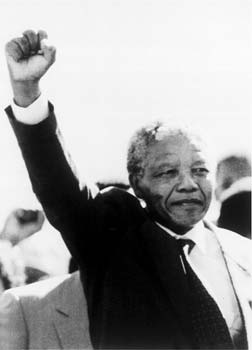
Representing Mandela

Picture from: http://www.freedomarchives.org/audio_samples/Nelson_Mandela.html
With the sad, but sadly inevitable, death yesterday of one of the greatest political figures of the last hundred years it might be a good time to look at how language shapes different representations and how those representations change over time.

For many, Nelson Mandela was always a hero: a man fighting injustice and racial intolerance in a country that had institutionalised racial separatism like no other. Given the almost-universal praise and warmth for Mandela upon his death, you might have thought that this was what people felt at the time, but it wasn't always like this.

While the Special AKA recorded the magnificent single Free Nelson Mandela, making the point that Mandela was not just a figurehead but  - as they put it "only one man in a large army" -  young Conservative Party activists designed tasteless Hang Nelson Mandela t-shirts and posters - an early form of trolling, no doubt - and leading Tory ministers actively campaigned against economic sanctions (probably the same ones who would now support harsher sanctions on Iran) or even (in the case of the current Prime Minister, David Cameron) went to South Africa on a jolly, paid for by an anti sanctions company.

But things move on, and people's views evolve and perhaps mellow as time goes on. Cameron is now singing the praises of Mandela's integrity, leadership and forgiveness. I used to think the Conservative government should be hung, drawn and quartered for their support of apartheid South Africa. Now, just 2 out of those 3 would do for me...

For each person who saw Mandela as a freedom fighter, another saw him as a terrorist. I'd like to think that there were more of us in the former camp, but as this article by Peter Beinhart points out, powerful forces saw Mandela as a dangerous agitator. Even in 2008 - yes, 2008 - the ANC and Mandela were still on a USA terrorist watch-list!

Others, like the excellent Guardian journalist Gary Younge and writer Musa Okwonga offer alternative viewpoints. Younge describes Mandela as "never a revolutionary, always a radical" and Okwonga cautions against a revisionist, sanitised view of Mandela, which removes his anger and replaces it with sainthood.

So, for English Language students there's a lot to consider in the coverage of Mandela's death. If you look back through articles from the 1970s to 80s when he was still in prison and the ANC were seen by the South African state as  a terrorist organisation, the language may well strike you as less sympathetic: often related to violence, struggle and conflict. Fast forward to 1990 when the world's press watched him walk free from prison with all the hope, reconciliation and bridge-building that seemed to embody, and now on to the sanctifying of Mandela as a modern day saint and you'll find the language shifting into a whole range of other fields: tolerance, forgiveness, understanding, inspiration and harmony.

A great man and a great study in how perceptions can change and how language can change the way we see the world.

Edited on 06.12.13 to add link and correct error.

Wednesday, May 22, 2013

The language of the workhouse

Val Gillies has written a great piece on the revival of a "Victorian lexicon" to describe class in the UK which echoes and magnifies some of the points brought up in this blog post from January about the polarised discourses surrounding people in work and out of work.

If you're looking for ENGA3 topics related to language and representation (for PC discourses) or are thinking ahead to ENGA2 topics for next year's coursework, it makes a good, if deeply depressing, read.

Friday, March 22, 2013

The language of love

There's a short and informative piece by David Shariatmadari in today's Guardian about the changing terminology used to label and describe people of different sexual orientation. In the comment piece, he talks about the terms that have developed over time and the arguments about such language.

Linking his points to a wider discussion of the role of language in shaping or reflecting people's attitudes to sexuality, he asks "Does language change politics, or is it the other way round? Or perhaps language is more like fashion, in having something to do with prevailing attitudes, but not, ultimately, being all that important".

It's a question we've looked at in A2 English language lessons recently, particularly around the language of race and discrimination. Shariatmadari goes on to raise this too.

Language certainly feels important if you've just been shouted at by a racist or a homophobe. But it's worth asking whether zero tolerance of the N-word, for instance, might be a precursor to, or an after-effect of, more enlightened thinking. Or whether in the US, where it is perhaps the biggest linguistic taboo of all, racism has, in fact, ceased to be a problem.

When we've looked at Political Correctness (PC) and the movement to change language or highlight its potential problems, we've often speculated on the relationship between language and attitudes. Can removing bad words remove bad ideas from people's heads? Or does it just create a vacuum for another bad word to rush into?

Shariatmadari argues what is essentially a reflectionist perspective: "Language is the imprint of our culture. It encodes – though it does not determine – the character of the age". The language that is used to label people who are gay, bisexual, transgendered or questioning is changing to reflect the range of sexual identities that are now gaining prominence (but were probably always there) rather than necessarily shaping identities.

There was another article on this topic a few weeks ago, which you can find here. It's good to have a range of references when you're answering ENGA3 questions about Language Change and Language Discourses, so have a read and make a few notes...

Saturday, February 23, 2013

Speak now, pay later

There's always been lively debate among linguists and non-linguists alike about the extent to which language might influence or even control the way we think. At its most extreme, we find the strong version of the so-called Sapir-Whorf hypothesis (largely the work of Benjamin Lee Whorf) which argues that the way we interpret the world around us is heavily influenced by the language available to us:

We cut nature up, organize it into concepts, and ascribe significances as we do, largely because we are parties to an agreement to organize it in this way — an agreement that holds throughout our speech community and is codified in the patterns of our language...

Many have taken this to mean that he believed that language helped control and shape the way we think (a view originally put forward by Wilhelm von Humboldt) but others suggest that Whorf was never really making such a bold claim.

Whatever the rights or wrongs of this, there has been a lot of interest in the idea that the languages we speak, the words we choose and the grammar we use might have an impact on how we view the world. This week's BBC news website carries an account of Professor Keith Chen's research into language and economic habits, wherein he suggests that speakers of languages that have a strong "future time reference" (i.e. use a separate tense to indicate future time) are less likely to plan ahead in terms of money and health. As the BBC story puts it, "... if you speak English you are likely to save less for your old age, smoke more and get less exercise than if you speak a language like Mandarin, Yoruba or Malay".

According to Chen, languages either have a strong or weak FTR (future time reference) and those with a strong FTR tend to separate present and future, making it less likely that the speakers connect present actions with future events. In other words, the stronger the difference between your language's representation of present and future, the weaker the speakers' ability to link present and future. He argues that this then leads to an inability to plan ahead.

Of course, this is a very difficult idea to prove, particularly if you're not actually a linguist (Professor Chen is primarily an economist), and Professor Geoff Pullum cautions against taking the research at face value in an interesting response on Language Log. One of his key points is that Chen is mistaken in claiming that English has strong FTR, given that we tend to use the present tense (I am going to play football to morrow) or modal verbs (I will play football tomorrow).

The story has been picked up elsewhere, including here, where other links between language and thought are discussed, and in this debate between Lera Boroditsky and Mark Liberman.


Thursday, January 24, 2013

Are you a QUILTBAG?

Labels for different social groups are a shorthand way of defining people and we use a lot of them in our language. Recently, we've looked at terms like handicapped, the handicapped, disabled, people with disabilities and wheelchair users as part of our work on ENGA3 Language Change, but on the Johnson blog they take a look at some of the rapidly evolving acronyms and initialisms for groups defined by their sexuality.

So, we have LGB (Lesbian, Gay and Bisexual) and LGBT (Lesbian, Gay and Bisexual and Transgendered) but in the past the labels weren't quite so neutral. Gay has had a fascinating history as a word, and queer has been reclaimed to some extent, but read more of the piece in Johnson to see where we're going now and what a QUILTBAG is...

For a full set of LGBTQIA (and more) terms, have a look here. A term that's fairly new to me, but seems to have been knocking around for a while, is cisgender (explained, I think, here). The recent media firestorm about Julie Burchill's 'transphobic' article in the Observer (removed from the Observer site but reprinted here) brought this term to my attention and it's another example of how language and identity are closely linked, and the ways in which language can be used to hurt others.

Tuesday, October 09, 2012

Everyday sexism

In looking at language and representation, we've started to think a bit about the links between language and gender: how language often reflects historically sexist attitudes while also constructing (or reconstructing) those same attitudes. Many of the comments in class along the way have treated sexism or patriarchal attitudes as things of the past, old-fashioned views held by long-dead men, but this disturbing article about the kind of everyday sexism experienced by university students shows that while the sexism still exists it has just shifted its frame of reference.

It's the almost normal way in which slut-dropping, rape and hoes are talked about that makes this so wrong. If the words are treated in such a casual way, doesn't that also suggest that the attitudes are pretty casual too?

There's more about this on the Everyday Sexism Project's site.

Thursday, October 04, 2012

Over two and a half million 'faggots'

We've started to look at language and representation in AS Language recently, so this link might be of interest to you. It uses Twitter to track the use of potentially homophobic language items, such as dyke and faggot.

It's pretty shocking that so many casually abusive words are chucked around so frequently, but is it the whole story?  As we've been looking at with racist and sexist terms, part of the consideration we need to give to some of these words is the context they're used in. For example, slut might mean one thing when shouted across a street or posted by some sleazy internet troll, but might mean something completely different when used in banter with another female.

We've already seen that the n-word (or nigga) mean different things to different people in different contexts, so is a blunt tool like counting the number of times a word is used really going to reveal much abut homophobic attitudes? It's a start, at least, so might then allow a more detailed analysis of the contexts and meanings in each case.

There's more about the real-time Twitter feed here, where you can really look at each tweet as it appears, and yes, most of them are from teenage boys abusing each other or talking rubbish. The questions then might be, does it matter? Is anyone really offended by it? Why is it seen as acceptable for these words to be chucked around with such gay (sorry) abandon by some of these people? Does it reflect a deeply ingrained anti-gay attitude, or just a casual attitude to what words mean and how they can harm?

Some of these questions are addressed here on the No Homophobes site, and it makes for a provocative and interesting read.

Wednesday, October 03, 2012

Teenage dirtbags

The representation of social groups is an area that we're starting to look at in AS English Language this week, so I've been gathering together texts and extracts on different groups to start some discussion. One good area of study is how young people are represented in the media, so this piece in today's BBC News Magazine on the death of the teenage rebel is a good read.

Apparently, recent studies suggest that young people are now less likely to smoke, drink and take drugs than ten years ago. So, why are young people still almost universally slated in the mainstream media?

A study by the children's charity Barnardo's back in 2008 addressed some of these concerns and you can find some of the relevant blog posts about their study and campaign here (along with some older posts about attitudes to young people).

You'll also find these articles, which we'll be looking at in class over the next few weeks, go some way towards answering that question and are worth a read if you're planning ahead and thinking about your potential coursework project.

"Thugs consider ASBOs a diploma" - Daily Mail article
"We see young people as pestilent" - Tanya Byron in The Guardian
Tony Parsons on attitudes to young people

Friday, September 28, 2012

Bitch bad, woman good


Rap's never really had a good reputation for its representation of women. Bitches, hos, big booties bouncing and lollipops getting licked seem to be where it's at for a lot of rappers. But Lupe Fiasco isn't your average rapper and his latest album features a track called Bitch Bad, which pulls apart the construction of the word, its representation of women, its reflection of a materialistic society and its influence on malleable minds.

You can see the video here if it's not embedded above, and read the lyrics here. It's worth looking at how he pulls apart the assumptions and associations around the word, as it's a key part of what we do on ENGA2 when we look at the Investigating Representation task for coursework. Areas like how gender, ethnicity and sexuality are constructed and reflected through language are central to the unit, and it's worth spreading your net wide to gather language examples to focus on and write about.

If you're interested in other areas around words related to gender, try looking for material on this blog last year about Slutwalks. If the language used to describe disability is more your thing then you may want to look at the arguments here about the words mong and spastic.

Saturday, September 22, 2012

Tory toffs, plod and plebs

Tory Minister, Andrew Mitchell is in hot water over his alleged outburst to police officers at the Houses of Parliament. It is reported that he swore at them, using the dreaded f-word, but much worse than that for a Tory government consisting largely of ex-public schoolboys who are generally seen to be aloof, arrogant and out of touch (even by their own nannies), he called the police plebs. Worse than the f-word? Really? Well, it depends on what you think of its significance. Some describe it as "politically toxic".

Plebs is a back-formation from a Latin word plebeian used in ancient Rome, basically meaning "of the common people" as opposed to being from the ruling aritocracy. As this BBC News Magazine article explains, the word gained currency in British public schools which often modelled themselves on ancient classical tradition and in the class divide that such an education created.

Given the timing too - in a week where two police constables were shot dead in what appears to have been an ambush in Manchester - it's not really a great week for a Tory MP to belittle the men and women who are protecting them and shows again the power of language to reflect social attitudes when it's used.


Saturday, September 15, 2012

ENGA2 Investigating Representation

I'm going to be teaching the investigation coursework part of the AS course for the first time in a few years, so have been looking around for ideas that might work. What I am hoping is that this post can become a bit more collaborative than the usual ones, with students and teachers suggesting topics and approaches that have worked for them. So, if you are an A2 student who did an interesting topic last year or a teacher of the A spec who has some good ideas about topics from work you've set/seen, please add your comments.

Conscious of the fact that lots of students have gone for celebrity profiles in the past (representation of individuals) and that these are often a bit pedestrian, I've tried to suggest a couple of issue-based topics below, so any other ideas would be very welcome.

Page 3
Institution: is it an institution? Should it even exist?
Issue: sexism, pornography
Social group: women and representation of gender
Suggested text to start off with: Deborah Orr in The Guardian

Hillsborough
Event: comparison of reporting on event then and now, with The Sun's coverage being of particular interest.
Social groups: football fans, Liverpool fans/Scousers (regional stereotyping)
Institution: the police
Suggested texts to look at: Neil Warnock on memories of the disaster, The Sun's front pages then and now:


Football fans
Following on from coverage of the Hillsborough inquiry, it could also be worth looking at changing representations of football fans, from the hooligans of the 1970s and 80s through to the prawn sandwich munchers of the 2000s.
Social group: football fans
BBC News magazine article on this
Football Supporters Federation - representing fans

Some other possibilities (updated Friday 28th September):

Pussy Riot
Event: jailing of the band
Individuals: as band members
Issue: protest, feminism
Social group: women, activists
There are some sharply contrasting representations of them in the media too.
The Economist covers it here.
Guardian comment piece.
NME interview with jailed band members
Bad taste tweets?

Jeremy Forrest and Megan Stammers
Perhaps a bit too soon to look at this dispassionately, but now they've been found (apparently alive and well), this case and its coverage - particularly the representation of Forrest in the tabloid press and in interviews with his parents - could be a very interesting one to explore.
This link to the press conference where his parents spoke might be a good place to look.
The Sun's coverage a few days into the story.
Event, Individuals, Social groups, Issues could all be covered here.

Friday, June 03, 2011

Maximum chav-age

There's more on the word chav here on the BBC site, all inspired by the forthcoming book Chavs: The Demonization of the Working Class, by Owen Jones. It looks very promising, if this review by Labour MP John Cruddas is anything to go by.

Looking at arguments about language change and political correctness is all part of ENGA3 Language Discourses, while the language used to represent social groups - in this case, the working class, or sections of it - is covered in the coursework for ENGA2.

Wednesday, May 18, 2011

Hit the pause button

There's nothing I like for breakfast more than a big banana.
Can you pass me the bag of nuts?
I think I'll have the sausage, please.

What connects all of these seemingly innocuous food-related comments? Well, if you're an NBA basketball player, you'd probably want to insert (oo-er) the word pause after each. Why? To avoid sounding like you're gay, obviously. So, "I'm right behind you", "I've got your back" and "That driver was right up my arse" would all qualify as potentially smutty innuendoes requiring the pause treatment. Because to be gay in the macho world of professional sports is to be bad. Hell, it's even worse than being a girl!

Pause - according to Urban Dictionary - is used "to negate the sexual connotation of a comment" and has been recently appearing in spoken language and social networking (often Twitter) comments, perhaps following the patterns of usage of its slightly older brother no homo, which has been around since (apparently) the early 90s in hip hop slang and beyond.

The attempts by some men to police their own language use and avoid the potential embarrassment of letting slip a comment that might be perceived as gay are both interesting and slightly pathetic. Sociolinguists often look in detail at the language markers that help us define our identity and note - like Deborah Cameron does in her Myth of Mars and Venus - that we often use language as  much to define who we are not as who we are. So, in other words, the use of pause or no homo, could be a deliberate attempt to distance some men from gay men (or the stereotypical language styles associated with gay men). But why not just avoid saying things that are... like "gay"...in the first place? Well, that would be missing the point, because the whole point of using pause seems to be to draw attention to your words and encourage salacious connotations to be drawn from them before distancing yourself from the implications of the interpretation. Or something like that...

What's pathetic about it shouldn't be too hard to see. Do gay men really mince around discussing the relative merits of big bananas or succulent sausages? Probably not (unless you're Julian Clary). The whole use of pause might be seen as harmless fun, self-conscious mockery even, but at the same time it's peddling a view that gay men talk in a certain way which is easily identified and ridiculed, and that they are sex-obsessed, double-entendre-fixated "others". Some may be - surely that's up to them - but it's a lazy stereotype to assume it applies to all gay men.

So, is pause homophobic? Possibly. Is it dangerous? I'm not sure. There have got to be worse forms of linguistic homophobia than this - name-calling, abuse - but it probably says more about the speaker's attitudes to homosexuality than it does about gay men themselves.

Jay Smooth's brilliant video clip says it all so much better than me except he argues that pause came before no homo and is now (in his words) "played out", old, boring. 

Edited on 18.05.11 to add some more smutty innuendoes and a genius bit of hip hop linguistics

Follow EngLangBlog on Bluesky

The old Twitter account has been deleted (because of both the ennazification and enshittification of that site) so is now running on Bluesk...