There's a good opinion piece by Christopher Howse in today's Telegraph about swearing. It's good, not necessarily because of the opinion put forward (which comes across a bit like a fusty old wing commander sitting in a gentlemen's club in Ascot, complaining about young people these days and how national service should be brought back) but because it's argued in a fairly convincing fashion and is a suitable model for your ENA6 Language Debates paper, which we'll be starting on later this term.
Here it is: have a read.
Sunday, January 04, 2009
Words we do not <3
A story in the Daily Telegraph reports on the Lake Superior State University in Michigan, USA's annual list of words which should be banned. It's a light-hearted look at expressions that have become over-used in American speech, or that have become meaningless cliches, and makes a good companion piece to Susie Dent's list of words we hated in 2008.
Among the entries in the Lake Superior State University list are some we've probably all heard used here or in coverage of American politics - green for environmental, maverick for deranged and republican, iconic for anything/anyone remotely famous - and others I'd not come across such as the less than 3 emoticon used in the title of this post. It means heart, apparently. Yuck.
Among the entries in the Lake Superior State University list are some we've probably all heard used here or in coverage of American politics - green for environmental, maverick for deranged and republican, iconic for anything/anyone remotely famous - and others I'd not come across such as the less than 3 emoticon used in the title of this post. It means heart, apparently. Yuck.


Wednesday, December 31, 2008
Ring out the old (words); ring in the new (year)
Happy New Year*. And what better way to celebrate the end of 2008 than by looking at its worst words and looking forward to a better year of lexical innovation? Well, I can think of several better ways but they involve Angelina Jolie, a bottle of champagne and a hot tub, but you don't want to know about that. And neither does Brad Pitt - he'd get jealous.
Have a look at this if you'd like to find out about Susie Dent's worst words of 2008 and have a look here if you'd like to see a video about the new year and why it's over-rated.
Have a look at this if you'd like to find out about Susie Dent's worst words of 2008 and have a look here if you'd like to see a video about the new year and why it's over-rated.
Monday, December 29, 2008
Your mum's so fat she eats deep-fried mars bars
An American academic has claimed that the art of battling, so long associated with rap music, actually has its origins in the Scottish practice of flyting. The Daily Telegraph carries the story here and it's a good read.
I know I would say this, but this is a point I've been making to anyone who's cared to listen over the last few years of teaching English Language (grand total of listeners so far = 3). And while the academic quoted in the Daily Telegraph, Professor Ferenc Szasz, credits the Scots with inventing flyting, I thought it had existed from way back in Anglo-Saxon times with warriors such as Ragnar Hairytrousers chucking abuse across the battlefield. A fascinating piece on this blog makes a link between internet flaming, Anglo-Saxon flyting and rap battles.
Anyway, it doesn't really matter. I suppose what's interesting is that like so many things to do with language, there are ancient origins or paradigms for most of our current usages. If you can get to it before it's removed, the poet Benjamin Zephaniah has done a really interesting programme on the background to the dozens, a competitive and abusive form of wordplay, which you can find here on I-Player.
And for some light entertainment, try this link for The Pharcyde's excellent track Ya Mama.
Professor Szasz is convinced there is a clear link between this tradition for settling scores in Scotland and rap battles, which were famously portrayed in Eminem's 2002 movie 8 Mile.
He said: "The Scots have a lengthy tradition of flyting - intense verbal jousting, often laced with vulgarity, that is similar to the dozens that one finds among contemporary inner-city African-American youth.
"Both cultures accord high marks to satire. The skilled use of satire takes this verbal jousting to its ultimate level - one step short of a fist fight."
I know I would say this, but this is a point I've been making to anyone who's cared to listen over the last few years of teaching English Language (grand total of listeners so far = 3). And while the academic quoted in the Daily Telegraph, Professor Ferenc Szasz, credits the Scots with inventing flyting, I thought it had existed from way back in Anglo-Saxon times with warriors such as Ragnar Hairytrousers chucking abuse across the battlefield. A fascinating piece on this blog makes a link between internet flaming, Anglo-Saxon flyting and rap battles.
Anyway, it doesn't really matter. I suppose what's interesting is that like so many things to do with language, there are ancient origins or paradigms for most of our current usages. If you can get to it before it's removed, the poet Benjamin Zephaniah has done a really interesting programme on the background to the dozens, a competitive and abusive form of wordplay, which you can find here on I-Player.
And for some light entertainment, try this link for The Pharcyde's excellent track Ya Mama.
Wednesday, December 10, 2008
Feck off
 As we all know, swearing is not big and it's not clever. But it's something that many of us do in certain situations: pain, anger, frustration, as punctuation in a particularly dramatic story. Preston Council has decided though that swearing has to stop and have instituted on the spot fines for swearing and other antisocial behaviour (spitting, littering, dog fouling etc.).
But when is a swear word not a swear word? According to the Advertising Standards Authority, the word feck, as popularised by the brilliant Father Jack in Father Ted, is not rude. The Scotsman newspaper covers the story in more depth here. Lots of rude words, or blasphemous expressions have been toned down by swapping a few letters round. Expressions like Cripes and Jeepers are both believed to originate in attempts to avoid "taking the Lord's name in vain". So Cripes = Christ and Jeepers = Jesus. Oh Cripes, I've just blasphemed by typing those...
If you search using the blog search bar you'll find lots of useful stuff about rude words and people's attitudes towards them. As several of you are doing research into swearing and taboo language for your Language Investigations, some of this could make good background reading.
Monday, December 08, 2008
Words disappearing
Words don't just change (see below); they sometimes disappear completely. At least, that's what The Daily Telegraph tells us has happened to words like thrush, marzipan and willow in the latest edition of Oxford University Press's Junior Dictionary.
Not only have these words been removed, but they've been replaced with newfangled ones like MP3 player, broadband and dyslexic. While the tone of the article borders on the splenetic (look it up, lexis lovers) to begin with, it does quote some sensible linguists too:
Not only have these words been removed, but they've been replaced with newfangled ones like MP3 player, broadband and dyslexic. While the tone of the article borders on the splenetic (look it up, lexis lovers) to begin with, it does quote some sensible linguists too:
Oxford University Press, which produces the junior edition, selects words with the aid of the Children's Corpus, a list of about 50 million words made up of general language, words from children's books and terms related to the school curriculum. Lexicographers consider word frequency when making additions and deletions.
Vineeta Gupta, the head of children's dictionaries at Oxford University Press, said: "We are limited by how big the dictionary can be – little hands must be able to handle it – but we produce 17 children's dictionaries with different selections and numbers of words.
"When you look back at older versions of dictionaries, there were lots of examples of flowers for instance. That was because many children lived in semi-rural environments and saw the seasons. Nowadays, the environment has changed. We are also much more multicultural. People don't go to Church as often as before. Our understanding of religion is within multiculturalism, which is why some words such as "Pentecost" or "Whitsun" would have been in 20 years ago but not now."
So there you go...at least Christmas is still in it, otherwise I'd be complaining too.
Edited to add: Henry Porter of The Observer has made his own response here. It's a bit verbose (Gilberto, that's you, that is) but has this paragraph which is quite interesting:
However necessary these dull newcomers to the Oxford Junior Dictionary may be, it must be true that with each word and experience excluded, the 21st-century child is minutely deprived. Language becomes more functional, the interior life more arid and the opportunities for rich expression and playfulness fewer.
Words turning bad
There's a good piece on the BBC website's magazine about how words often pick up unpleasant meanings as time goes on - semantic change and, in this case, pejoration - and how this happens.
Their focus is on the word "groom" which has shifted from meaning "to beautify oneself or one's steed" (as in "I'm just popping out to groom the pony.") or to prepare someone for a particular position, usually a successor, to having unpleasant connotations of nurturing an unhealthy sexual relationship with (usually) a young person over the internet.
Given the words used in the article (words from, shall we say the "semantic field of Gary Glitter") you might find it a) unpleasant reading and/or b) blocked by your college filter, but if you can reach the link, it's a good read and one that chimes in with many other words that have changed meaning over time.
Their focus is on the word "groom" which has shifted from meaning "to beautify oneself or one's steed" (as in "I'm just popping out to groom the pony.") or to prepare someone for a particular position, usually a successor, to having unpleasant connotations of nurturing an unhealthy sexual relationship with (usually) a young person over the internet.
Given the words used in the article (words from, shall we say the "semantic field of Gary Glitter") you might find it a) unpleasant reading and/or b) blocked by your college filter, but if you can reach the link, it's a good read and one that chimes in with many other words that have changed meaning over time.
Friday, November 21, 2008
I-phone? Pah, US-phone!
 The I-phone is a beautiful thing. And I don't have one yet, so if you're drawing up a Christmas list remember me. But while the I-phone looks nice, it's causing all sorts of problems for those people who don't conform to a "standard accent". And because the I-phone's new voice recognition programme has been based on an American accent (which variety of US accent, I don't know), some British users are getting their wires crossed.
The Telegraph reports on it here. We covered a similar story on the blog way back in 2005 when Alex Ferguson, manager of a little-known Northern soccer club, had to return his posh car to be "fixed" as it couldn't understand his melodious tones.
But beyond the silly aspects of these stories, there is serious issue about the whole idea of what is "standard" and what's not. Who decides on what is a "normal" accent? Well, usually those who feel they have the right and the power to make their own accent the norm. So if it's north American software developers today using their own accents as the norm, five hundred years ago it was William Caxton and his printer chums who settled on the dialect of south east England as the standard of their era.
Me, I'm waiting for the cockney phone, which responds to any voice with a slap round the face and a shout of "Millwall".
Useful for:
ENA5 - Language Variation
ENGA3 - Language Explorations
Let's sort these parasites out
If you haven't already seen Barnardo's shocking film in defence of children's rights, you really should. It's here on the Barnardo's website and makes excellent material for looking at how language is used to represent young people. Remember, all the dialogue in the film is taken from UK newspaper websites: in other words, these are all things members of the British public have said about young people. Scary stuff.
Useful for:
ENGA2 - Investigating Representation
Useful for:
ENGA2 - Investigating Representation
When is a word not a word?
 When is a word not a word? Well, if you believe some people, the answer is when it's meh.
We covered meh a while ago on this blog post, picking up on an article in The Guardian and a discussion on the ace linguistics blog Language Log, but it's been made a new entry in the latest edition of the Collins English Dictionary. The story is reported here in The Times and discussed in the subsequent comments from readers.
What is meh? According to the The Times article the story goes like this:
“Meh” started out in the US and Canada as an interjection signifying mediocrity or indifference and has evolved, via the internet and an episode of The Simpsons, into a common adjective meaning boring, apathetic or unimpressive in British English.
So, you might describe something as meh in an adjectival way ("That was just so meh".) or as an interjection (Your mum*: "We're going to Aunty Betty's for lunch" You: "Meh".), but is it really a word? And should it be in the dictionary?
Ben Zimmer follows the discussion here on his Visual Thesaurus site, and it's worth a read as he tracks the development of the word and the debate about what "words" actually are.
And for a taste of a prescriptive versus descriptive take on language change, try these two Times comments for size:
1.No wonder we have such a slip in standards in this country, this word and the others being cited to appear in the Collins Dictionary, are slang and i don't think that slang has any place in a dictionary of our English words, why don't they just put them in a Slang Dictionary,marina, Hemel Hempstead, Herts
2.Language is fluid and constantly evolving. Many of the words we use today would have been considered slang in the past but we don't know the difference as we have always used them. The way we adopt new words and how they shape & reflect our understanding of the world fascinates me, i'm all for it!
Stephanie Barnett, Sheffield, UK
Go, Stephanie, go Stephanie, go Stephanie....
Useful for:
ENA5 - Contemporary Language Change
ENGA3 - Language Explorations
*Yes, I said "your mum" and I'm proud of it.
Monday, November 17, 2008
Grammar rock
Still struggling with word classes? Do you get your adjectives and adverbs mixed up? Try these videos from the Grammar Rock series in the USA...
First off, here are nouns:
Verbs
Adjectives
Adverbs
Prepositions
Conjunctions
First off, here are nouns:
Verbs
Adjectives
Adverbs
Prepositions
Conjunctions
Children in trouble
"What is happening to our children? They disrespect their elders, they disobey their parents. They ignore the law. They riot in the streets."A quote from the Telegraph newspaper in 2008?
No, that quote is attributed to the philosopher Plato, born more than 400 years before Christ. Let's try another.
"The manners of children are deteriorating... the child of today is coarser more vulgar... than his parents were."
A leader from the Daily Mail in 2008? No, that was CG Heathcote, the stipendiary magistrate for Brighton in 1898, giving evidence to an inquiry on juvenile delinquency.
Representation of young people in the media is a topic we've looked at in AS classes this term and there are some A2 students covering it for their Language Investigations too, so this story on the BBC website is pretty good for focussing your thinking on the key issues.
This link takes you through to the Barnardo's website where their campaign in support of young people is discussed in more detail. Barnardo's have run some brilliant (and often disturbing) campaigns over the years and this one looks very interesting. Here's a link to the video for the campaign. This could make a really good focus for a coursework investigation on ENGA2.
Wednesday, November 12, 2008
Apostrophe's must go!
Today's Telegraph and last night's Newsnight have features on that old friend of ours (why not our's?): the apostrophe.
Why does this punctuation mark exist? How come about 50% of the population can't use it properly? Should we just say "pah" and get rid of it? The Newsnight link is very good as it's got a 4 minute of Jeremy Paxman and David Crystal discussing its (why not it's?) history and use. And, it has to be said, it's a slightly more enlightening interview than Paxman's one with Dizzee Rascal last week.
There's more about this debate here on The Register and here on the linguist, John Wells' excellent blog (scroll down to Friday 3rd for this). It's John Wells, of course, who kicked off this particular round of apostrophe uproar with his call to get rid of the apostrophe as part of a more straightforward system of spelling and punctuation (covered here and here).
It's all part of the prescriptivist versus descriptivist debate which features in ENA5 Language Change.
Why does this punctuation mark exist? How come about 50% of the population can't use it properly? Should we just say "pah" and get rid of it? The Newsnight link is very good as it's got a 4 minute of Jeremy Paxman and David Crystal discussing its (why not it's?) history and use. And, it has to be said, it's a slightly more enlightening interview than Paxman's one with Dizzee Rascal last week.
There's more about this debate here on The Register and here on the linguist, John Wells' excellent blog (scroll down to Friday 3rd for this). It's John Wells, of course, who kicked off this particular round of apostrophe uproar with his call to get rid of the apostrophe as part of a more straightforward system of spelling and punctuation (covered here and here).
It's all part of the prescriptivist versus descriptivist debate which features in ENA5 Language Change.
Sunday, November 09, 2008
Yes we can
Can we analyse Obama's victory speech? Yes we can.
Like a lot of people, I'm still feeling a warm glow about Barack Obama's amazing victory in the US elections. And like a lot of people, I'm impressed with the victory speech he made in Chicago. But being a language nerd and teacher, that's not enough for me. I need analysis!
So, here's a link to The New York Times' video of the speech and their interactive transcript, a video of the whole speech from The Guardian website, and a link to an article in today's Times about the rhetorical techniques used in the speech.
Like a lot of people, I'm still feeling a warm glow about Barack Obama's amazing victory in the US elections. And like a lot of people, I'm impressed with the victory speech he made in Chicago. But being a language nerd and teacher, that's not enough for me. I need analysis!
So, here's a link to The New York Times' video of the speech and their interactive transcript, a video of the whole speech from The Guardian website, and a link to an article in today's Times about the rhetorical techniques used in the speech.
Friday, November 07, 2008
F*ck you, you f*cking f*ck
Apparently the f-word is being overused on TV and it's all getting too much for some people. The Daily Mirror has even launched a campaign to "clean up" the airwaves, calling for swearing to have "a specific point".
So, why does swearing upset so many people? Some words have been normal, inoffensive expressions for centuries and then become taboo. The c-word (which I can't type here or the college filters will ban the blog) is one example of this. Even the old favourite sh-word had few offensive connotations back in Middle English. But it's clear that some words are just seen as ruder than others, and certainly not suitable for children to hear.
The recent debate has probably been sparked by the Russell Brand and Jonathan Ross furore on Radio 2 the other week, where Ross claimed that Brand had "f*cked your grand-daughter" in a call to Andrew Sachs' ansaphone. But are we getting ruder and swearing more than we used to? We apparently send each other many more offensive greetings cards than we ever used to, according to this Guardian story earlier in the term. And an OFCOM survey of offensive language and behaviour in the media from 2005 made a range of interesting points about swearing:
So, what's your take on swearing? A natural response to shock and way of venting anger, or a deplorable reflection of modern society's low moral standards?
Useful for:
ENA5 - Language Change
ENGA2 - Investigating Representation
ENGA3 - Language Explorations
So, why does swearing upset so many people? Some words have been normal, inoffensive expressions for centuries and then become taboo. The c-word (which I can't type here or the college filters will ban the blog) is one example of this. Even the old favourite sh-word had few offensive connotations back in Middle English. But it's clear that some words are just seen as ruder than others, and certainly not suitable for children to hear.
The recent debate has probably been sparked by the Russell Brand and Jonathan Ross furore on Radio 2 the other week, where Ross claimed that Brand had "f*cked your grand-daughter" in a call to Andrew Sachs' ansaphone. But are we getting ruder and swearing more than we used to? We apparently send each other many more offensive greetings cards than we ever used to, according to this Guardian story earlier in the term. And an OFCOM survey of offensive language and behaviour in the media from 2005 made a range of interesting points about swearing:
- Swearing and offensive language is considered to be widespread and to have increased over time by all groups
- It was seen as a symptom of decline in public life, for which participants believed the media was partly responsible
- All groups considered that the worst aspect of the increase in swearing was because of the example it sets to younger people/children
- The use of offensive language by young people is most offensive overall as it is seen as indicating a lack of respect
- Through the process of detailed discussion, swearing becomes a benchmark for underlying fears about society ‘breaking down’, or standards ‘slipping’.
- Younger people were more likely to swear among their peer groups, and saw it as inoffensive in this context. However, there was a wide range of behaviours in relation to swearing across all groups.
So, what's your take on swearing? A natural response to shock and way of venting anger, or a deplorable reflection of modern society's low moral standards?
Useful for:
ENA5 - Language Change
ENGA2 - Investigating Representation
ENGA3 - Language Explorations
At the end of the day, I personally shouldn't of done this
Can you spot the three irritating expressions and/or mistakes in that headline? Come on, it's not rocket science...
The people behind the Oxford English Corpus have drawn up a list of the top 10 irritating phrases in English, which is featured in today's Telegraph. That list in full:
The people behind the Oxford English Corpus have drawn up a list of the top 10 irritating phrases in English, which is featured in today's Telegraph. That list in full:
1 - At the end of the day
2 - Fairly unique
3 - I personally
4 - At this moment in time
5 - With all due respect
6 - Absolutely
7 - It's a nightmare
8 - Shouldn't of
9 - 24/7
10 - It's not rocket science
Friday, October 31, 2008
Early words
New research from the USA suggests that children's acquisition of vocabulary begins earlier than previously thought and relies more heavily on phonology (the sounds of a language) than expected. The report in Science Daily draws on research from University of Pennsylvania psychologist Daniel Swingley and suggests that children's comprehension of words starts at around 8 months, even though the average child will probably say his or her first word at about 12 months.
You'll be starting ENGA1 Language Development quite soon as part of your AQA A English Language AS (or will already have studied it as part of your ENA1 unit in AS last year), so keep an eye out for research into child language to help you understand the topic.
Useful for:
ENGA1 - Language Development
Infants have a unique ability to discriminate speech-sound (phonetic) differences, but over time they lose this skill for differentiating sounds in languages other than their native tongue. For example, 6 month old babies who were learning English were able to distinguish between similar-sounding Hindi consonants not found in English, but they lost this ability by 12 months of age. Since the 1980s it has been known that infants start focusing on their language’s consonants and vowels, sometimes to the exclusion of non-native sounds. More recently, researchers have increasingly focused on how infants handle whole words.
Recent research has shown that during infancy, babies learn not only individual speech sounds but also the auditory forms of words; that is, babies are not only aware of the pieces that make up a word, but they are aware of the entire word. These auditory forms of words allow children to increase their vocabulary and help them to eventually develop grammar. Although they may not know what the words mean, children as early as 8 months start learning the phonological (sound) forms of words and are able to recognize them—and just being familiar with the words helps increase the children’s vocabulary. Studies have shown that 18 month old children who are familiar with a word’s form are better at learning what it means and are also able to differentiate it from similar sounding words.
You'll be starting ENGA1 Language Development quite soon as part of your AQA A English Language AS (or will already have studied it as part of your ENA1 unit in AS last year), so keep an eye out for research into child language to help you understand the topic.
Useful for:
ENGA1 - Language Development
Thursday, October 30, 2008
Welcome to the "Croydon Facelift"
 Or to put it more technically "a UK female hairstyle which pulls the hair back tightly from the face, supposedly giving the effect of a facelift; stereotyped as that of working-class young women". And how about prison whites: "expensive trainers favoured by rap stars and their acolytes; the implication is that such shoes are worn by young black men, who are de facto criminals".
These are new entries in Jonathon Green's Chambers Slang Dictionary (a reworking of his Cassell Dictionary of Slang, or "that big yellow swearing dictionary on the shelf" as it's become known in my classroom). The Daily Telegraph offers its views on the dictionary in an article here; it's a decent read, as it goes beyond the usual novelty take on new words and instead has a think about where the words come from and what this tells us about the English Language and its development over the last century, with a shift away from homegrown Cockney slang towards American influences:
But while the themes of slang have stayed much the same, the sources have changed hugely. Until the start of Second World War, slang in this country was basically home-grown. There was cockney rhyming slang, of course, with its cheery costermongers banging endlessly on about their 'apples and pears' and 'plates of meat'. But there were also numerous other secret languages, designed to be understood only by a small group of people. As words and expressions passed into more common usage, so slang evolved in order to retain its exclusivity.
All that changed, though, with the Second World War. 'After D-Day, American slang - principally black American slang - took over,' says Green. 'In the 1960s, middle-class white people used words like "cool" and "groovy" without realising that they were incredibly old black words. Actually, "groovy" started out in the early 20th century as an expression meaning "staid" or "unfashionable" - that is, stuck in a groove. By the 1940s, though, it was being used by jazz musicians to refer to "slipping into a groove" while they were playing.'
But whereas it used to take several years for new words or phrases to move into common usage, now it happens in a few days. 'That's been the biggest change recently. If you look at black rappers and hip-hop, which is undoubtedly the cutting edge of slang at the moment, they're coming up with words that the white middle classes in America and England are immediately trying out for themselves. That's why you get all those floppy-haired public schoolboys making complete idiots of themselves by referring to their girlfriends as "bitches".'
But the Telegraph article takes a bit of a strange sidetrack when it claims that Black British English (and to some extent Asian British English, if there is such a homogeneous thing) has lagged behind its US counterparts. Green seems to suggest that most Black British slang is just imported from the USA via rap music, but I'd argue that we still have a fairly healthy homegrown slang. Yes, it riles me (it vexes me even) to hear British teenagers describing the police as the "feds" (feds being a clipping of the full words of FBI, Federal Bureau of Investigation, an organisation we don't have in the UK): why not stick to coppers, boy dem or the rozzers?
But then trying to impose rules on slang - or arguing with someone about the etymology of a particular slang term ("Listen here, my good man. This homework cannot be "gay", as you suggest, for it is an assignment without sexuality of any kind") - is pointless. Green is to be admired for his love of language and desire to find out more about it. Maybe next time round, we'll see some citations from our own students and your research into some of these words.
And here's a link to a video clip of Jonathon Green talking about his dictionary.
Useful for:
ENA5 - Language Change
ENGA3 - Language Explorations
Friday, October 24, 2008
Pimping for beginners
 Having looked at the semantic change of fail yesterday, I had a look at some more language articles on Slate and found this excellent one about the word pimp. Again, it's a word that's gone through an interesting process of semantic change, ameliorating into something with quite approving connotations and shifting its grammatical function from noun to verb, as well as broadening to encompass an almost entirely new set of meanings.
As the Slate article points out, the original meaning of pimp appears to be as a noun referring to a person (usually) male who solicits customers for prostitutes in return for a share of their money (from Dictionary.com). Etmology online suggests a possible origin for the term as the verb pimper from French meaning "to dress elegantly" or pimpreneau from French meaning "a knave, rascall, varlet, scoundrell" (ie a bad person). So far so good... or bad depending on whether you're the unfortunate prostitute renting out body parts to desperate men or the elegantly dressed arranger of the liaisons.
But as Slate goes on to discuss, the word has semantically shifted more significantly over recent decades:
But the word has seen a renaissance of sorts, with a strong increase in use in recent years. Media attention to (and glamorization of) the stereotype of the inner-city pimp brought such terms as pimpmobile and pimp walk—an ostentatious swagger affected chiefly by African-American men—to public attention in the 1970s. More recently, we've seen the advent of a range of benign figurative uses. We can now pimp our possessions, making them flashily decorated or customized, a use mainstreamed by MTV's car-detailing show, Pimp My Ride. An attractive or appealing man may be called a pimp, and this is viewed as a positive description. To describe something using the accolade pimping is to mark it as wonderful or exciting. Jay-Z's 2001 hit "Big Pimpin'" used the term as shorthand for a livin'-large lifestyle.
So, a more modern meaning of pimp appears to be as a term of approval for a sexually successful man (in the same way that stud, playa, cassanova, romeo have all been used too) , but the term has broadened in its verbal form to take in anything that is enhanced or made more attractive. But is this a good thing? Can we ever really say that language change is good or bad? (For a brief digression, have a look at this post on Language Log if you want to explore the idea of change being good, bad or just neutral.)
Some people, used to the older meaning of pimp as an immoral and uncaring man making money out of a woman's exploitation, object to the amelioration of the term. It's not a difficult point to understand: if the word pimp is used positively, does it now mean that the whole idea of pimping is seen more favourably? That it's ok to sell women's bodies? Or does it just mean that the word has changed and has little to do with its original meanings? Slate writer Jesse Sheidlower goes on to say:
Many younger speakers find these uses neutral and unobjectionable. Many older speakers think that any positive use of pimp is sexist or demeaning. But you can't make someone feel a certain way about a word. Younger people will continue to use suck ("to be notably bad") or gay ("lame, boring, terrible, stupid") heedless of what their elders think; it's just as hard to get people to reject something they think is OK as to get people to accept something they've been taught is wrong. (Though it's interesting to observe the online trend of writing the pejorative sense of gay as "ghey," to explicitly disassociate it from the homosexual sense.)
So, pimp, pimping, to pimp... what does it mean to you?
Useful for: ENA5 - Language Change ENGA2 - Investigating Representations ENGA3 - Language Explorations
Thursday, October 23, 2008
The definition of FAIL...
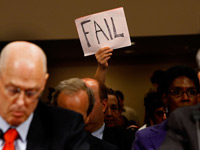 ...is you. Ha ha. Or your mum to be more precise.
But no, what does FAIL mean these days? In this very good article from the American online magazine Slate, Christopher Beam traces the origins of this rather splendid word and how it has changed thanks to its appearance in obscure Japanese video games, online gamer chat and now a brilliant blog dedicated to the art of fail.
We all know what fail used to mean: it existed as a verb. I fail, you fail, she fails, we all fail: you get the general idea. But now it's undergone conversion and can be used as a noun - a fail, a total fail, an epic fail - or even an adjective - you are fail - but it's unclear whether this will last or if it's just another passing language fad.
Have you come across it? Is it part of your vocabulary? Or just another nerdy internet thing like w00t and pwned which two students (Leanne and Henrietta, hello!) and me (hello...oh hang on) know about from our mis-spent time on t'internet?
Useful for:
ENA5 - Language Change
ENGA3 - Language Explorations
Subscribe to:
Posts (Atom)
Follow EngLangBlog on Bluesky
The old Twitter account has been deleted (because of both the ennazification and enshittification of that site) so is now running on Bluesk...

-
 As part of the Original Writing section of the NEA, students will be required to produce a commentary on their piece. This blog post will pr...
 -
As lots of students are embarking on the Language Investigation part of the Non-Exam Assessment, I thought it might be handy to pick up a fe...
-
I'm on a roll. Nothing from me for ages, then three posts come along! This is a lovely story from the Kenya Times about a dialect called...