Showing posts with label grammar. Show all posts

Thursday, October 05, 2017

SPaG spat

I started writing this post nearly a year ago while arguments were raging over the Key Stage 2 grammar tests. At the time, feelings were running high (yes, over grammar...) and I didn't want to stick my oar in and make matters worse, so I've come back to it and tried to look at the argument in slightly different terms, with more of a focus on how it relates to A level English Language.

The teaching of grammar is not necessarily at the top of the list for topics that will interest A-level students reading this blog; after all, you're studying it already as part of this course, so do you really want to find out the gory details of how teachers and educators argue about it?

Well, maybe... and the debate about how grammar is taught is quite closely connected to some of the big language debates covered in your course: arguments over Standard and non-Standard English, the importance of understanding how language works and who has the right to tell us what is 'right' or 'wrong'. All that stuff. So, you might want to read on, if you're a student.

Shots have been fired recently (and since it was all initially proposed) over the test taken by pupils in Year 6 at Primary Schools as part of what have been called the Key Stage 2 SPaG tests (Spelling, Punctuation and Grammar) but have more recently been named the GPS tests (Grammar, Punctuation and Spelling), perhaps to reflect the renewed focus on grammar (first, not third, in the list).

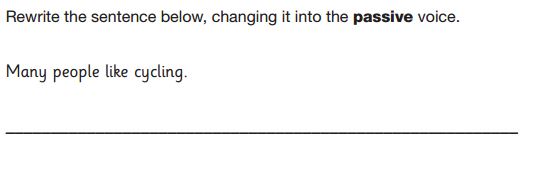
The test features some quite demanding questions about grammar, including some of the following:


source: https://www.gov.uk/government/uploads/system/uploads/attachment_data/file/327332/2014_KS2_L6_English_GPS_short_answer_booklet_DIGITALHO.pdf

How would you do on these? Well, you might want to try them yourself and check the mark schemes that are available to the public.

Why is there an argument over this test and why should it matter to you? Because politics. Grammar is political.

It's not purely about politics and that is one of the first points to make about this, because much of the debate between linguists, teachers and educationalists has actually been about the grammar of the grammar tests, and more precisely the amount of grammar that a 10 year-old should be learning, why they should be learning it and what they should be doing with that grammar. Linguists disagree to some extent over how important it is to teach grammar and the meta-language of grammar (i.e. the grammatical terminology) to school students and there are good arguments from both sides of the debate about this. But grammar is also very political, because it is used by politicians to signal their attitudes to a range of other things.

Deborah Cameron, who is perhaps better known recently for her ace language blog and excellent The Myth of Mars and Venus, wrote an important book in 1995 called Verbal Hygiene. In this, she argued that much of the debate around grammar in the media back in the 1980s and early 90s - when last there was a big bust-up over it - was tied up very closely, not so much with language, but with morality and social cohesion, and the threat of imminent social collapse that was pinned by many conservatives on the permissive 1960s and their anything goes attitude to sex, drugs and err...grammar.

Grammar had been a part of English teaching for many years but had started to fall by the wayside in the late 1960s and early 1970s. By the time I was at secondary school in the 1980s (ironically, at a grammar school, where very little grammar was taught outside French and German lessons), grammar was off the menu.

By restoring grammar teaching to the English curriculum, the government of the time could show a return to academic rigour and old-fashioned virtues of correctness. The certainties of grammar - where there is (supposedly) a clear right and wrong - would take the place of the limp-wristed liberalism of the 1980s classrooms where communist teachers and perfumed fops (or skanky goths, in my case) would discuss poetry and feelings with barely a mention of a clause or phrase. That was one view anyway...

According to Cameron, the desire to get grammar back on the agenda was about much more than just language:

Grammar was made to symbolise various things for its conservative proponents: a commitment to traditional values as a basis for social order, to ‘standards’ and ‘discipline’ in the classroom, to moral certainties rather than moral relativism and to cultural homogeneity rather than pluralism. Grammar was able to signify all these things because of its strong metaphorical association with order, tradition, authority, hierarchy and rules.
It was interesting that these seismic rumblings about grammar should have resonated so powerfully in the 1980s, because it was a time of turbulence in education, with the birth of the National Curriculum, but also a time of political and social upheaval brought about by a right-wing Conservative government. And that's where there's a link to what is happening with grammar today.

Another right-wing Conservative government is in power. Tests must be 'rigorous' because 'rigour' is what works. Tests are vital because how else do we judge schools and teachers? How else do we feed data into league tables that tell us which school is doing better than another? Well, it doesn't have to be like this, but that's another issue entirely.

When Michael Gove - then the Minister for Education - set about creating a new literacy test for Key Stage 2, he definitely wanted grammar at the heart of it. He hated the kind of English lessons where you would study the language of online communication or spoken conversations and longed for Victorian novels and the thwack of tough, hard, rigorous grammar on his soft... sorry, getting carried away there, but you get the picture. He wanted nouns, verbs, adjectives, noun phrases, relative clauses, the present progressive and the passive voice to feature in the tests. But most of all, he wanted the subjunctive mood: a piece of grammar that has been in decline since the Nineteenth Century.

And if these sound like the kinds of things you learn at A level, that's because they are - and I like to think we make quite good use of them in how we analyse and discuss language. But for Key Stage 2, when children are 10-11 years old?

At the same time, grammar also provided Gove with a way of assessing a slippery subject. As anyone will tell you, English can be very subjective. I might analyse a poem and see an extended metaphor for the tragic decline of a long-term relationship; you might read the same poem and see it as a few images about candles being snuffed out to prevent a fire. English has *all* the feels. But grammar... well, that's nearly like maths, or some some might argue, at least.

So, let's take this back to what it all has to do with A level English Language. You might not start the course looking at arguments about standard and non-standard uses of English, or the importance of 'correct' grammar, but you'll certainly move onto those at some point, and the debates are perennial and often very heated.

Modern linguists have generally taken a position that might be defined as descriptivist: they study language, describing its features, its functions and (sometimes) its users and what they might be doing with it.

On the other side, there's often been a position held by conservatives (sometimes conservatives with a little 'c', sometimes conservatives with a big 'C' and sometimes conservatives who are - quite frankly - just complete 'C's) that tells us language should not change too quickly, that old is best and that grammar is all about following rules and being right or wrong. This is generally called prescriptivism because it's an approach that prescribes "good English" to us in the same way a doctor might prescribe medicine to make us better.

The trouble is - as nearly every linguist will tell you - language always changes. The history of English is one of change, and grammar has changed a great deal. Just look at the pronoun system and what Old English used before Old Norse added to it (clue: the Vikings didn't just like 3rd person plural pronouns: they loved them).

And then have a look at the disappearance of thee and thou (in Standard English usage, at least, not in far-flung corners of Yorkshire or Kaiser Chiefs lyrics). Word order is another area of huge change - in the general syntax we use for most structures in modern English, but especially in how we form questions. If grammar changes more slowly than other aspects of language - and linguists are generally agreed that this is the case - it still changes and those changes stack up over time.

The other aspect of all of this is that the so-called 'rules' of English grammar are often not that at all; they are conventions, agreed upon by users of language and therefore susceptible to change. As an article a week or two back about the split-infinitive pointed out, this supposed error in English grammar was always a dubious rule to follow.

So, if grammar changes and grammar rules can be questioned, can we really place such high importance on teaching "correct" grammar? Yes and no. The debate about the grammar tests at Key Stage 2 shouldn't be about whether grammar is a good thing or a bad thing to learn and understand. I'll be clear about my own view: it's definitely a good thing. I think we need to understand the system of our own language and be able to describe its elements to explain how it works and see what we can do with it. And we also need a shared grammar to understand each other - that's why Standard English exists and one of the reasons why it's valued.

But what kind of grammar should be taught? The prescriptive kind doesn't really work when you live in a world of change. It might be attractive to a certain kind of person because it symbolises an adherence to tradition and offers the possibility that change can be stopped or at least slowed down, but I don't really buy that view. The problem with a prescriptive approach to grammar is often that it goes beyond what grammar really is (word classes, clauses, phrases and all that stuff) and into the policing of all forms of language - accents, dialects, slang and even body language and tone of voice.

It's instructive, I think, that at the same time Gove was introducing the grammar tests for 10 and 11 year-olds (even taking such an interest that he insisted his own favourite, the subjunctive mood appeared in the tests, against the advice of actual linguists on his expert panel) he was also getting rid of spoken language and electronic texts from the GCSE syllabus (and replacing them with 19th Century novels).

Why should that matter? Surely, great literature is more important to study than some "tape recordings of Eddie Izzard and the Hairy Bikers"? Well, it doesn't have to be either/or. There *has* to be a place for studying language in all its forms, not just its most respected and long-lasting ones. Other forms of language need to be studied too, you know... the actual language we use nearly all the time and from which we might gain something really useful.

But all of this is part of a bigger picture; a picture in which grammar is about rigour, correctness, tradition and hard knowledge. And that's where we come back to A level English Language study. When people argue about language, it's often not really language that they are arguing about at all. As Milroy and Milroy put it back in 1985 in their excellent Authority in Language:

Language attitudes stand proxy for a much more comprehensive set of social and political attitudes, including stances strongly tinged with authoritarianism, but often presented as ‘common sense’.

Henry Hitchings, author of The Language Wars, made a similar point in a slightly different way:

These debates quickly become heated because they involve people’s attitudes to – among other things – class, race, money and politics.
So, next time you look at a debate about accent, dialect, texting 'ruining' language, emojis dumbing us all down or how vocal fry makes women sound stupid and immature, just remember that it might appear to be a debate about 'just' language, but it's probably got deeper roots, and it often pays off to understand the wider agendas at work.

Tuesday, October 01, 2013

Grammar do and grammar don't

Last time there was a teachers' strike, I put the blog on strike for a day; this time round, I've decided not to. I'm on strike but have decided that the blog is a labour of love, for which I get no payment, and anyway, I update it so infrequently at the moment that nobody would be able to tell it's on strike. A bit like my teaching, in fact...

Anyway, today's post is a quick one about the rules of grammar - which ones to worry about and which ones not to - by The Guardian's Style Guide author David Marsh. In it he deals with some of the arguments people have about things like split infinitives, starting sentences with conjunctions, who/whom and all the rest of it.

It's a particularly useful article for A2 students looking at ENGA3 and Language Discourses, but is also handy for anyone who cares about writing clearly and how clarity can be improved with a a bit of careful thought.

Wednesday, May 29, 2013

Language Discourses revision June 2013

For those of you revising for the ENGA3 exam next Monday, there have been some really good recent examples of articles that focus on attitudes to language use and abuse. A few of these have featured on the @EngLangBlog twitter feed, so thanks to the various teachers and students who alerted me to them.

Last year's ENGA3 paper featured a Section B question all about the Queen's English Society and their prescriptivist views about language. Some really on-the-ball students - readers of this blog, no doubt ;-) - managed to mention the demise of the QES as reported here in their answers to the June exam: exactly the kind of contemporary reference that always impresses examiners.

The recent articles that you might like to have a look at all take a look at how people feel about the ways in which language changes.

In this one, Steven Poole looks at how the internet has both spawned linguistic development and, for some at least, linguistic abominations such as LOL and bad spelling.

In this one, Simon Horobin, an English Professor at Oxford University, stirs up the readers of The Daily Telegraph into splenetic projectile-vomiting by telling an audience at the Hay-on-Wye Festival to chillax and STFU about apostrophes and spelling errors.

In this one, Michael Rundell of MacMillan Dictionaries has a dig at those who tell us we should strictly adhere to grammar "rules" just because they say so.

All of them provide plenty of food for thought and ammunition for the exam.

Monday, May 13, 2013

Grammar and Gove

It probably comes as no surprise to regular readers that this blog is not a fan of Michael Gove, the Education Secretary, but his pronouncements last week were particularly grim, even by his own standards. And, while this blog is primarily concerned with A level English Language and not politics, we all know that arguments about the English language  - as Henry Hitchings, author of The Language Wars, puts it in his interview with emagazine - are often really about "people’s attitudes to – among other things – class, race, money and politics".

A quick look at today's BBC News Magazine article about attitudes to grammar and punctuation (a really nice intro to the topic if you're still looking for a way into this for the ENGA3 exam) helps illustrate this very point.

In a speech last week, Gove attacked a number of teaching approaches, teachers and journalists with an interest in education, while once again trying to fly the flag for "correct grammar". He also had a go at the Mr. Men. It's interesting that he referred to grammar in his speech, as Year Six pupils are doing their National Curriculum Tests this week , and a new grammar test has been introduced as part of this: something that Gove is keen to trumpet as a new, 'rigorous' approach to the teaching of English.

Now, you might expect an Education Secretary to have a decent grasp of what grammar is and how it can be taught, but Gove clearly doesn't. He certainly has some knowledge of it, but it's a very narrow, blinkered view, and one that doesn't really match the reality of how language is actually used.

In his speech , Gove states the following:

We are introducing a basic test of competence in spelling, punctuation and grammar at the end of primary school.
But again the unions - and their allies - have objected to the suggestion that eleven year-olds should be able to spell words in Standard English, use full stops and commas with confidence or deploy adverbs appropriately.
One of the critics - Michael Rosen - attacked the proposed assessment in his column, “Letter from a Curious Parent”, in the Guardian.
Mr Rosen criticised the test on the basis that there was no such thing as correct grammar, but if you were perverse enough to want to ensure children knew how to use Standard English you could of course devise some form of assessment. However, such a test was only ever accessible to a minority because when a comparable test of grammatical knowledge existed in the past, only a minority of students passed that. So this new test was clearly a fiendish exercise to brand hundreds of thousands of children as failures so that they were reconciled to a future of supine wage slavery.
I could argue that nothing is more likely to condemn any young person to limited employment opportunities - or indeed joblessness - than illiteracy. I could point out that the newspaper Mr Rosen writes for has a style guide, a team of trained sub-editors and a revise sub-editor as well as a night editor and a backbench of assistant night editors to ensure that what appears under his - and everyone else's - byline is correct English. I could observe that it was a funny form of progressive thinking that held that the knowledge which elites have used to communicate with confidence and authority over the years - and which they pay to ensure their children can master - should be denied to the majority of children.
To Gove it appears simple: there is a correct form of English and that is what young people should be taught. End of.

Now, I don't actually think that Gove believes this; he's a clever man and is no doubt aware that language can change, that the "rules" we have often followed in the past haven't really been rules, as such, but preferences for particular styles. As Henry Hitchings points out so convincingly in The Language Wars and Robert Lane Greene so clearly in You Are What You Speak, these preferences are often rather misguided, relying on models of grammar (for example, Latin) that don't really match the flexibility and fluidity of English in its various forms. And clearly, grammar consists of different structures, some of which might be seen as non-standard when compared to formal, written English, when it is used in a spoken form or online.

No, I think Gove is aware of all this but chooses to present the argument in such a simplified, polarised and partial way because it suits his political agenda. He wants to help educate young people; the lefties and linguists don't care about that. It can't be a coincidence either that he's currently positioning himself as David Cameron's heir apparent to a sympathetic audience on the right-wing of the Conservative Party who are disaffected enough to vote UKIP.

As the other (better) Cameron (Deborah) explains in Verbal Hygiene (1995), grammar is a useful touchstone because it can be made "...to symbolize various things for its conservative proponents: a commitment to traditional values as a basis for social order, to ‘standards’ and ‘discipline’ in the classroom, to moral certainties rather than moral relativism and to cultural homogeneity rather than pluralism. Grammar was able to signify all these things because of its strong metaphorical association with order, tradition, authority, hierarchy and rules". Last week grammar and "dumbed-down" teaching, this week Europe, next week immigration?

If this is where Gove is coming from , then fair play to him. In studying Language Discourses for ENGA3, if we haven't discovered that different people construct their own discourses around language for their own reasons and with their own agendas, then we haven't really discovered very much at all. But what we've also learnt along the way is that we can analyse the arguments and language used to present them, to identify the positions being adopted and take them to task, if necessary. And what's more, we can use grammar to do that analysis.

Gove's arguments fit into a long line of prescriptivist thinking that we've seen characterised in Jean Aitchison's models from The Language Web, in Simon Heffer's belief that grammar is logic and in Lindsay Johns' assertions that "ghetto grammar" is destined to destroy the employment prospects of young people. These arguments can be quite convincing: who doesn't want young people to develop clear communication? Crazy people and communists, obviously. But is it really that simple?

In response to Gove's attack, Michael Rosen - one of those specifically singled out and named in Gove's speech - argued in a piece for Saturday's Guardian that Gove had got it wrong on grammar. While part of Rosen's objection is philosophical and stems from a socialist, humanist position, he's also a writer and educator, and not exactly a slouch when it comes to grammar.

 I can agree with some of Rosen's points on a gut level: "A problem that arises from talking about "correct grammar" is that it suggests that all other ways of speaking or writing are incorrect. This consigns the majority to being in error. Gove might be happy with that way of viewing humanity, but I'm not". However, I also need a bit more than gut feeling to go on.

A more convincing argument, to my mind at least, appears at the start of his article:
All language has grammar, otherwise it wouldn't be language. Grammar is what gives words sense. We produce language in strings of words, and the means by which they stick together and make sense is grammar. This applies to all language, all dialects – not one particular way of speaking and writing. So grammar is not a matter of being correct or not. It's a way of describing how all language works. All linguists believe there is grammar, but linguists do not all agree on grammatical terms or categories. Pretending that there is only one correct way to describe language is confusing and untrue.
This is it, in a nutshell. Grammar tests that judge answers as right or wrong, without giving proper consideration to context and usage, are not really going to help anyone develop their language skills. And if you don't want to take my word for this, then just ask Debra Myhill, one of the advisers to the government on the new test. When interviewed by the TES she said "The grammar test is totally decontextualised; it just asks children to do particular things, such as identifying a noun ... But 50 years of research has consistently shown that there is no relationship between doing that kind of work and what pupils do in their writing".

Grammar is a huge part of what we do in A level English Language, and as a grammar nerd, I also think it should be part of what we teach at Key Stages 2-4 as part of a wider English curriculum. But, unlike Gove, I don't agree that there's such a thing as a single "correct" grammar that we should teach, that there's a right or a wrong answer to every question. I think it's essential that we develop an understanding of how language works and tools to describe its use, its development and its variety, just not in the way that Michael Gove reductively claims that we can.


Thursday, January 10, 2013

Grammar for teachers (and students)

Michael Rosen - poet, socialist, writer of the mighty Bear Hunt and all-round good guy - has been adding some new material to his blog recently, posting material aimed at Key Stage 2 teachers who are worried about their own grammar knowledge, in the run-up to the new KS2 grammar tests. This is something I'm particularly interested in , both as a father of twin boys who are going to sit the test in May this year and a sad grammar nerd, but I think it has relevance to A level students too.

Grammar teaching has had a pretty vexed history, with arguments raging for decades about its use and effects. I  won't go into all of that here, because I've tried to cover it in a previous incarnation as a language researcher at the Survey of English Usage at UCL and posted a lot about it on this other blog, but it is well worth taking a look at Michael Rosen's stuff to get a sense of the bigger picture where grammar is concerned.

Wednesday, October 03, 2012

A noun phrase to end all noun phrases

Ed Miliband's speech to the Labour Party conference (of which there'll be more on this blog tomorrow), featured a cracking example of a super-long noun phrase for those of you who like that kind of thing.

Here we go... "Have you ever seen a more incompetent, hopeless, out-of-touch, U-turning, pledge-breaking, make-it-up-as-we-go-along, back of the envelope miserable shower than this prime minister and this government?".

For this week's Haribo prize, what's the head word in the highlighted noun phrase? First person to post the right answer in a comment gets the prize.

Thursday, February 09, 2012

New approaches to child language acquisition

http://www.instablogsimages.com
This probably isn't a link to follow if you're still struggling with the basics of child language on your A level course, but it's a really fascinating way of looking at how languages are acquired that offers a challenge to the Chomskyan model of a language acquisition device that's specifically designed to process the rules of grammar.

Construction grammar is a relatively new field of linguistics to me and one I can't claim to fully grasp as yet, but in this blog post, the expert grammarian and ELT specialist, Scott Thornbury takes a look at how construction grammar might be applied to language acquisition.

Instead of looking at language as words and rules (lexis and grammar) as we often do when looking at stages of acquisition and how children move from one word to two words to telegraphic talk, and the rest of it, construction grammar offers a model in which children pick up chunks of language from those they hear around them. It's not a simple parroting of input, as per Skinner's behaviourist model, but a more subtle processing of meaningful units of language that they hear around them.

As Thornbury explains here, language learners are not just picking up words from around them like leaves and sticking them back onto a pre-programmed grammar tree:

Rather than mapping individual words on to a pre-specified grammatical ‘architecture’ (as in a Chomskyan, generative grammar view), speakers construct utterances out of these routinised sequences – the operative word being construct.

It's therefore an active process, one which involves putting together chunks of meaning rather than piecing together individual units and linking them by grammar rules to other bits.  Where this differs markedly from Chomsky's model is that he sees a child's language environment as linguistically impoverished: this is the poverty of the stimulus argument in which a child can't be simply taking in language data from around them and regurgitating it because what they hear is so fragmented and often apparently ungrammatical. Construction grammar offers a different approach which seems to be arguing that a child can make much more sense of this language input and that by hearing enough language they tune in to the patterns that emerge and can start to spot the most frequent structures, using them in their own language soon after.

Thornbury points to the fact that so many of English's phrase and clause structures are repeated patterns, where if you know the first part you can have an educated guess at what the second part will consist of. He points to structures such as:

  • take the [noun] for a [noun] (e.g. take the dog for a walk, take the cure for an illness, etc.)
  • [prep] the [sing N] of the [sing N] (e.g. on the top of the mountain, in the middle of the night, on the tip of the tongue)
So, perhaps what young children acquiring language hear around them isn't quite the jumbled mess of  random noises and unfinished structures that the poverty of the stimulus argument posits, but a rather regular system that can be picked up more quickly than previously thought.

Thursday, October 13, 2011

Hiding the agent

Liam Fox, the Defence Secretary who is embroiled in a scandal about his relationship with an "adviser", has made some mistakes apparently, not that he would put it that way. He would say "I accept that it was a mistake to allow distinctions to be blurred between my professional responsibilities and my personal loyalties to a friend". And that, as Jonathan Freedland in The Guardian says, is a pretty rubbish way of saying sorry.

Freedland's article looks closely at Fox's slippery language, particularly his abuse of the passive voice, a grammatical technique that he describes as "grammar's way of telling you somebody is hiding something", which is a neat turn of phrase. It's a good bit of textual analysis and something that would make a sound starting point for a language investigation.

Friday, September 02, 2011

iGE - interactive Grammar of English

I've not normally used this blog to plug commercial products and my income from Amazon ads has amounted to a massive 29 pence, but this product's been developed by colleagues of mine at UCL (and if they sell enough, I might just keep my job).

The interactive Grammar of English (iGE) is an app for the iPhone 3 and 4, iPod Touch and iPad, designed to help you develop your understanding of English grammar. It uses examples of real English from ICE-GB, the International Corpus of English and contains many interactive tests and tasks.

If you're looking for a way into understanding grammatical frameworks for A level English Language or for developing your grasp of higher end concepts for undergraduate or post-graduate study, it will definitely be really useful.

One interesting area of debate about language which has already been raised in a 3-star review of the app on the American i-Tunes site is about the use of "incorrect" English in examples of spoken language:


IGE English grammar - ★★★


I'm a substitute teacher and was looking for an app that I could quickly refresh my memory. This is an okay app but there are some errors. I was always taught to not use uhm and ah in a sentence, however, in the test areas the sentences often use uhm as if it had been created by someone dictating. There are also run on sentences and incorrect punctuation in the tests. The glossary seems to be correct and will be a good reference when I need it.


Should a grammar app use "good" English examples which avoid uhms and errs, and run on sentences? Well, we would argue that analysing grammar is not just about analysing "perfect" written English but about looking at all types of English - written and spoken - and studying their grammar. Part of the appeal of an app like this which uses a corpus of genuine English , rather than made-up examples, is that it allows us to look at how English is really used, and to describe its grammar rather than judge it.

Wednesday, July 13, 2011

I walk, I walked, I text, I texed?

There's some interesting discussion on David Crystal's blog about the past tense of the verb to text. In his post, Crystal mentions that the word existed as a verb way back in the 16th Century, long before the appearance of mobile phones and SMS, but back then it had a regular -ed inflection.

More recently, people have begun to notice how the past tense has started to appear as texed rather than texted, and Crystal suggests that this might be down to the xt consonant cluster at the end and how we react when an -ed past tense is tacked onto it:

Indeed, there is evidence from the history of English that the 'xt' pronunciation is actually easier than some alternatives, as when we see asked change to axed in many regional dialects. But adding an -ed ending alters the pronunciation dynamic. We now have two /t/ sounds in a rapid sequence, as we had in broadcasted, and that could motivate people to drop the ending. Speakers generally prefer shorter forms.

John Wells, UCL's guru of phonetics, also addressed the issue of the phonology of texted/texed in this blog post a while back.

What strikes me as interesting about this is that - as Crystal points out - so many new words seem to follow regular patterns of inflection. You can pretty much bet your house on new verbs taking -ed in the past tense, so it's odd to see irregular inflections appearing like this and interesting that it's linked to phonology.

What would be the chances of a new noun taking an irregular plural ending like -en (as we have with older words from previous centuries -  children, oxen, brethren)?

Thursday, June 23, 2011

Performing mouth to mouth on grammar

If you're looking for more language discourses topics in readiness for tomorrow's ENGA3 exam, this might be a good link to have a look at. One of the debates that's been knocking around for a long time (probably forever) is that around the seemingly inevitable decline in standards of English grammar among the general population and whether or not we should care. In this article, the author, Barbara Gunn, suggests we need to "resuscitate" grammar.

As an English teacher, I think grammar is important, but perhaps not for the same reasons that Barbara Gunn puts forward in her article. I can't help but shudder when I read someone using  your instead of you're, or there instead of their, but perhaps that's my inner prescriptivist crying out and I should learn to ignore it, a bit like I ignore the cat as it mewls for food seconds after being fed. Prescriptivists have complained about the general public's inability to use grammar properly ever since English came into existence, but is it actually getting any worse?

Henry Hitchings - whose book, The Language Wars I've plugged endlessly on here - makes the point that people have been confusing should have and should of and you were and you was since the 17th Century. Perhaps it's because more of us write now than ever before (tweeting, emailing, texting and even blogging all being new forms of "writing") that these grammatical errors/non-standard forms are being noticed more. Maybe we are becoming less literate. I dont no.

If you have a look through this blog for posts about grammar usage (usually tagged prescriptivism or descriptivism) you'll find a number of articles about Simon Heffer's (appalling) Strictly English, and the Queen's English Society's most recent musings on our language going to the dogs, along with some descriptivist critiques of their arguments. As you're having a look at these, you'll probably notice the familiar models that Jean Aitchison pointed out in her classic Language Web lectures: the crumbling castle, the damp spoon and the infectious disease.

Wednesday, March 23, 2011

To verb like no one has verbed before

The English language is always adding new words to its lexicon and it's also quite partial to using existing words in new ways: we're all aware of lexical and semantic changes and can probably point to several new words or new meanings that we've spotted every month, whether it's a charming new (?) word for stabbing someone or a knife used to do it (nank), a word to describe an attractive member of the opposite sex (reem, choong or boom) or an old word like optics used in a strange new context (to describe public perception of a war event) .

But English is also pretty flexible in its adaptation of a word from one class to another, something that's generally called conversion or functional shift, but which has often been called verbing too. It's probably worth being clear here that we're not talking about derivational morphology where a word is altered so it functions in a new word class (like walk - walker, run - runner, smile - smiler) but a straightforward shift from (usually) a noun to a verb without any extra bits (morphemes) being added.

On Radio 4's Today Programme this morning, a housing expert talked about the process of staircasing and referred to shared ownership buyers who staircase their share of a property. The process is probably familiar to lots of public sector workers (including me) who have found that shared ownership is about the only way they could afford to buy a house of their own, but clearly sounded a bit odd to the presenter, John Humphrys, who needed an explanation of this term.

Jonathan Marks on the MacMillan Dictionary blog has looked at other examples of this process in a number of posts about the subject and he provides lots of good illustrations. Have a look here, here and here to see what kinds of examples he cites.

It's also interesting to look up some examples in the OED and see if you can see which usage came first. I was under the impression that to ramp was a fairly recent verb ("to ramp up prices") and it may be fairly recent in its use as a phrasal verb (with the up particle) but its use as a verb predates its appearance as a noun by about 300 years, although the various different meanings of the word may slightly complicate that.

Wednesday, March 02, 2011

National Grammar Day

It's National Grammar Day in the USA on March 4th, and this webpage has lots more information about it is being celebrated. Among my favourites are the Correct the Celebrity classroom task in which you spot the grammatical errors in Justin Timberlake lyrics, Paris Hilton's blogs and various film titles, although I'm saddened by the fact that we can't just put a big red ring around Paris Hilton herself and fail her.

There are some good tips on writing clearly, some myths exploded about "bad" grammar, and overall it's good clean fun. It veers a little towards the prescriptive for my tastes (Why's there no discussion about dialect forms, for example?), but you can't win 'em all.

Thursday, February 03, 2011

Keeping it old school

Most of the links I put up here are to fairly recent news stories about language, but this one is nearly 16 years old. That means it's possibly older than some of you who use this blog for your AS levels. Wow.

Anyway, I stumbled across this Miles Kington article from The Independent of December 1993 while doing some research on attitudes to grammatical errors (which more often than not, aren't really "errors" at all) and it's a good read.

It's about people's language peeves and how they are often not really very well rooted in linguistic reality. My favourite bit concerns the guidance that we're often given about the adjective unique. In Strictly English, Simon Heffer pompously tells us that phrases like almost unique or nearly unique are "vacuous" because "something is either unique or it is not". Kington sees it differently:

Now, this to me is the kind of pedantic rule-of-iron that a third- rate schoolteacher falls back on. Not only that, but it is demonstrably untrue. For example, if there were two unicorns left in the world, and one was very ill, then the other one would be nearly unique . . .

Monday, November 22, 2010

A prescriptivist pot-pourri

Conservative governments - even ones that barely scraped into power and find themselves propped up by Lib Dem MPs - tend to like their pronouncements about "tradition", especially when it comes to cultural touchstones like the English language itself and the traditions of the language. So, it's not much of a surprise to find that Michael Gove, the Tory Education Minister, has started to talk tough about spelling and grammar in school students' work. According to Friday's Daily Telegraph, students will lose up to 5% of their marks at GCSE (in any subject) if their spelling, punctuation and grammar aren't up to scratch.

Now, you'd be hard-pressed to find an English teacher who doesn't think that clear communication is vital to the education of a student, and I think most students would probably agree too. But dig a little deeper into what Gove and his supporters say and you get a much more muddled picture of what "clear communication" means. Take the comments on this page of the Daily Telegraph's site, where posters bring up many of their own pet hates about language usage - "sloppy speech", innit, we was, slang of all colours (but mostly black and/or American), anyone who doesn't speak RP -  and you can see that to the Conservative Party's natural support base, the perception is that the English language has been wrested away from them and placed in the hands of the infidels and chavvy proletarians, but now they can claim it back as their own.

The horrible prescriptivist pot-pourri that appears on pages like this shows us what confusion there is about grammar and how we should be studying it in more detail: not studying it to be prescriptive and claim that one should never dangle a participle or split an infinitive, but to learn more about the language in all its fantastic variety. The approach I'd support is the one outlined here on the UCL project blog and here in an article for the TES that Professor Dick Hudson and I wrote the other week.

More grammar - yes please, but not the kind of "grammar" that should remain in the Victorian schoolbook or in the snug of some Surrey village pub where the bar is propped up by retired wing-commanders and investment bankers whose grammar is basically prejudice dressed up to look like knowledge.

Monday, October 11, 2010

More on slang and correcting dodgy grammar

Here's a couple of follow-ups to recent stories featured on this blog.

For starters, this is a comment piece by Bob Nicholson in The Guardian which looks at how Victorian English took in American slang, and how the Americanisation of English is hardly a recent phenomenon.

Then there's this piece by Belinda Webb, also from The Guardian, that takes a look at reactions to slang. It's not a particularly brilliant article as the writer appears to confuse dialect and slang, but it's an intervention in the debate about language, so worth a look.

Finally, there's this article about Queen's English Society arch-pedant, Bernard Lamb in last month's Times Higher.

Monday, August 02, 2010

Grammar incomprehension

In a sneaky attempt to build up traffic to the other blog I'm working on as part of my new job, here's a cross-posting. A week or two back, the research of Dr Ewa Dubrowska from Northumbria University was reported on in a couple of places, and since then there's been some discussion about what her research proves or doesn't prove. The gist of her work is that some people who have not gained higher level qualifications (gone to university, in other words) find it harder to understand some grammatical structures than those who have those qualifications.

While some might argue that this just proves that some people are smarter than others, it's not quite that simple. Pretty much everyone picks up grammar very quickly as a child, even though we are not taught it explicitly when we are young (or ever, in some cases). Some have argued that her research shows that we don't all have a common grammatical understanding: that the built-in grammar we are told is part of our genetic heritage by the nativist theorists such as Noam Chomsky and Steven Pinker isn't as developed as we have been led to believe.

Others have argued that it raises no such doubts and all Dabrowska's research tells us is that some people are better at taking tests than others. Anyway, there's more here on the Teaching English Grammar in Schools blog, including a link to BBC i-player where you can hear a fairly clear introduction to the debate on the Material World programme broadcast last week (20 minutes into the programme).

Monday, May 24, 2010

The glamour of grammar

This is just a quick plug for a course we're putting on at UCL for teachers of English (primarily...others would be welcome too). It's called the Glamour of Grammar and it's all about grammar, obviously.

More details can be found here on the workshop's webpage.

The Glamour of Grammar - Thursday 8th July 2010

Grammar is seen by some as a set of dreary rules, by others as hoops to jump through on the way to assessing pupils’ progress in English and by many others as something that is joyless and difficult. We hope to show you that while describing it as “glamorous” might be pushing it a bit, grammar can open up different ways of thinking about language, give you new approaches to teaching and equip your students with analytical and problem-solving tools that can help in all sorts of ways.

The day is designed to offer teachers of key stages 3-5:

·         sessions which will consolidate your own knowledge of grammar

·         resources that can be used with classes from year 9 to A level

·         ideas and practical approaches to teaching spoken language

·         examples of investigative approaches to language study

·         illustrations of actual language usage, drawn from the ICE-GB corpus

Monday, November 17, 2008

Grammar rock

Still struggling with word classes? Do you get your adjectives and adverbs mixed up? Try these videos from the Grammar Rock series in the USA...

First off, here are nouns:


Verbs
Adjectives
Adverbs
Prepositions
Conjunctions

Wednesday, September 03, 2008

Grammar rage!


You know what really makes my blood boil? It's not knife crime, the prospect of David Cameron being the next Prime Minister or global warming: its people who dont no how to use proper grammer and spellings.

Have a look at this list of grammar crimes and feel your own blood boil...or not.

Follow EngLangBlog on Bluesky

The old Twitter account has been deleted (because of both the ennazification and enshittification of that site) so is now running on Bluesk...