Today, we will have a quick look at Section A Language Change questions. The last two ENGA3 exams have used pairs of texts in this section of the paper. So, last June we had an advert from the 19th Century to look at alongside a Caffe Nero webpage*. The January paper of that year (the last time a January paper was set) had a rugby match report from The Scotsman in the 19th Century alongside a web version of The Scotsman reviewing a similar game.
While it's quite possible that such a question will turn up again, there's a chance it might be a different type of question, so be prepared. Political Correctness is an interesting topic for Language Change as it is the kind of "change from above" that we rarely see (or at least, rarely see working) in English. To revise this topic you might want to think about some of the reasons why words become viewed as offensive - how they pejorate and how changes in society lead to different meanings being viewed as offensive. A good case study of course is gay and the coverage of its changing meanings here might help. Elsewhere, there's a fair bit on the blog from years ago about words such as spastic, mad and coloured, so have a look through the old articles for some good ideas.
Another type of question might focus on how a more recent text uses language and how that reflects a changing aspect of modern language, perhaps technology, popular culture or youth fashions. Again, we've covered these areas in the past, so articles like this one on youth slang or this one on slang through through the decades might be worth a read. Remember, you're encouraged to use your own studies and knowledge on this paper, so come equipped with plenty of examples of language change in action; Kerry Maxwell's Buzzwords is a great place to look. Examiners like to see new and original examples, rather than the same ones year in year out.
Whatever happens, the chances are your second bullet point will be asking you to address ideas around how and why language changes, so you should be prepared to think about the big drivers of language change and the processes that lead to change taking place. This link from the I Love English Language blog is handy for some useful theories and concepts.
*For the benefit of any Daily Mail "journalists" reading this, that was a demanding 19th Century text alongside a modern webpage, not a question "simply asking students to analyse the language of the Caffe Nero website". Got that?
Monday, May 26, 2014
Sunday, May 25, 2014
ENGA3 June 2014 - revision tips part 1
There's just over a week to go before the ENGA3 exam, so my plan is to do a short post each day with advice about how to approach this difficult (but rather splendid) paper.
Seeing as there is still a whole week of half-term in which to revise, the first tip I'd offer is to read a couple of books. Yes, whole books.
First off, read Henry Hitchings' The Language Wars. It covers pretty much every Language Discourses question you could hope to get and it's a damn good read.
We've covered it here on the blog lots before (like here and here) and I did an interview with the author for emagazine a couple of years ago. Click here to visit the emagazine website and use your school/college log-in to find it under Language Topics: Attitudes to Language Change: At War With the Pedants.
Secondly, if you haven't already looked at it, Jean Aitchison's Language Change: Progress or Decay? is a fascinating read. It's got many of the things you'll no doubt have covered as part of your course (the crumbling castle, damp spoon and infectious disease models, for instance) but lots of other excellent stuff too, including discussion of how and why language changes, which is pretty much a staple of Question 1 on Language Change on the paper.
Tomorrow, we'll start looking at each question on the paper in turn and some ideas about how to prepare for them.


Tuesday, May 13, 2014
Depeche mode
Good luck to everyone doing tomorrow's ENGA1 exam*. Just a couple of quick things to remind you of for Language and Mode.
Mode can be both big and small: a tiny detail like a non-fluency feature (umm...errr) or a non-standard spelling are worth looking at and relating to mode, but don't forget the bigger picture of what each mode can offer (affordances) and how it can hold you back (constraints) .
E.g. think about why a particular mode (and technology?) might have been used: what does it offer that another mode doesn't? And how does it restrict what you can say or write?
Mode is for life, not just for Christmas: don't just talk about mode in your intro and then forget about it like that unwanted Christmas puppy. Weave mode into the rest of your answer.
Channel your thoughts: don't forget the concept of channel. You've got texts using the visual channel and/or the auditory channel. Even fairly basic points about (say) graphology (in the visual channel) or emphatic stress (in the auditory channel) can become quite significant in a text when you relate them to mode.
Things mean things: don't forget meaning. One of your first jobs should be to work out the following:
*or any other English exam
Mode can be both big and small: a tiny detail like a non-fluency feature (umm...errr) or a non-standard spelling are worth looking at and relating to mode, but don't forget the bigger picture of what each mode can offer (affordances) and how it can hold you back (constraints) .
E.g. think about why a particular mode (and technology?) might have been used: what does it offer that another mode doesn't? And how does it restrict what you can say or write?
Mode is for life, not just for Christmas: don't just talk about mode in your intro and then forget about it like that unwanted Christmas puppy. Weave mode into the rest of your answer.
Channel your thoughts: don't forget the concept of channel. You've got texts using the visual channel and/or the auditory channel. Even fairly basic points about (say) graphology (in the visual channel) or emphatic stress (in the auditory channel) can become quite significant in a text when you relate them to mode.
Things mean things: don't forget meaning. One of your first jobs should be to work out the following:
- What is each text about?
- How is that topic being represented?
- What views and perspectives are being presented to the reader/other speakers?
- How can we tell?
*or any other English exam
Sunday, May 11, 2014
Defending A level English Language
Anyone with an interest in English who has been following the news over the past week can't have missed the storm over the exam board OCR's plans to include the language of Russell Brand, Dizzee Rascal and Caitlin Moran in their proposed Language and Literature A level specification.
The Guardian ran the story on Tuesday, claiming that a "DFE insider" had already slammed the syllabus as being "immensely patronising" and "rubbish". The Telegraph was also up in arms about it and The Daily Fail was predictably splenetic, splashing large pictures of Brand, Mr Rascal, Grayson Perry and Michael Gove all over their article to reinforce the horror of what was being proposed. After all, these figures - bar the eminent Mr Gove, of course - are enemies of mainstream British values: Russell Brand is a former heroin addict (and therefore, as a drug user, no longer a human being with a valid opinion on anything), Dizzee Rascal is young, black, working class and successful (Why is he not in prison?) and Grayson Perry is a man who dresses as a woman (What my butler and groundsman often refer to as a "tranny". I ask you!).
The articles themselves gave only a tiny taste of the rage bubbling under the surface of middle England against this crackpot left-wing conspiracy to dumb down British students and ruin their education. Comments from Mail readers included some of the following gems:
But what was reported in all of these papers was only part of the story. In a response to the furore, OCR and The English and Media Centre (a brilliant educational charity who produce resources and run courses for English teachers - and, I've got to add, for whom I do quite a lot of work) issued a statement to explain what was actually happening. The tweets of Caitlin Moran, the speeches of Russell Brand and the interview between Dizzee Rascal and Jeremy Paxman were not being treated as "great literature" - as some stories had implied - but as forms of spoken and blended mode language for linguistic analysis, alongside a range of classic and contemporary literature:
And that - as they point out elsewhere in their statement on the blog - is exactly what the exam boards have been tasked with producing by Ofqual for the new A levels (which start being taught next year). I'm involved in a team working on AQA's new English Language specification and I know we have worked very hard over the last two years to ensure we meet those demands, so it's immensely depressing to see others' hard work rubbished in this way and deliberately, wilfully, misinterpreted by those with a massive axe to grind.
It's not exactly surprising to see the Daily Mail up in arms about contemporary texts being taught - their standard view tends to be if it's dead and white, it's alright - but in an article in today's Mail (The A-levels in idiocy: Celebrity obsession of examiners revealed in MoS survey of test papers as Gove is told standards are being ‘fatally undermined’) they go a few steps further and start to attack the existing A levels. And if you're a student reading this, or a teacher preparing your students for the forthcoming exams, that's the set of exams you're working towards now. Normally, the press hang on until results day to tell you your qualifications ain't worth sheeit, but they're telling you this the week before your AS level exam. Nice touch, I think.
And what are they telling us about English Language A level? Well, it's very much the same angle they took with the OCR Language and Literature specification: that you are being taught dumbed down, incorrect, fashionable speech because it's trendy and accessible and that teachers and exam boards don't want to challenge you with really difficult texts because we're intellectually lazy and morally suspect. And let's remember, this is The Daily Mail telling us this: telling us A levels in English are "celebrity-obsessed". Next to a sidebar of pictures of celebrity cellulite, Katie Price's ample cleavage and a picture of Will.i.am. Irony? Not half.
They have chosen to illustrate this supposed dumbing down by quoting examples from recent exam papers. Let's have a look at a couple of these in more detail, because I think these make great case studies of spin and selective quotation. Nice practice for a bit of critical discourse analysis too, if you're revising for your ENGA3 exam!
According to the Daily Mail...
This time, the quote is a little more accurate, but not much. There's more to it, obviously, because the actual question featured a longer interview in which Juvenile switched from non-standard to a more standard form of English. It also featured a second bullet point that stated:
This was alongside a diagram from Janet Holmes' An Introduction to Sociolinguistics which presented data on ethnicity, class and the use of multiple negation. So, dumbed down? Lacking rigour? Clearly, the Mail hopes to present the idea of a rapper's language being studied as part of an A level in English Language as both of these things. But it's not is it? To answer these two questions well, students need to know a large amount about grammar, phonetics, sociolinguistic theory such as code-switching, ideas of covert and overt prestige and much more besides. In fact, I wrote a fairly long article for NATE's Teaching English, using this interview as an example of much that is good in the English Language A level, some of which I've quoted below to illustrate why I think it's a demanding and useful text to explore.
That's why the Daily Mail is so massively, colossally, knuckle-headedly wrong about everything they say in their article.
For those of you doing ENGA3 Language Discourses, you might recognise the tendency of the comments in and after the articles to dredge up notions of decline, pollution and collapse - all great staples of the prescriptivist mindset - and it's no great surprise to find that such reactions appear in right-wing publications when spoken language and contemporary reference points are held up as valid for analysis. Because, after all, studying contemporary English - spoken language, text messaging, urban slang and twitter, for example - is just shallow, unacademic and immature, isn't it?
Well, no. And I hope I've made it clear here just how valuable I think this kind of study is and why the AS levels you are taking next week, the A levels you are taking in June and (I hope) the Language and Linguistics courses many of you will go on to do at University are valuable, useful, intellectually stimulating, rigorously academic and, above all, worth defending.
Edited on 11.05.14 to add link to NATE Teaching English article - thanks to NATE for permission to link and lots of other English Language teachers for their support :-)
The Guardian ran the story on Tuesday, claiming that a "DFE insider" had already slammed the syllabus as being "immensely patronising" and "rubbish". The Telegraph was also up in arms about it and The Daily Fail was predictably splenetic, splashing large pictures of Brand, Mr Rascal, Grayson Perry and Michael Gove all over their article to reinforce the horror of what was being proposed. After all, these figures - bar the eminent Mr Gove, of course - are enemies of mainstream British values: Russell Brand is a former heroin addict (and therefore, as a drug user, no longer a human being with a valid opinion on anything), Dizzee Rascal is young, black, working class and successful (Why is he not in prison?) and Grayson Perry is a man who dresses as a woman (What my butler and groundsman often refer to as a "tranny". I ask you!).
The articles themselves gave only a tiny taste of the rage bubbling under the surface of middle England against this crackpot left-wing conspiracy to dumb down British students and ruin their education. Comments from Mail readers included some of the following gems:
- Finally, it has happened! The barbarians have taken over and the country is officially in the gutter.
- This dumbing down of education began back in the late 50s and early 60s when the lefties infiltrated the whole education system where they are now in full in control - as they are in most public services.
- The dumbing down of a nation continues.
But what was reported in all of these papers was only part of the story. In a response to the furore, OCR and The English and Media Centre (a brilliant educational charity who produce resources and run courses for English teachers - and, I've got to add, for whom I do quite a lot of work) issued a statement to explain what was actually happening. The tweets of Caitlin Moran, the speeches of Russell Brand and the interview between Dizzee Rascal and Jeremy Paxman were not being treated as "great literature" - as some stories had implied - but as forms of spoken and blended mode language for linguistic analysis, alongside a range of classic and contemporary literature:
The language of a House of Commons Select Committee, with Russell Brand, is not being put up as a challenge to Shakespeare. It is not a literary text and it is not being judged against the measure of whether it is ‘good’ literature, because it isn’t literature. That is not comparing like with like. That is muddling the literary aspect of study with the required linguistic elements of the course. It’s not even saying it is ‘good’ speaking. That is not what linguists do. It is being offered to students for analysis, as a fascinating example of language use, in the terms used within the academic discipline of linguistics.
And that - as they point out elsewhere in their statement on the blog - is exactly what the exam boards have been tasked with producing by Ofqual for the new A levels (which start being taught next year). I'm involved in a team working on AQA's new English Language specification and I know we have worked very hard over the last two years to ensure we meet those demands, so it's immensely depressing to see others' hard work rubbished in this way and deliberately, wilfully, misinterpreted by those with a massive axe to grind.
It's not exactly surprising to see the Daily Mail up in arms about contemporary texts being taught - their standard view tends to be if it's dead and white, it's alright - but in an article in today's Mail (The A-levels in idiocy: Celebrity obsession of examiners revealed in MoS survey of test papers as Gove is told standards are being ‘fatally undermined’) they go a few steps further and start to attack the existing A levels. And if you're a student reading this, or a teacher preparing your students for the forthcoming exams, that's the set of exams you're working towards now. Normally, the press hang on until results day to tell you your qualifications ain't worth sheeit, but they're telling you this the week before your AS level exam. Nice touch, I think.
And what are they telling us about English Language A level? Well, it's very much the same angle they took with the OCR Language and Literature specification: that you are being taught dumbed down, incorrect, fashionable speech because it's trendy and accessible and that teachers and exam boards don't want to challenge you with really difficult texts because we're intellectually lazy and morally suspect. And let's remember, this is The Daily Mail telling us this: telling us A levels in English are "celebrity-obsessed". Next to a sidebar of pictures of celebrity cellulite, Katie Price's ample cleavage and a picture of Will.i.am. Irony? Not half.
They have chosen to illustrate this supposed dumbing down by quoting examples from recent exam papers. Let's have a look at a couple of these in more detail, because I think these make great case studies of spin and selective quotation. Nice practice for a bit of critical discourse analysis too, if you're revising for your ENGA3 exam!
According to the Daily Mail...
One question simply states: 'Analyse the text on this Caffè Nero website'
It doesn't take a genius to see that the Mail has reworded the question and deliberately left out the most important parts of it, namely that the Caffe Nero ad is being looked at alongside a 19th Century text as an example of language change in action. They also quote an extract from the Language Variation question on that paper:
Analyse the distinctive features of American rapper Juvenile’s language in Text C (an interview) and how he conveys his experiences and ideas, eg ‘You know when I was young a lot of cats would make a song… you know what I’m saying? Now you got it to where artists is goin’ out there makin’ money like football players… I ain’t doin’ nuthin… I ain’t causin’ no harm to nobody. She [his mother] widdit, you know what I’m saying?’
This time, the quote is a little more accurate, but not much. There's more to it, obviously, because the actual question featured a longer interview in which Juvenile switched from non-standard to a more standard form of English. It also featured a second bullet point that stated:
Referring to Text C, Figure 1 and your own studies, evaluate how far people’s social class affects their use of English.
This was alongside a diagram from Janet Holmes' An Introduction to Sociolinguistics which presented data on ethnicity, class and the use of multiple negation. So, dumbed down? Lacking rigour? Clearly, the Mail hopes to present the idea of a rapper's language being studied as part of an A level in English Language as both of these things. But it's not is it? To answer these two questions well, students need to know a large amount about grammar, phonetics, sociolinguistic theory such as code-switching, ideas of covert and overt prestige and much more besides. In fact, I wrote a fairly long article for NATE's Teaching English, using this interview as an example of much that is good in the English Language A level, some of which I've quoted below to illustrate why I think it's a demanding and useful text to explore.
...the interview offers a slice of English language at its most vital, subtle and provocative, not simply in its delivery but in the areas for discussion that it opens up. In doing these things, it offers some of the most fruitful territory for students interested in finding out more about how language works: the influences that shape our linguistic identities, from where we were born to the colour of our skin, from the work we do to the people we associate with, and maybe more importantly than all of these, the choices we make ourselves about the identities we wish to project to others. In other words, an analysis and discussion of such language can open up the external and internal factors that shape our language use as individuals, as members of groups in society and in a multiplicity of different situations, using language for different purposes with different people. And this can all be done with genuine linguistic depth and, dare I say it, rigour.There's more, if you want read it, and you can find it here, but I hope that the extract above makes the point clearly enough that what we're looking at here is not something that is dumbed down and fashionable, designed to appeal to the lowest common denominator, but genuine language in use by real people and eminently worthy of close study.
With Juvenile, the question in the ENGA3 paper tells us that he is a rapper from a working class area of New Orleans, and we might also assume from his language choices (correctly, in this case) that he is black, so we already have a number of “boxes” we could put him into based on his nationality, region, gender, ethnicity, social class and occupation – all factors that have been looked at in detail by linguists such as Peter Trudgill, Viv Edwards, Malcolm Petyt, Sue Fox, Paul Kerswill and Jenny Cheshire, who would be known to most students – but there are many other factors to consider too.
Juvenile employs a number of features of non-standard grammar in his language: the deletion of the copula verb in the utterances “We family” and “Everything the same”; the deletion of auxiliary verbs in “We still doin the same thangs”, “We paperchasin, cousin” and “We tryin to get all the money, cousin”; the multiple negation of “Ain’t nuthin changed”. In terms of phonology, he drops the –g in some –ing endings such as “livin”,“doin”, “paperchasin” and “tryin” and pronounces the i in things as thangs. Lexically and semantically, he uses colloquial terms of address such as man and cousin to relate to his interviewer, as well as the slang term for making money “paperchasin” (where dollar bills are the paper being chased).
There’s a lot to look at in terms of Juvenile’s non-standard usage here, but what’s also interesting is that it’s not a question of him being unable to use standard forms; on many occasions he chooses to use them. So, he uses a copula verb when he says “She’s down with it now”, inserts an auxiliary verb (admittedly with a non-standard agreement between subject and verb) when he tells us that “artists is goin out there makin money” and elsewhere in the interview switches between standard and non-standard English. He is making choices about his language, many of which may well be dependent on the audience he’s addressing and the persona he wishes to project. The discussion of what Juvenile is saying and how he says it is much more than just identifying “errors” in his speech and blaming them on different facets of his identity – his upbringing, his education, his class, his lifestyle - but treating what he says and how he says it as a source of wider discussion. Why does he choose to say a) here while he chooses to say b) there? Why does he choose this form when he’s addressing this topic, but that form when he addresses that topic?
That's why the Daily Mail is so massively, colossally, knuckle-headedly wrong about everything they say in their article.
For those of you doing ENGA3 Language Discourses, you might recognise the tendency of the comments in and after the articles to dredge up notions of decline, pollution and collapse - all great staples of the prescriptivist mindset - and it's no great surprise to find that such reactions appear in right-wing publications when spoken language and contemporary reference points are held up as valid for analysis. Because, after all, studying contemporary English - spoken language, text messaging, urban slang and twitter, for example - is just shallow, unacademic and immature, isn't it?
Well, no. And I hope I've made it clear here just how valuable I think this kind of study is and why the AS levels you are taking next week, the A levels you are taking in June and (I hope) the Language and Linguistics courses many of you will go on to do at University are valuable, useful, intellectually stimulating, rigorously academic and, above all, worth defending.
Edited on 11.05.14 to add link to NATE Teaching English article - thanks to NATE for permission to link and lots of other English Language teachers for their support :-)
Friday, May 09, 2014
Approaching child language essay questions
With the 2014 ENGA1 exam fast approaching, I thought I'd add a few quick posts to help with revision and exam technique. This post is about the Language Development essay in Section B of the paper.
Key things to remember here are:
Key things to remember here are:
- You need to answer the question! Generic, all-purpose answers only get you so far; it's vital to actually address the question that you've been set.
- Your intro doesn't need to be talk about all the stages, pre-verbal and otherwise; it's much better to unpack the question's wording in your intro. For example, in the question "Discuss how children develop their vocabulary and learn to use it appropriately", think about what the two key areas actually mean: vocabulary = lexis and semantics & "use it appropriately" = pragmatics.
- Use examples to illustrate your points. It's not enough to just say general things about what children do: quote actual examples either from your own study or from the data provided in the short question before.
- Don't just offload theory: evaluate it too. Try to find the most appropriate theoretical explanations for different aspects of children's language acquisition. If the question is on vocabulary and pragmatic understanding, social interaction and cognitive theories are probably more appropriate than nativist ones. If you've studied usage-based theories, they might be a really good explanation for how children develop their vocabularies in chunks rather than as separate lexical items.
- Try to offer a line of argument. While AO1 is only worth 5 marks on this question, it's important to guide your reader. Use signposting techniques to allow your reader to follow where your argument is going.
Tuesday, April 01, 2014
Internet fragments and new language
Just a quick round-up of recent articles about language...
Internet language and the prevalence of very short "fragments" of language are discussed in this New York Times article by Teddy Wayne. He considers how the constraints of Twitter often lead to compressed grammar and the growth of what he sees as questions being formed by simply adding question marks to statements, or just one word tweets (like "This" or "Adorable") appearing. Worth a look for both Language and Mode and Language Change.
The innovations associated with Multicultural London English (MLE) continue apace. We've already seen some interesting discourse-pragmatic features such as quotatives and tag questions along with phonological features, but it's grammar that's focused on in this piece by Jenny Cheshire on the Linguistics Research Digest, and specifically the appearance of a new pronoun "man" (as in the example, "(1) didn’t I tell you man wanna come see you . I don’t date your friends I date you (Alex)"). Man's been hearing this for bare time in south London, but it's good to see it getting a closer look from the team who have done so much to put MLE on the map.
This Guardian article by Gary Nunn offers a fascinating take on different views about slang, as well as the ways in which slang is used by different groups, including older people. Tony Thorne, one of the country's top slang experts (along with the mighty Jonathon Green) makes the point that "Slang, considered objectively, is not a defective or substandard form of language, but one that creatively mobilises all the technical potential of the English language". So, we get to see granny-slang, yoof-slang, generational and international undercurrents influencing the language we use and an age-old favourite like cool.
Attack of the grammar nazis
In an interesting profile of the linguist Geoff Pullum, the Daily Telegraph's Tom Chivers takes a look at the arguments that still rage around the 'rules' of English. For any of you working on ENGA3 Language Discourses, it's a good read, particularly from about halfway through where Pullum outlines his views on the role of linguists in studying how people in the real world use language and how this contrasts with those prescriptive grammarians who pronounce from on high with little grasp of what language actually does.
And in a later section of the article he illustrates just how he is not a "flaming liberal" by making a strong case for teaching Standard English:
Whenever linguists point out that the rules of language can’t be what the “grammar Nazis” think they are, people claim that they’re saying anything goes. Not at all, says Pullum. “We grammarians who study the English language are not all bow-tie-wearing martinets, but we’re also not flaming liberals who think everything should be allowed. There’s a sensible middle ground where you decide what the rules of Standard English are, on the basis of close study of the way that native speakers use the language.”
And in a later section of the article he illustrates just how he is not a "flaming liberal" by making a strong case for teaching Standard English:
However, there are good reasons to teach the rules of Standard English to children who speak different dialects. “I’m conservative on educational matters,” says Pullum. “It’s entirely to the benefit of all of us that newspapers’ editorials are written in Standard English, and that we can all speak it in situations such as business and air traffic control, and understand each other.” Because this particular form of English, and not northern British English or African American Vernacular English, is the language of prestige and power in much of the world, children who can master it are likely to do better in life than children who can’t.It's worth having a think about where Pullum's arguments fit into what we've looked at in the Language Discourses part of the course and how his points about the value of teaching Standard English contrast with those of Lindsay Johns and Michael Rosen, two writers whose work we've looked at in class.
Friday, March 21, 2014
Old goths never die: they just fade to grey.
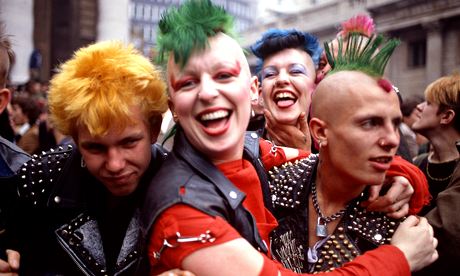 |
| Punks in 1983: probably teaching you English in 2014 |
Each movement has had its own associated look, musical style and even language terminology - as you'd probably expect from any community of practice - and an article by the excellent Alexis Petridis in today's Guardian* tells us all about relatively recent subcultures and some of the language associated with them.
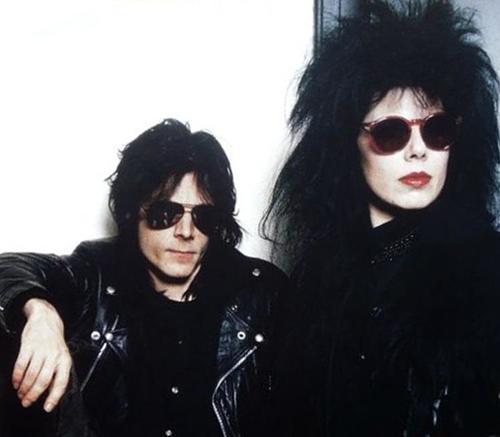 |
| Sisters of Mercy: none more goth |
If you're looking for material to help you with ENGA3 (or ENGB3) Language Change and the influences, processes and reasons for language changing, it's got plenty of examples. From a word formation angle, we've got compounds such as sea punk and haul girl, clippings such as emo and potential eponyms-in-the-making, Molly Soda. And from the angle of social change and technology driving language, there's lots to talk about in terms of the power of web-based media and different forms of prestige and influence.
*Thanks to Sally F for link
Wednesday, March 19, 2014
Exaggerating the differences?
On Monday Lynne Murphy, of Sussex University and Separated By A Common Language fame, came to talk to our students at Colchester and it was great to hear her bust the myths of US English 'destroying' English English. As she put it, in many ways American English has (kinda) saved the English Language.
So, it's good timing for all of us doing ENGA3 World Englishes, and especially Language Discourses around American English, that Lynne has also posted an interesting response to an article by the linguist Geoff Pullum about what he sees as the minimal differences between the American and English varieties.
In his original article, Pullum claimed that "the differences have been wildly, insanely overstated" and "the one thing that has always struck me about the differences, particularly in grammar, is how tiny and insignificant they are". He concludes by saying, "Many people seem to enjoy getting hot under the collar about Americanisms in Britain or Britishisms in America; but it can’t be the linguistic differences that motivate them. Looked at seriously, the tiny differences between standard American and standard British English are trivial, barely even worth mentioning".
And he's kind of right...
Many people do enjoy getting hot under the collar about one variety influencing another, American creeping into English, or Britishisms (yes, they exist!) permeating American conversation. But maybe that's because they are worried about culture and identity, rather than language per se. It's the age-old argument that Henry Hitchings, author of The Language Wars identifies when he says that "These debates quickly become heated because they involve people’s attitudes to – among other things – class, race, money and politics".
But, as Lynne Murphy tells us, to underplay the differences between US English and British English is a bit daft too. As she explains in her recent post on Separated By a Common Language, many of Pullum's grammatical definitions are rather narrow and his article doesn't really address pragmatic differences between the two varieties. As she concludes in her blog post:
Are the differences exaggerated due to cognitive biases and prejudices? Absolutely. Are we still mostly able to communicate easily? Yes, certainly. But that doesn't make the differences that are there any less interesting to me. And the fact that there are so many biased perceptions about national differences makes me feel like this blog provides a public service in countering the myths. I hope you do too. I even hold out a little hope that Pullum might.
Tuesday, February 18, 2014
The age of the LOLcat is over; the time of Doge has come
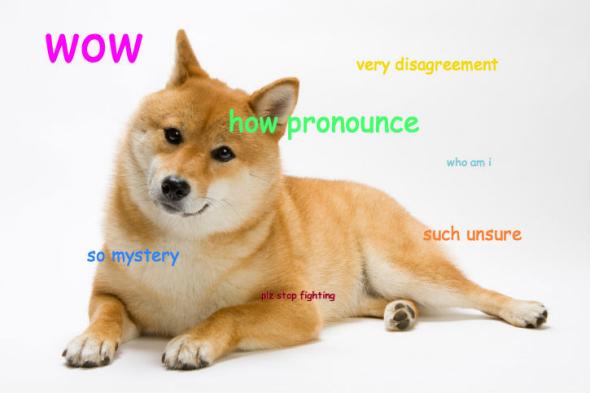
Dogs are better than cats - it has been scientifically proven, by scientists using science - so it's no surprise that LOLcats are so last year when it comes to language memes and dogs are where it's at just now. Well, not dogs exactly, but Doge, a weird variant of English (some use of wow, a deliberate mis-spelling or two, a strange unnatural combination of an adverb plus a noun, for example) that exists on the internet in pictures like this one below.

If you're still not sure what Doge is or why you should care, you can have a look here for a more detailed update, read this link on Superlinguo, or listen to this clip from this morning's Radio 4 Today programme.
(HT to @suewalder for Toast link and @StanCarey for LOLcats article)
If you're still not sure what Doge is or why you should care, you can have a look here for a more detailed update, read this link on Superlinguo, or listen to this clip from this morning's Radio 4 Today programme.
(HT to @suewalder for Toast link and @StanCarey for LOLcats article)
Friday, February 14, 2014
Evolution or decline?
If you are studying Language Change or Language Discourses for either AQA A or B A2 English Language, a recent run of articles should be really helpful to you. One of the big debates - probably the biggest, overarching debate of all - connected to this topic is over the ways in which people view language change. Is it a downward spiral of decline or a natural process of evolution and progression?
As you might expect, it's rarely a simple answer and opinions are often divided. For members of the declinist to-hell-in-a-handcart brigade (aka the prescriptivists), like Simon Heffer and Lynne Truss, our language (usually ours, not theirs) is permanently at risk from the eroding winds of change and the tides of textual degradation.
In a recent piece for The Daily Telegraph (which you'll be reading/working on now if you're in one of my A2 classes), Lynne Truss bemoaned what she saw as the increasingly blurred distinction between single and compound words such as any way/anyway and may be/maybe, declaring - in a slightly hyperbolic and tongue in cheek fashion, I hope - that "the English language as we know it was hereby doomed, and we might as well all go off and kill ourselves". Furthermore, she blames it on technology and the Americanisation of English, those familiar enemies of traditional English throughout time (Remember how the printing press simply ruined English and how American English insists on having more logical spelling?).
Erin Brenner, writing for Visual Thesaurus magazine in the USA (subscription needed, so just a brief quote here) takes issue with Truss, stating that
In today's Guardian, David Marsh (author of For Who The Bell Tolls and one of The Guardian's style gurus) contextualises clashes like those between Truss and Brenner within a much longer struggle between the descriptivists and prescriptivists. In his article, The Pedants' Revolt, he argues that
So, is language like a disease? Or a crumbling castle? And where's the damp spoon? As Aitchison herself pointed out in her Reith Lecture A Web of Worries (still available here as an mp3) rigid systems aren't much help with a changing language and tend to stand in the way of the new language that we need to describe a changing world. As for language as a disease, Aitchison explains that we don't catch change like a nasty dose of flu, but we choose our language styles.
And do descriptivists sit back and allow change to take place, documenting it as everything goes to hell in a handcart or to sh*t in a shovel? Well, language is changing all the time - even the most ardent prescriptivist will acknowledge that - so why not learn to understand and describe those changes? Does doing so, amount to embracing those changes? Not really. Most descriptivists would still argue that Standard English is important because it allows mutual intelligibility (i.e a chance to understand each other through a shared language) but they might disagree that certain uses are 'correct' or 'incorrect'. They argue that it's not a clear cut, black and white distinction. Michael Rosen makes exactly this point in an article about grammar for The Guardian in 2012:
Steven Pinker, whose amazing hair is to heads what David Crystal's beard is to chins, argues in an article for The New Yorker, False Fronts in the Language Wars, that we shouldn't see the world in such simple terms as descriptivist versus prescriptivist:
Instead he argues that - very much like David Marsh in The Guardian - once we accept that the "rules" are not rules at all and instead "tacit conventions", we realise that it's all a matter of taste and appropriacy. If we are educated to a certain level of literacy to make our choices about what we want to say - you and I, me and him, ain't doing nothing - then we have control over our own language and an understanding of others' language.
As Pinker goes on to say, "The rules of standard English are not legislated by a tribunal but emerge as an implicit consensus within a virtual community of writers, readers, and editors. That consensus can change over time in a process as unplanned and uncontrollable as the vagaries of fashion". For Pinker, there's a need for prescriptive rules to help police what has been agreed as being Standard English at a given time, but there's no need for prescriptive points-scoring or for claiming that one form is superior to another.
So, perhaps we should be pleased that there is a debate at all. The tension between prescriptivists and descriptivists is actually exerting a creative force over our language: the prescriptivist urge to keep things together, to make things stay the same, is constantly in opposition to the natural inclination of language to change and vary, and for descriptivists to document and recognise that change. Maybe one can't live without the other.
As you might expect, it's rarely a simple answer and opinions are often divided. For members of the declinist to-hell-in-a-handcart brigade (aka the prescriptivists), like Simon Heffer and Lynne Truss, our language (usually ours, not theirs) is permanently at risk from the eroding winds of change and the tides of textual degradation.
In a recent piece for The Daily Telegraph (which you'll be reading/working on now if you're in one of my A2 classes), Lynne Truss bemoaned what she saw as the increasingly blurred distinction between single and compound words such as any way/anyway and may be/maybe, declaring - in a slightly hyperbolic and tongue in cheek fashion, I hope - that "the English language as we know it was hereby doomed, and we might as well all go off and kill ourselves". Furthermore, she blames it on technology and the Americanisation of English, those familiar enemies of traditional English throughout time (Remember how the printing press simply ruined English and how American English insists on having more logical spelling?).
Erin Brenner, writing for Visual Thesaurus magazine in the USA (subscription needed, so just a brief quote here) takes issue with Truss, stating that
Truss and other language commentators like her bug me. They make proclamations from on high that conform to their ideal of English but have no relationship with how we really use English. They make broad statements about the state of English without any evidence. They offer little to no reasoning for their preferences, and they offer no proof of their statements.
In today's Guardian, David Marsh (author of For Who The Bell Tolls and one of The Guardian's style gurus) contextualises clashes like those between Truss and Brenner within a much longer struggle between the descriptivists and prescriptivists. In his article, The Pedants' Revolt, he argues that
Conservatives long for a golden age, usually about 50 years in the past, when everyone knew their grammar and all was right with the world. "What is more, even Grammar, the basis of all education, baffles the brains of the younger generation today ... There is not a single modern schoolboy who can compose verses or write a decent letter" – not Michael Gove, but William Langland (born 1332!). Sadly, there never was a golden age.For Truss and her prescriptivist pals, descriptivism is a form of laissez-faire, let-it-all-hang-out liberalism that has allowed the language to sink into disrepair and a car crash of OMGs and LOLs. In her Telegraph article she attacks descriptivism. Using not one, but two Jean Aitchison metaphors in the same paragraph, she says:
Imagine if other academic fields were dominated entirely by a “descriptive” ethos: we could have “descriptive” epidemiologists, perhaps, who just sat back with a clipboard and monitored the way we all died from contagious diseases. Or “descriptive” architects, who collected large salaries for watching and making detailed notes while all the buildings fell down.
So, is language like a disease? Or a crumbling castle? And where's the damp spoon? As Aitchison herself pointed out in her Reith Lecture A Web of Worries (still available here as an mp3) rigid systems aren't much help with a changing language and tend to stand in the way of the new language that we need to describe a changing world. As for language as a disease, Aitchison explains that we don't catch change like a nasty dose of flu, but we choose our language styles.
And do descriptivists sit back and allow change to take place, documenting it as everything goes to hell in a handcart or to sh*t in a shovel? Well, language is changing all the time - even the most ardent prescriptivist will acknowledge that - so why not learn to understand and describe those changes? Does doing so, amount to embracing those changes? Not really. Most descriptivists would still argue that Standard English is important because it allows mutual intelligibility (i.e a chance to understand each other through a shared language) but they might disagree that certain uses are 'correct' or 'incorrect'. They argue that it's not a clear cut, black and white distinction. Michael Rosen makes exactly this point in an article about grammar for The Guardian in 2012:
If we are serious about enabling those who want to acquire what we have called standard English then first we should be honest about change and its lack of encoded rules. Then, together with them, we should look closely at how such people's speech and writing diverges from the kind of English that they would like to acquire. There will always be social reasons for this and knowing these helps people take on the dialects they don't fully speak or write.This isn't easy. We shouldn't pretend it's easy.
Steven Pinker, whose amazing hair is to heads what David Crystal's beard is to chins, argues in an article for The New Yorker, False Fronts in the Language Wars, that we shouldn't see the world in such simple terms as descriptivist versus prescriptivist:
According to the sadly standard dichotomy, prescriptivists believe that certain usages are inherently correct and others inherently incorrect, and that to promote correct forms is to uphold truth, morality, excellence, and a respect for the best of our civilization. To indulge incorrect ones, meanwhile, is to encourage relativism, vulgar populism, and the dumbing down of literate culture.
Descriptivists, according to this scheme, believe that norms of correctness are arbitrary shibboleths of the ruling class, designed to keep the masses in their place. Language is an organic product of human creativity, and the people should be given the freedom to write however they please.
Instead he argues that - very much like David Marsh in The Guardian - once we accept that the "rules" are not rules at all and instead "tacit conventions", we realise that it's all a matter of taste and appropriacy. If we are educated to a certain level of literacy to make our choices about what we want to say - you and I, me and him, ain't doing nothing - then we have control over our own language and an understanding of others' language.
As Pinker goes on to say, "The rules of standard English are not legislated by a tribunal but emerge as an implicit consensus within a virtual community of writers, readers, and editors. That consensus can change over time in a process as unplanned and uncontrollable as the vagaries of fashion". For Pinker, there's a need for prescriptive rules to help police what has been agreed as being Standard English at a given time, but there's no need for prescriptive points-scoring or for claiming that one form is superior to another.
So, perhaps we should be pleased that there is a debate at all. The tension between prescriptivists and descriptivists is actually exerting a creative force over our language: the prescriptivist urge to keep things together, to make things stay the same, is constantly in opposition to the natural inclination of language to change and vary, and for descriptivists to document and recognise that change. Maybe one can't live without the other.
Subscribe to:
Posts (Atom)
-
 As part of the Original Writing section of the NEA, students will be required to produce a commentary on their piece. This blog post will pr...
-
As lots of students are embarking on the Language Investigation part of the Non-Exam Assessment, I thought it might be handy to pick up a fe...
-
I'm on a roll. Nothing from me for ages, then three posts come along! This is a lovely story from the Kenya Times about a dialect called...