Showing posts with label politics. Show all posts

Saturday, January 23, 2016

English language: the civilising force?

David Cameron's recent comments about the importance of the English language to people moving to, or already settled in, the UK have led to some interesting articles about the value of the language and its use as a political football. Many of Cameron's comments were directly addressed to one section of the community who have been given a kicking in the media in recent times: Muslim women. Cameron's logic goes like this, according to The Daily Telegraph: "one of the main reasons why young men are vulnerable to radicalisation is the "traditional submissiveness of Muslim women" (Cameron's words), which prevents them from speaking out against the influence of the radical Imams". So, is English a powerful force for integration, or is language being used as yet another stick to beat a minority group?

Many of the responses to the ideas concentrated on the fact that at the same time as Cameron is pushing for English to be learned, he has managed to slash budgets for ESOL teaching, thus reducing the chance of non-English speakers actually learning the language. Others noted that along with an encouragement to learn English, the threat of deportation was also lurking. They pointed to the line "We will now say if you don't improve your fluency, that could affect your ability to stay in the UK". Tied to the apparent encouragement for Muslim women to learn English was also a threat to punish them. And why single out Muslim women? Would English ex-pats who live in Spain but don't speak a word of the local language beyond "cerveza" be deported by the Spanish authorities for not speaking  a word? And would the knuckledragging keyboard warriors of far-right organisations - born, bred, and supposedly educated, in this country - be sent back to their mums for not being able to spell "Go hoam immagrnat"?

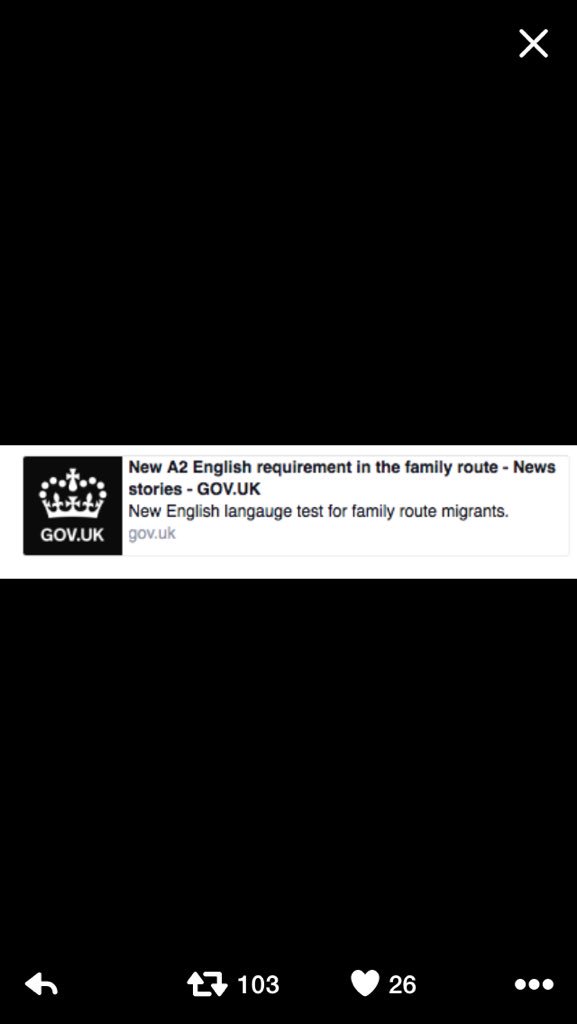
Finally, Anita Anand noted that the UK government website couldn't actually manage to spell "language" properly in its own tweet. D'oh!

Obviously, English can be a unifying and integrating force for good: if we can all talk to each other, the argument goes, we can all start to get along. But the imposition of English on people has a long history of problems. English is not just a language of the world because it's flexible and absorbent (like your favourite kitchen roll) but because it has often been accompanied with political and social systems that have forced it on others, often at the end of a gun. There's nothing intrinsically better about an English speaker than someone who speaks French, Cantonese or Yoruba, but many still cling to the colonial belief that English can be a "civilising force" on Johnny Foreigner.

But English can also be something that allows people to feel part of a wider community and that's why so many people want to learn it - in the UK and beyond - and one reason why teaching English as a second language is so important. If Cameron were really serious about the power of language, he wouldn't be singling out one group of people or cutting funding to ESOL and the FE sector that are so vital in its provision.

Edited to add:
Frank Monaghan has written an article here which is worth a read.


Wednesday, May 13, 2015

General Dejection

You might have missed it, but there was a General Election last week. While many of us in Sixth Form Colleges are still weeping, wailing and gnashing our teeth - not to mention drowning our sorrows in red red wine - at the prospect of another 5 years of underfunding and fragmentation, at least the election gave us some good stuff to look at for language analysis. Every cloud has a silver lining...

Anyway, here's a quick round-up of things that you could look at for English language A level related to the recent campaign.

First off, it's the rise of the hashtag #Milifandom. For a while, it looked like people might actually vote for Miliband, and the rise of the Milifandom hashtag seemed to crystallise the feeling among a (clearly deluded, in hindsight) minority that the time of the geek had come. Obviously, it hadn't...

Accommodation was also under the spotlight: not the kind of accommodation that we need - you know, houses and stuff - but accommodation in the form of Howard Giles' Communication Accommodation Theory. A year or two ago, we looked on this blog at George Osborne's attempts to converge to working class speech but this time round it was Ed Miliband who was mocked for his apparent convergence to Russell Brand's Essex/mockney style.

Have a look at this piece which explains some of the background to the Milibrand interview and the ways in which such convergence can happen and is often viewed.

And in a separate article, David Shariatmadari looks at the glottal stop and its stigmatisation, making the following observation:

The glottal stop (more specifically, the glottalisation of “t”) is a feature traditionally associated with male, working-class speakers. But even as far back as 1982, linguist John Wells noticed it being picked up by young speakers of “prestige” British English – otherwise known as received pronunciation. It’s difficult to say exactly why that happened, but Labov’s idea of “covert prestige” makes intuitive sense. Some sounds, even though they’re generally regarded as markers of an “inferior” dialect, are nevertheless used to signal group membership, solidarity or cool.


Away from the two main male players in the General Election, Cameron and Miliband, the three female party leaders of the Greens, Plaid Cymru and SNP attracted much media coverage. Was this the first election since Thatcher's in 1979 that would see women making a splash? Well, yes and no, Sturgeon's splash appears to have seriously dampened Miliband's chances of taking power or exerting any influence on a hung parliament, with the SNP butchering Labour in Scotland and then Labour failing to make gains in England.

But what about the speech styles of the female party leaders? Were these women breaking the mould of adversarial Punch and Judy politics by injecting some much needed co-operation and civility into the debates? 

Deborah Cameron, ace linguist and author of The Myth of Mars and Venus, looked at this with a sceptical eye in this really interesting piece about gender and the debates, arguing that much of the coverage of the three female party leaders has succumbed to tedious stereotyping:

The specific ways in which women are said to differ from men (more supportive and less aggressive, more into consensus and less into point-scoring, etc.) could come straight from the pages of Men are from Mars, Women are from Venus. These are hoary old gender stereotypes, which in other contexts feminists would decry as crude and sexist. Yet in the context of the election campaign they are being dusted off and trotted out as if they constituted a feminist argument. ‘Look, women are different from men, that’s why we need more of them in politics’. There is an excellent feminist case for equal political representation. So why use an argument whose basic assumption is that women deserve a place because they’re from Venus rather than Mars?

As she points out elsewhere in her article, female speakers aren't all the same:

Some differences among women are produced by the intersection of gender with other social divisions like ethnicity and class; others reflect variation at the level of individual personality or life experience. It’s true that ‘female politicians’ is a much smaller and less internally diverse category than ‘women’. Even so, it cannot be assumed that they have a single style of speaking. In fact, it’s obvious they don’t: even among the three female party leaders I've been discussing there are clear individual differences.

Perhaps what has shaped so much of this coverage of the female party leaders and their 'female language style' is the sheer novelty of seeing women in power, and that is hugely depressing in 2015. As much as I detest pretty much everything Margaret Thatcher ever did, I can still recognise that having a female Prime Minister was still a pretty big moment in history, but 36 years later there still hasn't been another woman PM and we are still short of equality for the sexes in parliament. 

So, even when things look apparently very different, they actually stay the same. Or get worse...

Sunday, May 11, 2014

Defending A level English Language

Anyone with an interest in English who has been following the news over the past week can't have missed the storm over the exam board OCR's plans to include the language of Russell Brand, Dizzee Rascal and Caitlin Moran in their proposed Language and Literature A level specification.

The Guardian ran the story on Tuesday, claiming that a "DFE insider" had already slammed the syllabus as being "immensely patronising" and "rubbish". The Telegraph was also up in arms about it and The Daily Fail was predictably splenetic, splashing large pictures of Brand, Mr Rascal, Grayson Perry and Michael Gove all over their article to reinforce the horror of what was being proposed. After all, these figures - bar the eminent Mr Gove, of course - are enemies of mainstream British values: Russell Brand is a former heroin addict (and therefore, as a drug user, no longer a human being with a valid opinion on anything), Dizzee Rascal is young, black, working class and successful (Why is he not in prison?) and Grayson Perry is a man who dresses as a woman (What my butler and groundsman often refer to as a "tranny". I ask you!).

The articles themselves gave only a tiny taste of the rage bubbling under the surface of middle England against this crackpot left-wing conspiracy to dumb down British students and ruin their education. Comments from Mail readers included some of the following gems:

  • Finally, it has happened! The barbarians have taken over and the country is officially in the gutter.
  • This dumbing down of education began back in the late 50s and early 60s when the lefties infiltrated the whole education system where they are now in full in control - as they are in most public services.
  • The dumbing down of a nation continues.


But what was reported in all of these papers was only part of the story. In a response to the furore, OCR and The English and Media Centre (a brilliant educational charity who produce resources and run courses for English teachers - and, I've got to add, for whom I do quite a lot of work) issued a statement to explain what was actually happening. The tweets of Caitlin Moran, the speeches of Russell Brand and the interview between Dizzee Rascal and Jeremy Paxman were not being treated as "great literature" - as some stories had implied - but as forms of spoken and blended mode language for linguistic analysis, alongside a range of classic and contemporary literature:

The language of a House of Commons Select Committee, with Russell Brand, is not being put up as a challenge to Shakespeare. It is not a literary text and it is not being judged against the measure of whether it is ‘good’ literature, because it isn’t literature. That is not comparing like with like. That is muddling the literary aspect of study with the required linguistic elements of the course. It’s not even saying it is ‘good’ speaking.  That is not what linguists do. It is being offered to students for analysis, as a fascinating example of language use, in the terms used within the academic discipline of linguistics.

And that - as they point out elsewhere in their statement on the blog - is exactly what the exam boards have been tasked with producing by Ofqual for the new A levels (which start being taught next year). I'm involved in a team working on AQA's new English Language specification and I know we have worked very hard over the last two years to ensure we meet those demands, so it's immensely depressing to see others' hard work rubbished in this way and deliberately, wilfully, misinterpreted by those with a massive axe to grind.

It's not exactly surprising to see the Daily Mail up in arms about contemporary texts being taught - their standard view tends to be if it's dead and white, it's alright - but in an article in today's Mail (The A-levels in idiocy: Celebrity obsession of examiners revealed in MoS survey of test papers as Gove is told standards are being ‘fatally undermined’) they go a few steps further and start to attack the existing A levels. And if you're a student reading this, or a teacher preparing your students for the forthcoming exams, that's the set of exams you're working towards now. Normally, the press hang on until results day to tell you your qualifications ain't worth sheeit, but they're telling you this the week before your AS level exam. Nice touch, I think.

And what are they telling us about English Language A level? Well, it's very much the same angle they took with the OCR Language and Literature specification: that you are being taught dumbed down, incorrect, fashionable speech because it's trendy and accessible and that teachers and exam boards don't want to challenge you with really difficult texts because we're intellectually lazy and morally suspect. And let's remember, this is The Daily Mail telling us this: telling us A levels in English are "celebrity-obsessed". Next to a sidebar of pictures of celebrity cellulite, Katie Price's ample cleavage and a picture of Will.i.am. Irony? Not half.

They have chosen to illustrate this supposed dumbing down by quoting examples from recent exam papers. Let's have a look at a couple of these in more detail, because I think these make great case studies of spin and selective quotation. Nice practice for a bit of critical discourse analysis too, if you're revising for your ENGA3 exam!

According to the Daily Mail...

One question simply states: 'Analyse the text on this Caffè Nero website'

I checked last summer's ENGA3 paper. Here's what appeared:

Text A, below, is an advertisement for coffee published during the Great Exhibition of 1851. Text B, on page 3, is a webpage produced by the coffee company Caffè Nero in 2012.
Analyse how language is used in Text A and Text B to represent the companies’ coffee. 

With reference to Text A, Text B and your own studies, illustrate and evaluate different ways of explaining how language changes.
It doesn't take a genius to see that the Mail has reworded the question and deliberately left out the most important parts of it, namely that the Caffe Nero ad is being looked at alongside a 19th Century text as an example of language change in action. They also quote an extract from the Language Variation question on that paper:

Analyse the distinctive features of American rapper Juvenile’s language in Text C (an interview) and how he conveys his experiences and ideas, eg ‘You know when I was young a lot of cats would make a song… you know what I’m saying? Now you got it to where artists is goin’ out there makin’ money like football players… I ain’t doin’ nuthin… I ain’t causin’ no harm to nobody. She [his mother] widdit, you know what I’m saying?’

This time, the quote is a little more accurate, but not much. There's more to it, obviously, because the actual question featured a longer interview in which Juvenile switched from non-standard to a more standard form of English. It also featured a second bullet point that stated:

Referring to Text C, Figure 1 and your own studies, evaluate how far people’s social class affects their use of English.

This was alongside a diagram from Janet Holmes' An Introduction to Sociolinguistics which presented data on ethnicity, class and the use of multiple negation. So, dumbed down? Lacking rigour? Clearly, the Mail hopes to present the idea of a rapper's language being studied as part of an A level in English Language as both of these things. But it's not is it? To answer these two questions well, students need to know a large amount about grammar, phonetics, sociolinguistic theory such as code-switching, ideas of covert and overt prestige and much more besides. In fact, I wrote a fairly long article for NATE's Teaching English, using this interview as an example of much that is good in the English Language A level, some of which I've quoted below to illustrate why I think it's a demanding and useful text to explore.


...the interview offers a slice of English language at its most vital, subtle and provocative, not simply in its delivery but in the areas for discussion that it opens up. In doing these things, it offers some of the most fruitful territory for students interested in finding out more about how language works: the influences that shape our linguistic identities, from where we were born to the colour of our skin, from the work we do to the people we associate with, and maybe more importantly than all of these, the choices we make ourselves about the identities we wish to project to others. In other words, an analysis and discussion of such language can open up the external and internal factors that shape our language use as individuals, as members of groups in society and in a multiplicity of different situations, using language for different purposes with different people. And this can all be done with genuine linguistic depth and, dare I say it, rigour.

With Juvenile, the question in the ENGA3 paper tells us that he is a rapper from a working class area of New Orleans, and we might also assume from his language choices (correctly, in this case) that he is black, so we already have a number of “boxes” we could put him into based on his nationality, region, gender, ethnicity, social class and occupation – all factors that have been looked at in detail by linguists such as Peter Trudgill, Viv Edwards, Malcolm Petyt, Sue Fox, Paul Kerswill and Jenny Cheshire, who would be known to most students – but there are many other factors to consider too.

Juvenile employs a number of features of non-standard grammar in his language: the deletion of the copula verb in the utterances “We family” and “Everything the same”; the deletion of auxiliary verbs in “We still doin the same thangs”, “We paperchasin, cousin” and “We tryin to get all the money, cousin”; the multiple negation of “Ain’t nuthin changed”. In terms of phonology, he drops the –g in some –ing endings such as “livin”,“doin”, “paperchasin” and “tryin” and pronounces the i in things as thangs. Lexically and semantically, he uses colloquial terms of address such as man and cousin to relate to his interviewer, as well as the slang term for making money “paperchasin” (where dollar bills are the paper being chased).

There’s a lot to look at in terms of Juvenile’s non-standard usage here, but what’s also interesting is that it’s not a question of him being unable to use standard forms; on many occasions he chooses to use them. So, he uses a copula verb when he says “She’s down with it now”, inserts an auxiliary verb (admittedly with a non-standard agreement between subject and verb) when he tells us that “artists is goin out there makin money” and elsewhere in the interview switches between standard and non-standard English. He is making choices about his language, many of which may well be dependent on the audience he’s addressing and the persona he wishes to project. The discussion of what Juvenile is saying and how he says it is much more than just identifying “errors” in his speech and blaming them on different facets of his identity – his upbringing, his education, his class, his lifestyle - but treating what he says and how he says it as a source of wider discussion. Why does he choose to say a) here while he chooses to say b) there? Why does he choose this form when he’s addressing this topic, but that form when he addresses that topic?

There's more, if you want read it, and you can find it here, but I hope that the extract above makes the point clearly enough that what we're looking at here is not something that is dumbed down and fashionable, designed to appeal to the lowest common denominator, but genuine language in use by real people and eminently worthy of close study.

That's why the Daily Mail is so massively, colossally, knuckle-headedly wrong about everything they say in their article.


For those of you doing ENGA3 Language Discourses, you might recognise the tendency of the comments in and after the articles to dredge up notions of decline, pollution and collapse - all great staples of the prescriptivist mindset - and it's no great surprise to find that such reactions appear in right-wing  publications when spoken language and contemporary reference points are held up as valid for analysis. Because, after all, studying contemporary English - spoken language, text messaging, urban slang and twitter, for example - is just shallow, unacademic and immature, isn't it?

Well, no. And I hope I've made it clear here just how valuable I think this kind of study is and why the AS levels you are taking next week, the A levels you are taking in June and (I hope) the Language and Linguistics courses many of you will go on to do at University are valuable, useful, intellectually stimulating, rigorously academic and, above all, worth defending.

Edited on 11.05.14 to add link to NATE Teaching English article - thanks to NATE for permission to link and lots of other English Language teachers for their support :-)

Thursday, January 10, 2013

Skivers and strivers, workers and shirkers: why words matter

In a cracking Guardian article today, Zoe Williams takes a critical look at the new language used to split the haves and the have-nots. With this week's vote on limiting benefit increases affecting millions of people - many of them/us actually in work - it's clear that to successfully turn one part of society against the other, you need to win the language war first.

As Williams explains, the false dichotomy created by labelling one group as strivers - working hard, supporting themselves, not relying on benefits - and another group as skivers - not working, sponging benefit taxpayers' money to pay for a feckless lifestyle on a council estate - has rapidly been established and spread into our own language and thinking. But why?

Don't tell me it is because it rhymes. It will destroy my faith in humanity, and that's exactly what they want. But the point is not that politicians spout it, nor that people who haven't given it any thought believe it. The point is that it has seeped so far, so fast, into the national consciousness as a meaningful idea that the very people vilified by it – the people who know they are unemployed by circumstance and not by choice – feel their lives judged against its fictional benchmarks.

So, while Iain Duncan-Smith (a man who recently claimed that £70 a week was too much for Job Seekers' Allowance but allegedly put in a £39 bill for a single breakfast, charged to the taxpayer) is busy chipping away at what already impoverished people can get in support, he must be happy that there are massive misconceptions among the public about how much of the government's budget goes into social security payments or how much those payments actually amount to and that people are so easily convinced that they are shirkers while we are workers. Williams goes on to argue that the shift in language - especially the move from the positive connotations of social security to welfare - has coincided with a shift in attitudes:

People sometimes ascribe this adoption of "welfare" as an Americanism, designed to convey some of the US's sneering synecdoche where the name of the government support becomes shorthand for the person being supported. I think it's also an attempt to dehumanise people on state benefits – we never used to talk about welfare in terms of humans, but the word has been in everyday UK usage, for as long as I can remember, to describe animals. To be in receipt of state benefits thus tacitly becomes a passive, piteous, dumb thing to do. You don't necessarily begrudge the animals their welfare, but you wouldn't mistake yourself for one of them.

It's exactly the kind of language technique we've looked at on the AS level course, using animalistic imagery to describe young people as feral or hunting in packs. Once you demonise the group you're attacking through language, it makes it easier, not only for the dominant group to carry out more attacks, but for others to sympathise with the attacks and align themselves with the persecutors rather than the victims, even if they themselves are probably next in the government's firing line.

This is the kind of language that the linguist Norman Fairclough highlights in his Critical Discourse Analysis approach to language study. If we don't analyse and challenge language choices, we get sucked in by them and end up accepting such false dichotomies, such intrinsically unfair outlooks, and even end up recycling it ourselves. With critical language analysis, however, we can start to pull apart those choices, highlight the ideologies that lie behind them and make our own educated choices about what we think or feel.

That's how language matters and why we need to analyse it.

Friday, April 09, 2010

Election 2010

There's bound to be some good material for language and representation in the papers over the next few weeks with the General Election coverage, so keep an eye out for extracts you can use in class. One of the best places to go for a bit of entertainment is the excellent mydavidcameron site which has spoofed the Conservative Party's recent media campaigns with some genius parodies. If you want to be a language nerd about it (and that is a good thing to be...not like being a Tory) you could have a look at the language techniques employed in the parodies - grammatical cohesion, semantic wordplay, pragmatics, the whole lot - and think about which ones work best.

But, more importantly than all this language stuff, make sure that if you're 18 now or by the 6th of May you're registered to vote. Find out more here.

And remember: if you vote Tory, I can't help you with your exams. It's the law.

Wednesday, September 02, 2009

Weasel words

Today's Independent features an article by columnist Johann Hari on the euphemisms he would expunge from the English Language. As he puts it, "The English language needs periodically to be given a spring-clean, where we scrape off the phrases that have become stuck to the floor and toss out the rotting metaphors that have fallen down the back of the settee".

Among the expressions are "fair trade", of which he says:

This phrase suggests that paying desperately poor people a decent wage is a nice
ethical add-on, and a gratifying departure from the norm. In fact, it should be
taken for granted – the default position of civilised human beings. If we
believed that, the labelling would be reversed: it's all the other food that
should be labelled as "Unfair Trade", "Rapacious Trade", or
"Let's-Pay-a-Pittance Trade." The terrific comedian Andy Zaltzman suggests a sign
that could be on the packets: it is a silhouette of an obese businessman pissing
on an African child.


Fair enough. But several comments in response to the article accuse Hari of doing exactly the same thing that he's complaining about: giving a political spin to the language he uses and the meanings he creates. So, is any language genuinely neutral? Can we open our mouths and speak without allowing our language choices to inadvertently reflect our views and political/ philosophical outlooks?

Again, this is an interesting article not only for the language issues addressed but for its potential use as a style model for the text you'll be writing about a language issue in your ENGA4 coursework and the Language Discourses part of the ENGA3 exam paper.

For more on euphemisms - what they are, how they're often used and why they annoy people - try this 2007 post on the blog.

Sunday, April 12, 2009

Words of warcraft

Today's New York Times runs an article on the changing language of the Whitehouse under Barack Obama's administration. It's not "a war on terror" anymore; it's overseas contingency operations, and it's no longer "terrorist attacks" but man-caused disasters.

Why should we care? They're just words, aren't they? And words don't kill people: weapons do. Well, kind of, but words are part of war and the groundwork that goes into softening up a population for war, or in Obama's case (we hope) a step away from the deranged war his nutty predecessor decided to wage.

Peter Baker explains in his article:
Every White House picks its words carefully, using poll-tested, focus-grouped language to frame issues and ideas to advance its goals. Mr. Bush's team did that assertively. The initial legislation expanding government power after the attacks of Sept. 11, 2001, was called the USA Patriot Act. The eavesdropping without warrants that became so controversial was rebranded the Terrorist Surveillance Program. The enemy was, for a time, dubbed ''Islamofascism,'' until that was deemed insensitive to Muslims.

And he goes on to argue that while Obama is keen to change perceptions about his policies, in Baker's view, the substance of Bush's policies actually remains in place:
He has made no move to revise the Patriot Act or the eavesdropping program. He has ordered the Guantánamo prison to be closed in a year but has not settled on an alternative way to house inmates deemed to be truly dangerous.
Are the Obama administration's words a whitewash then? Is the emphasis on a change of language just a way of hiding the fact that the policies remain the same, or does the shift in tone signal a profound shift in direction to come? The jury's out...

And how is this useful to you at A level? The contemporary language change question on ENA5 often asks you to consider how new words and phrases come into existence or how existing words change, and politics has been explicitly mentioned on a couple of occasions as an are to look at (along with technology, communication, youth culture, immigration and war), so it's worth trying to have a few examples from contemporary news stories at your fingertips.

You might also want to look at how the recent global economic crisis (a nice new noun phrase) has led to new expressions, or how technology has co-opted older expressions and recycled them. How about these examples:

  • credit crunch
  • financial liquidity
  • quantitative easing
  • fiscal stimulus package
  • avatar
  • icon
  • virus
  • bankster
  • menu
  • zombie
  • downturn

Follow EngLangBlog on Bluesky

The old Twitter account has been deleted (because of both the ennazification and enshittification of that site) so is now running on Bluesk...