Sue Fox and Jenny Cheshire at Queen Mary University, London have set up a new blog to help students and teachers of A Level English Language. It's called the Linguistics Research Digest and is part of their From Sociolinguistic Research to English Language Teaching ESRC Knowledge Transfer Project (more details of which can be found here).
The blog features accessible summaries of recent research in linguistics and offers a way into some of the most relevant areas of recent study. Their plan is also to set up a resource site to run alongside the blog, but for the time being there's already some very useful material on there for teachers and students alike.
Thursday, September 29, 2011
That's cool. No, that's kewl
The OED's latest online update has ruffled a few prescripivist feathers (again) by including kewl, "an affected or exaggerated pronunciation of cool".
A few months ago, elderly wing commanders in Surrey (and other Telegraph readers) were appalled to discover that the OED had included internet acronym LOL and vaguely blasphemous initialism OMG in its pages, so it's not as if the OED isn't used to causing a bit of controversy. But as Graeme Diamond, chief editor of new words, explains, adding words to the OED is not about trying to change the language but reflect actual usage: "You have to show that the word has been in usage for a decent length of time and, most importantly, that the word is used and understood by a wide audience".
Cool itself, in its original spelling, is a tenacious piece of slang that has been knocking around for a very long time, much longer than its groovy and rad brothers as the slightly unscientific but helpful graphic on the right shows.
Michael Quinion has written about cool's development as a slang term here, and there's more from the British Library here, but it's clear that if cool is still evolving, with new uses and spellings, it's a healthy word in a healthy language.
A few months ago, elderly wing commanders in Surrey (and other Telegraph readers) were appalled to discover that the OED had included internet acronym LOL and vaguely blasphemous initialism OMG in its pages, so it's not as if the OED isn't used to causing a bit of controversy. But as Graeme Diamond, chief editor of new words, explains, adding words to the OED is not about trying to change the language but reflect actual usage: "You have to show that the word has been in usage for a decent length of time and, most importantly, that the word is used and understood by a wide audience".
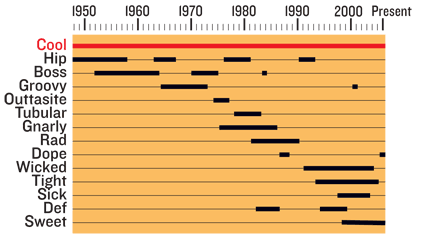 |
| from http://www.fastcompany.com/magazine/107/next-essay-sidebar.html |
Michael Quinion has written about cool's development as a slang term here, and there's more from the British Library here, but it's clear that if cool is still evolving, with new uses and spellings, it's a healthy word in a healthy language.


Friday, September 23, 2011
Learn some proper Gypsy rokker, mush
With the Dale Farm eviction set to take place today, Gypsy life and culture is again in the spotlight, but this BBC Kent article takes a look at Gyspy language contributions to English, contributions that go back a long way and are quite deeply embedded in our common language.
A couple of these - mush and cushti - were just normal English slang as far as I was concerned growing up in Wiltshire in the 1980s and it didn't really cross my mind that it was Gypsy dialect/slang until much later.
This page from the BBC Voices site gives a bit more detail about the roots of Romany/Gyspsy/traveller dialects while this 1897 Dictionary of Slang, Jargon and Cant features some great examples from Gypsy and other non-standard varieties.
A couple of these - mush and cushti - were just normal English slang as far as I was concerned growing up in Wiltshire in the 1980s and it didn't really cross my mind that it was Gypsy dialect/slang until much later.
This page from the BBC Voices site gives a bit more detail about the roots of Romany/Gyspsy/traveller dialects while this 1897 Dictionary of Slang, Jargon and Cant features some great examples from Gypsy and other non-standard varieties.
Thursday, September 22, 2011
Debate of the month: gender and language variation
One of the big topics for debate in English Language A level in recent years has been over whether women and men communicate differently. Since the early 1970s, with the publication of Robin Lakoff’s Language and Woman’s Place , there has been plenty of focus on what might be termed “women’s language” but as Lakoff herself was quick to point out, her observations weren’t based on empirical studies (systematic data collection) but “(data)... gathered mainly by introspection: I have examined my own speech and that of my acquaintances, and have used my own intuitions in analyzing it”.
Lakoff’s observations included some that have made it into pretty much every A level student’s (and teacher’s) list of key facts about gender and language: women use more precise colour terms, more tag questions and more evaluative adjectives than men. But of course, without any actual data to back these claims up, it was hard to work out whether what Lakoff was saying was perceptive and new or just the recycling of fairly standard stereotypes.
While Lakoff herself made some powerful points about the ways in which girls are socialised to behave in ways that are viewed as linguistically female - not talking rough or appearing "unladylike" - other linguists focused a little more on the conversational interactions between men and women. Some chose to look at interruptions and the dominance of men and submissiveness of women in conversational interaction (like Zimmerman and West – pdf here - in 1975), others at power and status (O’Barr and Atkins - summary here – in 1980), before Maltz and Borker (1982) started looking in a bit more detail at the ways in which men and women are socialised into different gender roles and how this might affect language patterns.
This was an approach that led to Deborah Tannen’s work – subsequently referred to as the Difference Model - and her bestselling book You Just Don’t Understand (Tannen talks about it here).
Tannen’s approach focussed on what she called the “cross-cultural communication” between the genders:
However, Tannen’s approach came in for criticism from some for its broad-brush approach to gender, and the industry spawned by the Tannen book – John Gray’s Men Are From Mars, Women Are From Venus being one big seller – dumbed everything down to a new low.
Elsewhere, Jennifer Coates produced masses of work on the dynamics of spoken interaction in her excellent books Women Talk and Men Talk, pinning down the details of talk among and between the sexes and interpreting the results with an open mind. It’s about as far removed from the hippy dippy generalisations of John Gray as you can get.
More recent work on gender and language has taken one of two approaches. With advances in neuroscience, some commentators have started to look at how certain characteristics might be hard-wired into us and how men and women might just be built genetically in certain ways that we can’t avoid.
This approach has attracted criticism – this article by Madeline Bunting of The Guardian is really good – and linguists such as Deborah Cameron have argued that gender is just one factor in many that might affect our conversational styles, and that anyway, there are more differences between different men or different women (within the sexes) than there are between most men and women.
Her excellent Myth of Mars and Venus lays into the gender difference industry with an accessible overview of research and an argument that suggests it’s not only women who suffer from the obsession with different speech styles, but men too.
So, over to you. What has your own study and research suggested about gender and language variation? Are you about to embark on an A2 Language Investigation into gender? If so, what are you going to look for and why?
Lakoff’s observations included some that have made it into pretty much every A level student’s (and teacher’s) list of key facts about gender and language: women use more precise colour terms, more tag questions and more evaluative adjectives than men. But of course, without any actual data to back these claims up, it was hard to work out whether what Lakoff was saying was perceptive and new or just the recycling of fairly standard stereotypes.
While Lakoff herself made some powerful points about the ways in which girls are socialised to behave in ways that are viewed as linguistically female - not talking rough or appearing "unladylike" - other linguists focused a little more on the conversational interactions between men and women. Some chose to look at interruptions and the dominance of men and submissiveness of women in conversational interaction (like Zimmerman and West – pdf here - in 1975), others at power and status (O’Barr and Atkins - summary here – in 1980), before Maltz and Borker (1982) started looking in a bit more detail at the ways in which men and women are socialised into different gender roles and how this might affect language patterns.
This was an approach that led to Deborah Tannen’s work – subsequently referred to as the Difference Model - and her bestselling book You Just Don’t Understand (Tannen talks about it here).
Tannen’s approach focussed on what she called the “cross-cultural communication” between the genders:
For women, as for girls, intimacy is the fabric of relationships, and talk is the thread from which it is woven. Little girls create and maintain friendships by exchanging secrets; similarly, women regard conversation as the cornerstone of friendship. So a woman expects her husband to be a new and improved version of a best friend. What is important is not the individual subjects that are discussed but the sense of closeness, of a life shared, that emerges when people tell their thoughts, feelings, and impressions.
Bonds between boys can be as intense as girls', but they are based less on talking, more on doing things together. Since they don't assume talk is the cement that binds a relationship, men don't know what kind of talk women want, and they don't miss it when it isn't there.
Boys' groups are larger, more inclusive, and more hierarchical, so boys must struggle to avoid the subordinate position in the group. This may play a role in women's complaints that men don't listen to them. Some men really don't like to listen, because being the listener makes them feel one-down, like a child listening to adults or an employee to a boss.
However, Tannen’s approach came in for criticism from some for its broad-brush approach to gender, and the industry spawned by the Tannen book – John Gray’s Men Are From Mars, Women Are From Venus being one big seller – dumbed everything down to a new low.
Elsewhere, Jennifer Coates produced masses of work on the dynamics of spoken interaction in her excellent books Women Talk and Men Talk, pinning down the details of talk among and between the sexes and interpreting the results with an open mind. It’s about as far removed from the hippy dippy generalisations of John Gray as you can get.
More recent work on gender and language has taken one of two approaches. With advances in neuroscience, some commentators have started to look at how certain characteristics might be hard-wired into us and how men and women might just be built genetically in certain ways that we can’t avoid.
This approach has attracted criticism – this article by Madeline Bunting of The Guardian is really good – and linguists such as Deborah Cameron have argued that gender is just one factor in many that might affect our conversational styles, and that anyway, there are more differences between different men or different women (within the sexes) than there are between most men and women.
Her excellent Myth of Mars and Venus lays into the gender difference industry with an accessible overview of research and an argument that suggests it’s not only women who suffer from the obsession with different speech styles, but men too.
So, over to you. What has your own study and research suggested about gender and language variation? Are you about to embark on an A2 Language Investigation into gender? If so, what are you going to look for and why?
- What do you think of the whole debate?
- Is it helpful to generalise about how men and women communicate or should we always look at specific contexts?
- In your experience, do men and women, boys and girls talk differently?
- If so, why might this be and how does it show itself in what they say and how they say it?
- If not, what do you see happening instead?
- How different are the speech styles within one gender group? Do all boys share similar speech characteristics....girls, football, beer and..err...meat?
Wednesday, September 21, 2011
Quick and dirty
Just a few quick links to really good new language stuff that might be exciting for you.
How awesome changed and grew
How "Britishisms" started to invade the USA
Why slang is a sign of a healthy language
Enjoy!
How awesome changed and grew
How "Britishisms" started to invade the USA
Why slang is a sign of a healthy language
Enjoy!
Friday, September 16, 2011
Stoking up spelling trubble

Does spelling matter? Residents of Stoke-on-Trent seem to think so, because they're worried that people will think they're thick if they see the name of their new shopping development.
This report from the BBC News website suggests that some locals feel that the name will reflect badly on them, while the agency behind the name thinks it gives the development "stand out quality"...maybe like the "stand out quality" of turning up to a funeral in pink lurex batty-riders, or declaring that your football team's new strip will be birthday suits.
Lots of businesses create deliberately deviant spellings to offer "stand out quality". Take Kwiksave, Kwikfit, Krispy Kreme and my old favourite (sadly no longer with us) Mr Byrite. At some point, a creative in an advertising agency decided that Qu and C were just old-fashioned and that K was where it was happening. K was cool...sorry Kool. Is there something intrinsically more exciting about K than C, or is the act of mis-spelling something part of the rebellious appeal of a brand? Vodafone chooses to use f instead of ph and Toys'R'Us abbreviates too, but do we see them as edgy, unconventional brands? Maybe not.
But is it harmless fun, or is this trendy phonetic spelling something that sends out mixed messages to younger people? Is it leading to an acceptance of bad spelling? One teacher quoted in the BBC piece, Mark Rayner, seems to think so:
In terms of grammar we are fighting a battle on many fronts, from text speak, on the internet, even in emails now you find shortened words are creeping in. Pupils regularly write C for see and U for you. But one hopes schools can still teach the correct spelling and grammar.The need for an agreed spelling system is something that lies at the heart of the notion of Standard English: an accepted and recognised way of using English that provides mutual intelligibility for all speakers and writers. As we've seen many times though, the discussion around what the standard and accepted rules should be is fraught with other, non-linguistic worries.
Some people see apparently declining spelling standards as a measure of a nation's moral collapse (one minute they're spelling Krispy Kreme wrong the next minute they're looting it) while others argue that the English spelling system is so messed up in the first place that it should be radically overhauled.
So, edgy branding or idiotic illiteracy? The last word goes to a resident of Stoke-on-Trent who just says "It makes us look like the people in Stoke are thick".
Thursday, September 15, 2011
Heated debates
Now the new term has started and I'm back teaching again (huzzah, I think) I'll try to update the blog with relevant material for AQA Language A and B specs a bit more frequently.
The first thing I'd like to set up is a Debate of the Month, which I hope will help A2 students with Language Intervention coursework and the Language Discourses part of the ENGA3 paper. The plan is to highlight a particular topic each month and look at different arguments around the issue, flagging up various style models for written pieces and offering suggestions for different angles on each debate.
I'm hoping that any keen followers of the blog (and I know there are some out there...mother, can you hear me?) will also chip in and join the debate by adding comments and links. We can all dream, I suppose.
The first topic will be gender differences in conversation and I'll kick it off next week with a quick survey of the different positions and some of the recent debates about how men and women are supposedly hard-wired to use different conversational styles and why this is a controversial (and rather dubious) position.
If anyone would like to suggest links to articles, case studies or just offer a view, I'd be interested to hear.
The first thing I'd like to set up is a Debate of the Month, which I hope will help A2 students with Language Intervention coursework and the Language Discourses part of the ENGA3 paper. The plan is to highlight a particular topic each month and look at different arguments around the issue, flagging up various style models for written pieces and offering suggestions for different angles on each debate.
I'm hoping that any keen followers of the blog (and I know there are some out there...mother, can you hear me?) will also chip in and join the debate by adding comments and links. We can all dream, I suppose.
The first topic will be gender differences in conversation and I'll kick it off next week with a quick survey of the different positions and some of the recent debates about how men and women are supposedly hard-wired to use different conversational styles and why this is a controversial (and rather dubious) position.
If anyone would like to suggest links to articles, case studies or just offer a view, I'd be interested to hear.
Thursday, September 08, 2011
His and hers
MacMillan Dictionary blog has been running a gender month, taking a look at how gender is represented, constructed and debated in language. If you're studying gender as part of the AQA B spec (ENGB1) you'll find good stuff here and here, and if you're looking at gender and variation for the AQA A spec (ENGA3) this one and this one might be of interest to you.
You can find a complete run-down of gender month posts here and there's lots of good stuff to look through.
You can find a complete run-down of gender month posts here and there's lots of good stuff to look through.
Tweets, Tweeps and Twerps
Any new technology that is used for communication is bound to lead to some concern about its impact on language use. In his book, A Better Pencil, the linguist Dennis Baron looks at how writing technologies such as the pencil, pen , typewriter and word processor developed and traces worries about these (then) new forms of communication. So it's not a great surprise to see that digital communication - text messaging, Facebook, MSN and Twitter being four recent examples - has spawned its own set of worries.
Twitter is often viewed as a fairly limited means of communication, forcing its users to transmit simple, terse 140-character messages to their followers, compressing and trimming language to create anodyne, bite-sized chunks, but in an article for The Guardian this week, the poet Carol Ann Duffy argues that texting and tweeting are brilliantly creative tools for helping people think more carefully about how they're communicating.
It's an appealing argument and one that I think is very true. Writing creatively is not so much about writing as much as you can in as flowery and dense form as possible but finding the best ways to say what you want to say. Sometimes, the process of editing yourself down to fewer words, or finding a new combination of words, is exactly what you need to make yourself a clearer communicator. Poetry is often prized for its sparing use of telling words, and tweets can be like that too, honing the editing skills of their senders.
Inspired by this (if slightly confused: Duffy was talking more about texting than tweeting) The Guardian has launched its own Twitter poetry challenge which you can find here.
Another creative dimension to Twitter is covered by the BBC News magazine where the new words inspired by Twitter are surveyed. We get: tweeple (or tweeps), a blend of Twitter and people; tweet cred, a compound of tweet and street cred; and twisticuffs (my favourite), a blend of Twitter and fisticuffs, in other words a fight on Twitter.
Exploring the tw- unit (sound? morpheme?) in more depth, the article goes on to look at other words formed with the same letters and makes the point that many of them are deliberately playful, perhaps suggesting that there's something inherently silly in the sound.
Twitter is often viewed as a fairly limited means of communication, forcing its users to transmit simple, terse 140-character messages to their followers, compressing and trimming language to create anodyne, bite-sized chunks, but in an article for The Guardian this week, the poet Carol Ann Duffy argues that texting and tweeting are brilliantly creative tools for helping people think more carefully about how they're communicating.
"The poem is a form of texting ... it's the original text," says Carol Ann Duffy. "It's a perfecting of a feeling in language – it's a way of saying more with less, just as texting is. We've got to realise that the Facebook generation is the future – and, oddly enough, poetry is the perfect form for them. It's a kind of time capsule – it allows feelings and ideas to travel big distances in a very condensed form."
It's an appealing argument and one that I think is very true. Writing creatively is not so much about writing as much as you can in as flowery and dense form as possible but finding the best ways to say what you want to say. Sometimes, the process of editing yourself down to fewer words, or finding a new combination of words, is exactly what you need to make yourself a clearer communicator. Poetry is often prized for its sparing use of telling words, and tweets can be like that too, honing the editing skills of their senders.
Inspired by this (if slightly confused: Duffy was talking more about texting than tweeting) The Guardian has launched its own Twitter poetry challenge which you can find here.
Another creative dimension to Twitter is covered by the BBC News magazine where the new words inspired by Twitter are surveyed. We get: tweeple (or tweeps), a blend of Twitter and people; tweet cred, a compound of tweet and street cred; and twisticuffs (my favourite), a blend of Twitter and fisticuffs, in other words a fight on Twitter.
Exploring the tw- unit (sound? morpheme?) in more depth, the article goes on to look at other words formed with the same letters and makes the point that many of them are deliberately playful, perhaps suggesting that there's something inherently silly in the sound.
Friday, September 02, 2011
iGE - interactive Grammar of English

The interactive Grammar of English (iGE) is an app for the iPhone 3 and 4, iPod Touch and iPad, designed to help you develop your understanding of English grammar. It uses examples of real English from ICE-GB, the International Corpus of English and contains many interactive tests and tasks.
If you're looking for a way into understanding grammatical frameworks for A level English Language or for developing your grasp of higher end concepts for undergraduate or post-graduate study, it will definitely be really useful.
One interesting area of debate about language which has already been raised in a 3-star review of the app on the American i-Tunes site is about the use of "incorrect" English in examples of spoken language:
IGE English grammar - ★★★
I'm a substitute teacher and was looking for an app that I could quickly refresh my memory. This is an okay app but there are some errors. I was always taught to not use uhm and ah in a sentence, however, in the test areas the sentences often use uhm as if it had been created by someone dictating. There are also run on sentences and incorrect punctuation in the tests. The glossary seems to be correct and will be a good reference when I need it.
Should a grammar app use "good" English examples which avoid uhms and errs, and run on sentences? Well, we would argue that analysing grammar is not just about analysing "perfect" written English but about looking at all types of English - written and spoken - and studying their grammar. Part of the appeal of an app like this which uses a corpus of genuine English , rather than made-up examples, is that it allows us to look at how English is really used, and to describe its grammar rather than judge it.
Thursday, September 01, 2011
Ringing the changes
Following on from the last post about new words, here's a link to an article in The Daily Telegraph by Henry Hitchings. It's a good antidote to the plethora of grumpy responses to any new words announcement...they're not real words...they'll disappear next year...I've never heard that word so it can't exist...young people these days need a good beating and a hefty dose of national service...you know the kind of thing.
His argument is an interesting one which sees resistance to new vocabulary as a reflection of wider concerns:
Hitchings is author of the excellent The Language Wars, which I've reviewed for emagazine here (and there's an interview with him in the latest edition if you have a subscription and want to read more about why his book is great for A level English Language students).
His argument is an interesting one which sees resistance to new vocabulary as a reflection of wider concerns:
Hostility to a new word (candidates from the latest Chambers might include “webisode” and “OMG”) is fraught with unarticulated concerns about class, politics, propriety and taste. Right now, the pace of linguistic change seems high, and those concerns are supercharged. Thanks to modern technology, the volume and rapidity of communication have increased, and the flow of information is constant.If the comments after many of the recent articles about language change are anything to go by, Hitchings is spot on with his argument. A quick trawl of discussions about David Starkey's deluded comments on "Jafaican", or on the Daily Mail's coverage of Chambers Dictionary reveal racism, class snobbery and the casual denigration of single mothers and most young people, to name a few.
Hitchings is author of the excellent The Language Wars, which I've reviewed for emagazine here (and there's an interview with him in the latest edition if you have a subscription and want to read more about why his book is great for A level English Language students).
Thursday, August 25, 2011
OMG that's so NEET
Chambers Dictionary is publishing its latest edition and the papers are full of the new words they've included. Here The Daily Mail looks at the inclusion of what they call the acronyms (but which are actually initialisms - shame on you Daily Fail) OMG and BFF, pointing to the dictionary's interest in text-speak and words derived from celebrity culture. But there are loads more mentioned too, some of them less current than others (jeggings, bromance and skank have all been knocking around for a good few years now). They also like the acronym (which is an acronym this time) NEET - Not in Education, Employment or Training - which is nice, given that there are now more NEETs than ever before thanks to cuts and university fees.
Elsewhere, The Scotsman looks at labradoodle and dubstep, among others, but also at wider trends - economic collapse, "men's liberation" and environmental issues, while the BBC focuses more on the role of internet language.
The Chambers press release also points out that among all the new words, they've also highlighted what they see as "rare, literary or quirky" words such as thunder-plump, tickly-benders and mallemaroking, all of which sound brilliant.
Elsewhere, The Scotsman looks at labradoodle and dubstep, among others, but also at wider trends - economic collapse, "men's liberation" and environmental issues, while the BBC focuses more on the role of internet language.
The Chambers press release also points out that among all the new words, they've also highlighted what they see as "rare, literary or quirky" words such as thunder-plump, tickly-benders and mallemaroking, all of which sound brilliant.
Wednesday, August 24, 2011
Glorping the wug
Here's a quick link to a piece of research from University of Liverpool's Child Language Study Centre which points to children having a clear understanding of some grammar functions a long time before they are able to use these functions themselves:
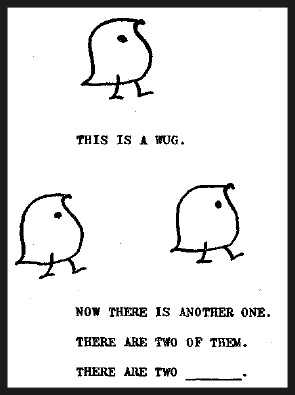
The use of made-up words is interesting as it's a feature of child language research from as far back as 1958 when Jean Berko Gleason's wug test revealed that children are able to apply plural rules to words they've never heard before.
 Child Language researcher, Dedre Gentner also used made-up words in her interestingly titled 1978 paper What Looks Like a Jiggy but Acts Like a Zimbo (pdf link).
While the appearance of made-up words in reading tests for primary school children has upset and angered many reading experts, their use in child language experiments is helpful because they can shed light on how patterns and rules are internalised by children and applied to examples of language they haven't heard before, perhaps suggesting that there's an innate capacity for language acquisition (or at least, some sort of generalised puzzle-solving equipment) in all children.
Researchers at the University’s Child Language Study Centre showed children, aged two, sentences containing made-up verbs, such as ‘the rabbit is glorping the duck’, and asked them to match the sentence with a cartoon picture. They found that even the youngest two-year-old could identify the correct image with the correct sentence, more often than would be expected by chance.
The use of made-up words is interesting as it's a feature of child language research from as far back as 1958 when Jean Berko Gleason's wug test revealed that children are able to apply plural rules to words they've never heard before.
While the appearance of made-up words in reading tests for primary school children has upset and angered many reading experts, their use in child language experiments is helpful because they can shed light on how patterns and rules are internalised by children and applied to examples of language they haven't heard before, perhaps suggesting that there's an innate capacity for language acquisition (or at least, some sort of generalised puzzle-solving equipment) in all children.
Wednesday, August 17, 2011
Ghetto grammar
The linguistic fall-out from last week's riots continued yesterday with an article by Lindsay Johns in the Evening Standard proclaiming that "Ghetto grammar robs the young of a proper voice". While Johns' work in Peckham with disadvantaged young people has to be applauded, he's got a very narrow view of street slang and has prescriptive form - this article on supposed "gang slang" and this on "proper English" being cases in point (and covered here on the blog last November).
While Johns talks a lot of sense about the power of language and the need to unlock potential in inner city teenagers who might be stereotyped and demeaned for their use of certain varieties of English, he's also unwilling to accept sound linguistic arguments about code-switching and sets up something of a straw man argument with his attack on what he calls "cultural relativism":
The problem here is two-fold. Firstly, you'd be pretty hard-pressed to find any linguist or educator who doesn't argue that a mastery of Standard English is a prerequisite of a good education. Who are these cultural relativists that Johns is referring to? It smacks of the right wing arguments about the "PC brigade": some nebulous and sinister cabal of liberals and lefties hell-bent on messing up everything about young people's education with their crazy commie views. They don't really exist...
Secondly, code-switching is not that difficult for young people. They do it all the time. But only if they have another form to switch into. That's essentially the point that Johns is missing. The young people he works with - if they have as poor a command of Standard English as he claims - don't have a problem with slang: they have a problem with basic literacy. To lay the blame for these young people's inability to write and speak clearly at the door of street slang and those people who don't condemn it out of hand is a very weak argument.
Blame the education these young people have received so far. Blame the system that values grades above individual achievement. Blame racist and classist stereotyping of young people. Blame the young people themselves for messing around, bunking off and generally taking the piss; but don't blame slang.
Such an argument is made weaker by the seemingly arbitrary list of features that Johns gathers as markers of this "ghetto grammar":
Like so many other arguments about accent, slang and non-standard English, the list just serves to flag up a few personal peeves. A quick look at the comments after the article shows that there are plenty of others happy to jump on the bandwagon and list their personal dislikes in language use. And again, this is part of the wider problem. So many of these features are just down to personal prejudices and individual taste. I don't really have a problem with ain't and innit - perhaps because they're forms that I heard being used around me from quite an early age - but I bristle when I hear feds or po-po for police. So what? As William Labov showed in his studies of New York speech, the post-vocalic "r" (farm, park, card) was often viewed as a marker of upper-class speech , while here in Britain it's often been associated with rural accents and given much less prestige (Drink up thy ciderrrrr, ooo-arrrrrr). There are different ways to pronounce things and different words we like or dislike, but these aren't sound principles on which to build the "rules" of a language.
In many ways, Lindsay Johns adopts a Bernsteinian approach to language, talking about restricted and elaborated codes, and that's an interesting and valid angle, but in other ways he adopts a prescriptivist approach that undermines his wider argument. I can't argue with his desire to increase the linguistic skills of the young people he mentors, to increase their articulacy, self-esteem and employment prospects, but to blame street slang for where they are now just seems plain wrong.
(Edited on 13.11.15 to fix broken links)
While Johns talks a lot of sense about the power of language and the need to unlock potential in inner city teenagers who might be stereotyped and demeaned for their use of certain varieties of English, he's also unwilling to accept sound linguistic arguments about code-switching and sets up something of a straw man argument with his attack on what he calls "cultural relativism":
Some educators take a position of cultural relativism. They assert the legitimacy and value of street talk, or at the very least, the importance of teaching young people to "code switch" - how to differentiate in which milieu it is socially acceptable.
I have no time for such an approach. In my experience, young people find it very hard to code switch. Text-speak, poor grammar and street patois routinely pervade the essays I set them, let alone their conversations with me.
The problem here is two-fold. Firstly, you'd be pretty hard-pressed to find any linguist or educator who doesn't argue that a mastery of Standard English is a prerequisite of a good education. Who are these cultural relativists that Johns is referring to? It smacks of the right wing arguments about the "PC brigade": some nebulous and sinister cabal of liberals and lefties hell-bent on messing up everything about young people's education with their crazy commie views. They don't really exist...
Secondly, code-switching is not that difficult for young people. They do it all the time. But only if they have another form to switch into. That's essentially the point that Johns is missing. The young people he works with - if they have as poor a command of Standard English as he claims - don't have a problem with slang: they have a problem with basic literacy. To lay the blame for these young people's inability to write and speak clearly at the door of street slang and those people who don't condemn it out of hand is a very weak argument.
Blame the education these young people have received so far. Blame the system that values grades above individual achievement. Blame racist and classist stereotyping of young people. Blame the young people themselves for messing around, bunking off and generally taking the piss; but don't blame slang.
Such an argument is made weaker by the seemingly arbitrary list of features that Johns gathers as markers of this "ghetto grammar":
an inarticulate slang full of vacuous words such as "innit" and wilful distortions like "arks" for "ask" or tedious double negatives
Like so many other arguments about accent, slang and non-standard English, the list just serves to flag up a few personal peeves. A quick look at the comments after the article shows that there are plenty of others happy to jump on the bandwagon and list their personal dislikes in language use. And again, this is part of the wider problem. So many of these features are just down to personal prejudices and individual taste. I don't really have a problem with ain't and innit - perhaps because they're forms that I heard being used around me from quite an early age - but I bristle when I hear feds or po-po for police. So what? As William Labov showed in his studies of New York speech, the post-vocalic "r" (farm, park, card) was often viewed as a marker of upper-class speech , while here in Britain it's often been associated with rural accents and given much less prestige (Drink up thy ciderrrrr, ooo-arrrrrr). There are different ways to pronounce things and different words we like or dislike, but these aren't sound principles on which to build the "rules" of a language.
In many ways, Lindsay Johns adopts a Bernsteinian approach to language, talking about restricted and elaborated codes, and that's an interesting and valid angle, but in other ways he adopts a prescriptivist approach that undermines his wider argument. I can't argue with his desire to increase the linguistic skills of the young people he mentors, to increase their articulacy, self-esteem and employment prospects, but to blame street slang for where they are now just seems plain wrong.
(Edited on 13.11.15 to fix broken links)
Tuesday, August 16, 2011
Starkey's "Norman Tebbit moment"
Amid the horrific mayhem and destruction of last week's riots, there were a few moments of grim irony - David Cameron deriding the violence of the British underclass shortly before "declaring war" on gang culture, a Labour MP criticising looters for their "naked greed" having made a claim on his parliamentary expenses the year before for an £8,865 flatscreen TV, Nick Clegg propping up a government who he'd previously warned the public about as being likely to cause riots on the streets - but surely the most bizarre moment of all was historian and TV pundit, David Starkey's appearance on Newsnight last Friday in which he blamed the riots on white people turning black, before clumsily reading out the text of a BBM he said represented the broken English of a looter.
Many media commentators struggled to find the right words to describe what was going on. Were the people smashing up shops and lobbing bricks at the police protesters or looters, scum or terrorists? The Guardian wasn't sure. Were these disturbances race riots, London riots, British riots or English riots? The BBC settled for England riots, which strikes me as odd, given that England weren't even playing. Were the young people using the term feds to describe the police showing the influence of US hip hop and mimicking the antics of the LA rioters back in the early 1990s? The BBC News magazine reflected on these issues and even got some linguists and lexicographers to comment, making it a more informative and nuanced discussion than many others.
But let's go back to David Starkey and his rant on Newsnight. Back in 1996, the linguist Jean Aitchison delivered a series of lectures for the BBC on language (which can be read here or listened to here) in which she talked about the worries that exist for many people about how language changes. In one example, she quoted the then Conservative Minister Norman Tebbit making a direct link between language use and crime:
So, in David Starkey's diatribe against "Jafaican" I think we have this generation's Tebbit moment. Let's look more closely at what Starkey said and unpick why it's not only racist and wrongheaded but linguistically suspect too. The Independent quotes Starkey's words as follows:
Many media commentators struggled to find the right words to describe what was going on. Were the people smashing up shops and lobbing bricks at the police protesters or looters, scum or terrorists? The Guardian wasn't sure. Were these disturbances race riots, London riots, British riots or English riots? The BBC settled for England riots, which strikes me as odd, given that England weren't even playing. Were the young people using the term feds to describe the police showing the influence of US hip hop and mimicking the antics of the LA rioters back in the early 1990s? The BBC News magazine reflected on these issues and even got some linguists and lexicographers to comment, making it a more informative and nuanced discussion than many others.
But let's go back to David Starkey and his rant on Newsnight. Back in 1996, the linguist Jean Aitchison delivered a series of lectures for the BBC on language (which can be read here or listened to here) in which she talked about the worries that exist for many people about how language changes. In one example, she quoted the then Conservative Minister Norman Tebbit making a direct link between language use and crime:
"If you allow standards to slip to the stage where good English is no better than bad English, where people turn up filthy ... at school ... all those things tend to cause people to have no standards at all, and once you lose standards then there's no imperative to stay out of crime."
So, in David Starkey's diatribe against "Jafaican" I think we have this generation's Tebbit moment. Let's look more closely at what Starkey said and unpick why it's not only racist and wrongheaded but linguistically suspect too. The Independent quotes Starkey's words as follows:
"I think what this week has shown is that profound changes have happened. There has been a profound cultural change. I have just been re-reading Enoch Powell. His prophecy was absolutely right in one sense: the Tiber didn't foam with blood, but flames lambent wrapped around Tottenham, wrapped around Clapham.
"But it wasn't intercommunal violence; this was where he was completely wrong. What has happened is that the substantial section of the chavs that you [Mr Jones] wrote about have become black. The whites have become black."A particular sort of violent, destructive, nihilistic gangster culture has become the fashion. Black and white, boy and girl operate in this language together, this language, which is wholly false, which is this Jamaican patois that has intruded in England. This is why so many of us have this sense of literally a foreign country."Listen to David Lammy, an archetypal successful black man. If you turn the screen off, so you were listening to him on radio, you would think he was white."
What strikes me as so twisted is Starkey's leap from the assertion that "the whites have become black" to the apparent linking of "blackness" to "violent, destructive, nihilistic gangster culture". At that point in his argument, he makes no attempt to draw a distinction between skin colour and culture. Later, he offers some (feeble) attempts at mitigation, perhaps when he tries to argue that not all black people - David Lammy, for example - "sound black", but it's still a reductive and idiotic argument. Why? Because in Starkey's mind black = "violent, destructive, nihilistic gangster culture". And your degree of blackness can be identified by the way you talk...
From a linguistic standpoint, his assertion that the "Jamaican patois" that has "intruded in England" and is used by young people involved in the riots is "wholly false" smacks of desperation. As one Twitter user @vivmondo wittily put it, "Asking David Starkey for his views on youth culture is a little like
asking Lady Sovereign for her views on Elizabethan shipping law" but even so he goes ahead and gives us the benefits of his massive knowledge. And that's before he launches into his freestyle, which has been remixed for your pleasure and delight in the You Tube clip here.
As Geoff Pullum explains on Language Log, Starkey's views about the insidious influence of Jamaican patois on the native language are ill-informed and wide of the mark. What Starkey quotes in his poorly performed rap is nothing like Jamaican patois and much closer to Multicultural London English (MLE, MEYD or what some dubiously call "Jafaican").
Even Katherine Birbalsingh (who normally gets my goat about as much as Toby Young and Richard Littlejohn) gets it right when she says that the language Starkey is talking about is "a kind of fusion of many cultures, including
Cockney East End speech. One can also hear some Jamaican influence,
general working-class London influence and so on. Does Starkey really
believe that Jamaicans go around saying “innit”? “Innit” has a Cockney
glottal stop in it! Interestingly, this accent not only is not Jamaican,
but neither is it in American gangster culture. What MTV rapper sounds
like our kids?".
In yesterday's Evening Standard, Sam Leith made a slightly different point about the language of Starkey's rant. Annoyingly, he insists on calling the variety of English in question as "Jafaican" with all its connotations of affectation and mimicry, when any good language student knows that what is emerging in London and has been developing for well over two decades is an organic form of language that has its roots in a range of different varieties brought together by contact in urban areas. He can be forgiven though as he's not a linguist and doesn't claim to be an expert on language. Plus he makes some good points elsewhere.
Discussing Starkey's claim that "so many of us have this sense of literally a foreign country" he agreed that "(Starkey) touches an anxiety more people feel than admit to" before going on to say "it's actually a
class and generational anxiety. It finds its most poisonous outlet in
fears about race" and concluding by saying "Prof Starkey defended his position by saying that in times like this,
"plain speaking" is needed. No. Careful, precise speaking is needed".
Wise words indeed, and all the wiser because Leith - and Birbalsingh - notice that the people who use the language Starkey so derided are actually all around us: they are our students, our own children, us, our communities, not some alien race. To mark them out as a separate group because of their "wholly false" language use is to misunderstand and misrepresent both young people and the ways in which language works.
*Edited 16.08.11 to change title after inadvertently copying Stan Carey's MacMillan blog title from yesterday. Woops!
*Edited 16.08.11 to change title after inadvertently copying Stan Carey's MacMillan blog title from yesterday. Woops!
Thursday, July 21, 2011
-tivism and -geddon
I'm not really sure if this is worth a post of its own, but if I make it number one in a series of occasional new word lists and tag each post in the series with the new words label, by the end of the year we might have lots of new words...and it might be useful to someone.
Anyway, for today:
Clicktivism - blend of click and activism, related to online petition signing (from The Guardian).
Slacktivism - blend of slack/er and activism, related to lazy activism or not doing much but just clicking to sign a petition but but actually getting involved (from The Guardian).
Carmageddon - blend of car and Armageddon, relating to apocalyptic prediction that LA roads would grind to a halt as a bridge was demolished. Didn't come to pass, a bit like the rapture, I suppose.
Eurogeddon - blend of Euro and Armageddon, relating to apocalyptic judgement day for European currency (today, apparently)
Dollargeddon - blend of Dollar and Armageddon, relating to apocalyptic judgement day for USA's currency if braindead republicans don't back down (very soon, apparently)
Anyway, for today:
Clicktivism - blend of click and activism, related to online petition signing (from The Guardian).
Slacktivism - blend of slack/er and activism, related to lazy activism or not doing much but just clicking to sign a petition but but actually getting involved (from The Guardian).
Carmageddon - blend of car and Armageddon, relating to apocalyptic prediction that LA roads would grind to a halt as a bridge was demolished. Didn't come to pass, a bit like the rapture, I suppose.
Eurogeddon - blend of Euro and Armageddon, relating to apocalyptic judgement day for European currency (today, apparently)
Dollargeddon - blend of Dollar and Armageddon, relating to apocalyptic judgement day for USA's currency if braindead republicans don't back down (very soon, apparently)
Wednesday, July 20, 2011
Back in the USA

As picked up on here last week and discussed at much more length and in more academic detail at Language Log, Engel's piece was fairly reactionary in tone and seemed to be rallying the troops to defend the borders against foreign invasion. And it seems to have done its job, because many readers have sent in their contributions, ranging from fanny packs, medal used as a verb to 24/7 instead of the much catchier and quintessentially English all day every day. Jeez....
Edited on 21.07.11 to add: taken to bits on Language Log here!
Tuesday, July 19, 2011
Hackgate
Given that we're in the middle of what's becoming known as Hackgate with its mass of resignations and revelations, this post from John List over on the Oxford Words blog offers a helpful discussion of what hacking means to him.
According to List, being a hacker is not about secretly accessing someone's voicemail, or taking down a website (however funny that might be) and everything to do with taking pride in your geekiness, or as Oxford Dictionaries Online defines it, "an enthusiastic and skilful computer programmer or user".
According to List, being a hacker is not about secretly accessing someone's voicemail, or taking down a website (however funny that might be) and everything to do with taking pride in your geekiness, or as Oxford Dictionaries Online defines it, "an enthusiastic and skilful computer programmer or user".
Wednesday, July 13, 2011
USA! USA!
He tells us at the beginning that "The Americans imported English wholesale, forged it to meet their own needs, then exported their own words back across the Atlantic to be incorporated in the way we speak over here" which is a model that is fairly well-established in existing writing about American English, but one that comes with a few problems attached.
In one sense it still presumes that English English (or British English) is the standard to which all other varieties aspire and that while the Americans have been busy forging away (possibly a loaded metaphor, suggesting that they're making an inferior copy rather than bashing it with lump hammers and making it new) our language remains unchanged, aloof and just better, dammit. And what do we mean by "our" language anyway?
The title of the article is intriguing, because it suggests - as Lynne Murphy has identified in her tweets about this piece - that Americans aren't people, or at least they're not the "people" to whom Engels was addressing his piece. It's a strange piece of audience positioning for an author who must know that the BBC site is read all across the world... even by Americans. It smacks a bit of marking out territory and dividing lines between languages...which is OK, if that's what floats your Mayflower.
Also, towards the end when he makes a point about enjoying the "vigour and vivacity" of American English (words that always get used, often along with "articulate" when describing a language, or speaker of a language, that you think is good at "keeping it real" but probably not as clever as you) Engels states "...what I hate is the sloppy loss of our own distinctive phraseology through sheer idleness, lack of self-awareness and our attitude of cultural cringe. We encourage the diversity offered by Welsh and Gaelic - even Cornish is making a comeback. But we are letting British English wither". This strikes a fairly prescriptivist note, and suggests that as we import American words our home-grown variety dies out. Is it really like that?
I know that I cringe when I hear UK teenagers talk about the feds rather than the old bill, filth or boy dem (all good, old-fashioned British names for the police) but does that mean that the US word has taken the place of an English word, or just that its temporarily occupying its place while fashions come and go?
In one way, Engels is right that American words are creeping in through popular culture and spreading throughout British society, but in other ways he's not: regional varieties of English are apparently growing in strength, with some dialect terms making a comeback. While the bigger picture might be of a drift towards more Americanisms, it's not all one-way traffic and the drift is not uniform.
The article - despite my misgiving here - is certainly worth a read for anyone looking at global Englishes and the spread of American English around the world, as well as those looking for a good topic for a future Language Discourses question on ENGA3.
You can find a lot more about American English (and British English too!) on Lynne Murphy's excellent blog Separated by a Common Language and by following her on Twitter.
Edited and republished 13.07.11 because I've struggled to distinguish between save and publish on Blogger's new interface. D'oh! No, I mean "dash it!"
I walk, I walked, I text, I texed?
There's some interesting discussion on David Crystal's blog about the past tense of the verb to text. In his post, Crystal mentions that the word existed as a verb way back in the 16th Century, long before the appearance of mobile phones and SMS, but back then it had a regular -ed inflection.
More recently, people have begun to notice how the past tense has started to appear as texed rather than texted, and Crystal suggests that this might be down to the xt consonant cluster at the end and how we react when an -ed past tense is tacked onto it:
John Wells, UCL's guru of phonetics, also addressed the issue of the phonology of texted/texed in this blog post a while back.
What strikes me as interesting about this is that - as Crystal points out - so many new words seem to follow regular patterns of inflection. You can pretty much bet your house on new verbs taking -ed in the past tense, so it's odd to see irregular inflections appearing like this and interesting that it's linked to phonology.
What would be the chances of a new noun taking an irregular plural ending like -en (as we have with older words from previous centuries - children, oxen, brethren)?
More recently, people have begun to notice how the past tense has started to appear as texed rather than texted, and Crystal suggests that this might be down to the xt consonant cluster at the end and how we react when an -ed past tense is tacked onto it:
Indeed, there is evidence from the history of English that the 'xt' pronunciation is actually easier than some alternatives, as when we see asked change to axed in many regional dialects. But adding an -ed ending alters the pronunciation dynamic. We now have two /t/ sounds in a rapid sequence, as we had in broadcasted, and that could motivate people to drop the ending. Speakers generally prefer shorter forms.
John Wells, UCL's guru of phonetics, also addressed the issue of the phonology of texted/texed in this blog post a while back.
What strikes me as interesting about this is that - as Crystal points out - so many new words seem to follow regular patterns of inflection. You can pretty much bet your house on new verbs taking -ed in the past tense, so it's odd to see irregular inflections appearing like this and interesting that it's linked to phonology.
What would be the chances of a new noun taking an irregular plural ending like -en (as we have with older words from previous centuries - children, oxen, brethren)?
Subscribe to:
Posts (Atom)
Follow EngLangBlog on Bluesky
The old Twitter account has been deleted (because of both the ennazification and enshittification of that site) so is now running on Bluesk...

-
 As part of the Original Writing section of the NEA, students will be required to produce a commentary on their piece. This blog post will pr...
 -
As lots of students are embarking on the Language Investigation part of the Non-Exam Assessment, I thought it might be handy to pick up a fe...
-
I'm on a roll. Nothing from me for ages, then three posts come along! This is a lovely story from the Kenya Times about a dialect called...