Tuesday, November 09, 2010

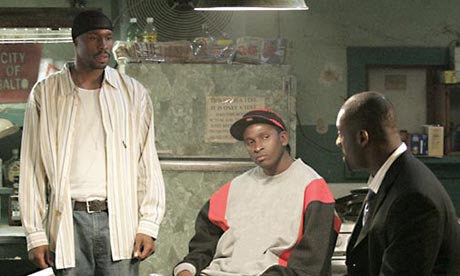
Woop woop - it's the sound of the gavvers/boy dem/po po/filth/coppers/babylon

Here's the real sound of the police, but for those of you who don't want to travel back in time to the prehistoric days when hip hop meant something, just go straight to yesterday's Guardian which ran a short item on the slang used by some British police: you can find it here.

The whole area of occupational language is a good one to study. Doctors, teachers, soldiers, call centre workers and firefighters are all likely to have their own occupational varieties, which themselves might be affected by the speech styles of the individuals in the job, or the geographical area that people work in. The police are no exception to this and their occupational variety is probably one of the more widely scrutinised forms because it often appears in transcript form in court, or (perhaps more glamorously) on TV dramas and even reality police shows.

So is this sort of occupational variety a slang or a form of jargon? To what extent might we call the police a "community of practice"? According to the definition given by Graeme Trousdale in his excellent new book, An Introduction to English Sociolinguistics, a community of practice is defined by three characteristics: mutual engagement, a jointly negotiated enterprise, and a shared repertoire. He uses the example of a school rock band to illustrate these characteristics.

Here, a number of individuals come together in face-to-face contact (mutual engagement) for a particular purpose, that is, to play music (jointly negotiated enterprise), often conversing using jargon common in discourse on popular music, such as riff, bridge, amp, bass guitar and so on (shared repertoire).

Is the same true for the police? I think so. And like other communities of practice, there is pressure from within to use language in the accepted way, meaning that members of the community of practice become institutionalised in the language of the organisation.

Quite where this leaves the firearms police involved in this case, I don't know. they seem to have developed their own discourse, which apparently consists of slotting in as many song titles as possible into their witness testimony...

If you're interested in the language of the police, this link to a forum about police slang/jargon might be of interest.

Also, the many different words used to describe the police can be found here.

edited to add: 
While on the subject of communities of practice, this short article about the language used on message boards by divorced women discussing their relationships is quite a good one. There's the usual mix of acronyms and initialisms that we tend to see online (although I'm not sure LOL has been correctly defined here) along with a  smattering of new ones like STBXH (Soon to be ex-husband) and OW (other woman).

Tuesday, November 02, 2010

Evolving English - lots of languagey stuff

The British Library's Evolving English exhibition starts next week and looks really amazing. Here's a link to the evening talks and events. There's slang, swearing, the language of the Bible, Multicultural London English, gender and language. It's all there and blooming exciting.

Gang slang is not nang but don't be prang...

...and other desperate attempts to use slang in a headline in a(nother) post about slang.

There's now quite a number of comments that have been added to the article in Yesterday's Evening Standard, and they make for an interesting read, especially if you are an AQA A spec student looking at Language Discourses on ENGA3.

We've got some fairly rabid anti-immigrant postings, where the link between young black people, slang and crime seems to have got a few EDL/BNP types all upset. We've got some "crumbling castle" views, suggesting that our once beautiful language has been reduced to a vile slang code understood only by debased urban raggamuffins. We've got some descriptivists arguing that slang has always been around and is just one code that people use in certain contexts. We've also got a few others arguing the toss over the meanings of certain slang terms that have appeared in the glossary in the article. It's quite a range. Why not contribute yourself and add to the debate?

The writer of the article, Lindsay Johns, has a track record of  attacking slang and defending what he calls "proper English", as you can see from this article from 2009.

Finally (until I get worked up again and start ranting about slang) I've added a poll to the right of the blog homepage where you can add your view to what "peak" actually means to you. If you feel particularly passionately about this latest bit of London slang you can add a comment too.

Monday, November 01, 2010

Gang slang: not peak, just moist

Today's Evening Standard features an article by Lindsay Johns which sports the terrible headline "The secret world of gang slang". It's a terrible headline for two reasons. Firstly, the article isn't really about "gang slang"  (whatever that is supposed to mean): it's more to do with youth slang in general. Secondly, the headline gives the impression that slang is linked to gangs and violence: it can be - as anyone who has studied slang should know, some forms of it have their origins in the secret language of criminals - but more often than not has nothing to do with criminal behaviour.

The article itself is a bit of a let-down. Instead of talking to linguists (you know, the people who actually spend their lives studying language and looking at its usage), instead of talking to slang lexicographers (the people who put together and research dictionaries about slang, people like Jonathon Green and Tony Thorne), the writer talks to people who have opinions about slang but don't really have much to say about it: people like Simon Heffer, a man who knows virtually nothing about slang but has lots of views about how awful teaching is these days and how slang is a bad thing.

What really bugs me about the article is that it casts young people as some kind of alien species, whose language is so different from that of mainstream society that they are unintelligible. That may be the case for one or two unfortunate individuals who can barely pass a bus without saying "Dat's peak, bruv" but for most young people this really isn't the case at all. Code-switching - moving between languages or registers of languages - is something that people do all the time. Young people are especially adept at it.

So, to cast youth slang as simply gang-related and sinister just adds another dimension to the alienation already felt by a lot of teenagers. But I'm 41 years old and a "trendy leftist", that breed of linguist that Simon Heffer blames for the collapse of standards in teaching, so what do I know?

To be fair, there are some interesting bits in the article, but I'm just a bit jaded after reading so many articles about slang that say the same thing. So have a read and see what you make of it yourselves, I suppose.

Thursday, October 28, 2010

Attitudes to foreign accents

With the post earlier today focussing on changing English accents and pronunciation, here's something different. A piece of psychological research from the USA and covered on the BPS research digest shows that in a study of "believability" heavier foreign accents came out lower in their score than light accents or "normal" ones.

The researchers suggest that it isn't just down to prejudice, but might have something to do with what they refer to as the "fluency effect" (Wikipedia defines and explains it here). Perhaps if we struggle to process a heavier, less familiar accent, we tend to believe the content of it less. The study referred to by the BPS seems to suggest that the fluency effect really has an impact.

A while ago (1971 to be precise) Howard Giles carried out a famous sociolinguistic study when he looked at attitudes towards different accents in the UK. He used a matched guise structure for his study (read more about this methodology here) and the American study is similar in many respects.

Edited on 26.11.10 to add:
This piece of research into the brain's activity when faced with foreign accents is also quite interesting.

Why we love i and simples

There's lots of good stuff for students of language change in today's papers and online, with the latest additions to the Collins English Dictionary getting some coverage. The Scotsman gets some expert opinion from Edinburgh University's Geoff Pullum on the new entries to the dictionary and you can read more here. Elsewhere, the BBC covers it here and The Guardian here.

For many of these articles, the highlight is the inclusion of a humorous Russian meerkat and his use of "simples". Linked to new words and their formation, the BBC News magazine also has an interesting look at the way i- has entered the language as a kind of trendy prefix. According to the article, now we have the iPod, the i-Player and the i-Phone (well I don't have an i-Phone but I wish I did) but soon we will have i-everything. In the same way that e took off as a briefly funky prefix to add to anything you wanted to pretend was modern (e-commerce, e-marketing, email...) i- has become the new must-have prefix. It's a good read and features the wisdom of Tony Thorne from King's College, London, a man who knows his onions when it comes to language change and new words.

Getting in a pickle with lickle Mr Tickle

The forthcoming British Library Evolving English exhibition is looking like a brilliant event for anyone who is interested in our language, and it's receiving some national coverage today for its focus on our evolving accents.

This morning's Radio 4 Today programme featured Jonnie Robinson from the British Library and John Wells, the UCL phonetician, talking about how our pronunciation of different words changes and how people feel about those changes. You can listen to it on i-Player here and if you're an SFX student try the link through Moodle that will appear later this week.

The BBC News website covers the exhibition's focus on collecting pronunciation here and they explain how the Mr Men story, Mr Tickle, is being used to collect our regional, social and ethnic differences in pronunciation.

So, how do you say little? Is it li??el (with glottal stops), littel (with Ts in your mouth), lickle (if you're Jamaican...or Tim Westwood)? And what about the eighth letter in our alphabet: is it Haitch or Aitch? The British Library wants to know. There's more about it here as well.

Wednesday, October 27, 2010

So, farewell then, Melissa. Those who dissed you will be retributed.

It's with great sadness that we wave farewell to Melissa from this season's Apprentice. Not only did she have the charisma of a young Amy Winehouse, the self-belief of Gordon Gecko and the haircut of a porcupine, but she also changed our language.

Today's fantastic moments included (following on from the other week's comfortability where adding an "-ity" suffix to a word makes it even more serious than just plain comfort) professionality , manoeuvrement (not manoeuvrability)and (at the end of the show where she claimed to have been ganged up against by her fellow boardroom candidates) the bloodcurdling threat that for their behaviour... "karmically they'll be retributed".WTF?

Goodbye, Melissa. We salute you for making up random new words.

edited the morning after to add:
...but are they random? A colleague says that, while they appear random, Melissa is actually following some rules with her use of -ity and -ment. But what are those rules and why should professional, the adjective, take -ism to make it a noun, or manoeuvre, the verb, take -ability rather than -ment?

Friday, October 22, 2010

Representation of celebrities

There's a good piece in today's Independent about the ways in which celebrities are represented in the media. It looks at the cycles of build-em-up-and-knock-em-down that are so common in the press and focuses particularly on Cheryl Cole and Wayne Rooney.

Definitely some good material here for an ENGA2 Investigating Representations task, I think.

Wednesday, October 20, 2010

The mode map

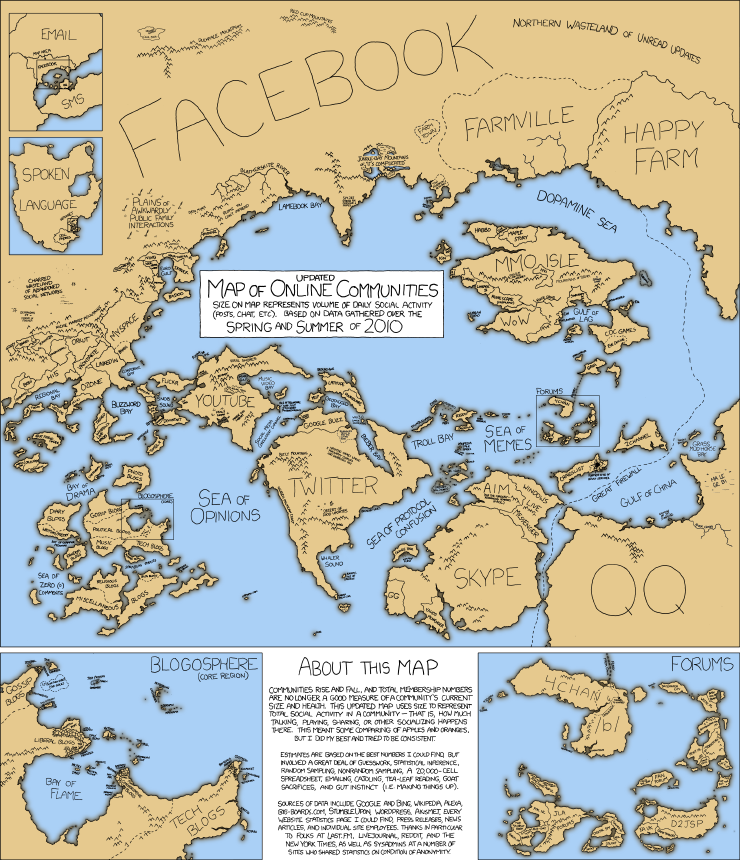
While it doesn't quite cover all modes, this map by the cartoonist, Randall Munroe, is a really great way of visualising the different forms of communication available to us in 2010. He's chosen to make the land masses' sizes proportional to their number of users, as this article in The Independent explains.

The full image of the map can be found here. You'll see me bobbing up and down in the Gulf of Lag, just off the south coast of the MMO Isle.

Thursday, October 14, 2010

Comfortability?

I nearly choked on my Chilean Merlot last night (drunk to celebrate the rescue of the trapped Chilean miners rather than out of any dependence on the tranquilising effects of alcohol, honest) when Apprentice contestant Melissa used the expression "to find comfortability" while referring to her team's hopeless product the Book-Eze, designed to make reading on the beach less onerous (watch from about 30-31 minutes into this episode if you want to hear it for yourself).Am I getting prescriptive in my old age?

"Comfortability"? Is it a real word? When I type it wrongly, my Blogger spellcheck corrects it, so Blogger thinks it's real. I've checked it on WebCorp and it seems to appear on several US business websites and it gets used  by American footballer, Shawne Merriman here. But what does it mean? And why not just "comfort"?

This guy claims he coined it to refer to an ability to be "fully present/comfortable in an uncomfortable situation". I can't find it in the OED or Merriam-Webster, but it appears as long ago as 1984 as part of a medical test, "A Comfortability Level Scale for Performance of Cardiopulmonary Resuscitation". Weird...

So, is this like conversate: a word that might have originally just been a mistake, a slip of the tongue, and which gets picked up and spread into wider usage because of its apparently impressive sound? Is it better than "comfort", and, more importantly, will I be able to read my Girl With The Dragon Tattoo on Bognor beach in comfortability?

Tube tips for women revisited

Back in 2005, Transport For London issues a leaflet called Tube Tips For Women which set out to help women "get the most out of the tube and stay safe". It contained such brilliant and original advice as minding your step on the escalator if you're wearing "party shoes", always carry a cereal bar (fits well in even the tiniest of handbags, apparently) and capped it all with graphology straight from the high street perfume counters, all lippie and pink squiggles. Zoe Williams of The Guardian didn't like it and after a few complaints it was withdrawn.

The original link to the leaflet died after the leaflet was pulled, but I've uploaded it as a clickable image on the original post from 2005, which you can find here. If you're looking at representation of gender for ENGA2, the leaflet, Williams' response and 2 or 3 other short extracts about the same theme would probably make a good set of materials for an investigation.

Monday, October 11, 2010

More on slang and correcting dodgy grammar

Here's a couple of follow-ups to recent stories featured on this blog.

For starters, this is a comment piece by Bob Nicholson in The Guardian which looks at how Victorian English took in American slang, and how the Americanisation of English is hardly a recent phenomenon.

Then there's this piece by Belinda Webb, also from The Guardian, that takes a look at reactions to slang. It's not a particularly brilliant article as the writer appears to confuse dialect and slang, but it's an intervention in the debate about language, so worth a look.

Finally, there's this article about Queen's English Society arch-pedant, Bernard Lamb in last month's Times Higher.

Thursday, October 07, 2010

The English Language: it's not doing great

Each day seems to bring another argument about language and how it should be used. It is a great time to be an English Language student, huzzah!

Today's Independent features an opinion piece by Dr. Bernard Lamb, the President of the Queen's English Society (Surely that's a dangerously republican title for a staunchly royalist organisation?) who argues, among other things, for an end to the inverted snobbery and deliberate dumbing down of language that have led to a generation of nitwits not knowing the difference between they're and their. He rails against many other things too: the glottal stop; the lack of capitalisation of proper nouns; using great as an adverb when it's an adjective (Stop press! It's been used as an adverb for a long time. Deal with it!).

And as a professor of genetics, he's obviously eminently qualified to talk about... genetics. So why is he holding forth about language?

Anyway, he does make some sensible points too. There is a really good argument that we all need Standard English as it is a mutually intelligible dialect for all English speakers. If we all have access to Standard English then we all have a chance to communicate with each other, regardless of the region, the social class, the ethnic group or the age group we come from. I wouldn't argue against any of that. But when the definition of Standard English (or the Queen's English as Lamb insists on calling it) spreads like a BP oil slick to cover strong regional accents, glottal stops and the "misuse" of literally, then it's no longer really about a mutually intelligible means of communication and much more to do with personal prejudices.

Tuesday, October 05, 2010

Slang: now the teachers don't know nuffink neither

Yesterday's Daily Mail featured a brief story about a school in Portsmouth where two teaching assistants have been criticised in an OFSTED report for their "poor grammar". As usual, the Daily Mail's message boards seem to act like a magnet to every droooling, knuckledragging dimwit in the universe (as well as the occasional rational human) so within a day 100 comments about the state of the British education system had been posted, ranging from those that blame Nigerians, Alesha Dixon and Tony Blair to those that are sure it's the fault of scruffy (male) teachers and Alan Sugar.

The story actually turns out to have very little to do with slang (despite the Mail and this blog's headline) and much more to do with dialect. The teaching assistants had apparently used the local construction "I likes football" (which shows a different subject verb agreement from Standard English's "I like football", or more accurately "I hate Millwall"). But again, and like so many other stories about aspects of language, the anger isn't really directed at the feature itself (which is pretty harmless) but at the users of it and those that are perceived as letting it ruin young people's education.

I've done a (slightly) more technical post about this over on the Teaching English Grammar in Schools blog if anyone's interested, but is it really such a bad thing to have a couple of teaching assistants using a local variety of English in the classrroom?

And wouldn't it be good if next time the Daily Mail ran a story like this, a mass language intervention of intelligent comments from A level English Language students drowned out the nutty ramblings of the usual message board trolls?

Thursday, September 30, 2010

Slang: evil or nice?

Let's follow up the recent stories about Emma Thompson's views on slang with a quick poll. What's your view on the slang debate?

Does it make young people sound stupid, like Emma Thompson suggests?
Is it a normal part of language that we should accept and celebrate?
Is it only stupid when used by 40 year-old English Language teachers trying to like bond with da yoot dem, ya get me?

You can vote to the right of this post*.

Edited to add: The Observer has a debate on this very issue in today's paper. Have a look here.

*Calls cost 20 Czech Kroner and lines close at 8am. Calls after this time will not be counted towards the vote and you will be charged. Double.

Wednesday, September 29, 2010

The benefits of slang

Emma Thompson's attack on young people's slang has been covered in a range of newspapers and websites, with an interesting one here in today's Daily Telegraph and another here on the BBC News Magazine pages here. There was even a feature on Channel 4 news last night.

To listen to David Crystal talk about this story, go here (BBC World Service interview: about 10 mins 30seconds into it).

Edited to add this link from the Daily Mirror: quite a nice style model for a language intervention on ENGA4, or media text on ENGB4, perhaps.

Tuesday, September 28, 2010

Learn to code-switch or "look like a knob"

...so says Emma Thompson, actor and ex-pupil of Camden School For Girls. Despite sounding like it should be an exclusive private school for the daughters of city bankers and royal equerries, CSFG is actually a north London comprehensive and therefore reflects - to some extent (exorbitant local house prices aside) - the social and ethnic make-up of that part of London. So when Emma Thompson went back there to a charity evening, she was struck by the slang being used by the pupils (says The Independent).

"I went to give a talk at my old school and the girls were all doing 'likes' and 'innits?' and 'it aint's', which drives me insane," she told the Radio Times. "I told them, 'Don't do it because it makes you sound stupid and you're not stupid.' There is the necessity to have two languages – one you use with your mates and the other that you need in any official capacity. Or you're going to sound like a knob."

Thompson's point about having two languages is a fair one, but to write off a few slang terms as  making you sound "stupid" seems to me to be a step or two too far. Fair enough, if you don't like those expressions, then you've got a right to say so, but to equate slang with stupidity is just narrow-minded. To make matters worse, Thompson then slips into her own generation's slang when she says that saying "like" and "innit" makes you "sound like a knob".

Why is it OK for Emma Thompson to mix her codes in the pages of a national publication, while it's apparently not OK for teenagers at her old school to switch codes? Sounds to me like the old prescriptivist stance that younger people's use of language is a degraded form: a crumbling castle idea, that Jean Aitchison effectively nails in her famous Reith Lectures.

The Independent has a good leader article on the story, which you can find here.

Friday, September 24, 2010

English RIP

If you're looking for style models to help you with media texts for ENGB4 or language interventions for ENGA4, this fake obituary for the English language is a nice example. While the content is pretty standard prescriptivist fare (The language is doomed! People make spelling errors! Newspapers print bad English!) the style in which it's written is quite interesting. Here's the first paragraph:

The English language, which arose from humble Anglo-Saxon roots to become the lingua franca of 600 million people worldwide and the dominant lexicon of international discourse, is dead. It succumbed last month at the age of 1,617 after a long illness. It is survived by an ignominiously diminished form of itself.

Tuesday, September 21, 2010

Has feminism caused obesity epidemic?

It's all too easy to mock the Daily Mail, but yesterday's headline about feminism killing home cooking and therefore being responsible for the current "obesity epidemic" was a gem. Elsewhere in the Mail, Philip Norman got very upset about some words and phrases - Americanisms and sloppy phrasing - that he doesn't like.

ROFLMAO @ attempts to use LOLspk in blog headlinez. WTF

Moderate (and sometimes vaguely illiterate) outrage has been sparked on message boards in the USA with the announcement that the latest edition of the Oxford American Dictionary will now include examples of webspeak, such as Twitter's mighty hashtag (#) and TTYL.

AOL news's Carl Frantzen has a look at the changes here and compares the new entries to those on the always interesting but sometimes stupid Urban Dictionary.

An Introduction to Language: David Crystal event in south London

David Crystal will be appearing at King's College (just near Waterloo) on the afternoon of October 20th and his publishers want A-level students to attend. He's being filmed for a new Routledge DVD called an Introduction To Language so it will be a lecture that will undoubtedly suit AS and A2 level students very well.

If you're interested in attending either as a student, or as teacher bringing students along, please email me through this link and I'll get back to you.

Friday, September 17, 2010

More effin' Heffer

Just in case you've not had enough of this man's bumptious prescriptivism, here's a link to the fourth extract from his book and another link to a piece on Radio 4's site. And better still, here's a link to Bad Linguistics where the linguist, Pauline Foster, lays out her criticisms of Heffer's brand of dubious pedantry.

Wednesday, September 15, 2010

Destructivism: the death of languages

The BBC News Magazine (always a good source of language stories) has a feature on dying languages this week. It's a good read that starts to raise questions about the links between language, culture and identity. For example, when a language dies, does part of human culture go with it? Or should we just treat the death of an obscure language as an inevitable and unlamented consequence of progress?

Given the rise of English (or Globish...or ELF) around the world, it's a process that will occur more and more frequently as time goes by.

Friday, September 10, 2010

Two postscripts

Just two quick follow-ups to yesterday's posts.

Firstly, Kira Cochrane in The Guardian has picked up the David Haye "as one-sided as a gang-rape" story and put together a more wide-reaching piece on the word "rape" itself and its changing uses. It's an interesting read which touches on many issues to do with language reflecting and shaping social attitudes, while also making some good points about how the casual use of the word can both emphasise the horror of the act itself and also diminish its significance. The etymology of the word itself though is worth a look. According to Etymology online, the original (late 14th Century) meaning of "to rape" was to "seize" or "take by force" and it had no clear sexual connotation. It was only later (late 16th Century) that sexual meanings became applied to the word, and then in the sense that the woman was treated as any other "object" that had been taken by force, perhaps revealing the attitude that women were the property of men and the violation of a woman was actually a crime against the man who "owned" her.

Secondly, in response to the Simon Heffer piece on Radio 4's Today yesterday, Emeritus Professor of Linguistics at UCL, Dick Hudson, points out that the example Heffer gives of "I will, you shall, he shall" is not actually right if he is talking about the rule of "simple futurity" that he has referred to seconds before. Was this dodgy editing by Radio 4, or should Mr Heffer go back to school? Where this stuff isn't actually taught anyway...

Thursday, September 09, 2010

The grumbling appendix of prescriptivism

"The teaching of English has left most pupils with nothing but a random and often erroneous understanding of the components of language." So began John Humphrys on this morning's Today programme on Radio 4* as he introduced an item about a man he clearly admires, Simon Heffer.

The opening quotation comes from Heffer's new book, Strictly English, published by Random House (I'm sure Heffer would be appalled at the fairly recent semantic change random has undergone.) and which Heffer's very own Daily Telegraph has been serialising over the last three weeks (part one, part two, part three).

In his book, and in the Radio 4 interview, Heffer SLAMS the teaching of grammar, RAGES against a generation of linguistic illiterates and BLASTS the exaggerated language of tabloids. He's quite angry, it's fair to say.

But he's also very big on "correctness", asserting on a number of occasions that we are judged by how we speak and write. This is no doubt true, but who is doing the judging? Heffer mostly. He comes from a long line of prescriptivists (one of whom is John Humphrys himself, whose books have recently appeared in extract in A level exam questions on Language Change) who see a general decline in literacy standards wherever they look. If it's not the tabloid press, then it's teachers wot carnt spell. And if it's not gangster rap, then it's those people who use literally when they don't really mean literally. He's literally frothing at the mouth over that one.

Clearly, some people do have problems switching between registers, while others aren't really that clear on word etymologies, and it's probably fair to say that, for a minority of young people, formal written English is not a very familiar or comfortable variety to use, but it's always been that way. This generation (or the last, or even mine) is not any worse than the others.

One point raised by Heffer in the Radio 4 interview is about the distinction between shall and will. He says, "To say I will do something is a statement of resolution: you're saying I am absolutely determined to do it. To say I shall do something is a statement of simple futurity: that it's going to happen. It's I will, you shall, he shall". Frankly, who cares?

Recent research by linguists suggests that this shall/will distinction is becoming increasingly redundant, with usage of shall falling between 40-50% over the last 30 years. Perhaps we now have other ways of expressing "resolution" and "futurity", and the rather antiquated "rule" - dreamt up by "experts" who based their rules on their own usage, funnily enough - is dying out. It's like the appendix: no one really knows what it does and it sometimes grumbles and causes us pain. A bit like Heffer and his ilk?

*Listen to it on i-Player here (from 2:36.44 - 2:41.38)
and thanks to Julia H for tipping me off about this great interview.

A simile too far

Boxers speak with their fists, but occasionally one comes out with something poetic and deep from his mouth - float like a butterfly & sting like a bee, maybe. David Haye is not one of those people. His recent comment that his fight with Audley Harrison would be "as one-sided as a gang rape" has been met with outrage. His defence via Twitter? "If I apologised for every stupid/ignorant thing i said, I wouldn't have time for anything else during the day!"

So that's OK then...

Tuesday, September 07, 2010

NY speak

There's a nifty article in last week's BBC News magazine about changing accents in New York which is well worth a look. While the AQA A spec hasn't tended to cover American varieties in the past, there is now a World Englishes topic on ENGA3 where this might come in handy. From a different perspective you can also see more general patterns of language change in the ways that the NYC accent is reported to have changed over time. Anyway, the story is here and there is some video to go with it.

Twitter helps regions reign while twitz drop their slang

It's not every day that I get to write something that links Twitter, regional slang and N'Dubz, but here goes...

Research from Dr Eric Schleef at the University of Manchester, reported in the Telegraph and Guardian last week, suggests that regional dialects are not dying out quite as quickly as linguists thought they might a couple of decades ago. The argument - called dialect levelling - was that as society became more mobile and people shifted away from smaller communities to larger urban sprawls, their local varieties of language would fade away and in their place would rise regional varieties, and perhaps even ultimately just one homogenous national variety. To some extent, this has already happened, and the story here about regional "super-accents" seems to support it.

But Schleef argues that social networking and mass media have actually helped spread many regional terms - dialect words and slang - among the wider population. In The Daily Telegraph report he is quoted as saying the following:

Twitter, Facebook and texting all encourage speed and immediacy of understanding, meaning users type as they speak, using slang, dialect respellings and colloquialisms.The result is we are all becoming exposed to words we may not have otherwise encountered, while absorbing them into everyday speech."

He added that it was not now uncommon to hear a northerner utter words such as “tidy” or “lush” – Welsh terms for attractive - or to catch southerners describing something good as “mint”, a term coined in Manchester. 


Fair enough, but does this actually mean that local varieties are here to stay or that we're adopting a buffet-style approach to our language choices, picking words we like from the table (like nice, tasty, breaded prawns) and ignoring ones we find odd or unpleasant (bits of limp cheese flan)?

Meanwhile, in news that will upset 12 year old girls all over limited parts of north London, the poor man's answer to the Black-Eyed Peas, N'Dubz, have decided to drop some of their trademark slang in order to appeal to the American market. In this article from The Sun, you can find out more...admittedly not much more, as it's a very short article, but presumably the reporter couldn't understand much of what they were saying as Dappy only seems to communicate through an elaborate series of hand gestures these days.

Whatever you think of E3's finest export, Dizzee Rascal, and his rise to pop fame at the expense of some of his musical credibility, at least he's kept his linguistic identity. So what are N'Dubz playing at? Will they gain a bigger audience in the USA because they don't say "bruv" and "innit" in their lyrics, or will the American audience take one listen to their lyrics and turn to each other saying, "These lyrics are as characterless as the rather anodyne music that accompanies them. I shall no longer listen to the so-called N'Dubz and instead invest my hard-earned dollars in some Kano and Wiley, artists who remain true to their linguistic roots. And whose music is better. Bruv."? On a slightly more serious level, doesn't it suggest that even while we're quite happy to pick-n-mix our vocabulary in casual chats between friends or on social networking sites, when it comes to a wider audience, we accommodate to a more neutral register?
 

Of course, you have to be careful if you're being rude about N'Dubz or Dappy will send you a poorly-spelled threatening text message, but I say bring it on*.


*Not really

Sunday, September 05, 2010

Stop your bitchin' and get back in the kitchen...

...is probably not the sort of headline Bidisha would like, and rightly so: it uses derogatory and belittling language about women and identifies them as complainers who are suited only to domestic roles. But I've used it for a cheap joke, so that's OK isn't it?

In this forthright and impassioned article about attitudes and words, the Guardian writer lays into the casual sexism of British society and the words that so often carry and propagate these attitudes. It's a provocative article and focusses on a language topic that has been debated before by English Language students, so it's definitely worth a read.

The writer refers to the "pyramid of egregiousness" - a chart of words offensive to women, ranked in order of their unpleasantness. You can find it here and also find out more about why feminists (and anyone with at least half a brain) find them objectionable.

Wednesday, September 01, 2010

I would get NIFOC but PAW

If you know what the title of this blog post means then you should either be ashamed of yourself or get out more. The answer's at the bottom of the post if you want to know*.

Different generations have always created new slang terms and with the massive growth of the internet and other forms of electronic communication, the pace of change has been ramped up another level. As ever, those who aren't young (like me) start to get confused about what the yoot dem are saying and think they're up to no good. And if you look at a site like this one, you'd probably fear the worst: that your son/daughter is engaging in pervy behaviour on a webcam in their room while you're reading the paper and picking your bunions in the living room.

But is the slang of the internet and texting, with all its BRBs and LOLs and ASLs really that different from what different generations used in the past? David Crystal, the bearded God of English Language, thinks not and wrote several chapters in his Txting: the GR8 DB8 about just this. Elsewhere, Ben Zimmer of Visual Thesaurus sees abbreviations in loads of older texts.

*NIFOC = Naked In Front Of Computer
PAW = Parents Are Watching

Thursday, August 26, 2010

You, sir, are a dandyprat with unfortunate farting-crackers

Lots of people think slang is new, that it's only used by young people, or black people, or dodgy East End geezers who've necked a couple of Britneys down the rub-a-dub. But slang has been around forever and has been used by all sorts of people. Now, one of the very first slang dictionaries from way back in 1699 is about to reprinted. Here's more about this brilliant resource.

Wednesday, August 25, 2010

Disappearing dialect

You wouldn't know that I'm back from holiday and catching up on stuff that I missed, would you? Here's a Daily Telegraph article from early August about old dialect words that have dropped out of use. I think it's interesting to see what kinds of words drop out as other ones enter the vocabulary and why this happens.

What's in this year

The Oxford Dictionary of English has been updated and its latest lexical additions can be found here. Some of these words aren't exactly brand new - haters, chillax and paywall - but they're included for the first time. It's all good ammunition for work on language change at A2.

The Guardian have covered it here.

Meanwhile, The Daily Telegraph looks at a slightly different angle here, reporting on "failed words" that didn't make it into the dictionary. It covers the original story about the words that have made it in here.

Sheeeeeeeeiiiiiiiiit

Here's a job that will appeal to the many fans of The Wire that have sprouted up in south London since we forced all A level students to watch it in class. The US Drug Enforcement Agency has advertised for speakers of "Ebonics" to sign up as translators in an attempt to decipher the language of African American drug dealers. But don't worry. They're not assuming it's only African Americans who are selling drugs: they're also recruiting Ibo, Berber and Farsi speakers, as well as lots of Spanish speakers, obviously.

The Guardian article covering this story makes some interesting points about what this tells us about attitudes to African American speech:

Ebonics is described by some linguists as English incorporating the grammar of African languages, but as it also includes many words invented on the streets, it is dismissed by others as mere slang.

Nonetheless, the administration is confused enough to ask firms providing translation services to provide the nine Ebonics translators to cover an area from Washington DC to New Orleans and Miami and even the Caribbean.

The move is a contentious one. American officials have in the past denied that there is any such thing at Ebonics.

There's more on Ebonics here if you're interested. Meanwhile, I am busy writing my letter of resignation (this is becoming a habit) and sending an application to Baltimore. Aight?

Tuesday, August 24, 2010

Men are from Earth and so are women.

A new book by Cordelia Fine called Delusions of Gender takes on many of the same targets that Deborah Cameron's brilliant Myth of Mars and Venus demolished a couple of years ago.

For a while now, the argument that men and women are hard-wired from (or before) birth to be different has been gaining popular support, but many studies suggest that the differences between the sexes are not as pronounced as many might like to believe. And certainly, in terms of verbal abilities, gender seems to account for only a small proportion of difference. Here's a review of Fine's book in last week's Guardian and here's a nice bit about language and gender:

The latter example, on the issue of verbal skills, is particularly revealing, neuroscientists argue. Girls do begin to speak earlier than boys, by about a month on average, a fact that is seized upon by supporters of the Men Are from Mars, Women Are from Venus school of intellectual differences.

However, this gap is really a tiny difference compared to the vast range of linguistic abilities that differentiate people, Robert Plomin, a professor at the Institute of Psychiatry in London, pointed out. His studies have found that a mere 3% of the variation in young children's verbal development is due to their gender.

"If you map the distribution of scores for verbal skills of boys and of girls you get two graphs that overlap so much you would need a very fine pencil indeed to show the difference between them. Yet people ignore this huge similarity between boys and girls and instead exaggerate wildly the tiny difference between them. It drives me wild," Plomin told the Observer.

LOLcats, apps and rickrolling: the language of technology

New technology has always been a major influence on the English language: new inventions spring up and words have to be found to name them. This article on the BBC Technology news site (thanks to Simon Lavery on the English Language List for the link) looks at some of the most recent developments in language - many caused by developments in communications technology - such as weird phenomena like rickrolling, LOLcats and apps.

Monday, August 23, 2010

"Tidal waves of mindless Americanisms"

And following on from the mention of this in Alison Flood's article about attitudes to language change, here's a typically prescriptive perspective from the vile Daily Mail, laying the blame for the decline of our once great language squarely at the door of Johnny Yankie and his foul, colonial distortions of our beautiful tongue. And here's a second link to an earlier (and funnier) rant about American English.

A level results

Congratulations to my ex-students at SFX on your A level results. I hope you got what you wanted/needed to get to university and are happy with your results. I know some of you who have emailed me have done really well, and I'm chuffed for you (and the teachers who didn't desert you). And I hope anyone else reading this blog who isn't an SFX student got good results too and found material on here helpful.

Always complaining

Here's a link to a short article in The Guardian last week, which plugs the new British Library exhibition, Evolving English. (If you haven't already booked a visit, you really should.) The article takes a look at the ways in which there have always been complaints about language change, right back to many centuries ago, and how the current moans and groans about Americanisms, text language, PC and youth slang are just part of a well-established pattern.

Monday, August 02, 2010

Grammar incomprehension

In a sneaky attempt to build up traffic to the other blog I'm working on as part of my new job, here's a cross-posting. A week or two back, the research of Dr Ewa Dubrowska from Northumbria University was reported on in a couple of places, and since then there's been some discussion about what her research proves or doesn't prove. The gist of her work is that some people who have not gained higher level qualifications (gone to university, in other words) find it harder to understand some grammatical structures than those who have those qualifications.

While some might argue that this just proves that some people are smarter than others, it's not quite that simple. Pretty much everyone picks up grammar very quickly as a child, even though we are not taught it explicitly when we are young (or ever, in some cases). Some have argued that her research shows that we don't all have a common grammatical understanding: that the built-in grammar we are told is part of our genetic heritage by the nativist theorists such as Noam Chomsky and Steven Pinker isn't as developed as we have been led to believe.

Others have argued that it raises no such doubts and all Dabrowska's research tells us is that some people are better at taking tests than others. Anyway, there's more here on the Teaching English Grammar in Schools blog, including a link to BBC i-player where you can hear a fairly clear introduction to the debate on the Material World programme broadcast last week (20 minutes into the programme).

Thursday, July 29, 2010

Solving crime with linguistics

Forensic linguistics is a really fascinating area of language study, so this lecture by Dr Malcolm Coulthard, one of the daddies of the discipline, is well worth a look. Here he shows how linguistic analysis can be used to piece together the identity/ies of text message senders in criminal cases.

Wednesday, July 28, 2010

Slang rules, ya smell me?

The Sun seems to be having a love-in with slang at the moment, and they've got a piece in today's edition giving lots of examples of different types of slang from various occupational and lifestyle groups. I can't claim it to be a very linguistic take on slang, but there are some funny ones (and a few dodgy ones too, like the definition of bare, which is just wrong).

Monday, July 26, 2010

Five Go Mad on Mephedrone

The news that Enid Blyton's classics children's series, The Famous Five is to have its language updated has upset some and pleased others. The Famous Five books were originally published over 60 years ago and have been huge sellers since then (I even read them when I was a little boy back in the 1970s.) but have often come under fire for their old-fashioned representations of boys' and girls' social roles and for their apparently class-ridden stereotypes. So, will we see the stories themselves updated to meet the demands of a 21st Century audience: teenagers indulging in binge drinking, chopping out lines of miaow-miaow while updating their Facebook profiles, casual threesomes and the like? Not on your nelly.

While the stories will remain the same, Hodder Children, which is revamping them for publication next month, is planning to update the language. So gone will be "we shall have a gay old time", "he's a queer looking fellow" and "school tunic", and in will come "I is cotching at my yard innit" and "Man's gotta make money y'feel me". Well, not exactly... Apparently the changes are relatively minor ones such as explained by Anne McNeil in this extract from The Guardian's piece last week:


Other changes include "housemistress" becoming "teacher", "awful swotter" becoming "bookworm", "mother and father" becoming "mum and dad", "school tunic" becoming "uniform" and Dick's comment that "she must be jolly lonely all by herself" being changed to "she must get lonely all by herself". McNeil said references to a "tinker" have also been changed to "traveller". "Enid Blyton wouldn't have meant that ['tinker'] pejoratively. It's a description of a person, in order to place the character. So 'dirty tinker' has become traveller."

 For anyone looking at the A2 topic of Language Change, this would be a fertile area for investigation. Why are some expressions being changed and others left the same? Is there any kind of pattern to some of the words being changed? Are they (for instance) dated slang terms that no one will recognise these days, or words that have shifted in meaning? Later in the article, an opponent of changes to the original books makes an interesting point about the names of characters:

Tony Summerfield, who runs the Enid Blyton Society, said he was "thoroughly against unnecessary changes just for the sake of it, from adults who underestimate the intelligence of children". He added: "I am in approval of changing language which has perhaps become offensive or has different meanings, or any racist references," he said. "And certain words such as 'gay' or 'queer' obviously have different meanings nowadays and it's fair enough to change them. But changes for the sake of them, I disapprove of."

Summerfield had heard Hodder would change the name of the circus boy, Nobby, in Five Go Off in a Caravan, to Ned, which struck him "as very strange". "How can you change Nobby to Ned and yet leave Dick and Fanny? It doesn't make sense.

Elsewhere, Zoe Williams of The Guardian argues that we shouldn't change the books, claiming that "In expunging the dated words, you strip out their personality: and even if you don't particularly like that personality, it's better than none at all, a skeletal adventure without the flesh of authorial voice".

Thursday, July 22, 2010

Street slang has no place in the classroom

That old bugbear, street slang, makes another appearance in the news and this time it's not all "let's all laugh at the white children speaking like they're black" it's like "street slang is really bad for kids". Frankly, as I type this I am kissing my bloodclart teeth.

A new pamphlet (actually a rather poorly researched and sketchy document) published by the Centre for Policy Studies makes the claim that teachers in primary schools are either a) too scared, or b) not allowed to "correct" children's slang use and are therefore hindering their literacy development. It's a typical right wing argument that PC has gone too far and that we are no longer allowed to speak our own language in our own country, and it's therefore no surprise that Boris Johnson writes the foreword to the pamphlet, right wing bozo that he is.

Here's an extract from the report:

In other European countries argot and slang are not allowed into the classroom; children know exactly what is “correct” usage in their main language, and what is not. In this country, by contrast, primary school teachers – dedicated as many of them are to “child-led” education – don’t feel that it’s their role to interfere with self expression in any shape or form. On the contrary, they encourage children to read poems and stories written in ethnic dialects – in Barbadian patois, for example – which is fine, but they omit to point out that there are linguistic discrepancies. Only later, when they get to secondary school, do these pupils discover that “Street” is not acceptable in their written work. Understandably, they find this both confusing and discouraging. 

Where to start? The conflation of dialect and slang is all too common, so that's maybe a first point to pick out. They're not the same thing at all. Slang is a type of language marked by its informality and its association with particular groups of people who share a common shared interest. It's often used to mark an affiliation or identification with a particular way of life. Dialect is often associated with particular regions and varieties of English. So, for the writer of the document, Miriam Gross, to say that children are taught dialect poetry and then to extend this to street slang is just plain wrong. Yes, students of all ages get to study a range of literature from all over the world, some of it in dialect, but that's not the language they recognise as slang. I suspect the fact that some of it is Caribbean dialect poetry and a lot of recent slang is heavily influenced by Caribbean terms has caused her brain to melt down and assume it's one and the same.

Secondly, Gross then claims that "child-led" education (which she seems to hate more than slang) is a philosophy that prevents teachers from "correcting" children's "misuse" of language. That's news to me. If we're going to get anecdotal (and let's face it, there are no references in Gross's report to actual research so I won't be the first to) my own kids came back from their caring sharing child-led primary school the other week to tell me "Daddy, innit is not a word". So much for not correcting speech in primary schools. Of course, I tell them innit is a perfectly acceptable use of an invariant tag question when used in the appropriate colloquial context, but then they've already gone back to FIFA on the X-box to compare their bare skillz and that.

Thirdly, young people do not find reactions to different language styles "confusing and discouraging". They deal with them, like we all do and adjust their language to suit the purposes and contexts of what they're doing. It's called code-switching and we all do it. Children are taught Standard English at school from a very early age and to claim that what they get is a diet of patois and slang is utter rubbish.

Finally, the whole report has a horrible whiff of Tory back-to-Victorian-values crustiness about it. English is great. Everything that's not proper English is bad. Children need facts not self-expression etc etc. 

The Lancaster University linguist Paul Kerswill, in the reader comments to a Guardian piece on this report puts a very convincing case against the report:

This is a big debate and we mustn't jump to conclusions. Four points: (1) The English language like all living languages is always in a state of change. There was no Golden Age. (2) London's English has always reflected the city's multiethnic, multilingual character, and today is no exception. We cannot suppress creativity in young Londoners’ use of language, written and spoken. See my short article(3) We empower children economically and socially by helping them achieve literacy, but with the huge technology-driven changes in the way we communicate we should recognise that ‘literacy’ nowadays needs to encompass much more than it did 20 years ago. It goes far beyond a question of apostrophes or whether we should say ‘fewer’ or ‘less’. (4) Teachers and the people who train them need to be absolutely clear about their objectives when teaching literacy skills, and to develop methods accordingly. The Guardian’s report about Miriam Gross’s work suggests this isn’t the case, regrettably.

Wednesday, July 21, 2010

Teh spread of t'intertube wordz

An article by Linton Weeks on the National Public Radio website makes a number of interesting points about the ways in which language spreads from the web and into popular spoken usage. Weeks argues that many words that once only appeared in print/ on screen  are now being spoken: LOL, noob and pwned being prime examples. He points out too that as with so many other forms of language change (and linked to the wave model of change), new words start with a core group and spread out to wider society like a ripple effect. So far so simple, but what he also points out is that while the internet is creating new language for us, its own technology is perhaps restricting its use in some ways.

The ways in which search engines operate is being used by headline writers, he argues, to simplify headlines into more straightforward and descriptive summaries of what's in an article, rather than (like with the stupid title of this post) to play around with words and meanings for fun. As Weeks puts it:

One important way that websites lure traffic is through search engines, such as Google, Bing and Yahoo. When someone types in a search term, he is led to a ranked series of websites. Needless to say, websites are extremely competitive when it comes to those search engine rankings. Every website wants to be #1... As search engines have gotten more sophisticated, their crawlers and scrapers have learned to also sort through all the text on the site. So many websites, trying to enhance their SEO, now pepper headlines and stories with nuts-and-bolts, no-nonsense words that pigeonhole the story. The overuse of this tactic is called keyword stuffing. Purists frown on the practice, but it works.

So what the internet gives us with one hand - hilarious misspellings like teh and pwn, new blends such as blegging and vlogging, leet words such as n00b, and initialisms like FTW and WTF - it takes away with the other. So, what I should have called this posting is "A posting about how the internet affects language change".

Everyone's descriptive nowadays

Sarah Palin's recent use of the made up word "refudiate" (an apparent blend of refute and repudiate, neither of which would have been accurate in the context she was speaking) has sparked a discussion about our attitudes towards new words and slips of the tongue.

George W Bush was famous for his mistakes (misunderestimate being one notable example) and Palin was quick to make light of her error by referring to Bush, but also by referring to an apparent slip by Barack Obama (wee-wee'd up) and, more surprisingly, William Shakespeare.

In a tweet a day or two back she stated in her folksy way that "English is a living language. Shakespeare liked to coin new words. Got to celebrate it!". And yes the bard did coin plenty of expressions (whether or not he made them up himself or was the first to put them in print and into wider circulation isn't really clear) as you can see from this link. But is Palin in the same category?

Some have argued not, while others have argued that it's just snobbery to pick out faults in other people's language. You could go further and argue that attacking Palin's language use actually adds to her credibility as an outsider and maverick, by making her look like she's being picked on by an intellectual, liberal elite. So where do we draw the line? Are we all descriptivists now, embracing every change to our language however weird...or wrong? Does anything go? And is it rude to point out mistakes in usage?

For more look here on the OUP blog and here in today's Guardian.So is Sarah Palin really a desriptivist (someone who believes in the natural evolution of language) or just a numbskull (someone who doesn't believe in evolution)?

Monday, July 05, 2010

Cockney's done a runner

Here's a link to Ant Heald's blog where he covers the recent story about the Cockney accent dying out. Well, it's not really a recent story, more the latest instalment in a much longer narrative of dialect levelling and accent change, but it's interesting stuff none the less. And as Ant's covered it I don't have to.

Tuesday, June 22, 2010

ENGA3 exam - good luck

ENGA3 is coming up as you already know, so good luck with it. It's a tough paper and it's really important to know exactly which skills to use on which part of it, so think carefully about how you plan your answers.

The January paper had the following questions:

A quick look at Question 1 should tell you that it's a language change question , but not one of the "old texts" ones that could crop up on Thursday. Here you're being asked to do different things in different bullet points. The first bullet point is about analysing the texts linguistically (identifying and discussing the effects of  language features such as nouns, verbs, tense, sentence types, functions, clause structures etc.) and the second bullet point is much more to do with explaining what you know about language change and how the examples in the texts given to you are part of this (or not). The second bullet point is much more like an essay on language change where you can show your understanding of key theories, major processes of change and what you think of it all.

Question 2 is a language variation one, and you have to be really careful to read the question! On question 1 you were asked to analyse both texts in the first bullet point but on this question you were only asked to analyse the first text. It might not be the same this summer, so read the question carefully. For this question you were being asked to do much the same as you were in question 1 but with a focus on language variation (dialect etc.) rather than change. The other key thing is to think not just about the features of the extract (its non-standard grammar, lexis etc.) but also the views the guy is putting forward - what he means and how he conveys his ideas. The second bullet point is then asking you to do a more essay based answer on the different attitudes towards regional dialects and accents.

Question 3 is very different and you need to have a clear sense of how it's different. Whereas you had a choice of answering either 1 or 2, you get no choice here and anything from A2 could turn up - regional variety, language change, male female variation, age-related variation, social groups and language use, even world Englishes. You have to have covered all the bases just in case (or be very lucky).

The texts you are given for question 3 will be aimed at a non-specialist audience: they're not written for linguistic experts but the general public, so they will often over-simplify, misrepresent or just rant about a language issue. You're being asked on question 3 for your expert opinions as A level Language students (OK...I know...) on what these writers have said. You must pull what they say apart linguistically (breaking down word choices, sentence choices, clause structures just like you did on the first part of the paper) and then evaluate what they have said in the light of what you and others know about the issue. It's supposed to encourage you to put your own ideas forward and take part in a debate about language, so don't be afraid to offer your own views or those of other relevant experts. The topics are usually chosen to give you something to talk about, not to catch you out.

So, in the case of the January paper, the two texts present men and women as homogenous groups. Men pretty much always do this and women pretty much always do that. But that's not right, is it? Most linguistic research (and especially the most recent work by people like Deborah Cameron) suggests that while differences may occur between men and women, there are also huge differences between men and men and women and women. Gender is only one factor in a range of other ones and to claim it's all biologically determined is a load of cobblers. There are many other approaches to take too and these will depend on the topic you're given:

Texting is destroying language! No it isn't.
Political correctness is changing language for the worse! Err, no...
English is the language of the world! Kind of...but think about this too

Anyway, if you have any questions, add them as comments and I'll try to help you (unless it's between 3pm and 5pm tomorrow in which case I will probably be weeping into a can of Stella).

 My top tips for Thursday (blind guesswork only, it has to be said):
Question 1: two texts from different times to compare and a discussion about language change over time
Question 2: gender related variation with some data
Question 3: texting and how it's destroying our language.

Friday, June 11, 2010

Swear down

Swearing on TV and radio is the subject of a new report by OFCOM, which takes a very detailed look (300 pages) at the attitdues of different sections of British society to a range of potentially offensive words. It's not just traditional swearwords like f***, sh*t and b*llocks that they focus on (beeped out here to avoid school and college nanny-filters banning the blog) but racial epithets and terms for disability.

The report itself (although I haven't read all 300 pages of it) seems very interesting, with some quite subtle distinctions made between audiences, based on age, ethnicity, gender, whether or not they're parents, etc. and it shows that attitudes are generally softening to some swear words, while for some age groups certain swear words no longer carry much sense of taboo.

The Guardian covered it here yesterday and The Daily Mail got really p*ssed off here, starting  a heated debate here too. While swearing is clearly neither big nor clever, it's often lots of good fun and educational too. Looking at changing attitudes to swearing is a good way of looking at language change and thinking about the main reasons for why social changes are reflected in language usage.

Wednesday, June 09, 2010

Texting and literacy - radio debate

This was broadcast a few months ago, but I've only just come across it through this rather splendid blog.
If you click on this link and scroll down to 8.43 you'll get an interview between Dr Clare Wood from Coventry University and the so-called Communications Tsar, Jean Gross all about the impact of texting on young people's literacy.

We've covered lots of this here before (and you can do a quick search through the tags for this post or in the search bar at the top to find them) but it's a good one to listen to if you're revising ENGA3 Language Discourses or Language Change, or even if you're an AS B spec person doing Language and Technology for ENGB1.

I could care less


Thought I'd better post this very funny David Mitchell rant about American English here rather than leave it as a link on a comment squirreled away under a post. Thanks to the anonymous A level student who recommended it.

Tuesday, June 08, 2010

L'Academie Anglaise

The Queen's English Society - an organisation that prides itself on its prescriptivist stance over language change - has set up what it calls an "Academy" in order to regulate our language, and it's hoping to gain some form of official status if this report is anything to go by. Their belief is that English is going to the dogs, and even worse, to the damn yankees. Martin Estinel of the QES is quoted in The Times as saying “At the moment, anything goes. Let’s set down a clear standard of what is good, correct, proper English. Let’s have a body to sit in judgment”.

Oh dear. It's clear that they don't really know much about language or language change if they seriously think they can regulate English. More arguments are put forward in this Times article, and the issue was also debated on yesterday's Radio 4 PM programme, which you can find 53 minutes into this link (or if you're an SFX A2 student, it'll be in a link on Moodle) and my (ahem, namedrop alert) esteemed UCL colleague Professor John Mullan has penned a suitably descriptive response in today's Guardian, which you can find here.

Elsewhere, Gerald Warner of the Telegraph blames "trendy educationalists" and "illiterate teachers" (wot's he chattin abaht, bruv?) for promoting a laissez-faire attitude towards "spelling, grammar and syntax".

D'oh! Not only does Warner lapse into French to discuss English, but even this illiterate teacher knows that syntax is part of grammar. Nil points to you, Gerald for your silly error. With a spectacular and possibly frothing-at-the-mouth flourish, Warner then concludes by telling us this:

In this climate of anti-aestheticism it is unsurprising that even an attempt to preserve the beauty and coherence of the English language should meet with opposition by those who claim that it needs to “evolve” unimpeded. There is nothing wrong with a language evolving – English has always done so; but what is happening now is not evolution but nihilism. It must be resisted and the Queen’s English Society is to be congratulated on its initiative. All champions of literacy will wish the society success in establishing a much-needed Academy of English.
Luckily, not all Daily Telegraph readers are as narrow-minded as Mr Warner, and if you scroll down to the comments below his article, you'll see some interesting defences of language change.

The good thing for all A2 English Language students is that whatever your views on this issue, it's all excellent material for your Language Discourses section on the ENGA3 paper. This is exactly the kind of debate that will be appearing on the exam paper, so get reading and analysing!

Monday, June 07, 2010

Cameron on Globish

No not that Cameron, the good one, Deborah Cameron, who starts her review of Robert McCrum's Globish: How the English Language Became the World's Language with some nice scene setting:

Last month, as volcanic ash drifted across the skies of Europe, I found myself in a van travelling from Dubrovnik to Antwerp with a Belgian, a German, a Turkish couple living in Holland, a Russian studying in Dublin, a Chinese woman heading to Beijing via Amsterdam, and two Croatian drivers whose services we had hired. How did we communicate? In English, of course. That "of course" is the starting point for Robert McCrum's book, an account of how English achieved its present status, framed by an argument about the present and future consequences.

She goes on to discuss whether McCrum's book is just another addition to the flag-waving and patriotism that appears in some other accounts of English's rise to international power and decides that it probably is. More important to Cameron  is what McCrum doesn't talk about: the unequal access to English around the world and the different values placed upon different varieties of the language. This last point chimes in with many other arguments about English as a Lingua Franca and/or English as a World Language, and it's an area that's worth a look if you're an A2 student thinking of Language Discourses around this topic for your ENGA3 exam in a few weeks.

Wednesday, May 26, 2010

ENGA1 - good luck for Thursday

Good luck for ENGA1 on Thursday. Any last minute queries can be posted as comments here and I'll try to answer them as best I can (if I can tear myself away from my Sookie Stackhouse novel).

Tuesday, May 25, 2010

Glad to be gay

Polari - the slang used by a subculture of gay men for much of the twentieth century - is the focus of a really excellent article by top linguist and author, Paul Baker.

The A2 textbook mentions both Polari and Baker's work on this slang variety, but there's more good stuff to have a look at here, including the ways in which the slang evolved in different ways through its widespread but unstandardised usage. Baker also makes the point that the conditions that gave rise to Polari - draconian legislation against gay people, disapproving public attitudes and widespread prejudice and violence (just like Uganda, Zimbabwe and several other African states these days) - no longer exist in the same way in this country these days. And while that's got to be something to celebrate, the language (or anti-language) spawned by the repressive social climate is now nearly extinct, which is sad.

Monday, May 24, 2010

The glamour of grammar

This is just a quick plug for a course we're putting on at UCL for teachers of English (primarily...others would be welcome too). It's called the Glamour of Grammar and it's all about grammar, obviously.

More details can be found here on the workshop's webpage.

The Glamour of Grammar - Thursday 8th July 2010

Grammar is seen by some as a set of dreary rules, by others as hoops to jump through on the way to assessing pupils’ progress in English and by many others as something that is joyless and difficult. We hope to show you that while describing it as “glamorous” might be pushing it a bit, grammar can open up different ways of thinking about language, give you new approaches to teaching and equip your students with analytical and problem-solving tools that can help in all sorts of ways.

The day is designed to offer teachers of key stages 3-5:

·         sessions which will consolidate your own knowledge of grammar

·         resources that can be used with classes from year 9 to A level

·         ideas and practical approaches to teaching spoken language

·         examples of investigative approaches to language study

·         illustrations of actual language usage, drawn from the ICE-GB corpus

Instant death...MSN RIP

Instant Messaging is on the wane, if this article in the BBC News magazine is anything to by. Apparently, sitting at a computer screen using MSN and the like has been ditched, with a move towards social networking via Facebook and Twitter and messaging via the the phone.

The article is a good read if you're revising for ENGA1 this week (and you blinking well should be) as it will remind you of some of the key aspects of language and mode: synchronous vs. asynchronous communication, formality, distance and one to one conversations vs social networking conversations that go out to many more conversational participants.

Wednesday, May 19, 2010

Talk (seriously) to me, baby

There's a nice bitesize piece of research here for anyone who wants to impress their ENGA1 examiner this summer with an up to date reference. According to Lotte Henrichs, a Dutch researcher, verbal interaction with young children (3-6 year olds) can have a positive impact on their language skills, especially if they are approached as intelligent conversational partners. According to her research, if we talk to children in a way that is similar to the "academic discourse" they hear at nursery and school, their language development will be helped.

In ur fridge eatin ur foodz

OK, this may or may not help you with your ENGA3 language change topic, but it's a great article nonetheless. In it, David Bamman writes about what the data Twitter produces tells us about language usage in the USA and some of the pros and pitfalls of analysing it. As he points out, while there's lots of information stored about each tweet and about each twitter user, some of it isn't easy to pin down:

The user-defined geographic information is noisy data: while "Boston, MA" can be automatically disambiguated relatively easily to a physical location on the earth (corresponding to coordinates 42.35843, -71.05977), others ("Springfield") are more difficult (there are many Springfields); others still are nearly impossible ("home of that boy Biggie," a reference to New York City quoted from Jay-Z's "Empire State of Mind"), and some ("in ur fridge eatin ur foodz") don't map to any space in physical reality. The sheer volume of data, however, gives us the flexibility to focus more on precision than on overall accuracy - we can throw away all tweets where we aren't over 99% sure of the physical location.

What I like about the article and the research connected to it is that instead of talking about the technology (Is it bad for our language? Is it destroying our ability to talk to each other?) it just gets on and uses it to find out interesting things about the language around us.

It's linked to this site, The Lexicalist, which calls itself "a demographic dictionary of modern American English"

Top tips for ENGA1 - part 2

Part 2 Language Development (question 2b)

Again, here are some quick pointers gleaned from my marking experiences over the years about what to do and what not to do when answering essay questions on child language acquisition.

Do these:
  • Answer the question! This is an obvious point, but one which about 20-30% of students don't do. You have to think about what the question is actually asking you and write your first paragraph in response to the question itself. Don't launch into a generalised "Children make their first sounds straight after birth and move through three different stages..." when the question is asking you about grammar, interaction or imitation.
  • Make sure you use plenty of real examples of child language, either from your text book, your own research and experience, or from the data given to you in question 2a. Explain what the examples show and try to make sure you're linguistic in your approach (i.e. using technical terminology to describe the processes shown by your data).
  • Link in research and theory to your arguments, but don't just wheel out the old Chomsky versus Skinner battle at every opportunity. Examiners get very bored of seeing the same old arguments in the same old words. Try to think of a clear way of explaining the problems different theoretical positions have when accounting for how children acquire language.
  • Try to conceptualise your answer: think of the bigger picture. What is actually happening when children say things like "I runned" or "She falled over"? Yes, they're overgeneralising, but why?
  • Think about your structure and guide your reader. Try to use paragraphs and discourse markers to make your answer fluent and easy to follow.
For a list of (nearly) all the past questions set on language development on the old spec (which is very similar to your spec) look here.

    Tuesday, May 18, 2010

    Top tips for ENGA1 - part 1

    Part 1 Language & Mode

    Here are some quick pointers as to what might work with Language & Mode answers (and what might not).

    Do these:
    • Make sure you talk about MODE: you should be explicit about where on the mode continuum you would place the 2 texts and explain your thinking. I marked loads of answers last year which didn't mention mode at all, or very much. 
    • Make sure you give precise, contextualised examples of language. It's not very helpful to say "the 2nd person pronoun you is used in text A" unless you tell us where it's used and why it's important in that particular place.
    • Always relate language to meaning. You can pick up lots of marks for identifying and labelling language feature, but you'll get even more if you explain the effect a language feature might have in its context, or how it links to the mode of the text. For example, "The text uses a number of minor sentences ("Why not?" and "True.") to imitate the structure of spoken language and achieve a more casual relationship with the ideal reader." is better than "Text A uses many minor sentences."
    • Try to structure your answer in a way that helps you use your writing time effectively. You don't have to compare the texts, but it's sensible to point out key differences and similarities. Comparison might save you time.  Then again, if you don't feel confident, don't compare.
    • Use linguistic terminology all the way through your answer and remember that the only way to get into the top band (13-15) is to discuss sentences, clauses and structures. Try to find at least one example of a simple , a complex and/or a compound sentence. And even better still, give an example that is accurate!
    • Always think about the audience, the purpose(s) and the positioning of the author/s. Who are they and what relationship are they trying to create with their reader/listener/conversational partner?

    OK that's enough top tips for ENGA1 for today. If you want to ask questions, or add your own ideas, please add comments and I'll try to respond.

    Monday, May 17, 2010

    ENGA1 Language & Mode revision help

    If you're looking for practice papers for the Language and Mode part of the ENGA1 exam on May 27th, you could do a lot worse than visit this blog, where there are two questions:

    Keira Knightley texts
    Obama vs Guardian

    I'll post some more stuff on ENGA1 in the next few days.

    Friday, May 14, 2010

    Throw another shrimp on ye olde campfire

    The new Robin Hood film, starring Aussie actor Russell Crowe, is featured on this morning's Radio 4 Today programme. Crowe has tried to adopt a Northern - he reckons a Yorkshire - accent, but has been criticised by some for getting it wrong. The Today programme features an interesting interview with an expert on accent, Andrew Jack (I think that's his name) talking about the differences between various accents. If you click here (before the end of Friday 21st May) and move the slider to about 1:43:52 you'll get the interview.

    Thursday, May 13, 2010

    Conrats? Condemnation? Tory Party?

    The sickening sight of David Cameron's smug old-Etonian-never-had-a-proper-job-where's-my-duelling-sword-butler mug peering out of the doors of Number 10 is still upsetting me, so have a look at this piece in today's Guardian about what we should call the new Tory Lib-Dem coalition.

    Are they the (very appropriate) blend, Conrat (Conservative + Liberal Democrat)?
    Or should we call them the Daily Mirror's nice rastaman-reminiscent, Condemnation? Closing stations fi cause deprivation inna de nation.
    Or how about the Guardian's own witty one, which reflects the true nature of the coalition: The Conservative Party (taking Conservative from the Conservative Party and Party from the Liberal Democratic Party)?

    Global Englishes and the future of English

    One of the big language debates currently raging around the world is about the ways in which English, as it spreads into new territories, changes to become something different from the English English we native speakers are used to.

    Is this stripped down language actually English anymore? Should we be talking about Global Englishes instead - different varieties of English spoken around the world - or insisting that Standard British English be taught as an international language? And then, there's a more recent movement (ELF) which suggests that English is increasingly becoming a Lingua Franca, being used by speakers for whom English is not their first language, and that English as a Lingua Franca should be the umbrella term that covers this mode of communication, that basically (and I hope I get this right) anyone whose first language is not English and who is talking to someone else whose first language is also not English, will be using ELF, whatever variety they choose to speak in. In other words, while Global Englishes are specific varieties around the world (Singaporean English, Chinese English, Australian English etc.), ELF covers the broader function of the language being used.

    Anyway, a recent book by Robert McCrum called Globish, takes a look at some of these arguments around English  and a lengthy extract appeared in last Sunday's Observer. Among some other interesting points, this one is probably worth a bit more consideration:

    Today there is almost no limit to the scope of this subject. The world's varieties of English range from the "crazy English" taught to the Chinese-speaking officials of the Beijing Olympics, to the "voice and accent" manuals issued by Infosys and Microsoft at their Bangalore headquarters. Thus, English today embodies a paradox. To some, it seems to carry the seeds of its own decay. In the heartlands of the mother tongue, there are numerous anxieties about its future: in the United States, language conservatives agonise about the Hispanic threat to American English. But simultaneously, and more stealthily – almost unnoticed, in fact – the real challenge to the English of Shakespeare and the King James Bible comes less from alien speech than from the ceaseless amendments made to English in a myriad daily transactions across the known world. Here, global English, floating free from its troubled British and American past, has begun to take on a life of its own. My prediction is that the 21st-century expression of British and American English – the world's English – is about to make its own declaration of independence from the linguistic past, in both syntax and vocabulary.


    Tuesday, May 04, 2010

    The Twitter police

    New technology is often blamed for a general decline in literacy standards: we've all seen texts and message board posts which feature appalling spelling and grammar ("just wandering wot your doing") and some of us might even have made these horrendous mistakes, but an expanding group of Twitter users have been policing others' language usage, as revealed in this article from the New York Times.

    Uptalk upsurge upsets

    You've probably looked at High Rising Intonation, or what's often called uptalk, as part of your ENGA3 Language Variation work, so this brief article in yesterday's Guardian about its recent reported growth is quite timely. The article itself doesn't really tell us much new, but it contains some good links to previous, more detailed articles which should prove helpful. It's worth remembering that this accent has previously featured on an AQA A Language paper, so it's clearly fair game for the ENGA3 paper.

    You might also find this link to the Word of Mouth Radio 4 message board interesting for different views people have on the accents and/or pronunciation of others. I can see an infectious disease and a damp spoon response in just the first 5 or 6 posts!

    Follow EngLangBlog on Bluesky

    The old Twitter account has been deleted (because of both the ennazification and enshittification of that site) so is now running on Bluesk...