Friday, September 02, 2011

iGE - interactive Grammar of English

I've not normally used this blog to plug commercial products and my income from Amazon ads has amounted to a massive 29 pence, but this product's been developed by colleagues of mine at UCL (and if they sell enough, I might just keep my job).

The interactive Grammar of English (iGE) is an app for the iPhone 3 and 4, iPod Touch and iPad, designed to help you develop your understanding of English grammar. It uses examples of real English from ICE-GB, the International Corpus of English and contains many interactive tests and tasks.

If you're looking for a way into understanding grammatical frameworks for A level English Language or for developing your grasp of higher end concepts for undergraduate or post-graduate study, it will definitely be really useful.

One interesting area of debate about language which has already been raised in a 3-star review of the app on the American i-Tunes site is about the use of "incorrect" English in examples of spoken language:


IGE English grammar - ★★★


I'm a substitute teacher and was looking for an app that I could quickly refresh my memory. This is an okay app but there are some errors. I was always taught to not use uhm and ah in a sentence, however, in the test areas the sentences often use uhm as if it had been created by someone dictating. There are also run on sentences and incorrect punctuation in the tests. The glossary seems to be correct and will be a good reference when I need it.


Should a grammar app use "good" English examples which avoid uhms and errs, and run on sentences? Well, we would argue that analysing grammar is not just about analysing "perfect" written English but about looking at all types of English - written and spoken - and studying their grammar. Part of the appeal of an app like this which uses a corpus of genuine English , rather than made-up examples, is that it allows us to look at how English is really used, and to describe its grammar rather than judge it.

Thursday, September 01, 2011

Ringing the changes

Following on from the last post about new words, here's a link to an article in The Daily Telegraph by Henry Hitchings. It's a good antidote to the plethora of grumpy responses to any new words announcement...they're not real words...they'll disappear next year...I've never heard that word so it can't exist...young people these days need a good beating and a hefty dose of national service...you know the kind of thing.

His argument is an interesting one which sees resistance to new vocabulary as a reflection of wider concerns:

Hostility to a new word (candidates from the latest Chambers might include “webisode” and “OMG”) is fraught with unarticulated concerns about class, politics, propriety and taste. Right now, the pace of linguistic change seems high, and those concerns are supercharged. Thanks to modern technology, the volume and rapidity of communication have increased, and the flow of information is constant.
If the comments after many of the recent articles about language change are anything to go by, Hitchings is spot on with his argument. A quick trawl of discussions about David Starkey's deluded comments on "Jafaican", or on the Daily Mail's coverage of Chambers Dictionary reveal racism, class snobbery and the casual denigration of single mothers and most young people, to name a few.

Hitchings is author of the excellent The Language Wars, which I've reviewed for emagazine here (and there's an interview with him in the latest edition if you have a subscription and want to read more about why his book is great for A level English Language students).

Thursday, August 25, 2011

OMG that's so NEET

Chambers Dictionary is publishing its latest edition and the papers are full of the new words they've included. Here The Daily Mail looks at the inclusion of what they call the acronyms (but which are actually initialisms - shame on you Daily Fail) OMG and BFF, pointing to the dictionary's interest in text-speak and words derived from celebrity culture. But there are loads more mentioned too, some of them less current than others (jeggings, bromance and skank have all been knocking around for a good few years now). They also like the acronym (which is an acronym this time) NEET - Not in Education, Employment or Training - which is nice, given that there are now more NEETs than ever before thanks to cuts and university fees.

Elsewhere, The Scotsman looks at labradoodle and dubstep, among others, but also at wider trends - economic collapse, "men's liberation" and environmental issues, while the BBC focuses more on the role of internet language.

The Chambers press release also points out that among all the new words, they've also highlighted what they see as "rare, literary or quirky" words such as thunder-plump, tickly-benders and mallemaroking, all of which sound brilliant.

Wednesday, August 24, 2011

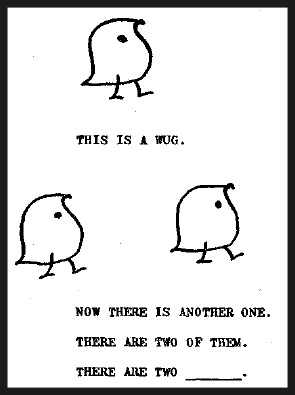
Glorping the wug

Here's a quick link to a piece of research from University of Liverpool's Child Language Study Centre which points to children having a clear understanding of some grammar functions a long time before they are able to use these functions themselves:

Researchers at the University’s Child Language Study Centre showed children, aged two, sentences containing made-up verbs, such as ‘the rabbit is glorping the duck’, and asked them to match the sentence with a cartoon picture. They found that even the youngest two-year-old could identify the correct image with the correct sentence, more often than would be expected by chance.

The use of made-up words is interesting as it's a feature of child language research from as far back as 1958 when Jean Berko Gleason's wug test revealed that children are able to apply plural rules to words they've never heard before.

Child Language researcher, Dedre Gentner also used made-up words in her interestingly titled 1978 paper What Looks Like a Jiggy but Acts Like a Zimbo (pdf link).

While the appearance of made-up words in reading tests for primary school children has upset and angered many reading experts, their use in child language experiments is helpful because they can shed light on how patterns and rules are internalised by children and applied to examples of language they haven't heard before, perhaps suggesting that there's an innate capacity for language acquisition (or at least, some sort of generalised puzzle-solving equipment) in all children.

Wednesday, August 17, 2011

Ghetto grammar

The linguistic fall-out from last week's riots continued yesterday with an article by Lindsay Johns in the Evening Standard proclaiming that "Ghetto grammar robs the young of a proper voice". While Johns' work in Peckham with disadvantaged young people has to be applauded, he's got a very narrow view of street slang and has prescriptive form - this article on supposed "gang slang" and this on "proper English" being cases in point (and covered here on the blog last November).

While Johns talks a lot of sense about the power of language and the need to unlock potential in inner city teenagers who might be stereotyped and demeaned for their use of certain varieties of English, he's also unwilling to accept sound linguistic arguments about code-switching and sets up something of a straw man argument with his attack on what he calls "cultural relativism":

Some educators take a position of cultural relativism. They assert the legitimacy and value of street talk, or at the very least, the importance of teaching young people to "code switch" - how to differentiate in which milieu it is socially acceptable.

I have no time for such an approach. In my experience, young people find it very hard to code switch. Text-speak, poor grammar and street patois routinely pervade the essays I set them, let alone their conversations with me.

The problem here is two-fold. Firstly, you'd be pretty hard-pressed to find any linguist or educator who doesn't argue that a mastery of Standard English is a prerequisite of a good education. Who are these cultural relativists that Johns is referring to? It smacks of the right wing arguments about the "PC brigade": some nebulous and sinister cabal of liberals and lefties hell-bent on messing up everything about young people's education with their crazy commie views. They don't really exist...

Secondly, code-switching is not that difficult for young people. They do it all the time. But only if they have another form to switch into. That's essentially the point that Johns is missing. The young people he works with - if they have as poor a command of Standard English as he claims - don't have a problem with slang: they have a problem with basic literacy. To lay the blame for these young people's inability to write and speak clearly at the door of street slang and those people who don't condemn it out of hand is a very weak argument.

Blame the education these young people have received so far. Blame the system that values grades above individual achievement. Blame racist and classist stereotyping of young people. Blame the young people themselves for messing around, bunking off and generally taking the piss; but don't blame slang.


Such an argument is made weaker by the seemingly arbitrary list of features that Johns gathers as markers of this "ghetto grammar":

an inarticulate slang full of vacuous words such as "innit" and wilful distortions like "arks" for "ask" or tedious double negatives

Like so many other arguments about accent, slang and non-standard English, the list just serves to flag up a few personal peeves. A quick look at the comments after the article shows that there are plenty of others happy to jump on the bandwagon and list their personal dislikes in language use. And again, this is part of the wider problem. So many of these features are just down to personal prejudices and individual taste. I don't really have a problem with ain't and innit - perhaps because they're forms that I heard being used around me from quite an early age - but I bristle when I hear feds or po-po for police. So what? As William Labov showed in his studies of New York speech, the post-vocalic "r" (farm, park, card) was often viewed as a marker of upper-class speech , while here in Britain it's often been associated with rural accents and given much less prestige (Drink up thy ciderrrrr, ooo-arrrrrr). There are different ways to pronounce things and different words we like or dislike, but these aren't sound principles on which to build the "rules" of a language.

In many ways, Lindsay Johns adopts a Bernsteinian approach to language, talking about restricted and elaborated codes, and that's an interesting and valid angle, but in other ways he adopts a prescriptivist approach that undermines his wider argument. I can't argue with his desire to increase the linguistic skills of the young people he mentors, to increase their articulacy, self-esteem and employment prospects, but to blame street slang for where they are now just seems plain wrong.

(Edited on 13.11.15 to fix broken links)

Tuesday, August 16, 2011

Starkey's "Norman Tebbit moment"

Amid the horrific mayhem and destruction of last week's riots, there were a few moments of grim irony - David Cameron deriding the violence of the British underclass shortly before "declaring war" on gang culture, a Labour MP criticising looters for their "naked greed" having made a claim on his parliamentary expenses the year before for an £8,865 flatscreen TV, Nick Clegg propping up a government who he'd previously warned the public about as being likely to cause riots on the streets - but surely the most bizarre moment of all was historian and TV pundit, David Starkey's appearance on Newsnight last Friday in which he blamed the riots on white people turning black, before clumsily reading out the text of a BBM he said represented the broken English of a looter.

Many media commentators struggled to find the right words to describe what was going on. Were the people smashing up shops and lobbing bricks at the police protesters or looters, scum or terrorists? The Guardian wasn't sure. Were these disturbances race riots, London riots, British riots or English riots? The BBC settled for England riots, which strikes me as odd, given that England weren't even playing. Were the young people using the term feds to describe the police showing the influence of US hip hop and mimicking the antics of the LA rioters back in the early 1990s? The BBC News magazine reflected on these issues and even got some linguists and lexicographers to comment, making it a more informative and nuanced discussion than many others.

But let's go back to David Starkey and his rant on Newsnight. Back in 1996, the linguist Jean Aitchison delivered a series of lectures for the BBC on language (which can be read here or listened to here) in which she talked about the worries that exist for many people about how language changes. In one example, she quoted the then Conservative Minister Norman Tebbit making a direct link between language use and crime:

"If you allow standards to slip to the stage where good English is no better than bad English, where people turn up filthy ... at school ... all those things tend to cause people to have no standards at all, and once you lose standards then there's no imperative to stay out of crime."

So, in David Starkey's diatribe against "Jafaican" I think we have this generation's Tebbit moment. Let's look more closely at what Starkey said and unpick why it's not only racist and wrongheaded but linguistically suspect too. The Independent quotes Starkey's words as follows:

"I think what this week has shown is that profound changes have happened. There has been a profound cultural change. I have just been re-reading Enoch Powell. His prophecy was absolutely right in one sense: the Tiber didn't foam with blood, but flames lambent wrapped around Tottenham, wrapped around Clapham.


"But it wasn't intercommunal violence; this was where he was completely wrong. What has happened is that the substantial section of the chavs that you [Mr Jones] wrote about have become black. The whites have become black. 

"A particular sort of violent, destructive, nihilistic gangster culture has become the fashion. Black and white, boy and girl operate in this language together, this language, which is wholly false, which is this Jamaican patois that has intruded in England. This is why so many of us have this sense of literally a foreign country. 

"Listen to David Lammy, an archetypal successful black man. If you turn the screen off, so you were listening to him on radio, you would think he was white." 

What strikes me as so twisted is Starkey's leap from the assertion that "the whites have become black" to the apparent linking of  "blackness" to "violent, destructive, nihilistic gangster culture". At that point in his argument, he makes no attempt to draw a distinction between skin colour and culture. Later, he offers some (feeble) attempts at mitigation, perhaps when he tries to argue that not all black people - David Lammy, for example - "sound black", but it's still a reductive and idiotic argument. Why? Because in Starkey's mind black = "violent, destructive, nihilistic gangster culture". And your degree of blackness can be identified by the way you talk...

From a linguistic standpoint, his assertion that the "Jamaican patois" that has "intruded in England" and is used by young people involved in the riots is "wholly false" smacks of desperation. As one Twitter user @vivmondo wittily put it, "Asking David Starkey for his views on youth culture is a little like asking Lady Sovereign for her views on Elizabethan shipping law" but even so he goes ahead and gives us the benefits of his massive knowledge. And that's before he launches into his freestyle, which has been remixed for your pleasure and delight in the You Tube clip here.


As Geoff Pullum explains on Language Log, Starkey's views about the insidious influence of Jamaican patois on the native language are ill-informed and wide of the mark. What Starkey quotes in his poorly performed rap is nothing like Jamaican patois and much closer to Multicultural London English (MLE, MEYD or what some dubiously call "Jafaican"). 

Even Katherine Birbalsingh (who normally gets my goat about as much as Toby Young and Richard Littlejohn) gets it right when she says that the language Starkey is talking about is "a kind of fusion of many cultures, including Cockney East End speech. One can also hear some Jamaican influence, general working-class London influence and so on. Does Starkey really believe that Jamaicans go around saying “innit”? “Innit” has a Cockney glottal stop in it! Interestingly, this accent not only is not Jamaican, but neither is it in American gangster culture. What MTV rapper sounds like our kids?".

In yesterday's Evening Standard, Sam Leith made a slightly different point about the language of  Starkey's rant. Annoyingly, he insists on calling the variety of English in question as "Jafaican" with all its connotations of affectation and mimicry, when any good language student knows that what is emerging in London and has been developing for well over two decades is an organic form of language that has its roots in a range of different varieties brought together by contact in urban areas. He can be forgiven though as he's not a linguist and doesn't claim to be an expert on language. Plus he makes some good points elsewhere. 

Discussing Starkey's claim that "so many of us have this sense of literally a foreign country" he agreed that "(Starkey) touches an anxiety more people feel than admit to" before going on to say "it's actually a class and generational anxiety. It finds its most poisonous outlet in fears about race" and concluding by saying "Prof Starkey defended his position by saying that in times like this, "plain speaking" is needed. No. Careful, precise speaking is needed". 

Wise words indeed, and all the wiser because Leith - and Birbalsingh - notice that the people who use the language Starkey so derided are actually all around us: they are our students, our own children, us, our communities, not some alien race. To mark them out as a separate group because of their "wholly false" language use is to misunderstand and misrepresent both young people and the ways in which language works.

*Edited 16.08.11 to change title after inadvertently copying Stan Carey's MacMillan blog title from yesterday. Woops!

Thursday, July 21, 2011

-tivism and -geddon

I'm not really sure if this is worth a post of its own, but if I make it number one in a series of occasional new word lists and tag each post in the series with the new words label, by the end of the year we might have lots of new words...and it might be useful to someone.

Anyway, for today:

Clicktivism - blend of click and activism, related to online petition signing (from The Guardian).
Slacktivism - blend of slack/er and activism, related to lazy activism or not doing much but just clicking to sign a petition but but actually getting involved (from The Guardian).
Carmageddon - blend of car and Armageddon, relating to apocalyptic prediction that LA roads would grind to a halt as a bridge was demolished. Didn't come to pass, a bit like the rapture, I suppose.
Eurogeddon - blend of Euro and Armageddon, relating to apocalyptic judgement day for European currency (today, apparently)
Dollargeddon - blend of Dollar and Armageddon, relating to apocalyptic judgement day for USA's currency if braindead republicans don't back down (very soon, apparently)

Wednesday, July 20, 2011

Back in the USA


The BBC has curated a veritable gripefest of peeves about American English in response to Matthew Engel's article and broadcast about his dislike of the spread of American English into mainstream British usage .

As picked up on here last week and discussed at much more length and in more academic detail at Language Log, Engel's piece was fairly reactionary in tone and seemed to be rallying the troops to defend the borders against foreign invasion. And it seems to have done its job, because many readers have sent in their contributions, ranging from fanny packs, medal used as a verb to 24/7 instead of the much catchier and quintessentially English all day every day. Jeez....

Edited on 21.07.11 to add: taken to bits on Language Log here!

Tuesday, July 19, 2011

Hackgate

Given that we're in the middle of what's becoming known as Hackgate with its mass of resignations and revelations, this post from John List over on the Oxford Words blog offers a helpful discussion of what hacking means to him.

According to List, being a hacker is not about secretly accessing someone's voicemail, or taking down a website (however funny that might be) and everything to do with taking pride in your geekiness, or as Oxford Dictionaries Online defines it, "an enthusiastic and skilful computer programmer or user".

Wednesday, July 13, 2011

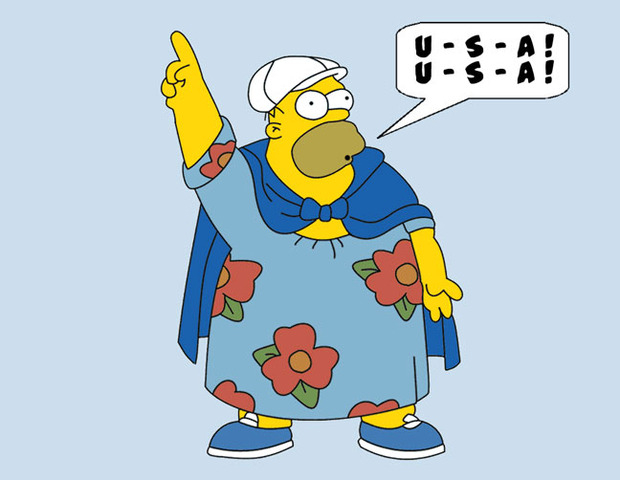
USA! USA!

There's a good article by Matthew Engel on the BBC News magazine this week which takes a look at the UK's attitudes to American language imports.

He tells us at the beginning that "The Americans imported English wholesale, forged it to meet their own needs, then exported their own words back across the Atlantic to be incorporated in the way we speak over here" which is a model that is fairly well-established in existing writing about American English, but one that comes with a few problems attached.

In one sense it still presumes that English English (or British English) is the standard to which all other varieties aspire and that while the Americans have been busy forging away (possibly a loaded metaphor, suggesting that they're making an inferior copy rather than bashing it with lump hammers and making it new) our language remains unchanged, aloof and just better, dammit. And what do we mean by "our" language anyway?

The title of the article is intriguing, because it suggests - as Lynne Murphy has identified in her tweets about this piece - that Americans aren't people, or at least they're not the "people" to whom Engels was addressing his piece. It's a strange piece of audience positioning for an author who must know that the BBC site is read all across the world... even by Americans. It smacks a bit of marking out territory and dividing lines between languages...which is OK, if that's what floats your Mayflower.

Also, towards the end when he makes a point about enjoying the "vigour and vivacity" of American English (words that always get used, often along with "articulate" when describing a language, or speaker of a language, that you think is good at "keeping it real" but probably not as clever as you) Engels states "...what I hate is the sloppy loss of our own distinctive phraseology through sheer idleness, lack of self-awareness and our attitude of cultural cringe. We encourage the diversity offered by Welsh and Gaelic - even Cornish is making a comeback. But we are letting British English wither". This strikes a fairly prescriptivist note, and suggests that as we import American words our home-grown variety dies out. Is it really like that?

I know that I cringe when I hear UK teenagers talk about the feds rather than the old bill, filth or boy dem (all good, old-fashioned British names for the police) but does that mean that the US word has taken the place of an English word, or just that its temporarily occupying its place while fashions come and go?

In one way, Engels is right that American words are creeping in through popular culture and spreading throughout British society, but in other ways he's not: regional varieties of English are apparently growing in strength, with some dialect terms making a comeback. While the bigger picture might be of a drift towards more Americanisms, it's not all one-way traffic and the drift is not uniform.

The article - despite my misgiving here - is certainly worth a read for anyone looking at global Englishes and the spread of American English around the world, as well as those looking for a good topic for a future Language Discourses question on ENGA3.

You can find a lot more about American English (and British English too!) on Lynne Murphy's excellent blog Separated by a Common Language and by following her on Twitter.

Edited and republished 13.07.11 because I've struggled to distinguish between save and publish on Blogger's new interface. D'oh! No, I mean "dash it!"

I walk, I walked, I text, I texed?

There's some interesting discussion on David Crystal's blog about the past tense of the verb to text. In his post, Crystal mentions that the word existed as a verb way back in the 16th Century, long before the appearance of mobile phones and SMS, but back then it had a regular -ed inflection.

More recently, people have begun to notice how the past tense has started to appear as texed rather than texted, and Crystal suggests that this might be down to the xt consonant cluster at the end and how we react when an -ed past tense is tacked onto it:

Indeed, there is evidence from the history of English that the 'xt' pronunciation is actually easier than some alternatives, as when we see asked change to axed in many regional dialects. But adding an -ed ending alters the pronunciation dynamic. We now have two /t/ sounds in a rapid sequence, as we had in broadcasted, and that could motivate people to drop the ending. Speakers generally prefer shorter forms.

John Wells, UCL's guru of phonetics, also addressed the issue of the phonology of texted/texed in this blog post a while back.

What strikes me as interesting about this is that - as Crystal points out - so many new words seem to follow regular patterns of inflection. You can pretty much bet your house on new verbs taking -ed in the past tense, so it's odd to see irregular inflections appearing like this and interesting that it's linked to phonology.

What would be the chances of a new noun taking an irregular plural ending like -en (as we have with older words from previous centuries -  children, oxen, brethren)?

Thursday, July 07, 2011

Language investigation ideas: rap taxonomies

Following on from last week's quick post about ideas for A2 Language Investigations, here's one that might work for the AQA B spec (It's about written language, so not suitable for the A spec.) and which gives me a chance to point you towards this amazing image of rappers, names, grouped by semantic category.

So, you get rappers who have named themselves after their size (Lil Wayne, Big Pun, Big Boi, Fat Joe), money (Chamillionaire), place of origin (Cypress Hill, Sugar Hill Gang), and many many more. As well as semantic categories, the chart takes in deviant spellings, repetition and err...guys named "Rob".

Why not do your own taxonomy for a genre of your choice - Emo, Goth, Heavy Metal, or Prog Rock... or whatever you young people listen to these days. Perhaps a cross-genre comparison might be a good way to carry out an investigation.

Gurtlush lexis

Thanks to massive piles of AS and A level marking and general tiredness, I've not posted much here recently, so here's a link to Telegraph article on dialect words being collected by the wonderful British Library.

There's some good material here for anyone looking at Language Varieties in the second year of the AQA A course.

Thursday, June 30, 2011

Solidarity

I wasn't going to post on here today, in solidarity with my striking public sector colleagues, but it's not really the same as crossing a picket line, is it? Anyway, good luck to all the teachers out there, and other public sector workers defending their pension rights and the principles of public service.

Language investigation ideas: I am so liking "like"

Seeing as thousands of English Language students are currently being told to come up with great ideas for next year's investigation coursework, I thought I'd offer a series of occasional posts that might help kick start a few projects.

First of all, here's an interesting piece by Mark Liberman on Language Log about how he went about investigating the use of like in spoken language. He was inspired to look at like because of a post by Erin Gloria Ryan entitled My Love Affair With "Like" in which she speculated about how like is used differently depending on age and gender factors.

What could you do with like for an ENGA4/ENGB4 investigation? Well, it's worth thinking about what you'd like to achieve with an investigation like this. Liberman uses a corpus (basically, a database of language) to test out the hypothesis that young women use the discourse-particle like more than men, and he makes this clear from the outset. What he also establishes is that he's not looking at any old mention of like -  but a specific function of the word, and this is good advice for anyone about to set up an investigation. So, he's set a research question/ hypothesis and established a clear focus for his investigation.

Another key piece of advice is to approach the investigation with an open mind, and this is what he does: not trying to make his findings fit any preconceived pattern but to see if his original hypothesis was actually right. He says:

... there's no evidence that women insert non-traditional like into their conversation more often than men do. There may be specific syntactic or pragmatic contexts where this is true; there may be effects in some registers and not others. But so far, I'm inclined to think that this is one of those cases where congruence with pre-existing stereotypes (here that women are less assertive) leads to post-hoc rationalization and confirmation bias.

Interestingly, he puts forward suggestions here about why there might be a perception that women use like more, and that in turn opens up other areas of investigation. Are women generally seen as more tentative and therefore assumed to use markers of tentativeness more frequently? Are women less assertive in some conversational situations? Are women using a "double voice discourse" (as Judith Baxter suggests) and shying away from confrontational language because of how they will be perceived by men? There are loads of other questions linked to this that would be really fascinating to pursue.

But bringing this back to A level projects, what could you do with something like this?

Perhaps there's a feature of language that you've noticed being used by one group of people and not another. Maybe it's like, innit, awesome, gay, standard or mans and you want to find out more about its usage. You could go to a database of language as Liberman does, set your search terms and get looking, or you could gather your own data and see if there is a pattern.

Recording your own data creates its own issues - most of them easily addressed, if you plan ahead well enough - but it is a great way of getting hold of new material and adding to the store of language data that we can all learn from.

So, over to you: what areas would be potentially interesting to explore?

Thursday, June 23, 2011

Performing mouth to mouth on grammar

If you're looking for more language discourses topics in readiness for tomorrow's ENGA3 exam, this might be a good link to have a look at. One of the debates that's been knocking around for a long time (probably forever) is that around the seemingly inevitable decline in standards of English grammar among the general population and whether or not we should care. In this article, the author, Barbara Gunn, suggests we need to "resuscitate" grammar.

As an English teacher, I think grammar is important, but perhaps not for the same reasons that Barbara Gunn puts forward in her article. I can't help but shudder when I read someone using  your instead of you're, or there instead of their, but perhaps that's my inner prescriptivist crying out and I should learn to ignore it, a bit like I ignore the cat as it mewls for food seconds after being fed. Prescriptivists have complained about the general public's inability to use grammar properly ever since English came into existence, but is it actually getting any worse?

Henry Hitchings - whose book, The Language Wars I've plugged endlessly on here - makes the point that people have been confusing should have and should of and you were and you was since the 17th Century. Perhaps it's because more of us write now than ever before (tweeting, emailing, texting and even blogging all being new forms of "writing") that these grammatical errors/non-standard forms are being noticed more. Maybe we are becoming less literate. I dont no.

If you have a look through this blog for posts about grammar usage (usually tagged prescriptivism or descriptivism) you'll find a number of articles about Simon Heffer's (appalling) Strictly English, and the Queen's English Society's most recent musings on our language going to the dogs, along with some descriptivist critiques of their arguments. As you're having a look at these, you'll probably notice the familiar models that Jean Aitchison pointed out in her classic Language Web lectures: the crumbling castle, the damp spoon and the infectious disease.

Political Correctness: theories and debates

I wouldn't normally copy a comment from another post over as a new post, but I think this might be helpful for tomorrow's ENGA3 if PC comes up as a topic.

This is in response to a comment by Jessica on the ENGA3 Language Discourses post from earlier in the week, asking about which theorists might be helpful on a question about PC. She'd already mentioned Sapir & Whorf, Miller and Swift and Norman Fairclough.  This is just my take on the theories and concepts that might help, so please add any comments or observations/criticisms to it as comments. I'd be interested to hear what anyone else has to say on arguments around PC.

I think you're fine with those theorists really, so long as you're clear that the underpinnings of the PC movement come from a belief that if you remove sexist & racist words from the lexicon, you'll either a) remove the pejorative association of that term, or b) go some way towards changing the discourse around sexism and racism by drawing attention to the problems inherent in those words.

E.g. You could argue that the debate about "slutwalking" has polarised opinion about the word slut and "slutty" dressing, but on a very simple level it has at least made everyone think about the word, what it means and whether or not it should be used. It's also given young feminists the chance to enter the debate about women's rights in a way that might not have been open to them before, thus intervening in the discourse.

I think the other thing is that it's important to realise that PC is quite a rarity in linguistic terms in that there has been a degree of success in imposing a "top-down" model of language change. You could argue to what extent it's been successful, but in many ways it's one of the few attempts at linguistic engineering that's actually worked.

Most of the time, language change is bottom-up - usage leads to adoption and codification of patterns of lexis and grammar - and organic.

This of course means that there are some who would normally see themselves as descriptivists aligning themselves with a rather prescriptivist stance - PC, after all, is all about prescription. So it makes for some unlikely bedfellows: normally prescriptive language commentators arguing that PC is a bad thing because it's telling us what we should and shouldn't say; normally descriptive linguists arguing that PC is a force for good.

That's why I think it's such an interesting debate.

Wednesday, June 22, 2011

Women, Speak Your Mind

Sunday's Observer had an article about new work by the linguist Judith Baxter on speaking patterns of men and women in business. It's a good read and exactly the kind of article that often appears in the ENGA3 Language Discourses question.

What's particularly interesting about this article is that it's based on recent research by a respected linguist, but that it's also been given a populist spin through the incorporation of various quotations from other individuals, some of them non-linguists. It also links in wider discourses about women in the workplace and the impact of status and power.

If gender crops up again in ENGA3 (which I think is unlikely this year) this is the sort of article that I think would appear.

Monday, June 20, 2011

ENGA3 Language Discourses: some pointers

With ENGA3 coming up at the end of this week and several requests for help with section B of the paper, here are some pointers about the topics and what to revise. 

There have been three ENGA3 papers set so far, and the topics for language discourses have been as follows:

Jan 2010
Popular psychology/ linguistic self-help books looking at male and female communication
Jun 2010
John Humphrys arguing prescriptivist views about language change
Jan 2011
Will Self and Lynn Truss discussing their attitudes to texting and txt language

There’s no point trying to “question-spot” and putting all your eggs in one basket, by proclaiming that as regional accents haven’t turned up yet it’ll definitively be that topic, but it can be useful to think about the types of questions that have been asked and those that haven’t yet.

So, the topics that haven’t cropped up yet are:

Changing varieties of English. There’s been quite a lot of discussion about how regional accents are thriving and local accents dying out, as well as new ones (like MLE/MEYD/”Jafaican”) emerging, and whether this is a good or a bad thing.

World English/es. This hasn’t cropped up yet and could appear as it’s on the spec. What could be asked about this? Well, there have been quite big debates around the world about the role of Standard English and whether we should be imposing World English (one variety) or showing awareness and understanding of different varieties (World Englishes) and how English changes thanks to local language and culture. There are also several interesting historical angles about why English has spread and whether this will continue in the same way.

New words and attitudes to them. While language change has cropped up before in the form of John Humphrys bemoaning the state of our common language and Truss and Self talking about texting and its impact on language, there is also scope for something on new words. Many new words have entered dictionaries in recent years and some commentators find this deeply discombobulating. “How can OMG and LOL be “words”? “ they cry. Dictionary compilers have argued in response  that they’re reflecting the changing nature of our vocabulary and that they have a duty to record new words.

Political correctness and Linguistic engineering. The need (or otherwise) to impose changes on language and remove offensive terms is a very good topic for debate and leads to some very polarised opinions. One man’s throwaway remark about chavs is another’s systematic demonization of the working class. Likewise, terms for gender, race and sexuality have been discussed recently in regard to the changing roles and status of different groups in British society.

Variation that isn’t gender or region-related. The topic of language variation doesn’t just have to cover females and males or regions; other areas on the syllabus that could appear are age-related variation, work-related variation and what might broadly be termed “communities of practice”.

Technology and changing language. Texting cropped up recently, but other technological advances and forms of Computer-Mediated Communication, like Facebook and Twitter, could be a focus for debate. 

Knowing something about the topics is only part of the knack to doing well in this exam. Equally, if not more, importantly, you need to know about how to analyse the language used to construct the debates. What are the writers saying and how are they expressing their views? What kinds of wider debates are these discussions tapping into?

Over the next day or two, I'll add some points about what often works on this paper and give some examples of how good students have approached language discourses.

Friday, June 10, 2011

Placing the accent on bigotry

Articles about different accents are often full of judgemental adjectives like "lazy", "pleasant" and "harsh" (and you can see what genuine linguists  think of such vocabulary by having a look at Paul Kerswill and John Wells' comments about the recent Economist article on changing accents) but a piece by Telegraph journalist Ed West reaches some new lows.

For him, "Jafaican" (or Multicultural London English) is "rather unpleasant, sinister, idiotic and absurd". His entire premise seems to be built upon the wrongheaded notion that MLE is something people "put on" - that it's a fake accent and one that reflects a desire to be street. As he puts it, "In London the adoption of Jafaican, even among the privately-educated, reflects both a lack of confidence in British cultural values and an aspiration towards some form of ghetto authenticity".

Frankly, this is a pile of steaming cobblers. Underpinning it seems to be a profound dislike for the speakers of MLE and a simmering resentment that otherwise decent posh people (white people, dammit) are picking up this dirty ghetto accent. It's almost like they want to be black. Shame!

The article annoys me too much to string many more sentences together, so I'm glad that a more restrained and analytical response to it is presented here by Ben Trawick-Smith on Dialect blog. He ends by characterises the article as not "a writer bravely fighting against an increasingly “PC” world... just an ignorant rant".

Wednesday, June 08, 2011

Greening the language

Stan Carey, whose stuff on Sentence First is always a good read for Language students, has written a short post about language and environmental concerns for MacMillan Dictionary's Language blog. He looks at how some companies are attempting to greenwash their image - make their public image appear more enviro-friendly than it really is.

As well as some interesting word formation processes for the A2 question on language change (ENGA3 or ENGB3) there's some food for thought about how gullible we might be as consumers when it comes to purchasing eco-products.

Tuesday, June 07, 2011

Berks versus w*nkers

Some appropriately named
"members of the Berkeley Hunt" in action
The always interesting Robert Lane Greene of The Economist's Johnson blog has written a good piece on prescriptivism versus descriptivism which is a good read for any A2 students revising Language Discourses.

In it, he quotes Kingsley Amis who split the world of language commentators up into berks and w*nkers. (I'm asterisking w*nker to avoid this blog getting blocked by various school and college filters, when the etymology of the Cockney rhyming slang berk - short for Berkeley hunt is much ruder...you work out the rhyme or look here.)

It's a neat distinction and much more eloquently put than my own attempt on this blog post which used Hippies and Hitler at each extreme of the spectrum.

Greene concludes by saying

...that wherever we place ourselves on the berk-w*nker spectrum is arbitrary. It can only be defended with an appeal to a sense of style and taste, with a strong dash of self-deprecating humour. Anyone who gets red-faced insisting that their place on the berk-w*nker spectrum is the only place God intended language to be can be safely ignored.

 Wise words.

Changing accents

Several newspapers have picked up on an article* the research and ideas of Lancaster University linguist Paul Kerswill featured in an article for The Economist in which he talks about how accents are changing over time and speculates about what the country will sound like in years to come (2030, to be precise).

The original Economist article is here under the title Geordie's Still Alreet.  The Daily Mail jumped on the Geordie angle and the chance to print a picture of the delightful Cheryl Cole (whose recent tribulations with Simon Cowell and the US X Factor have been covered at length recently and at least partly blamed on her accent being tricky for Americans to understand) and featured the story under the title More than "Alreet".

Kerswill is one of the key linguists in the field and has been involved in a lot of recent work on Multicultural London English, among other things, so he knows what he's talking about. However, not all the articles based on his work are problem-free and it's interesting to see what Kerswill himself, and other linguists, have to say about the ways in which accents are described in the media. You can read more here on John Wells' phonetic blog.

Language Variation is one of the big areas for ENGA3 (sadly, it's not currently covered on the AQA B spec) and there's a decent chance of something about accent and dialect cropping up as a Language Discourses topic too this year. It's therefore worth looking at some of the complaints about the language used to represent different accents. Adjectives like sloppy, lazy, guttural and bland abound in many of these mainstream articles, and that's before you even get onto the readers' comments which are often laced with quite offensive stereotypes about the inhabitants of different regions and the way they speak.

We've covered the main thrust of Kerswill's argument here before, but it's certainly worth having a look at all of this again in preparation for the A2 exam later this month.

* edited on Thursday 9th June to reflect Paul Kerswill's comments below (sorry, Paul!)

Monday, June 06, 2011

From BOLO to ZOMG

The latest list of new additions to Oxford Dictionaries Online is a veritable smorgasbord of delights. You can find new words linked to the global economic crash, so you get casino banking and the bunch of banksters who got us into it. You get words and phrases to do with fashion and lifestyle - mani-pedi and awareness bracelet - but above all you get masses and masses of words to do with new technology - breadcrumb trail, NSFW and permalink being obvious examples.

The range of word formation processes is interesting too, with plenty of blends (bridezilla) and compounds (lifehack), a whole load of affixation taking place (cyber-, perma- and eco- being popular prefixes), and the odd shortening with silly addition at end (laptop becomes lappy).

The full list is here and the accompanying article here.

Edited to add: there's a piece by Lucy Tobin in yesterday's Evening Standard, featuring some dubious commentary from a certain "language researcher" at UCL. Is posting this here, the definition of egosurfing? I'm not sure I quite get why it's newlogism rather than neologism...

ENGA1: good luck today

Good luck to all AQA A English Language students taking ENGA1 this afternoon (especially SFX students). And good luck to any other Language students from other specs who have been using this blog.

Plan your answers, read the texts carefully and use your frameworks!

Edited to add: I know that last minute revision is bad for you, but if you want to double check theories for Child Language, I've added some twitpics of theory posters/sheets on the right navigation bar, at the very bottom of the screen.

Friday, June 03, 2011

Maximum chav-age

There's more on the word chav here on the BBC site, all inspired by the forthcoming book Chavs: The Demonization of the Working Class, by Owen Jones. It looks very promising, if this review by Labour MP John Cruddas is anything to go by.

Looking at arguments about language change and political correctness is all part of ENGA3 Language Discourses, while the language used to represent social groups - in this case, the working class, or sections of it - is covered in the coursework for ENGA2.

Maximum LOL-age

Unlike much of textspeak it fulfils a useful purpose, for which there was previously no word in the English language and thus earns its place.

David Mitchell's latest Soapbox is an inspired rant about the usefulness of LOL. It is very funny.

Get geeky

Thanks to the wonders of Twitter, I've come across this site which pulls together linguistics lectures from across the internet. I've not had time to use it yet, but there are links to lectures on language acquisition, swearing and language evolution, so they should be good for anyone interested in English Language and Linguistics.

At least be consistent

People have always complained about others' language use and it's probably part of human nature to find the accents, vocabulary and mannerisms of another group of people - Geordies, Brummies, Yardies, Americans, teenagers, poshos - upsetting and annoying. But when commentators set themselves up as linguistic authorities and tell other people that their language use is "wrong", they'd better make sure that they are actually right.

Kevin Myers, writing in today's Irish Independent, is not one of those people. In his article Omigod, this linguistic gibberish is, like, so gross he gets quite upset about what he calls the spread of "pseudo-American" English among the Irish middle classes and their teenage offspring, but he's initially exercised by the "common and lazy usage" of different than as opposed to different from, something he praises Michelle Obama for getting right while all around her everyone else is getting it wrong.

That's fair enough in many ways. Historically, there's been a pattern of usage that suggests different from is preferred to different than in formal English. However, that's changing and there appears to be a gradual shift taking place - perhaps through slips and errors, but perhaps through analogy with other, similar structures - towards different than. Language change is often a slippery beast and it can happen for all kinds of reasons.

Where Myers is on shakier ground though is in his insistence that "(Michelle Obama) correctly used the preposition rather than the relative conjunction, which -- for example -- the comparative adverb "better" would have attracted: hence, "different from" and "better than"." The problem here is that amid all his seemingly knowledgeable grammar talk, he comes up with a word class - relative conjunctions - that just doesn't exist. We've got relative pronouns (words like which and that, used to introduce relative clauses) and we've got conjunctions (and, but, because, if) but there's no such thing as a relative conjunction.

You could say that this just doesn't matter and I'd be tempted to agree. But if you're trying to come up with a rationale for a "rule" you follow - and more importantly, a prescriptivist rule you seem to want others to follow too - at least get it right.

For more on similar arguments about language usage (Language Discourses on ENGA3), you could have a look at this post about Simon Heffer's terrible Strictly English and this post about Henry Hitchings' excellent The Language Wars.

My get-out clause, before anyone points out any grammatical shortcomings in this (or any other) blog post, is that I'm not telling other people what they should or shouldn't do.

Thursday, June 02, 2011

ENGA1 June 2011: language development questions

Here are the titles of the essay questions set since June 2009 on spoken language development:

Jan 2011
To what extent does acquisition of language depend on children’s experiences of the world about them?

June 2010
How important is interaction between children and adult speakers in the process of language acquisition?

Jan 2010
Discuss the ways in which children develop their grammatical skills.

June 2009
Discuss what you have learnt about language acquisition from children’s early uses of words and meanings.

If you're looking for possible essay titles for June 2011, it's probably a good idea to look through the questions set on the old A spec which are very similar to what's on the current spec. You can find a set of them here.

ENGA1 June 2011 language development

Following on from this week's first revision post on ENGA1, here's a link to the collected language development posts on this blog for the last few years. You'll find revision and exam tips, as well as snippets of new research and links to discussions about theory and case studies.

Wednesday, June 01, 2011

The swag-curve model

Slang tends to spread in particular ways. First, a new slang term will appear in the language, perhaps coined by a smallish group of people; it might get picked up by a few more people - usually this will depend on the novelty value, flexibility and impact of the word itself, along with the influence of the original creators - and then it will spread (or not) to an ever-increasing number of users. Charles-James Bailey's wave and s-curve models represent such a spread over time very clearly, even if they were originally used to measure pronunciation differences as they spread across a country.

Of course, as the word gets picked up by a wider base of users, the original users of it, the originators, may stop using it. Once slang terms achieve mainstream usage, they often lose their appeal, their covert prestige, among the original users. Look at it this way: if your mum is talking about bling (and she is - I heard her on the bus to Peckham yesterday) then you probably won't be. Slang gets rinsed out. Bruv. Or is it cuz. Or should I say fam. Anyway, moving swiftly on....

The slang term will probably then reach a peak of use - the top curve of the S in Bailey's model - before flattening out and dipping down. After a period of time - it might be 5 years, 10 years or longer - the only person left saying the word will be your mum and your English teacher.

So, is this what has happened to swag? In this article by Jason Richards, the rise and rise of swag is charted and the question asked (of linguist Geoffrey Nunberg) if it will stay popular (like cool) or die away. His response is interesting:

Almost all of these words come in and then disappear. Because that's the point—high school freshmen and young management consultants spin off new words so that their language sounds different from [that of] the old boys. Obviously, some of them do persist, but it's very hard to predict which ones will.

What's odd about swag is that while it now has very positive connotations - to get your swag on is clearly a good thing by most people's standards - it had a previous life not that long ago as a derogatory term. Back in the mid-2000s, swag meant rubbish, crap and useless. As Urban Dictionary entries from 2006 and 2007 reveal, it wasn't a term of approval at all, and I remember SFX students (always leaders in lexical innovation) using it in this way from around that time.

But it's clear that there's now been either a shift, or (more likely) a completely new meaning, bulldozing  the older and more restricted usage of swag as crap into dust. Perhaps the usage of swag as crap was geographically restricted, or it never achieved the same level of acceptance among people with covert prestige to catch on more widely. Perhaps there was a word occupying that slot already that prevented swag from catching on as a derogatory term (perhaps waste, or moist took the title). Maybe, the support of the likes of MIA and Puff Daddy/Diddy/whatever he's called gave swag as stylish, good, cool the push it needed to take it into an upward trajectory. And the rest is history, but for how long?

Edited on 14.10.11 to add links to two Nancy Friedman pieces on swagger, swag and schwag

Tuesday, May 31, 2011

Chav: the semantic broadening of abuse

An article in today's Guardian by Polly Toynbee takes aim at the word chav, describing it as a term of "acceptable class abuse by people asserting superiority over those they despise" and a word that is happily used by those who "would presumably never say the n-word or P*ki". She goes on to say that "wrapped inside this little word is the quintessence of Britain's great social fracture". It's strong stuff, and she argues the case passionately that there's much wrong with the word and of course the prejudices it might be seen to reflect.

It's not the first time that chav has been attacked. In this article, Zoe Williams argues that it's an unpleasant word but that attempts to ban it are silly. Meanwhile, Paul Flynn argues a case very similar to Polly Toynbee's that the use of the word reflects a sneering snobbery towards people with less money and fewer job prospects.

What's a little odd is that Toynbee is writing about this word in 2011, when chav really hit the mainstream around 6-7 years ago. But looking at the example she uses in her article it's fairly clear that  for some people the word has now broadened from its fairly specific field of reference - young men and women sporting prison whites, fake burberry, sovereign rings and number 1's (or for the women, a Croydon facelift) - into a much wider reference to the wider working class. To some people, working class = chav, and vice versa.

In fact, that's part of Toynbee's argument: by conflating the entire working class (the majority of the country, in fact) with a small subset of it, it's easy for right wingers to write off a whole section of the population as lazy, feckless and feral, further dividing already fragmented communities.

The wider language point here is, I think, that if we aren't careful, some words drift from their original moorings and if we don't see this taking place we can't challenge it. It's the same with hoodies being used interchangeably for most teenagers or urban for black.

Language change is inevitable, but we can have some say in how far we feel it's appropriate for words to shift and we can exercise some control over challenging their meanings. If language is at least partly a reflection of social attitudes then there has to be some place for arguing about what these words mean to us and why they might be dangerous, and Toynbee's article is a good contribution to that debate.

ENGA1 June 2011

With lots of students looking for revision tips about ENGA1, I thought I'd add a few bits and pieces over the next week or so. The exam isn't until June 6th so there'll be at least 2 or 3 more posts on this before then.

First off, here's a new and exciting graphic of the mode continuum:


Secondly, here's a list of past text pairings for Language and Mode:


Previous ENGA1 texts

Jan 2009:
Online advert/webpage for dating tips
Phone conversation transcript between two secret lovers

May 2009:
Written version of Green Party speech
Printed guidance about avoiding wasteful use of photocopiers

Jan 2010:
Message board posts about graffiti
Online Guardian article about Banksy

May 2010
Transcript of radio interview at Glastonbury
Article from The Observer’s television listings section

Jan 2011
Transcript of part of a conversation about children’s behaviour
Webpage giving advice about bringing up children.

Future exam papers? Some suggestions:

  •   written mode letters with blended mode emails/text messages/MSN “conversation” (like the sample stuff in the AQA A text book) 
  • spoken conversation between 3+ participants and online conversation
  • spoken commentary versus written match report  (or blended mode web commentary)
  • monologue of person telling anecdote and narrative in written form
  • written text that uses features of spoken mode to create “relationship” with reader

Thursday, May 26, 2011

Fry and kinetic typography versus the prescriptivists

Stephen Fry - writer, actor, author and lover of language - takes on language pedants in this neat little animation. It uses "kinetic typography" (animated words and stuff) and has been put together by Matt Rogers.

There's also some discussion of Fry's views here from Russell Smith in Canadian newspaper The Globe and Mail..

Worth a look if you're revising Language Discourses on ENGA3.

Wednesday, May 18, 2011

Hit the pause button

There's nothing I like for breakfast more than a big banana.
Can you pass me the bag of nuts?
I think I'll have the sausage, please.

What connects all of these seemingly innocuous food-related comments? Well, if you're an NBA basketball player, you'd probably want to insert (oo-er) the word pause after each. Why? To avoid sounding like you're gay, obviously. So, "I'm right behind you", "I've got your back" and "That driver was right up my arse" would all qualify as potentially smutty innuendoes requiring the pause treatment. Because to be gay in the macho world of professional sports is to be bad. Hell, it's even worse than being a girl!

Pause - according to Urban Dictionary - is used "to negate the sexual connotation of a comment" and has been recently appearing in spoken language and social networking (often Twitter) comments, perhaps following the patterns of usage of its slightly older brother no homo, which has been around since (apparently) the early 90s in hip hop slang and beyond.

The attempts by some men to police their own language use and avoid the potential embarrassment of letting slip a comment that might be perceived as gay are both interesting and slightly pathetic. Sociolinguists often look in detail at the language markers that help us define our identity and note - like Deborah Cameron does in her Myth of Mars and Venus - that we often use language as  much to define who we are not as who we are. So, in other words, the use of pause or no homo, could be a deliberate attempt to distance some men from gay men (or the stereotypical language styles associated with gay men). But why not just avoid saying things that are... like "gay"...in the first place? Well, that would be missing the point, because the whole point of using pause seems to be to draw attention to your words and encourage salacious connotations to be drawn from them before distancing yourself from the implications of the interpretation. Or something like that...

What's pathetic about it shouldn't be too hard to see. Do gay men really mince around discussing the relative merits of big bananas or succulent sausages? Probably not (unless you're Julian Clary). The whole use of pause might be seen as harmless fun, self-conscious mockery even, but at the same time it's peddling a view that gay men talk in a certain way which is easily identified and ridiculed, and that they are sex-obsessed, double-entendre-fixated "others". Some may be - surely that's up to them - but it's a lazy stereotype to assume it applies to all gay men.

So, is pause homophobic? Possibly. Is it dangerous? I'm not sure. There have got to be worse forms of linguistic homophobia than this - name-calling, abuse - but it probably says more about the speaker's attitudes to homosexuality than it does about gay men themselves.

Jay Smooth's brilliant video clip says it all so much better than me except he argues that pause came before no homo and is now (in his words) "played out", old, boring. 

Edited on 18.05.11 to add some more smutty innuendoes and a genius bit of hip hop linguistics

Wednesday, May 11, 2011

Birthers of new words

Morphology - the study of the form of words - is an element of grammar that sometimes gets overlooked at A level in the rush to analyse word classes and sentences, but it's an interesting and productive area. It's productive in that it helps us produce lots of new words and word forms, and productive in that it can help you produce good material in exams.

It's a particularly interesting language framework/method in two areas, child language and new word formation, and it's the latter we'll have a quick look at here. First of all, to refresh your memories about morphology, it's the study of how words themselves are made up of smaller units. Not all of this is essential reading for A level, but I think it's quite interesting to know (and A level should be more than just about doing what the spec tells you to do, shouldn't it?).

There are basically two types of morphology: derivational morphology is about creating (deriving) new words out of other units, while inflectional morphology is more to do with the ways in which words change depending on grammatical functions and forms. For example, to illustrate the latter, verbs inflect depending on the tense and aspect they're in (I walk - I walked - I am walking), the grammatical person they agree with (I walk - she walks) and nouns on whether they're singular or plural (dog - dogs), and there are plenty more too (An Introduction to English Morphology by Andrew Carstairs-McCarthy is a good read if you want to find out more.).

Derivational morphology is to do with putting morphemes (small units that make up words) together to create new words, so respect can become disrespect, terror become terrorise, and so on. A great deal of word formation in recent years has been the product of blending and compounding (bromance, staycation, podcast all being blends, and laptop, muffin top and bunny boiler all being compounds), but a tweet from MacMillan Dictionaries linking to this site offers some interesting examples of new words formed by derivational morphology.

They look at the use of the -er suffix in recent American neologisms. So, the people involved movement that claimed Barack Obama wasn't actually an American and demanded to see his birth certificate, became known as birthers. The US's satirical magazine The Onion even created a spoof movement that denied the providence of Obama's birth certificate after he had produced it, who were called Afterbirthers (demanding to see the placenta).

The Fritinanacy blog also mentions that those who refused to accept the official version of events for 9/11 were called truthers. Now we even have deathers, who refuse to accept that Osama Bin Laden is actually dead, an dthink that his burial at sea was all part of a cunning plan. There are older ones too. They point to right wingers, nutters and we even have some of our own, homegrown British ones such as lifers (prisoners on a life sentence) and ravers (people who like a particular club-based lifestyle).

So, if you're looking for some good examples of word formation processes to impress your ENGA3/ENGB3 examiners this summer, have a think about including morphology and the processes of prefixation (adding morphemes at the start of a root word), suffixation (adding morphemes at the end of a root word), or even infixing (adding morphemes in the middle of a root word...like hoo-f***ing-ray). It will help you avoid being a failer.

Tuesday, May 10, 2011

Gangsta rabble add their thang to Scrabble

According to an article in today's Daily Telegraph, Scrabble players are about to experience a massive shake-up from the slang massive. Hundreds of words from slang usage including thang and innit (and to be fair, Indian cookery and some technical jargon too) are set to appear in the new Collins Official Scrabble Words book.

On The Guardian's website, Sarah Churchwell talks about the new words and places them in the context of wider debates about new words entering mainstream use. For A2 students looking at language change and attitudes to change, it's a good article to read. As ever, the comments generated by the piece range from the deranged to the completely reasonable, so are worth a skim too.

Do the SlutWalk

The slutwalk: a bit like the cripwalk but with fewer clothes

SlutWalks are coming to a town (and dictionary) near you, but if you're a hormone-charged teenage boy don't get too excited: these slutwalks are feminist in nature and all about the ways in which women are viewed and treated by some men.

The SlutWalk is a response to a speech given by a police officer in Toronto, Canada who ill-advisedly told his student audience that if women wanted to avoid being raped they should stop "dressing like sluts". In this article in yesterday's Evening Standard, Rosamund Irwin makes the excellent point that rape is not necessarily something that happens to only scantily-clad young women, but pensioners, children and nearly all types of women in whatever type of clothing. Years ago, feminist friends made it clear to me that while sex is the means of inflicting the attack, rape is more about power and dominance than it is about sexual attraction. As Irwin points out, blaming the victim is "still a frighteningly common response to sexual assault", but it's a mindset that some people can't get out of. The SlutWalks are an imaginative and witty response to this.

This article on the BBC News magazine site takes a linguistic tack and explores the history of the word slut, making the point that very much like the n-word and queer, the word has been reclaimed... or at least, has been claimed to have been reclaimed: these things are never as simple as saying "This word used to mean x, but from now on, this word means y!".

Like other forms of reclamation, there are problems. Unreconstructed racists might still use the n-word in its pejorative and racist sense, while a black teenager from Peckham (or Tim Westwood-lookalikes) might use it in its reclaimed sense. Likewise, supporters of the gay rights movement might use queer in its reclaimed sense while homophobes and other bigots might still use it as a term of abuse. Each word exists in a state of duel identity: it's OK to use it in one context but not another. And tied in with reclamation is the idea that something in the original sense of the word is being celebrated. In the case of queer it's maybe a celebration of deviance as a positive force, with the n-word it's perhaps an embrace of the threatening, brutal aspects of the original word as a way of defiantly chucking an insult back into the faces of racists. With slut it's all about celebrating female independence and a woman's control over her own body and sexual desires.

Slut - like so many other words used to describe women's sexual behaviour and/or attractiveness - is still a loaded word, partly because of its connotations of dirt and "low morals" - but also because it is used by some men (and some women) to cast judgements on the behaviour of others. So what, you might say: lots of words do that.

The difference here, perhaps is that double-standards are at work. Just have a look at adjectives like dirty and filthy. Often these are used as terms of approval by men to describe sexually independent or adventurous women, but equally they can be used by the same men to abuse a woman they consider to be too independent or too adventurous (often because they're not having sex with them, but with someone else...).

Back in the early 1970s, Julia Stanley looked at the proportion of negative words used to label men and women and found a massive disparity, almost always in favour of men. Since then, things have changed - or so we're told. While the terms of abuse used to belittle boys and men tend to revolve around homosexuality - faggot, gay, batty man etc. - the ones used to denigrate girls and women are often related to their availability (or not) for sex with males: sket, slag, whore, junge, tight, frigid and slut.

To put it simply, lots of women - perhaps young women more than others - have to negotiate a world where to lots of boys if you're not tight, you're slack. It's not a level playing field for women, and the language used to describe them is often riddled with double-standards, so I'm all in favour of slutwalks and the rationale for holding them in the first place.

Thursday, May 05, 2011

Sick timing, blud

And as if by magic, or the internet even, this tweet from Oxford Dictionaries appeared on my screen, explaining that the words wicked and sick  have had positive meanings for longer than you might think. Read all about it here.

Don't test me, fam

The directorial debut of Joe Cornish (one half of the mighty Adam and Joe), Attack the Block, looks like it will be a masterpiece of hoodies, tower blocks, grimy beats and... err... space aliens. But in this short ITN clip, it's not the plot, the genre or the aliens that get the focus, but the film's use of south London slang.

It's a neat little clip because it shows the slippery nature of slang's meanings. When we ran a poll on this blog a few months ago about the word "peak", it was given a range of different meanings. I understand it as meaning something similar to "hectic", which could be good or bad, depending on the context: a party might be hectic (exciting and a little bit cer-azy - perhaps with people chugging Top Deck shandy and robot dancing in the kitchen ), while a job interview might be hectic (scary and overwhelming, just too much, man).

One of the actors explains it as "getting overwhelming, getting too much, there's danger, it's getting peak", but as Joe Cornish explains, with mock-English teacher seriousness at the end, sometimes these words "can be flipped...their meanings can change overnight without any warning at all".

There's a good interview with Cornish here and the Adam and Joe 6Music site is here.

Tuesday, May 03, 2011

Calm down, dear

David Cameron's put-down of Labour MP Angela Eagles in the House of Commons last week by telling her to "calm down, dear" has been attacked by many commentators for its sexist and patronising language and tone. One of the best responses appeared in last week's Guardian from Libby Brooks who quoted feminist linguist Dale Spender in her argument, and made the point that to dismiss it as just a joke was to misunderstand the power of language and its relationship to social context:

Because language really, really matters. It is fundamental to how we construct and convey meaning. And when that meaning is: "I am expressing paternalistic concern at your inability [as a woman] to rein in your emotion" then yes, that is sexist and yes, it is a big deal. To undermine her anger as hysteria, to reference her femaleness, is a particularly male way of putting a woman down.
Going on to link Cameron's comment to the Sky Sports sexism furore a couple of months ago, Brooks makes the point that sexist banter exists in a world where these notions aren't challenged and how we shouldn't let people (usually) men get away with this dismissive and demeaning language.

A wider point here is that taken out of context, the word dear probably isn't that bad - it's certainly not on the same level as many of the frequent, offensive terms used daily - bitch, cow, slag and the like - but it's the context that imbues it with its offence. It's the way its use represents a stance on the part of the speaker ("I am in a superior position to you and can address you in whatever way I choose") and ties in to a broader picture of social inequality - Cameron and his chums are largely the product of single-sex boarding schools, who treat gender equality as a hilarious wheeze, rather than an issue to be taken seriously - that make it such an inflammatory language act.

Edited to add comma in title - apologies for punctuation fail

Follow EngLangBlog on Bluesky

The old Twitter account has been deleted (because of both the ennazification and enshittification of that site) so is now running on Bluesk...